Can Laws Like Gravity Create Something from Nothing?

If gravity created the universe, the universe wasn’t created out of nothing.

Photo by Tyler Drendel at the Garden of the Gods

I’m not a scientist, and I am not even “a science person”, though I have become much more interested in science as an adult than I was as a child. I am more of a philosophical and theological person. My background is English literature, world religions, and American jurisprudence (law).

We give scientists quite a bit of deference in our modern society, and so we should. They are peeling back the layers of this universal onion in which we live. Scientific discoveries are fascinating, life-changing and significantly valuable.

I would be quickly lost in the weeds in a discussion of science among scientists, but scientists are human. They have flaws, and they usually are not schooled in philosophy or theology.

For instance, Stephen Hawking is one of the most brilliant scientists of our age. In his book, The Grand Design, he says, “In a world in which a law like gravity exists, the universe can and will create itself out of nothing.”

This isn’t a statement of science; it’s a philosophical statement with theological impact. The question is: does it make sense?

Continue reading “Can Laws Like Gravity Create Something from Nothing?”

The Ends of Science and Beginning of Faith

“A great scientist, even like Stephen Hawking, if he had to admit a creator, it would be unavoidable, he would have to seek him because he is a great scientist.”

Photo by Ted Wright near Grandfather, NC

I recently listened to a conversation between Ravi Zaccharias and Professor David Block. Professor Block is currently the director of the Cosmic Dust Laboratory at the University of the Witwatersrand in Johannesburg and a Professor in the School of Computational and Applied Mathematics. His accomplishments speak for themselves.

David Block was elected as a Fellow of the Royal Astronomical Society of London when he was 19. Block had a paper (on relativistic astrophysics) published by the Royal Astronomical Society in London when he was 20. Block has a Master of Science degree in relativistic astrophysics and a PhD that focused on the morphology of spiral galaxies. He has participated as a visiting research scientist at Australian National University, the European Southern Observatory in Germany, Harvard University, the California Institute of Technology and the Institute for Astronomy at the University of Hawaii and other places.

And there is more. Professor Block has been featured on the cover of the prestigious scientific journal, Nature, twice. He won the NSTF-BHP Billiton award in 2013 for “outstanding contribution to SETI through Communication for Outreach and creating Awareness over the last 5 years – sponsored by the South African Agency for Science and Technology Advancement (SAASTA)”. He wrote a book for which two Nobel Laureates wrote the preface.

US astronomer, John Kormend, says, “David Block is to South Africa what Carl Sagan was to American astronomy – his pioneering discoveries are reshaping astronomical paradigms….” David Block was the person to accompany Stephen Hawking and introduce him when he met Nelson Mandela.[1]

These things are relevant when considering the conversation he had recently with Ravi Zaccharias. He isn’t just some self-important Internet pundit. He is highly respected for his science, and he is a Christian.

In that context, Block says, “A great scientist, even like Stephen Hawking, if he had to admit a creator, it would be unavoidable, he would have to seek him because he is a great scientist.”

Continue reading “The Ends of Science and Beginning of Faith”

Is the Bible Scientifically Accurate?

Doesn’t the God of the universe know these things? Why doesn’t He get the facts right?!

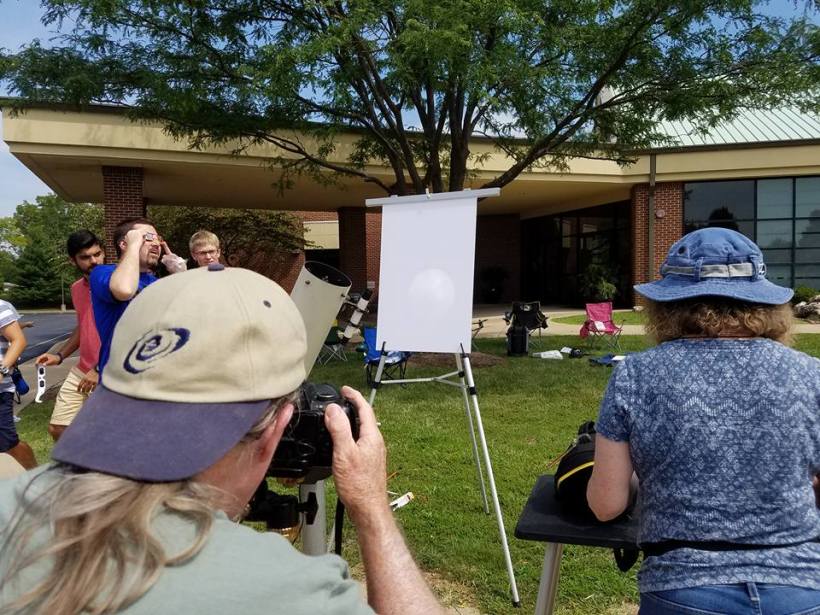
Photo taken of friends at a church in Missouri viewing the eclipse

I listened to a presentation by Jon Jorgenson on Science vs. the Bible in which he addressed the question whether the Bible has any scientific errors. Jon’s YouTube channel is aimed at teenagers and young adults, and he is a prolific producer of inspirational and devotional material.

He acknowledges, the answer, literally, is yes. For instance, in Genesis, the author describes the Moon as a “lesser light”, but we know the Moon is not technically a light. It doesn’t generate light of its own like the Sun.

Another example is the parable of the mustard seed. Jesus calls the mustard seed the smallest of all seeds. We know that there are other seeds in the world that are smaller than mustard seeds.

For these reasons, we cannot honestly say that the Bible, on its face, taken literally, is scientifically accurate. It simply isn’t.

Jon offers that we shouldn’t expect the Bible to be scientifically accurate because it isn’t meant to be.  2 Timothy 3:16 states: “All Scripture is inspired by God and profitable for teaching, for reproof, for correction, for training in righteousness”. (NASB) From this, he makes the point that the Bible is written for a different purpose.

Still, one might ask, doesn’t the God of the universe know these things? Why doesn’t He get the facts right?!

Continue reading “Is the Bible Scientifically Accurate?”

When Scientists Stray From Science

Some people today have made the mistake of using scientific methodology that is limited to the study of the natural world to conclude there is no reality but for the natural world.

Depositphotos Image ID: 151533714 Copyright: avemario

Methodological naturalism is the basic approach of science. Since science is the study of the natural world, the methodology of science is limited to the parameters of the natural world. Methodological naturalism is theologically neutral.

So what does that mean?

On a very fundamental level, it simply means that science is the study of the natural world, and, therefore, science is limited to naturalistic methodology. Science is limited to the observations of matter, energy, space, and time.

Another way of putting it is that science has no preoccupation with anything that is super natural. Science is limited to a focus on the natural world. Science doesn’t bother itself with anything but the natural world (though scientists might stray beyond it).

Science does not and cannot comment on anything but the natural world (though scientists often do), because the natural world is the focus of science. It’s as simple as that.

None of this should be in the least bit earth-shattering. Confusion arises, however, when we begin discussing the supernatural, the metaphysical, the theological, and the philosophical realms in relation to science.

There are those scientists, for instance, who have recently suggested that the advance of science today has done away with the necessity of philosophy. People like Lawrence Krauss and Neil deGrasse Tyson have made statements like that, though they have both backed off of those initial statements more recently. It’s important to understand that those statements, themselves, are philosophical in nature, and not scientific.

To suggest that science has done away with the necessity for philosophy is to ignore the limitations placed on science in its very methodology. Science, itself, is not philosophical, but evidence from science can support premises that are philosophical, and scientists may draw philosophical conclusions from scientific facts.

Science may inform philosophy, but it can never replace philosophy. To think otherwise is to exalt science beyond its natural parameters (pun intended) and to fail to appreciate the difference between science and philosophy.

Continue reading “When Scientists Stray From Science”

Follow The Evidence Where It Leads

Exploring the relationship between science and faith

Depositphotos Image ID: 97354170 copyright: alphaspirit

Francis Bacon, the father of modern science, used to say there are two books of God: the book of Scripture (the word of God) and the book of nature (the work of God). He believed, as did many people who came before him and after him, that all truth is God’s truth. He believed that there is no contradiction at the end of the day between those two “books”. Any apparent discrepancy or conflict is in the interpretation of one or the other of those two sources of the revelation of God. There is no discrepancy or conflict at the level of the facts themselves; the only discrepancy or conflict is in our understanding of Scripture (theology) or nature (science).

Theology and science are, at best, interpretations of the data. Theology and science are not the facts, but interpretations of the facts. Scientists and theologians have disputes and disagreement among themselves and between the disciplines. We all have preconceived ideas on ultimate and intermediate issues, but following the evidence where it leads is the approach most surely to result in the most accurate understanding.

People who identify in both camps of science and theology promote the misconception that science and theology (or science and faith if you will) are incompatible. That is unfortunate, because there shouldn’t be any tension between the two. While science is the study of the natural world and theology is the study of the super-natural world (so to speak), the two should be in perfect harmony if, indeed, a Causal Agent (who we might call God ) exists who caused the universe to begin.

Continue reading “Follow The Evidence Where It Leads”