I have listened to all 30 episodes of Season 1 of the podcast, The Surprising Rebirth of Belief in God, by Justin Brierley. I have listened to dozens of podcasts, and I think this is one among the best, most well-produced podcasts I have found. The first episode of Season 2 inspires my writing today.
In this episode, Justin Brierley poses the question, “Whether the seeming rebirth of belief in God is right wing?” A return to Christian values seems to coincide with a resurgence in conservative politics, but, let’s look closer.
Is Christianity right wing? The African American church would beg to differ. Does Christianity have a right wing and a left wing? Or is Christianity another bird entirely?
At about the 45 minute mark in the podcast, Glen Scrivener identifies three strains of culture in the current western world. One strain is “blasting off into progressive liberalism.” Another strain is “snapping back to the worship of the strong”, a return to the world of Nietzsche. A third strain involves the “surprising rebirth of belief in God”, as Brierley puts it, where a trickle my become a flood, and Christian revival happens.
Scrivener is hopeful that the signs of Christian renewal in the west foreshadow revival, but he observes that these different strains of culture are moving forward at the same time, albeit in conflict with each other. They each have a trajectory that will continue into the future, and, “It will be a mess,” says Scrivener.
He believes Christian revival will happen, but he believes that progressive liberalism will also continue on its trajectory, divorcing itself more completely than it already has from nature and the Christian story. He believes that a devolution into what he calls “the default nature of the flesh” will continue as well, where might makes right.
Indeed, these things are happening now. Will they continue on the same trajectory into the future? Time will tell, but I think he is right: that there is a “post-Christian right” and a “post-Christian left” that are presently locked in a battle for the minds of the people of the western world.
I would add that the world, generally, is and will continue to be the devil’s playground until Jesus returns. At least, that is what the Bible says (millennium variations aside).
Episode 124 – Statement of Triumph – from the BEMA Podcast, with Marty Solomon and Brent Billings, inspires my writing today. It was the subject of discussion for the Saturday morning Bible study I have attended off and on with an exceptional group of men for several years.
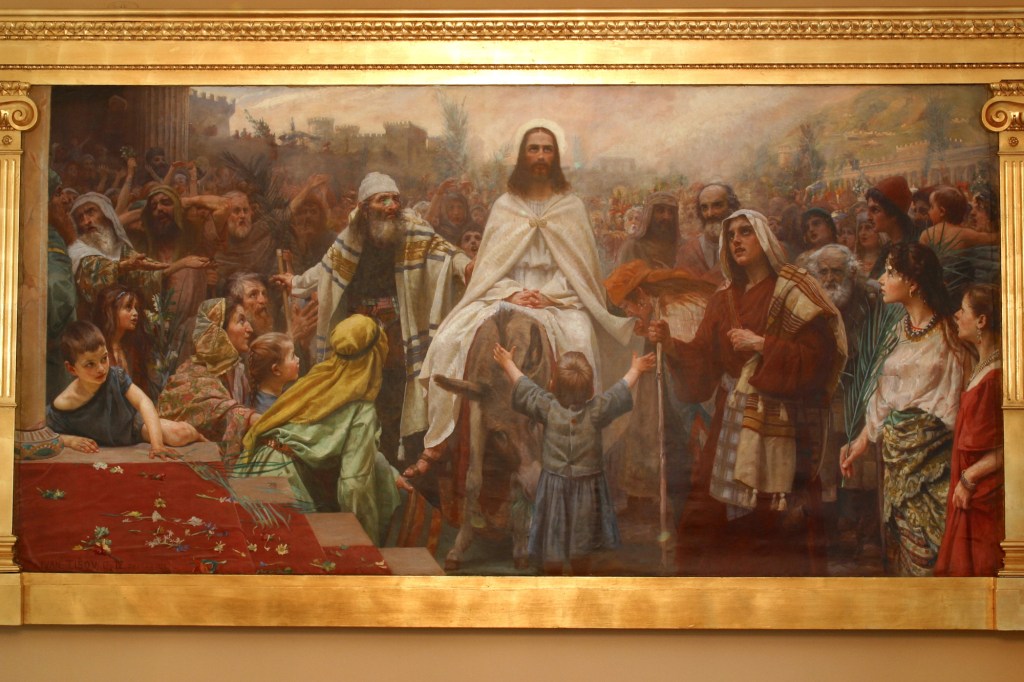
The subject was Matthew 21:1-11. The chapter heading in the NIV translation (which would not have appeared in the original text, because there were no chapter headings in the original text) is “Jesus Comes to Jerusalem as King”.
This is usually how we read it: a “triumphal entry”. We celebrate it as a triumph, and it was. But not perhaps in the way we tend to think about it. Certainly, not in the way the erstwhile followers of Jesus perceived it when it happened.
Marty Solomon sets the stage in the podcast, noting that Jesus rode into Jerusalem on a donkey during the week of Passover, an unusually tense time in this region of the Roman world. The uneasy tension arose in that time in that region because it was home to the only group of people in the Roman Empire who refused to worship the Emperor.
The Jewish people were stubbornly true to their God. Even so, Rome allowed the Jews to have their own ruler, Herod the Great. Herod was Jewish and powerful in his own right, but he was happy to be propped up by the Romans, and the Romans accommodated him to maintain stability in the region.
Even so, this small piece of real estate was problematic for Rome. It sat at the crossroads of the earth. The Hebrew people long inhabited it, but they were a headache for the Romans because of their entrenched religious traditions and unabated worship of their God.
When Herod the Great died, three of sons took over different areas of this land that Herod ruled as a vassal of the Romans. Herod Phillip ruled the north (Caesaria Phillippi). Herod Antipas ruled the middle region, and Herod Archelaus ruled in the south (Judea).
Archelaus only lasted two years, so Rome brought in its own ruler, Pontius Pilate (the Roman Bulldog), to maintain Rome’s control over the region. Pilate didn’t live in Jerusalem. Pilate lived in Caesarea Maritime (Caesarea, By the Sea), a city built by Herod to honor Caesar.
The week of Passover would have been a particularly tense time in Jerusalem, the Jewish holy city. Jews from all over were in town to celebrate the feast that remembered their great deliverance and triumph over the superpower of an earlier time, Egypt. The last thing that Rome wanted was for this celebration to get out of hand after rebel Jews got all fueled up with wine and remembrance of their former deliverance.
If there was any holiday that might make the Romans nervous in Judea, it was Passover. Zealots were always stirring up trouble, and Passover would be the most opportune time for a Jewish revolt against the Roman rule of this territory that the Jews long held out as their own. After all, the Jews still believed this land was to be theirs again through based on their understanding of prophecies about a military coup to be led by a messiah (savior) in the line of their once great King, David.
Every year at this time Pontius Pilate would head south from Caesarea down the coastal road to Joppa. He would head east from Joppa to make his way into Jerusalem. Pilate would enter Jerusalem from the west. He traveled with great pomp and a show of force, with an army of soldiers, trumpeters, heralds, banners, and pronouncements. Pilate would lead the way on a white stallion symbolizing Roman conquest and rule.
This show of power, of course, was intentional. I found the article, In Through the Back Door, September 24, 2022, by Terry Gau that describes these yearly processions made by Pilate into Jerusalem at the beginning of Passover week. He cites historians, John Dominic Crossen and Marcus Borg, in their book, Last Week, memorializing the historical and political context for the final chapter of Jesus’ ministry on earth. the procession is described this way:
“Traditionally, Pilate paraded into Jerusalem on the first day of Passover Week, entering the west gate – the front gate – with legions of chariots, horses, and foot soldiers, dressed for battle and armed with swords and spears. Rome’s authority would not be questioned. The majesty with which Pilate enters the front door of the city was meant to inspire awe and fear, respect and obedience.”
Marty Solomon says,
“You could have heard him coming from miles away. The message he wanted to send to the Jews was clear. ‘Don’t even think about it! Keep everything under control, or Rome will crush you!’”
BEMA Podcast, Episode 124
Pilate would stay in Herod’s palace in Jerusalem for the week until the festivities ended. Then he would go back to Caesarea. He wasn’t there to celebrate, though. He was there to ensure things didn’t get out of hand and to keep the peace.
During one Passover week under the rule of Pontius Pilate in Judea another procession took place. It may have even happened on the same day at the same time that Pilate was entering the City from the west. This procession took place on the east side of Jerusalem where Jesus, riding on a lowly young donkey with a small, rag tag bunch of unarmed disciples entered through the east gate – the back door to Jerusalem.
“This parade was just as carefully staged as Pilate’s entry into Jerusalem. It was a counter-procession, a different vision of what a Kingdom should be, a subversive action against the powers that ruled Jerusalem. Jesus’ humble, yet triumphal, entry into Jerusalem stood in contrast to the magnificence and brutality on display at the opposite end of the city. Jesus brings peace, while Pilate brings a sword.”
In Through the Back Door
This was the backdrop for episode 124 of the BEMA Podcast and of our discussion. I sit writing at a temporary table with one chair left in my house that is all but cleaned out and being readied for sale. My future is uncertain as I recount one of the most pivotal times in human history and the dealings of God with man and what it means for us, today.
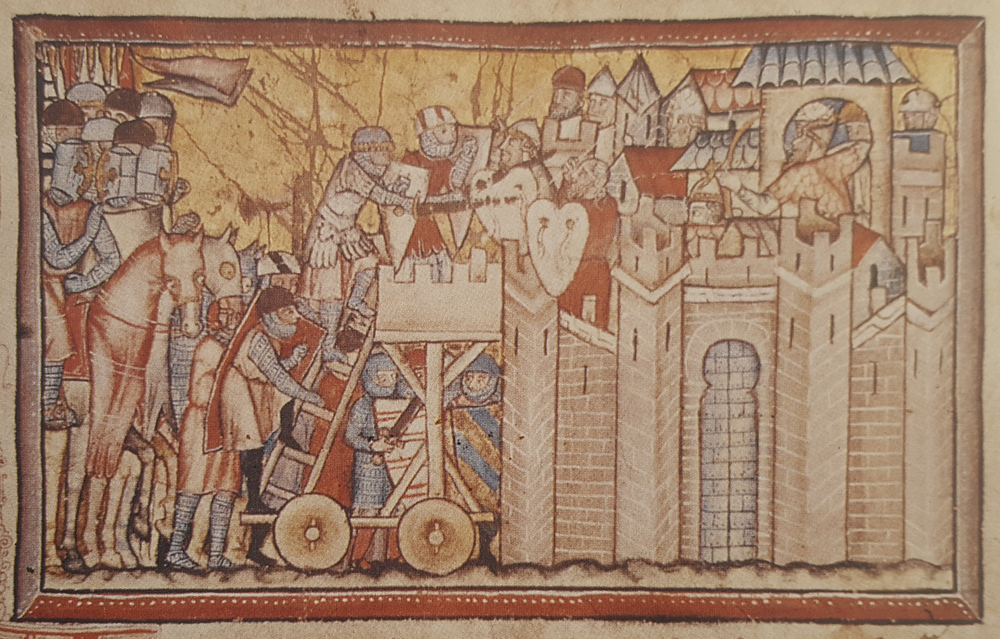
Miniature showing siege scene of conquest of Jerusalem, 1099. Nunez de Balboa House-Museum, Jerez de los Caballeros, Spain
I am working my way through Tom Holland’s book, Dominion: The Making of the Western Mind. I have just finished the segment on Pope Gregory VII and Pope Urban II at the turn of the first millennium since the birth of Jesus Christ.
Since Jesus first told an antagonistic group of religious leaders that people should “render unto Caesar that which is Caesar’s, and render unto God that which is God’s”, and for centuries afterward, the church was at the mercy of the state. Not even a generation after Jesus died, the Roman government, which controlled Judea where Jesus lived and his following sprung up, ransacked Jerusalem, scattering Jews and Christians into the countryside and beyond.
Through the first three centuries, the best the followers of Jesus could hope for was an indifferent Caesar or provincial ruler. At various times, they suffered at the hands of a Nero or more local prefects of local Roman rule in places like Lyons, Vienne or Carthage. The powerful Roman government was to be suffered and obeyed.
Christianity was illegal until Constantine decreed the prohibition lifted. Within a generation or two, Christianity was not just legal in the Roman Empire; it became the favored religion. Christian rulers became part of the governing structure of Rome, serving by the appointment and the pleasure of ruling authorities from mid-way through the 4th Century on.
Over the centuries, the Roman Church became a player in the ebbs and flows of power and influence in western and central Europe. When Gregory VII was made Pope by acclamation of the people, however, he hid himself, not having been chosen through the usual protocols. When he was affirmed, nevertheless – his affirmation having as much to do with popular will as with political protocols, it marked the beginning of a change.
Gregory and Henry IV, the Roman Emperor, had a fitful relationship. Gregory excommunicated him three times, each time undoing it, the last time on his death bed in a remote outpost to which he been banished by the powers that be. Henry IV, for his part, declared antipopes in opposition to the papacy of Gregory, but his antipopes never rose to the position of acceptance by the people. The tide was turning.
When Pope Urban II gathered and commissioned a vast army in the sacred duty of marching on Jerusalem to reclaim it from the Saracens who had overrun it a couple centuries earlier, the victory they attained in 1099 AD (the First Crusade) marked the completion of a transition. Carrying forward the efforts of Pope Gregory to divorce the church from the state, the goal was accomplished by the military victories won for Christendom – not by any Caesar or secular emperor, but by people marching under the banner of The Church.
Holland described the irony that, in obtaining freedom from the state, the church became a state. Holland calls it is “a supreme paradox” that ‘the church in freeing itself from the secular itself became a state”.
Peter and Paul, the pillars of the Church, were clear that the only citizenship that counts is our citizenship in heaven. (Phil. 3:20) W are only “sojourners and exiles” in this world. (1 Peter 2:11)
Paul submitted to earthly authorities as though they had been established by God. (Rom. 13:1) He submitted to lashing by Jewish authorities five times! He appealed to his Roman citizenship, but, he clearly saw himself not as a citizen of this world. He was a citizen of the kingdom of heaven that is to come.
He used his Roman citizenship to gain an audience for the gospel among the Romans, to be an ambassador for Christ as he spoke to people in the public squares. He used his credentials as a Hebrew scholar to gain an audience for the Gospel in the synagogues.
Paul submitted to the processes and protocols of Roman and Jewish authorities. He recognized their earthly authority over him. He appealed to that same authority, not for his own advantage, but for the purpose of advancing the kingdom of God.
When we get involved in politics in the 21st century, do we submit to the authorities established by God as Paul did? Paul boasted of his lashings. Paul used his Roman citizenship, not to get out of prison, but to get to Rome to support the followers of Christ there.
Do we count ourselves, first, as citizens of heaven? Paul longed to be with Christ. He used his time on this earth to advance the kingdom of God while he longed for the day when he would put off his perishable body and put on immortality.
Do we use our earthly citizenship not for our own advantage, but to advance the Kingdom of God? When we fight for tougher laws and tighter borders and the right to walk around without masks, are we fighting for the kingdom of God?
Paul said what needed to be said for the sake of the Gospel, but he accepted the earthly consequences of his focus on heavenly things. Paul lived in an earthly world that was hostile to him and everything that he stood for. He submitted to the world’s authority, but he did it in obedience to the authority of God for the advancement of the Gospel, the good news of the coming of the kingdom of God.
Sometimes, I wonder whether we resist authorities that to advance our earthly objectives and appeal to political power and influence to secure our earthly advantage. I wonder how often we have it all wrong.
What are our priorities? To whom do we owe our ultimate allegiance? What are our ultimate goals? Are we seeking to advance the kingdom of God at all costs, including the cost to ourselves and our own position in the world?
Paul used his station in life as a Jewish scholar and a Roman citizen not for his own benefit, but for the benefit of the kingdom of God, to gain audience in front of people, and to spread the gospel. How do we use our station in life, our political power and religious knowledge? To whose benefit are our actions accumulating?
Are we fighting to protect and preserve our own families, communities and country in this world only to lose sight of our citizenship in heaven? Are we striving to save our lives only to lose our souls?
These are questions, not accusations. God knows the heart. I pose these questions in my own heart as write them.
We live in interesting times. We have taken for granted for a long time in the United States that we are a Christian nation. Christians are fighting through political means and social media to convince this country of those origins and to hold on to them. This is a fight that began in my memory back in the 80’s, and maybe even before that.
In my opinion, we have moved past those Christian origins. Perhaps, the minute we had to start fighting to preserve that legacy we had already lost the fight. I am not sure we will ever go back, short of a revival orchestrated by the Holy Spirit.
Current attitudes in popular culture and among the intellectual elite in the US view the Christian heritage negatively, to the extent that people admit we have a Christian heritage. People view Christians as privileged, wielding power and oppressors. This is the cultural Marxist dialectic that has been playing out since at least the 70’s and maybe before that. We are losing the cultural war.
The positive connotation that went with the word, Christian, in our past has been replaced with a negative. This has largely happened in my lifetime.
Christians have not always deserved the positive connotation that unquestioningly followed the reference, Christian, in the past. Neither do Christians deserve the negative assumption that is evident today. While people may have previously distinguished the errors and failures as departures from the actual message of Christianity, that “nuance” (not that it is very nuanced) is largely lost today. Moderns increasingly equate Christians with those errors and failures. The exceptions have swallowed the rule.
We (Christians) need to be mindful in this realization that we can be guilty of the same failure to recognize the distinctions and nuances in “others” as well. Most Muslims, for instance, are not terrorists. Most feminists, gays, transgender people and others who do not see the world as we do are just trying to find meaning and purpose, healing from their pain and happiness in life. They aren’t the enemy. They are people Jesus died for.
But, I digress.
Christians are the most oppressed religious group in the world today, but you wouldn’t know it in the United States. It isn’t the kind of news that gets published (often) or that anyone wants to hear. It doesn’t fit the current narrative on Christianity that has developed in the west.
It may be that people don’t want to hear it because Christians have had it pretty easy. Christians in the US are viewed as the reigning social oligarchy. The consensus that has building for some time is that Christianity needs to be toppled from it privileged position.
Indeed, Christianity has enjoyed a long and enduring influence in the west, and especially in the US, unlike most other areas of the world, but Christians are now on the defensive as the “others” renounce allegiance and demand recompense. It seems to defy common understanding in the United States to consider Christians an oppressed group.
That privilege doesn’t exist in most other parts of the world where, ironically, Christianity is now growing fastest. While the Church in the US is losing ground rapidly to “the nones”, Christianity is growing fastest and gaining ground most in countries in which the environment is harshest and most hostile to the message of Jesus.
Maybe this is a reflection of the difference between the Gospel of Jesus and the institution of the Church – the difference between the simple message of the Gospel and the burdensome structure of religion. Just as “others” no longer understand the difference between the Gospel message and the errors and failures of the Church, equating and conflating the two, the Church in the US has largely lost its way, no longer shining like a bright light on the hill Jesus intended.
The vestiges of Christian power and influence are evident everywhere, but it is a blighted and obsolescent infrastructure that is crumbling and washing away. The cultural momentum that is gaining steam threatens to displace it altogether from its place of position in the social commonwealth. The current oligarchs in that marketplace of ideas threaten to oust the Christian voice and banish it from the public square.
As I survey the voices I hear, what I see that is being opposed is the voice of Christian power and influence. It isn’t so much the Gospel, but all the infrastructure that has been built up around it, that people are opposing. People don’t (very often) object to the simple message of the Gospel, They don’t even know or appreciate what it is! The message of the Gospel is effectively hidden behind the more public scaffolding of the Church.