The Mother Mirror: How Susie Wiles Became Donald Trump’s Surrogate Matriarch

by Daniel Wolfe, J.D., Ph.D.

(The views expressed in this article are solely those of the author and do not necessarily reflect the views of any employer, organization, or institution with which the author is affiliated. )

Trust in God and be true to yourself.” — Donald Trump (attributed to his mother)
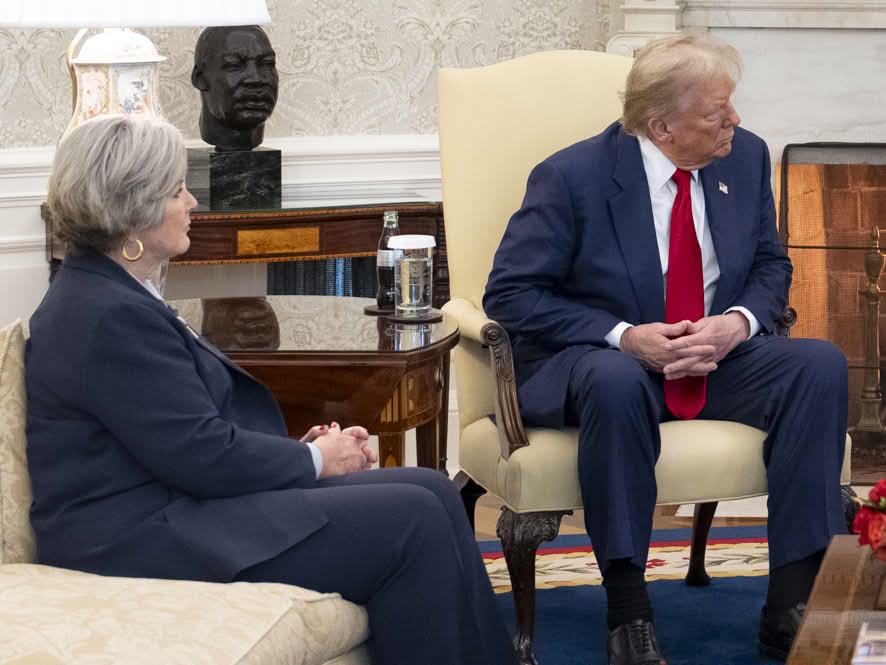


In a career defined by glitz, volatility, and domination, Donald Trump has rarely ceded power or emotional intimacy to anyone—especially not to women. And yet, two women stand apart from the parade of advisers, media figures, and family members who have passed through his orbit: Mary Anne MacLeod Trump, his late mother; and Susie Wiles, his current White House Chief of Staff and perhaps the most enduring political influence in his life.

From a psychodynamic standpoint, their connection is more than incidental. Wiles’s quiet dominance, maternal distance, and unflappable loyalty appear to mirror key psychological traits that Trump associated with his mother—a woman he revered, idealized, and never fully reached. As Trump now enters what may be the final chapter of his public life, Wiles is not merely a staffer. She is, in many respects, a surrogate matriarch—a stabilizing figure who satisfies his need for emotional containment, maternal loyalty, and internal order.

The Queen from Tong: Mary Anne MacLeod Trump’s Silent Influence

Born in 1912 in the Village of Tong on Scotland’s windswept Isle of Lewis, Mary Anne MacLeod was the tenth of ten children in a Gaelic-speaking, deeply Presbyterian household. The family home had no indoor plumbing, and her childhood was shaped by poverty, discipline, and religious rigor. At 18, she boarded the SS Transylvania and sailed to New York City, alone, with $50 to her name and a stated intention to become a domestic servant.

What followed was a dramatic social ascent. Mary Anne met Fred Trump, a rising real estate developer, at a party. They married in 1936 and had five children. Though she never shed her Scottish accent, she fully embraced American prosperity and Protestant respectability. She became active in the Daughters of the American Revolution, volunteered in hospitals, and dressed with regal precision.

As reported by journalist Mary Pilon in The New Yorker, friends and family members remembered Mary Anne MacLeod Trump as “tight-lipped,” “polished,” “proper,” “unassuming,” “friendly,” and “pleasant”—a reserved woman of dignity and discipline, but not demonstratively affectionate. Trump himself noted her deep reverence for public ceremony, stating, “Her loyalty to Scotland was incredible. She respected and loved the Queen.” He also credited her with influencing his “sense of showmanship.” (Pilon, 2016).

In her memoir Too Much and Never Enough, Mary Trump—herself a clinical psychologist—describes how her grandmother’s illness and retreat from family caregiving duties created emotional voids. Mary and her siblings took on caretaking roles in her absence, leading to feelings of abandonment and shaping Donald Trump’s later emotional defenses. She further details how Fred Trump Sr.’s emotional detachment and controlling behavior created insecurity in the family and contributed to Donald Trump’s narcissistic tendencies.

And yet Donald idolized his mother. “Part of her disinterest was, I believe, interpreted by Donald as exclusivity,” Mary Trump writes. “She was mysterious. The less she said, the more he needed to earn her attention.” From a psychodynamic perspective, this creates a powerful early template: a mother who is emotionally withheld but idealized—instilling in the child a lifelong yearning to gain her approval, or to replicate her presence through proxies.

In object relations theory, such a mother becomes an internalized object—a kind of psychic icon. She represents containment, elegance, structure—but also loss and emotional distance. The boy grows into a man who seeks out women who resemble her not in warmth, but in silence, dignity, and control.

The Strategist in the Shadows: Who Is Susie Wiles?

Susie Wiles is no stranger to male power. The daughter of legendary NFL broadcaster Pat Summerall, she grew up surrounded by high-stakes masculinity. But unlike many women in Trump’s orbit—Hope Hicks, Kellyanne Conway, Kayleigh McEnany, Karoline Leavitt—Wiles is not a media figure. She is a tactician. Her professional life has been spent in the background, managing Republican campaigns with ruthless efficiency, from Jack Kemp to Rick Scott to Ron DeSantis—and finally to Donald Trump.

She first joined the Trump campaign in 2016 to oversee Florida, and her work was credited as critical to his win. She returned in 2020 and again in 2024. In the chaos of Trump’s third presidential campaign, Wiles outlasted and outmaneuvered more combative or flamboyant aides. By 2025, she was named Chief of Staff—the first woman to ever hold the role under Trump. And perhaps the only one who truly commands his respect.

What makes Susie Wiles unique is not charisma or ideological purity but emotional restraint. She doesn’t grovel. She doesn’t scold. She doesn’t leak to the press. According to Politico Magazine and West Wing Playbook, Wiles is a discreet, disciplined strategist. She rarely seeks publicity and is consistently portrayed as a “steady hand” who effectively manages Trump’s impulses and internal chaos.

From a psychological standpoint, this demeanor taps directly into the mother archetype that Trump internalized: a woman who offers structure without intrusion, loyalty without dependence. She doesn’t try to be his friend or surrogate daughter. She is, psychologically, his mother in political form: elegant, efficient, and emotionally self-contained.

Recent reporting in Vanity Fair highlights the candid nature of Wiles’s own reflections on President Trump and members of his Cabinet, revealing an unusually frank assessment of internal dynamics, including comments on Trump’s personality and other senior officials—remarks that drew swift criticism from within the administration as being misrepresented or taken out of context. Vanity Fair journalist Chris Whipple, who conducted months of on-the-record interviews with Wiles, subsequently defended the accuracy of his piece, noting that all conversations were recorded and verified.

The Vanity Fair profile also underscores Wiles’s complex role: though she offered unusually candid characterizations of Trump and others in his orbit—comments that were later disputed as being selectively framed—she remained publicly loyal, reiterating her defense of Trump’s leadership and the administration’s accomplishments. This juxtaposition further illustrates the delicate psychological balance Wiles maintains: revealing enough about internal pressures to demonstrate credibility, yet steadfast in her alignment with Trump’s public persona.

The Vanity Fair interviews portray Wiles as central to both decision-making and narrative control inside the West Wing, a portrayal that has attracted debate not only about the content of her remarks but also about the media framing of her role—revealing once again how Wiles both shapes and buffers Trump’s inner circle.

A Psychodynamic Reading: Maternal Transference in Power Relationships

In classical Freudian terms, Wiles may represent a maternal transference object—a figure onto whom Trump projects unresolved feelings and unmet needs from childhood. Where Mary Anne withheld affection, Wiles withholds emotion. Where Mary Anne offered structured approval, Wiles offers structured control. And unlike Trump’s past advisers, Wiles never threatens his fragile ego. She doesn’t seek glory. She simply stays—a feat few others have achieved.


Psychological profiles consistently depict Donald Trump as a grandiose, high-energy, low-agreeableness figure—a volatile combination described by Dr. Dan McAdams as “sky-high extraversion … rock-bottom agreeableness … and grandiose narcissism” (McAdams, 2016). Indirect diagnostic work (Immelman & Griebie, 2020) places him squarely in narcissistic, dominant, and impulsive personality patterns. Mental health experts in The Dangerous Case of Donald Trump warn of malignant narcissism—a severe form characterized by interpersonal cruelty and paranoia (Lee, 2019). Clinicians like Craig Malkin and theorists such as Kohut and Bosson also point to the deeper emotional void underlying Trump’s persona—one that maternal transference figures may uniquely address. Therapists such as Wendy Behary similarly argue for a behavioral-based understanding of his narcissistic structure.

Nancy McWilliams (2011) describes narcissistic personality organization as marked by internal fragility, frequent use of idealization and devaluation, and a reliance on external validation. She explains that analysts working with this type often become unconscious “containers” for projected emotions, experiencing emotional obliteration, boredom, or invisibility.

As interpreted from McWilliams, transference figures often exert their power not through what they do, but through how they resonate. They become stand-ins for an early internal object—particularly in individuals who, like Trump, display signs of narcissistic personality structure: grandiosity, need for adulation, fear of shame, and an unconscious desire for omnipotent control.

What narcissistic individuals crave, McWilliams notes, is not just admiration—but a “containing other”: someone who does not collapse in the face of their outbursts, and who does not betray them by seeking autonomy. Wiles plays that role impeccably. She withstands Trump’s rage, channels it, and survives it. She offers maternal containment, not romantic or filial rivalry. That is what keeps her in his orbit.

Other advisers have challenged Trump (John Kelly), manipulated him (Steve Bannon), or infantilized him (Rudy Giuliani). Wiles does none of that. Instead, she mirrors back the qualities Trump yearned to see in his mother: discretion, loyalty, restraint, and elegance.

The Politics of Maternal Containment

This is not just a psychological curiosity. It is a political reality. Wiles has arguably had more sustained influence over Trump than any adviser since the beginning of his political career. She shaped the tone of his 2024 campaign—more disciplined, less erratic. She consolidated staffing, minimized legal exposure, and even managed access to the President.

Unlike previous chiefs of staff, Wiles does not appear to negotiate with Trump’s narcissism. She regulates it. That regulation—the ability to soothe without submitting—represents a maternal function in psychodynamic theory. And in Wiles, Trump may have finally found the mother he idealized but never emotionally possessed.

It also explains why he hasn’t turned on her. Trump, infamous for discarding aides with theatrical vengeance, has remained steadfastly loyal to Wiles. Even when others within his inner circle reportedly questioned her influence, he resisted. Just as a child resists separating from a “good enough” mother (in Winnicottian terms), Trump clings to Wiles not just as a strategist, but as a psychic anchor. In effect, Wiles might stabilize Trump not by commanding him, but by quietly containing him, as a good-enough mother does for an emotionally vulnerable child.

A Closing Reflection: The Boy and the Queen

As Donald Trump enters the final act of his storied and polarizing career, it is Susie Wiles—not his children, not his ideological acolytes—who quietly holds the reins. She does so not by reflecting Trump’s aggression, but by embodying his mother’s mystery: a woman whose silence commands, whose order contains, whose loyalty never fully soothes the ache it addresses.

In Wiles, Trump may see a second chance to earn the approval he never quite captured from Mary Anne. And in his loyalty to her, one glimpses the enduring truth of psychodynamic theory: that the past is never past. It is alive, enacted, and dressed in new clothes—this time, in a red blazer, seated quietly in the West Wing, holding the world’s most unmanageable man in the palm of her maternal hand.


References:

What Is Due Process, and Why Does It Matter for Christians?

Any first year law student knows the importance of due process as the basic structure of American law


The news waves are buzzing with reports of summary deportations with a mixed reaction of angst and anger on the on hand and zeal on the other hand. Social media is overtaken by the reports and the opposite reactions in a vortex of swirling vitriol.

I am as guilty as the next person of the desire to post knee-jerk reactions, I realize we need cooler heads to prevail if we are going to find a positive way forward as a nation.

The same swirling vortex of reaction is evident in the Church, even in the evangelical church, which is my “tribe”, and the same need for cooler heads to prevail exists. We also need biblical grounding and direction if we are going to maintain any sense of unity in Christ.

The latest news involves the visit to the White of El Salvadoran President, Nayib Bukele. The staged meeting of the two presidents comes in the wake of the mass deportation on March 15, 2025, of hundreds of men to a notorious Salvadoran prison known for its harsh and inhumane treatment of prisoners.

The deportations happened so fast that an emergency motion filed in court and an emergency order blocking the deportation came too late as the plane rushed off the runway just as the order was handed down. The White House maintained that every one of the several hundred men were violent criminals, though about half of them had no criminal records, and none of them received even a cursory hearing.

On April 10, 2025, the matter made its way up to the US Supreme Court in lightning fast fashion (for the court system), and the Court weighed in. (See Kristi Noem, Secretary, Department of Homeland Security, et al. v. Kilmar Armando Abrego Garcia, et al.) The appeal was prosecuted by the government to overturn the trial court injunction to block the deportation.

Homeland Security insisted to the trial judge that the plane had already left the runway when the order was issued. According to the Supreme Court, however, “The United States acknowledges that Abrego Garcia was subject to a withholding order forbidding his removal to El Salvador, and that the removal to El Salvador was therefore illegal,” suggesting that the order was in place before the plane took off.

The court found further that “[t]he United States represents that the removal to El Salvador was the result of an ‘administrative error.’” Thus, Homeland Security admits they made a mistake in deporting him. One of the reasons for “due process, which I will get into, is to avoid such mistakes.

Nevertheless, Homeland Security justifies the action taken by claiming that Abrego Garcia “has been found to be a member of the gang MS–13, a designated foreign terrorist organization, and that his return to the United States would pose a threat to the public.” They maintain they have done nothing wrong.

The subject of this post is due process, so I will ignore some of the other elements of this case, such as the Supreme Court’s affirmation of the order to facilitate the return of Abrego Garcia, the fact that the decision was 9-0, and Donald Trump’s insistence this was a victory for him (perhaps because he got away with it with no repercussions – yet).

While the Supreme Court remanded the matter back to the trial court for clarification, the Court did weigh in on the substance of the issues in various ways. The Supreme Court said:

  • “The order properly requires the Government to “facilitate” Abrego Garcia’s release from custody in El Salvador and to ensure that his case is handled as it would have been had he not been improperly sent to El Salvador.”
  • “To this day, the Government has cited no basis in law for Abrego Garcia’s warrantless arrest, his removal to El Salvador, or his confinement in a Salvadoran prison. Nor could it.”
  • The government is bound by a 2019 order effectively granting Abrego Garcia legal refugee status in the United States.
  • “Instead of hastening to correct its egregious error, the Government dismissed it as an ‘oversight.’”
  • The government’s request to be able to allow them to leave Abrego Garcia in El Salvador is based on “no reason recognized by the law.”
  • “The only argument the Government offers in support of its request, that United States courts cannot grant relief once a deportee crosses the border, is plainly wrong.”
  • “[T]he Government must comply with its obligation to provide Abrego Garcia with ‘due process of law,’ including notice and an opportunity to be heard, in any future proceedings.”
  • “Federal law governing detention and removal of immigrants continues, of course, to be binding as well. See 8 U. S. C. §1226(a) (requiring a warrant before a noncitizen ‘may be arrested and detained pending a decision” on removal)….”
  • “In the proceedings on remand, the District Court should continue to ensure that the Government lives up to its obligations to follow the law.”

These are direct quotes from the Supreme Court ruling. As you should be able to discern easily, this is not a victory for the Trump Administration, and it is not a vindication of what they have done (and continue to do) in detaining, arresting, imprisoning and deporting people without due process.

Continue reading “What Is Due Process, and Why Does It Matter for Christians?”

The Case of the Gonzalez Family: Putting Faces on Immigration Policies

People seeking asylum leave desperate circumstances to come here at the mercy of the process


The story of Gladys and Nelson Gonzalez, an Orange County couple who were deported to Colombia after living in the United States for 35 years, raises concerns about the complexities of U.S. immigration law and the human cost of its enforcement. The Gonzalez’s case exposes the tension between the rule of law and the values of compassion and mercy, values that lie at the heart of Judeo-Christian ethic.

Gladys and Nelson Gonzalez fled Colombia in 1989, seeking asylum from violence, drugs, corruption, and instability. According to news reports, the couple hired attorneys to help them, but those attorneys were eventually disbarred. (See Fox News LA) The news reports don’t provide details on the disbarment or on the long and winding process that came to an impasse in 2021.

During this time Nelson Gonzalez (59) found work in a laboratory as a phlebotomist, and Gladys (55) remained home to care for three daughters who were born and raised here: Gabby (23), Stephanie (27), and Jessica (33). They paid federal and state income taxes for 35 years. They paid into a Social Security and Medicare system that would never benefit them. If they owned a home, they paid real estate taxes, and they paid sales taxes, gasoline taxes, etc. over that time period.

Gladys and Nelson Gonzalez regularly checked in with ICE, and they were granted extensions. They didn’t hide, and they faithfully stayed in contact. Gladys had just been granted another extension when ICE showed up for what seemed like a routine check in, and everything changed. As reported by the local news outlet, KTLA:

“They were put into handcuffs by their wrists and ankles and treated as criminals before getting to these detention centers,” Stephanie Gonzalez told KTLA. “All they said is they extended their stay, even though every year they’ve had permission to be here and they’re law-abiding citizens who show up and are doing their duty to check in with immigration and say, ‘Hey I’m here. I’m not hiding or doing anything wrong.’ Then they just arrested them like that.” 

A spokesperson for U.S. Immigration and Customs Enforcement told The Orange County Register simply that the couple had “exhausted all legal options to remain in the U.S. between March 2000 and August 2021,” and they were in violation of immigration law. The news reports don’t explain the details of the legal process or why the attorneys were disbarred.

As an attorney myself, I can say with some degree of confidence that the attorneys they used were not good attorneys. Attorneys don’t get disbarred over mere incompetence, though attorneys who get disbarred are often incompetent, too. Attorneys get disbarred for taking their clients money and doing nothing, missing deadlines and court dates, embezzling client funds, violating court orders and other serious professional misconduct.


Immigrants like the Gonzalezes who leave their home countries because of desperate conditions usually have meager resources. Many of them spend their life savings just to get here. They seek asylum because they don’t know any other way forward, but proving eligibility for asylum is often very difficult. Without a competent attorney, the path is fraught with danger.


To be eligible for asylum, a person must be present in the United States. Such a person, by definition, doesn’t have legal status (yet), but petitioning for asylum requires a person to be present in the US.

Therefore, they must come here at the mercy of the process. They risk everything to seek asylum. It is the desperate path to legal status.

Eligibility for asylum requires evidence of persecution or “a well-grounded fear of future persecution“ from the government of their country of origin or from a group the government is unwilling or unable to control. The persecution must also be based on race, gender, nationality, political opinion, or membership in a particular social group.

For most asylum seekers, the only evidence they have is personal testimony. Other evidence is left behind in the country of origin. Most people without resources don’t have access to medical records of injuries or psychological trauma, police reports, court documents, or other official records that remain in their home country. The witnesses to their trauma are also not present to testify for them.

Attorneys charge upwards of $500 an hour. Costs can run into the thousands, but most asylum seekers have limited resources. They spend spent their life savings just to get here, often falling victim to the coyotes who prey on the vulnerable.

The immigration system provides no help. Asylum seekers do not have a right to attorney, so many people try to navigate the unfamiliar bureaucratic maze alone. Others are exploited by people who don’t know what they are doing and/or are just in it for the money.

People who are “only” escaping violence, corruption, poverty, and drug culture don’t qualify for asylum, even though no person I know would want to raise a child in such an environment. Run-of-the-mill desperate circumstances do not qualify a person for asylum. A person must be persecuted or face a well-grounded threat of persecution based on race, gender, nationality, political opinion, or membership in a particular social group to qualify for asylum.

People who manage to escape actual persecution or threats of persecution without injury maybe found to have insufficient proof. A judge may deny asylum because they suffered no harm or because the judge didn’t find their testimony credible enough. Language barriers don’t help.


The process is complex and can take years, and everything hangs on one determination. The movie, Between Borders, streaming now on Amazon. etc. does a good job of depicting the problems of proving eligibility, even by people who qualify. The outcome of the movie is heartwarming, but that outcome is nothing but fiction for many asylum seekers.


If a judge denies the petition for asylum, deportation is the result. An appeal is possible, but an appellate judge will only reverse the decision (generally) if the trial judge didn’t follow the process or made some other technical error. Appellate judges almost never overturn a trial judge’s factual determination. Handling an appeal, is a technical and unforgiving process, and many people fail because they do not understand the process.

You can theoretically obtain an order withholding removal, but only if you prove “certain harm” would occur if you return to your home country. If your couldn’t convince the trial judge of a “well-grounded fear of persecution in the future”, you aren’t likely to prove “certain harm” on appeal after asylum is denied.

Other countries won’t take you, so must go back to your home country. Typically, you must wait ten years or win the lottery before you can come back and try again.

Other paths to legal status exist, but they require luck or years of planning and legal resources. Without a sponsor (who generally must be a parent or spouse and have sufficient resources), a person must rely on the “Green Card Lottery.”

Only people from eligible countries (which change from year to year) can apply for the Green Card Lottery. “Winners” are chosen at random. Millions apply for the lottery each year, but only 55,000 visas are awarded. My research indicates that the number of lottery applicants has exceeds 22 million, depending on the year. At 22,000,000 applicants, one quarter of one percent (0.25%) of the applicants obtain a visa this way.

The details of the Gonzalez case are not reported in the articles I read. All we know is that, despite their efforts and the appeals they filed, they were not granted legal status. Despite that, they had been granted extensions, and they were given an extension immediately before they were suddenly and summarily deported.

Their case highlights a fundamental problem with current immigration law: it is inflexible and lacks common sense. It is cumbersome, bureaucratic, and full of pitfalls. Without good legal counsel at the start, the an immigrant is often unable to navigate the course well.

They system also fails to account for the human reality of people who come here seeking asylum. They don’t typically have resources, or they would try another way. They don’t have knowledge of the system. They have to pass a gauntlet of crooks who only want to take advantage of them.

If they make it into the country, the process can drag on. Even for 35 years. Meanwhile, people like Gladys and Nelson Gonzalez have children; they find jobs; they pay taxes; and they become productive members of American society. This is where common sense prevail.


Gladys and Nelson Gonzalez had no notice they would be deported. They had just received an extension when ICE showed up for what they thought was a routine check in. Instead, they were handcuffed and shackled in front of their children and grandson and hauled off to a prison in Louisiana.


The Gonzalez story is not unique. Many immigrants live in the shadows, contributing to their communities, paying taxes, and raising families, yet they remain vulnerable to deportation due to complications and missteps with the process to obtain legal status. We don’t usually see their faces, and we don’t usually hear their stories, other than the occasional news report with minimal facts and an impersonal tone.

I met a young woman a number of years ago who volunteered in the legal clinic I run. She dreamed of going to law school from a young age. She is one of the most exceptional people I have ever met, so I have maintained contact with her.

She explained that her parents traveled fluidly back and forth from Mexico to the US for stints of work. They didn’t need a passport to cross the border at that time, so they came and went to obtain temporary work and return home.

She was born in Mexico. Her parents were in the US when 9/11 happened. They were caught on this side of the border when travel restrictions were imposed, and they couldn’t foresee how things would change. They had a son; they continued to work, and to wait, and to hope things would go back to the way they were; and years went by.

Her father is entrepreneurial and started several businesses. The IRS was happy to give him a tax number and to receive his taxes. He employed many people, and he became a mentor to other would-be business owners.

This young woman knows no other home but the US. She has no connections in her home country. She is as Americanized as you and me, but she grew up under a dark cloud with the specter of deportation hanging over her head.

She knew she had to keep her head down. She could not call negative attention to herself. She excelled in school with a purpose, knowing that she would never qualify for a scholarship. Her parents would never receive Social Security or Medicare, though they paid into it for decades.

She graduated high school in three years with a perfect GPA, and she was on a pace to graduate from college in three years with a perfect GPA when I met her. Since that time she has graduated from college, and she graduated from law school.

In Law School, she worked in immigration clinics. She landed a job with a high-end estate planning law firm, but her heart was in doing immigration work. Even though she took a significant pay cut, she left the posh position and became an immigration attorney.


She is a “Dreamer” – children born out of the country who are raised here. She has married a US citizen, but the immigration landscape is dangerously potted with landmines, especially now. Even birthright citizenship (which is in the US Constitution) is up in the air. Her parents still live under a cloud of deportation that grows darker with each passing day.


I write this blog mainly for Christians and people who sense Jesus knocking at their door. I find myself increasingly writing to the Church in America, and specifically to my tribe – evangelicals – in recent years as the polarizing vortex of politics is blowing the country apart. Evangelicals and other segments of the American Church are not immune from the polarizing forces.

I might have remained in my own ignorance of God’s heart for the stranger if I had not decided one day in 2014 (during the Obama administration) to do a deep dive into Scripture to develop a biblical view of immigration. I realized at that time that I didn’t have a biblical view of immigration as I struggled to find solid footing in the gale of the political winds at that time.

Since then, the gale has increased to hurricane force winds. If you are a Christian, and you don’t have a solid, biblical view of immigration, I implore you to do your own deep dive. A study around the time I wrote my first article indicated that only 13% of Evangelicals said the Bible is the source of their views on immigration. My own study changed my mind in 2014.

If you do your own reading of Scripture, you may not come out where I have, but I believe every Christian who takes his/her faith seriously should ground their views solidly in the Bible first, and not in the politics, culture wars, and social media influences of the day. If you want to consider what I have I found focusing on “strangers” and “sojourners” in the Bible – words in the Bible that describe people we call immigrants today – a link is in the image below to the articles I have written describing what I found.

~~~~~~~~~~~~~~~

UPDATE:

In a follow up article, it was reported, “ICE confirmed to ABC News that Gladys and Nelson Gonzalez do not have criminal records….” The morning before Gladys Gonzalez was arrested and put in handcuffs and shackles, Gladys was granted a one-year extension to be in the US. (See Daughter of couple deported with no criminal record says they were transported ‘like animals’)

Responding to the Journalism Crisis

business man, aggressive businessman with typewriter and hammer


via Responding to the Journalism Crisis

We need to find a way to talk to each other, and not just at each other. We need to listen to each other, and not be so quick to respond with a put down or a label or an accusation.

Does the present state of journalism reflect our current attitudes toward “others”? Or does it drive our attitudes towards “others”?

Maybe its both.

We wouldn’t “buy” what they are dishing out if we didn’t want it. The biased, clickbait journalism that we consume is, sadly, just a reflection of who we have become. Maybe it’s who we always were?

At the same time, the hyped up “news” outlets of the left and right variety to a good job of stirring up the division among us and agitating us to fight with other. We toss meme hand grenades into the social media foxholes of our “enemies”, while we rally the troops hiding in the trenches, and they are fueled by a nonstop barrage of media assault.

What are coming too? Where does this end? Is there any hope?

Maybe, but we need to become better news consumers and demand more integrity from our news sources. We need to become more astute in our vetting of fact and eschew the clickbait headlines that dangle in front of our faces like garish posters advertising the wolf boy at a carnival.

We need to stop ourselves from posting knee-jerk responses on social media, labeling those we disagree with and parroting our talking points without really listening or engaging in independent thought. We need to stop the us-against-them mentality when it comes to politics and worldviews and see ourselves as neighbors who have different perspectives.

Yes, worldviews matter, but relationships matter more. No one is winning the social media debates. We are losing our connectedness in a sea of disjointed, clamorous rancor.

Followers of Christ should seek to set a better example. We should be salt and light. We should have a different flavor. We should not defined by the political positions that we hold, but by the love and character of Christ.

Should Google Censure the News?

kevingdrendel's avatarPerspective

Some of the backlash following the surprise results of the recent presidential election is the focus on the bogus news sites that were ubiquitous on social media during the dreadfully long campaign season. I’ve witnessed many conversations and multiple, people of good faith ask: how do we know when a news source is biased?

The latest thing on social media is the creation of lists of fake news sites for people to avoid. Everyone seems to be eager to jump in as a consultant. LA Times,[1] AOL News,[2] US News & World Report,[3] Snopes,[4] of course, and many, many others. The problem is compounded when the people reporting the list of fake news sites are charged with being misleading.[5]

Even the answer to the question of what news sites to avoid depends on who is answering the question. According to Scott Shackford of, Editor of…

View original post 1,208 more words