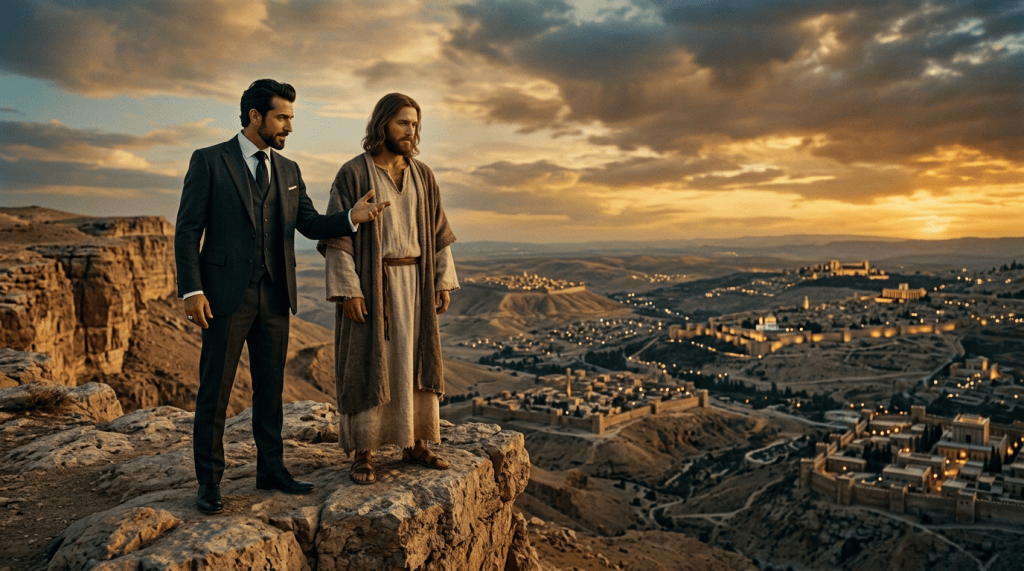
“And the devil took him up and showed him all the kingdoms of the world in a moment of time, and said to him, ‘To you I will give all this authority and their glory, for it has been delivered to me, and I give it to whom I will.’
And Jesus answered him, ‘It is written, ”You shall worship the Lord your God, and him only shall you serve.””
Luke 4:5-6, 8 ESV
From this passage it seems clear that Satan has authority over the kingdoms of this world. Satan has the authority to grant authority and the glory that goes with it to whomever he wishes. That the kingdoms of the world have been delivered to the devil. is a jolting statement.
In this passage, Jesus does not deny what Satan says, but he refuses to be tempted by Satan’s offering. He rejects the idea that he should take the authority that has been given to Satan over the kingdoms of the world, saying that a person should worship the Lord God and serve only Him.
This is one of the four temptations of Jesus with which the devil confronted him in the wilderness before he began his public ministry. All of those temptations are instructive for us, but I think this one in particular is instructive for us in this political moment of the United States.
As Jesus was about to go into his public ministry, he certainly knew that he could usurp all the authority of the kingdoms of the Earth. Jesus also knew that all the authority over the nations of the Earth came from God, but that authority had been given to Satan for the present time.
I believe this is why Jesus did not deny that authority existed, and he did not deny that the devil had been given that authority to hand out as he desired. Jesus did not deny any of that, but he rejected the idea that he should take the authority the devil had to give. (Matthew 4:8-10)
To be clear, the offer was “all the kingdoms of the world and their splendor” in exchange for worshipping the devil. The fact that the devil has the power and authority to give Jesus all the kingdoms of the world does not necessarily mean that someone who is in a position of power achieved it by worshiping the devil. I don’t want to leave any impression that I think that.
On the other hand, we should not be unaware that the authority over the kingdoms of the world is the province of the devil, given to the devil by God until Christ comes again.
This was the last attempt by the devil to tempt Jesus – a last ditch effort. I think this underscores the seductiveness of power and political influence. Power and influence is almost always accompanied with the accumulation of wealth. If the love of money is the root of all evil, the power and influence is its twin brothers.
In practical reality, there seems to be little separation between money and influence. People who have great influence nearly always amass wealth. Just look at the net worth of people in politics, especially at the national level.
Of course, money (itself) is not evil. It’s the love of money that is the problem. Jesus handled money, and it did not corrupt him. At the same time, the one man who handled the money for Jesus is the man who betrayed him.
Jesus warned his followers of the seductive influence of money when he said it is harder for a wealthy man to enter heaven than for a camel to go through the eye of a needle. Given the correlation between money and power/influence, we should be just as wary.
Christians should not rush to gain influence any more than Christians should seek wealth. We cannot serve two masters. If we love one, we hate the other. This is true of literally anything we seek, exalt, focus on, depend on, etc., more than God.
When Jesus talked about love and hate in these ways, he wasn’t talking about emotions. He was talking about priorities. When he said that a person who follows him must hate his mother, father, sister, and brother, Jesus wasn’t actually telling us to hate them. He was telling us to prioritize them below our love of God.
And so it is with God and money. To love money is to prioritize money above our love of God. To prioritize influence and power above our love for God is to hate God in comparison.
To focus on governmental authority or to focus on money is a dangerous endeavor for a Christian. If Jesus could be tempted by power and influence, how much more are we tempted by those things? How much more susceptible are we to giving into that temptation?
I am going to be frank here. I think we have seen the disordering of Christian priorities in our country. As Jesus has plainly told us, there are many who will say, “Lord, Lord.” There are many who will say the right things, who will speak of God and of Jesus, but their hearts belong somewhere else. And Jesus said we would know them by their fruit. If anyone has gained power and wealth, but they have not love – the primary fruit of the Spirit – they are like clanging gongs and cymbals.
We overcomplicate what love is. Paul tells us plainly that love is patient. Love is kind. Love does not envy or boast. Love is not arrogant or rude. (1 Corinthians 13:4-5)
Power and wealth corrupt. It warps our priorities. It twists our character. We begin to think that black is white and white is black. We begin to think of power and influence as a blessing from God, rather than a burden that threatens our very souls.
Jesus says, blessed are the poor in spirit. Blessed are those who mourn. Blessed are the meek. Blessed are those who hunger and thirst for righteousness. Blessed are the merciful. Blessed are the peacemakers. Blessed are those who are persecuted.
Notice that the devil did not tempt Jesus with any of those things! None of those things would be a temptation, would they? Yet, Jesus tells us plainly that people who experience those things are blessed. None of these things are desirable in the world, but they lead to the great treasure of eternal life and relationship with God.
Power and wealth are highly desirable in this world, but none of it will matter in the next. They are a stumbling block in this world. The attachment to power and influence hangs like a dead weight on the backs of human beings who have not shunned it like Jesus did.
Jesus did not preach that a wealthy man cannot enter into the Kingdom of God, but it’s harder than you might think. It’s like a camel squeezing through the eye of a needle. However you understand that metaphor, you should not miss the point that wealth is a very heavy burden when it comes to entering the Kingdom of God – and power/influence is the cousin of wealth.
I think we should take notice that the devil did not tempt Jesus with money. He tempted Jesus with the power of the kingdoms of the world. Perhaps, that is because wealth naturally flows from having power. If it’s difficult for a wealthy man to get into the kingdom of heaven, how much more difficult is it for a powerful (and wealthy) man to get into the kingdom of God?
I think we should be sober and alert to the devil’s schemes. If Jesus shunned the power that is the devil’s to give power, how much more should we shun it? Do we have more willpower than Jesus?
That attitude, of course, will not get us anywhere in the world. It looks utterly foolish for us to shun power and influence, but that is the foolishness of the cross. It is the foolishness of God’s wisdom, and I think we would do well to reclaim some of that foolishness.