What It Means to Know God

One sure way to know God


The age old questions humans have asked since time immemorial are, “What is God, and how do I know God?” We have conceived of gods as animated trees, mountains, and the sun, the stars, and the moon. We have conceived of gods as a pantheon of god-men and god-women. We have conceived of God as a force that is in everything, and we have conceived of God as an aloof judge and guardian of the ever after.

The Hebrew Scripture provides a robust concept of God, the Creator of the universe, who reveals Himself to human beings, but who remains mysterious and even “hidden” to people who must seek Him. The Tanakh (the Law, the Prophets, and the Writings) that Christians call the Old Testament purports to be God’s revelation to human beings with a promise that those who seek may find Him, “though he is not far from any one of us.” (As the Apostle Paul said to the Greeks in Athens. (Acts 17:27))

Of course, the God of the universe must be greater than we could ever fully comprehend to have created such an intricately designed universe as the one in which we live. If the men who passed on the revelation of this God that has been recorded in the Bible are correct, we can know much about God even if much remains a mystery.

I am impressed today with the words of the Prophet, Jeremiah, who provides a glimpse of who God is in the words of warning he spoke to Jehoahaz, the King of Judah,


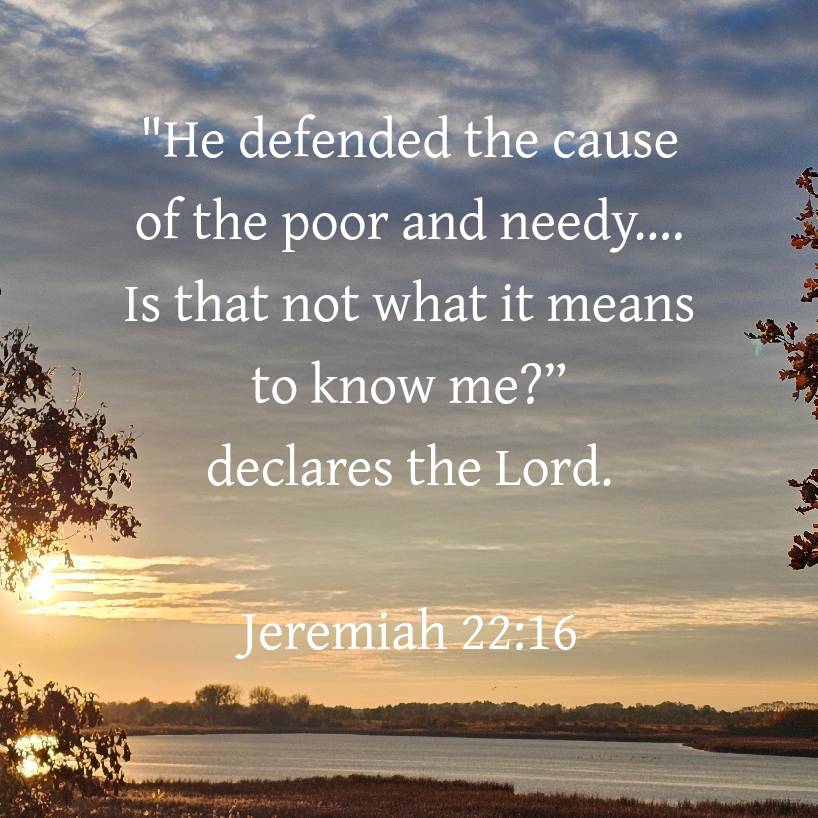
“Woe to him who builds his palace by unrighteousness, his upper rooms by injustice, making his own people work for nothing, not paying them for their labor. He says, ‘I will build myself a great palace with spacious upper rooms.’ So he makes large windows in it, panels it with cedar and decorates it in red. “Does it make you a king to have more and more cedar? Did not your father [King Josiah] have food and drink? He did what was right and just, so all went well with him. He defended the cause of the poor and needy, and so all went well. Is that not what it means to know me?” declares the Lord.

Jeremiah 22:13-16


I have never noticed before that Jeremiah equates defending the cause of the poor and needy with knowing God. In defending the cause of the poor and the needy, we come to know God.


We can search for God here and there and, perhaps, never find Him. In defending the poor and needy, however, we can know the Lord. It’s that simple.

To know someone in a biblical sense is to know more than facts about someone. To know someone biblically is to know someone intimately. The ultimate example of knowing someone biblically is to know someone as a spouse.

Thus, when Jeremiah says that defending the cause of the poor and needy is to know the Lord, he is talking about an intimate, experiential knowledge of the character and nature of God. The cause of the poor and needy is close to God’s heart, and it is essential to who God is.

The Psalmist says, “A father to the fatherless, a defender of widows, is God in his holy dwelling….” (Psalm 68:5) A dwelling place is where a person is most able to be who they are. God’s holy dwelling is where God is “at home”, where God is most like Himself, and the cause of the fatherless and the widow is at the core of who God is in His most intimate place.

Thus, people can intimately know who God is by taking up the cause of the poor and the needy, the widow and the orphan, and similarly vulnerable people.

The opposite is also true. People do not know God to the extent that they do not defend the cause of the poor and needy. This was the point Jeremiah was making when he said of King Johoahaz:


The father of Jehoahaz was Josiah. “He did what was right in the eyes of the Lord.” (2 Kings 22:2) Josiah found the Book of the Law, reestablished Temple worship of God, and destroyed the idols in Judah. (2 Kings 22 & 23) Josiah also defended the cause of the poor and needy, according to the Prophet Jeremiah, and defending the cause of the poor and needy is what it means to know God.

Indeed, Josiah modeled the entire law that Jesus said can be summed up in these two statements: 1) love God with all your heart, mind, body, and soul; and 2) love your neighbor as yourself.

Throughout the Bible, then, we find that a sure way of knowing who God is and what it means to know God is to be concerned with the cause of the poor and needy. This is not liberal wokeness; it is the essence of who God is and what it means to know God.


“Whoever claims to love God yet hates a brother or sister is a liar. For whoever does not love their brother and sister, whom they have seen, cannot love God, whom they have not seen.”

1 John 4:20


Jesus even goes so far as to say that we should love our enemies and so be perfect as our heavenly Father is perfect. (Matthew 5:43-48) Loving others – caring for the poor and needy – is not superfluous or secondary; it is central to who God is and a key in what it means to know God.

Be Like the Sons of Issachar Who Understood the Times

The Kingdom of God is among us and it is yet to come


I recently finished a review of the of history of the blogging on this site: Looking Back at 13 Years of Navigating By Faith. One article stands high above the rest in the sheer number of people who have read/viewed it.

I wrote that article, Who Were the Sons of Issachar? And What Might They Mean for Us Today?, during Donald Trump’s second presidential campaign. Christian support for Donald Trump was characterized by a sense of urgency and high stakes. State COVID restrictions jeopardized religious liberty. BLM aroused woke, liberal, mobs in streets around the country. Christians sounded the alarm that people of faith would be canceled by the most anti-faith Democratic ticket in years if Trump didn’t win.

Prominent Christian leaders like Robert Jeffress and Franklin Graham argued that Trump was a “strongman” needed to protect the nation from “anarchy” and “socialism.” Jeffress excused Trump’s obvious flaws, saying that American Christians didn’t need a “Sunday School teacher” but a “fighter” who would protect Christian interests in a hostile culture. Lance Wallnau framed Trump as a modern King Cyrus—the Persian king used by God to protect His people and restore them to the promised land.

Support for Donald Trump was increasingly framed as a battle against “darkness” and “anti-Christian” forces. While many traditional evangelicals focused on policy, the New Apostolic Reformation (NAR) was mobilized by prophecy, spiritual warfare, and the “Seven Mountain Mandate.” Dozens of self-identified prophets in this network insisted that Trump’s re-election was divinely mandated in a cosmic battle between good and evil controlled by a demonically influenced “deep state.” The current was strong, and a large number of Christians were swept along with it.

A conversation with my best friend from college, who I loved more than a brother, and who I trusted implicitly, left me in full spiritual crisis mode. He expressed his continued support of Trump on the basis of those prophetic claims predicting another presidential victory and the belief that God ordained Donald Trump for this time. My friend urged my to be like the sons of Issachar “who understood the times and knew what Israel should do.” (1 Chronicles 12:32)

I have a healthy respect for God’s ability to speak through people in what we call prophecy. The Apostle Paul commands us not to despise prophecy, but to test everything, hold fast to what is good, and abstain from every evil. (1 Thessalonians 5:20-22) I resolved to give Donald Trump another look and to reconsider him.

I had written in 2020 about wolves in sheep’s clothing with Donald Trump expressly in mind. Jesus said we would know falsehood by its fruit, and the fruit I saw in Donald Trump belied the claims of God’s providential blessing.

That a president is not a pastor made some sense. God can use anyone, even a donkey, right? Maybe Trump is like the Persian King Cyrus who is divinely appointed to restore the Christian heritage of the United States….

A year earlier, in 2019, I reflected on those claims that Trump is like a King Cyrus, and I came to a different conclusion. Trump seemed to me more like a King Saul, the king God’s people wanted – the king they wanted because they did not trust God. They wanted a king like all the other nations, though the Prophet Samuel warned them against it. God gave them the king His people wanted, even though they were rejecting God to ask for a king:


“[W]hen they said, ‘Give us a king to lead us,’ this displeased Samuel; so he prayed to the Lord. And the Lord told him: ‘Listen to all that the people are saying to you; it is not you they have rejected, but they have rejected me as their king. As they have done from the day I brought them up out of Egypt until this day, forsaking me and serving other gods, so they are doing to you. Now listen to them; but warn them solemnly and let them know what the king who will reign over them will claim as his rights.‘”

1 Samuel 8:6-9


God gave them the king they wanted in the same way that God gives people over “to the sinful desires of their heats.” (Romans 1:24) The people were rejecting God as their king, so God gave them over to the king they wanted.


People of that day might have assumed that God was blessing them to give them the king they wanted, but that was not the case. Samuel warned them against it, but they insisted anyway.


King Saul was rebellious, insecure, self-absorbed, and psychotic. He failed to obey God’s commands. He became obsessed with his power and reputation among the people, and he became jealous of David.

Though Saul remained king, God had already rejected him and anointed David to succeed him. Saul tried to take David’s life multiple times in fits of jealous rage, and David escaped into the wilderness.

This is where the Sons of Issachar entered the picture. Though Saul was still king, they “understood the times.” They could see the proverbial writing on the wall. They knew that David was God’s man, and Saul’s reign was ending.

Many people have argued that Donald Trump is like the foreign king, Cyrus, who protected and funded the nation of Israel to return to the Promised Land. I have argued that Donald Trump is not like the foreign king, Cyrus, but like the Israelite King Saul. Donald Trump is the king that God’s people wanted.

Continue reading “Be Like the Sons of Issachar Who Understood the Times”

An Exploration of God’s Hiddenness in the Bible

The Bible on the hiddenness of God


Divine hiddenness is an argument suggesting that God does not exist. According to J.L. Schellenberg, if a perfectly loving God exists, He would desire a genuine relationship with every person He creates. A loving relationship requires, at minimum, awareness that God exists, so a perfectly loving God would make Himself known. Some sincere and willing people who want to know God are unable to find sufficient evidence that He exists to believe in Him. Therefore, either God does not exist or He is not perfectly loving.

I don’t buy it. I think the argument is flawed, but other people have provided robust responses to this argument, so I am not going to attempt to provide a counter argument here. I am also unconvinced that arguments are the best way to achieve understanding.

On that ground, I am intrigued by the hiddenness of God, and I am intrigued that the Bible is forthright about the hiddenness of God. The Prophet Isaiah says it plainly: “Truly, you are a God who hides himself, O God of Israel, the Savior.” (Is. 45:15)

The entire Book of Job is about God’s hiddenness. Job assumed that God existed and had blessed him until he lost everything. When Job sought God in the desperation of his circumstances, he lamented, “Behold, I go forward, but he is not there, and backward, but I do not perceive him… I cannot behold him.” (Job 23:8-9)

David, who is held up in the Bible as a man after God’s own heart, lamented the hiddenness of God at various times in his life: “Why, O LORD, do you stand far away? Why do you hide yourself in times of trouble?” (Psalm 10:1); “How long, O LORD? Will you forget me forever? How long will you hide your face from me?” (Ps. 13:1); and “My God, my God, why have you forsaken me?… I cry by day, but you do not answer.” (Ps. 22:1-2)

Those last words were famously echoed by Jesus on the cross. Imagine, Jesus, who demonstrated and expressed the deepest and most intimate relationship with the Father, experiencing the utter absence of God at the moment of his greatest need.

I saw early in a world religion class in college when I wasn’t a believer that the Bible purports to be about the unfolding story of God’s encounter and revelation of who God is to mankind. Elsewhere, I have written about how God found in Abram a man who was able to grasp that the God of the universe is not like the gods of the provincial tribes and nations with which Abram was familiar. (For example, Abraham, Isaac and Paradigm Shift; and The Story of Abraham and Isaac Revisited: Introduction)

The revelation of God unfolded slowly as God needed to dispel notions of divine arbitrariness, capriciousness, brutality, and uncaring of the gods that Abram and ancient humanity understood. The gods of human imagination are no gods at all, and God is noting like ancient Near Easterners imagined.

While it is true that God is completely OTHER, the true God who made the heavens and the earth desires the benefit of and reciprocal relationship with the pinnacle of His creation. How does a God who is so completely OTHER than His creation communication Himself?

Consider a God who could make our universe with its vastness and detailed complexity down to the minutia of the precise intricacy of living cells and the unseeable building blocks of the physical world, like neutrinos, that are so small they can pass through your body and the core of the earth without hitting another particle. How does such a God who created such a world reveal Himself to finite creatures who live on a tiny planet in a tiny solar system among more stars, planets, and whole solar systems than such a creature can even imagine – how does such a God reveal himself to delicate, ephemeral creatures with limited perspective?

Continue reading “An Exploration of God’s Hiddenness in the Bible”

What If AI Destroys Our Confidence in Knowing the Truth about Anything?

Where there is knowledge, it will pass away.

I recently listened to Glen Scrivener on his Speak Life podcast episode, AI Destroys Everything, Including Atheism. What caught my attention was his replay of some observations by Kurzgesagt on AI, AI Slop Is Destroying the Internet. Kurzgesagt is a website dedicated to “a science-based, humanist and optimistic worldview,” which is interesting in light of its pessimistic view of the future with AI.

This is what the folks at Kurzgesagt say:


“In an online world where money is made with attention, fake users spread their slop in review sections, generate fake traffic, or poison discourse. AI has supercharged this and made slop much harder to spot. Today, about half of internet traffic is bots. The majority of them are used for destructive purposes. It’s never been easier to make mediocre content, from the black hole of meaninglessness that is linked in, low-effort short videos just engaging enough to hypnotize kids and fry their attention spans, to endless soullessly rewritten books on Amazon. AI music is invading streaming platforms. Google AI is summarizing websites instead of sending traffic to them. On YouTube, new channels publish long-form videos multiple times a week with AI-generated thumbnails, voices, and scripts. True crime, video essays, science, no space is safe. We’re in the golden era of soulless slop.”


The Kurzgesagt folks speak with learned experience about the effort and amount of time it takes to produce a thoroughly fact-checked video on science, which is what they do, spending on average 100 hours fact-checking and compiling sources for each video. They use firsthand sources and engage experts for input and critique before they post a video.

When AI became available, the folks at Kurszgesagt were excited to employ AI to cut down on all that time and effort to produce content. This is what they found:


“When AI appeared, we were very excited. A mechanical brain able to super quickly collect information. So we went to work, and it looked amazing. And then we started fact-checking. We didn’t expect it to be perfect, but it was way worse than we thought. Confidently incorrect. AI is so bad at this.”


The video provides an example of the ways in which AI invents truths that are not truths, and then untruths are added to the source code that the next generation of AI is going to use and assume is true. The falsehoods continue to be repeated. As this happens, “more and more of the slop is built up”, and the falsehoods becomes entrenched.

It seems pretty bleak. AI is running away with falsehoods that are becoming entrenched and may become impossible to weed out. But it gets worse, according to Kurzgesagt:


“When you catch it lying, it immediately admits it, vows to never do it again, and then it does it again. As eloquent as current language models feel, there’s nobody home. No greater intelligence or consciousness is talking back to you. Current AI is a very complex hammer that doesn’t understand what it’s doing or what nails are. But we’re letting it add new shelves to the library of human knowledge.”


Accordingly, “it may become impossible to know what’s true or not!” It’s an insidious problem. AI seems to be “confidently correct” even when it’s “casually lying to your face often very subtly.”

But it gets worse still. People are learning how to manipulate AI. “Just in July 2025, it was discovered that a number of researchers had started to sneak hidden messages into their papers. In white text, or too small for the human eye, they prompted AIs to review them positively and not point out flaws.”

Whether it’s intentional manipulation or lazy, careless dependence on AI, our ability to decipher truth may be severely compromised. “As more and more people are using AI carelessly, the library of human knowledge is getting less and less reliable.”

Of course, AI may get better. That is ultimately the confidence and hope of a science-based, humanist, optimistic worldview – that man is ever advancing and progressing and will overcome all obstacles. As I Christian, I don’t share that hope or confidence in the progress of mankind. My hope is in the redemption and saving grace of God.

What if, then, it doesn’t get better? What if AI so takes over the Internet and so entrenches the “slop” that we can not truly tell fact from fiction? What if AI gets so good at fooling us and churning out confidently packaged falsehoods faster than human fact-checking can debunk them, and takes over the Internet? What if our confidence in knowing the truth about anything is destroyed as AI takes over the world?

Paul has an antidote to that, and the antidote is love. Let me explain.

Continue reading “What If AI Destroys Our Confidence in Knowing the Truth about Anything?”

Submitting to Authority For the Lord’s Sake

Romans 13 is about refusing to become what oppresses you, not about endorsing whatever a governing authority does.

Bas-relief portraying the emperor Nero at the Certosa di Pavia

One of the most discussed texts in early Christian ethics is 1 Peter 2:13–17, because it calls believers to “submit… to every human institution” and to “honor the emperor,” even in times when those institutions were hostile or unjust. Peter, who penned this admonition, ultimately lost his life to an arbitrary, capricious, and unjust Roman Emperor.

13 Submit yourselves for the Lord’s sake to every human authority: whether to the emperor, as the supreme authority, 14 or to governors, who are sent by him to punish those who do wrong and to commend those who do right. 15 For it is God’s will that by doing good you should silence the ignorant talk of foolish people. 16 Live as free people, but do not use your freedom as a cover-up for evil; live as God’s slaves. 17 Show proper respect to everyone, love the family of believers, fear God, honor the emperor.”

1 Peter 2:13–17

Paul, who lost his life to the same Roman Emporer, says similarly,

“Let everyone be subject to the governing authorities, for there is no authority except that which God has established. The authorities that exist have been established by God. Consequently, whoever rebels against the authority is rebelling against what God has instituted, and those who do so will bring judgment on themselves.”

Romans 13:1-2


These two passages speak to the way Christians should honor and submit to earthly authorities. They have posed challenges to Christians from the time there were written. In Peter’s and Paul’s time, Nero was the Roman Emperor. Nero was a brutal, harsh, paranoid ruler who had his own wife and children killed to protect himself and to advance his own ends. Peter and Paul were both martyred by his decree.

The great American story is a far cry from the brutality and caprice of Roman history, but we have lived through our own unjust laws, including laws that protected the institution of slavery and the laws that perpetuated Jim Crow after slavery was finally prohibited. In more recent times, American have laws protected the practice of abortion, and we could find other examples of unjust laws and laws that protect unjust practices if we dig deeper.

I doubt I am exaggerating to say that no nation governed by men has ever been perfectly just, and I doubt no nation of men will ever be perfectly just. How then should Christians in any age govern themselves in light of Peter’s and Paul’s admonitions to honor and submit to governing authorities, including unjust ones?

I previously tried to parse these tensions when I published How Should the Church Act Regarding Authority? the day after January 6th, when supporters of Donald Trump, including many people flying banners of Christian faith, stormed the Capitol building in response to what they thought were unjust election results. At that time, I was critiquing the “insurrection” against the election and inauguration of President Biden. Even if the election results were unjust, shouldn’t Christian have submitted to them?

Now, I find myself critiquing the Trump Administration’s unjust enforcement of immigration laws. Some of the people who defended Trump’s complicity with the January 6th insurrection are now defending the current immigration enforcement practices based on the biblical mandate to honor and submit to authority. It seems to be a tangled mess!

We should obviously be consistent, and not selective, about the law and order we submit to, but how we should live that out in the face of injustice may not seem crystal clear. It’s important, though, that we do the work to rightly divide the Word of God

Continue reading “Submitting to Authority For the Lord’s Sake”