
I recently finished a review of the of history of the blogging on this site: Looking Back at 13 Years of Navigating By Faith. One article stands high above the rest in the sheer number of people who have read/viewed it.
I wrote that article, Who Were the Sons of Issachar? And What Might They Mean for Us Today?, during Donald Trump’s second presidential campaign. Christian support for Donald Trump was characterized by a sense of urgency and high stakes. State COVID restrictions jeopardized religious liberty. BLM aroused woke, liberal, mobs in streets around the country. Christians sounded the alarm that people of faith would be canceled by the most anti-faith Democratic ticket in years if Trump didn’t win.
Prominent Christian leaders like Robert Jeffress and Franklin Graham argued that Trump was a “strongman” needed to protect the nation from “anarchy” and “socialism.” Jeffress excused Trump’s obvious flaws, saying that American Christians didn’t need a “Sunday School teacher” but a “fighter” who would protect Christian interests in a hostile culture. Lance Wallnau framed Trump as a modern King Cyrus—the Persian king used by God to protect His people and restore them to the promised land.
Support for Donald Trump was increasingly framed as a battle against “darkness” and “anti-Christian” forces. While many traditional evangelicals focused on policy, the New Apostolic Reformation (NAR) was mobilized by prophecy, spiritual warfare, and the “Seven Mountain Mandate.” Dozens of self-identified prophets in this network insisted that Trump’s re-election was divinely mandated in a cosmic battle between good and evil controlled by a demonically influenced “deep state.” The current was strong, and a large number of Christians were swept along with it.
A conversation with my best friend from college, who I loved more than a brother, and who I trusted implicitly, left me in full spiritual crisis mode. He expressed his continued support of Trump on the basis of those prophetic claims predicting another presidential victory and the belief that God ordained Donald Trump for this time. My friend urged my to be like the sons of Issachar “who understood the times and knew what Israel should do.” (1 Chronicles 12:32)
I have a healthy respect for God’s ability to speak through people in what we call prophecy. The Apostle Paul commands us not to despise prophecy, but to test everything, hold fast to what is good, and abstain from every evil. (1 Thessalonians 5:20-22) I resolved to give Donald Trump another look and to reconsider him.
I had written in 2020 about wolves in sheep’s clothing with Donald Trump expressly in mind. Jesus said we would know falsehood by its fruit, and the fruit I saw in Donald Trump belied the claims of God’s providential blessing.
That a president is not a pastor made some sense. God can use anyone, even a donkey, right? Maybe Trump is like the Persian King Cyrus who is divinely appointed to restore the Christian heritage of the United States….
A year earlier, in 2019, I reflected on those claims that Trump is like a King Cyrus, and I came to a different conclusion. Trump seemed to me more like a King Saul, the king God’s people wanted – the king they wanted because they did not trust God. They wanted a king like all the other nations, though the Prophet Samuel warned them against it. God gave them the king His people wanted, even though they were rejecting God to ask for a king:
“[W]hen they said, ‘Give us a king to lead us,’ this displeased Samuel; so he prayed to the Lord. 7 And the Lord told him: ‘Listen to all that the people are saying to you; it is not you they have rejected, but they have rejected me as their king. 8 As they have done from the day I brought them up out of Egypt until this day, forsaking me and serving other gods, so they are doing to you. 9 Now listen to them; but warn them solemnly and let them know what the king who will reign over them will claim as his rights.‘”
1 Samuel 8:6-9
God gave them the king they wanted in the same way that God gives people over “to the sinful desires of their heats.” (Romans 1:24) The people were rejecting God as their king, so God gave them over to the king they wanted.
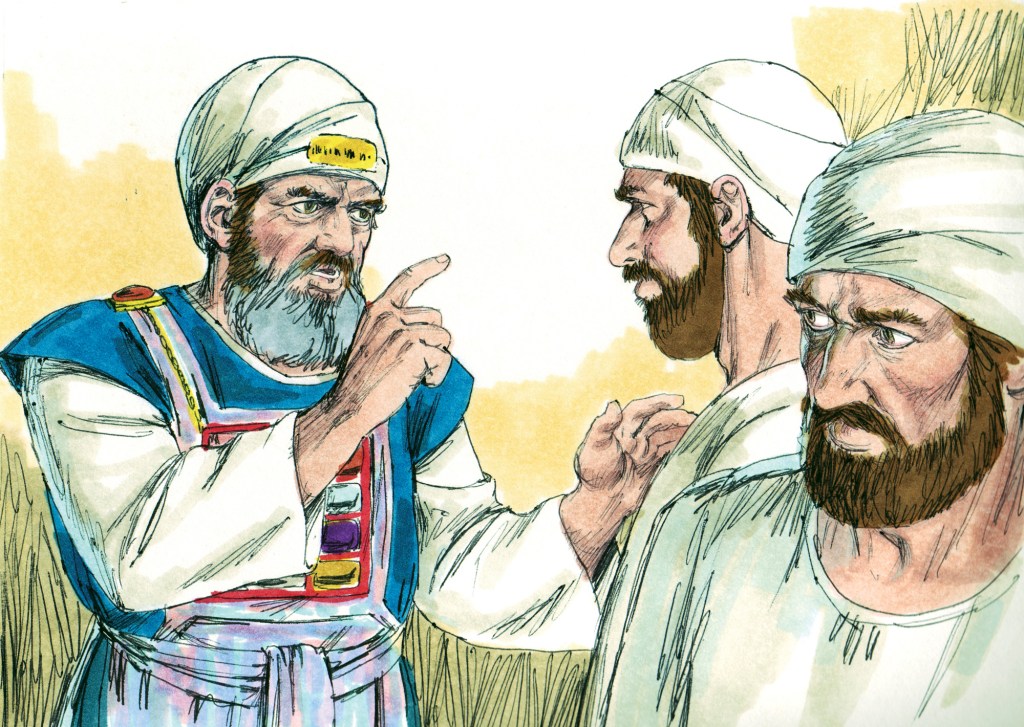
People of that day might have assumed that God was blessing them to give them the king they wanted, but that was not the case. Samuel warned them against it, but they insisted anyway.
King Saul was rebellious, insecure, self-absorbed, and psychotic. He failed to obey God’s commands. He became obsessed with his power and reputation among the people, and he became jealous of David.
Though Saul remained king, God had already rejected him and anointed David to succeed him. Saul tried to take David’s life multiple times in fits of jealous rage, and David escaped into the wilderness.
This is where the Sons of Issachar entered the picture. Though Saul was still king, they “understood the times.” They could see the proverbial writing on the wall. They knew that David was God’s man, and Saul’s reign was ending.
Many people have argued that Donald Trump is like the foreign king, Cyrus, who protected and funded the nation of Israel to return to the Promised Land. I have argued that Donald Trump is not like the foreign king, Cyrus, but like the Israelite King Saul. Donald Trump is the king that God’s people wanted.
Continue reading “Be Like the Sons of Issachar Who Understood the Times”



 Navigating by Faith