The Idol of the Mind

Wise_Fools


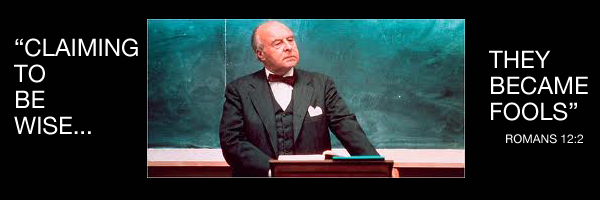
I listened to a lecture on materialism yesterday. Materialism is a predominant worldview that informs many people who adopt a view of science that conflicts with faith. A materialist worldview sees no purposeful principles in nature, no designing influence, no God, no inherent moral or ethical laws and ultimately no meaning in life. The world, in essence, is arbitrary and capricious. It is “governed” by unguided processes and chance.

When I woke this morning, I began thinking about government. I am an attorney, and I represent local governmental bodies. One cardinal rule that applies to governmental bodies in the United States is this: they can never be arbitrary or capricious. Every law must have a rational basis and (at a minimum) an articulable reason for every law. If no rational basis exists for a law, it will be determined unconstitutional and void because it is arbitrary and capricious.

Ironic, is it not, that we would govern ourselves by such a standard and not believe in purpose, meaning, intelligent design, God or inherent ethical and moral laws. We govern ourselves by reason and design, but many of us believe we live in a world that has no reason or design.

Continue reading “The Idol of the Mind”

Revisiting King Henry VIII

Henry VIII King of England
Depositphotos Image ID: 5598102 Copyright: georgios

I recently saw Shakespeare’s King Henry VIII at the Chicago Shakespeare Theater. The play, Shakespeare’s last one performed at the Globe Theater approximately 400 years ago, was very well done. The story line is not as compelling as most of Shakespeare’s works, but the interrelationship of church and state theme struck a chord with me, albeit a discordant one.

King Henry the VIII was born into aristocracy. Young Henry was appointed Constable of Dover Castle at age two, Earl Marshal of England and Lord Lieutenant of Ireland at age three, inducted into the Order of the Bath soon after, and a day later he was made the Duke of York. A month or so after that, he was made the Warden of the Scottish Marches. He had the best education available from the best tutors, was fluent in Latin and French and was familiar with Italian.

For all of his privilege, he was not expected to become king. His brother, Arthur, Prince of Wales, was the first born and heir to the throne, but Arthur died only 20 months after marrying Catherine of Aragon (daughter of the King and Queen of Spain). Henry VIII was only 10. (Wikipedia)

Henry became the Duke of Cornwall and assumed other figurehead duties. His father, the King Henry VII, made sure young Henry was strictly supervised, did not appear in public and was insulated from real authority. Henry VII quickly made a treaty with the King of Spain that included the marriage of his daughter, Catherine, to young Henry – yes the widow of recently deceased brother Arthur. (Wikipedia)

From this point begins a history of manipulation, abuse of power, shameless excess and rationalizations twisting biblical and religious notions to serve the king’s self-interest. This is a story that parallels the “marriage” of State and Church. The two are intertwined in an adulterous affair of blasphemous indiscretions.

Continue reading “Revisiting King Henry VIII”

Calvin & Will

Lynn Johnson Calm Beach


Calvinism and Arminianism represent two diverging views of God’s relationship with man. The two views are summarized at the graceonline.com website and charted at the jesusfollowme.com website. In a nut shell, Calvinism represents the view that people are predestined to believe or not believe; and Arminianism represents the view that people have free will to believe or not to believe. I am oversimplifying the positions, of course.

As an aside, I am no theologian. I was one thesis short of a religion major in college (finished with an English Literature major). I became a believer in college in the midst of prevailing liberal thinking and unbelief. I say this only to acknowledge that I am not an expert, but I have a personal faith in Jesus Christ. I have no doubt that I was drawn by God and that salvation comes by grace through faith, not by anything I have done or will ever do.

The countervailing views get to the heart of the Christian faith. Does God choose man? Or does man choose God? Continue reading “Calvin & Will”

The “Do’s” and the “Don’ts” Don’t Do It

One of the more common perceptions is that Christianity is all about “doing the right thing” and not committing sins. Being religious means being pious and observing a list of do’s and don’ts. But that is just plain wrong!

Consider what Paul says in Colossians (2:16, 20-21):

Therefore do not let anyone judge you by what you eat or drink, or with regard to a religious festival, a New Moon celebration or a Sabbath day….

Since you died with Christ to the elemental spiritual forces of this world, why, as though you still belonged to the world, do you submit to its rules: “Do not handle! Do not taste! Do not touch!”?

Those are liberating words we wish most churchgoers would take to heart. Right? It may be news to many non-churchgoers that Paul in the Bible rejects the notion of living by a list of rules. Indeed, many churchgoers have quite missed the point in that respect. But Paul is not saying that sin does not matter.

In the next chapter of Colossians, he writes: (Col. 3:5-9)

Put to death, therefore, whatever belongs to your earthly nature: sexual immorality, impurity, lust, evil desires and greed, which is idolatry. Because of these, the wrath of God is coming…. you must also rid yourselves of all such things as these: anger, rage, malice, slander, and filthy language from your lips. Do not lie to each other….

And shortly thereafter, he states: (Col. 3: 12-14)

…. clothe yourselves with compassion, kindness, humility, gentleness and patience. Bear with each other and forgive one another if any of you has a grievance against someone. Forgive as the Lord forgave you. And over all these virtues put on love, which binds them all together in perfect unity.

Is not this just another list of do’s and don’ts? He says one thing, and then he contradicts himself in the very next chapter of the same letter. Right? Well…, no. He is saying something quite different.

I left out verse 17 of Chapter 2 on purpose because I wanted to compare the two statements first in order to focus on the difference. Verse 17 gives us a clue to the difference between the two statements. Paul says that the rules regarding eating, drinking, the Sabbath, etc. (i.e; the “Law”) are “a shadow of the things that were to come; the reality, however, is found in Christ.”

Paul goes on to describe the type of person who focuses on the do’s and don’ts:

Such a person also goes into great detail about what they have seen; they are puffed up with idle notions by their unspiritual mind. They have lost connection with the head, from whom the whole body, supported and held together by its ligaments and sinews, grows as God causes it to grow. (Col. 2:17-19)

Paul calls such people “unspiritual.” Ironic, is it not, that many non-churchgoers think of the self-righteous, pious person when they conjure up a picture of a “Christian”; and, of course, they want nothing to do with that! Such a “puffed up” and self-righteous person is only a shadow; he is not the real thing. The reality is Christ, not a list of rules. The reality is a person in a relationship with Christ!

The list of rules lacks any value, ultimately:

These rules, which have to do with things that are all destined to perish with use, are based on merely human commands and teachings. Such regulations indeed have an appearance of wisdom, with their self-imposed worship, their false humility and their harsh treatment of the body, but they lack any value in restraining sensual indulgence. (Col. 2:22-23)

It is the reality that we need! Paul tells us the reality is in Christ (Col. 3:1-2):

Since, then, you have been raised with Christ, set your hearts on things above, where Christ is, seated at the right hand of God. Set your minds on things above, not on earthly things.

We are flawed by sin. (Rom. 3:10) Sin is in our nature, and we separated from God by that sin. (See Is. 59:2). Though we are separated from God, God has offered us redemption from the very thing that separates us. (Rom. 6:23) They way we access that redemption is simply to receive it, and to let go of our own striving and pride, to die to that sinful self and to live for God.

For you died, and your life is now hidden with Christ in God. When Christ, who is your life, appears, then you also will appear with him in glory. (Col. 3:3-4)

Salvation requires the surrender of self to God.

Now, we come back to the passage that I compared to the list of rules above (Col. 3:5-17)

Put to death, therefore, whatever belongs to your earthly nature: sexual immorality, impurity, lust, evil desires and greed, which is idolatry. Because of these, the wrath of God is coming. You used to walk in these ways, in the life you once lived. But now you must also rid yourselves of all such things as these: anger, rage, malice, slander, and filthy language from your lips. Do not lie to each other, since you have taken off your old self with its practices and have put on the new self, which is being renewed in knowledge in the image of its Creator. Here there is no Gentile or Jew, circumcised or uncircumcised, barbarian, Scythian, slave or free, but Christ is all, and is in all.

Therefore, as God’s chosen people, holy and dearly loved, clothe yourselves with compassion, kindness, humility, gentleness and patience. Bear with each other and forgive one another if any of you has a grievance against someone. Forgive as the Lord forgave you. And over all these virtues put on love, which binds them all together in perfect unity.

Let the peace of Christ rule in your hearts, since as members of one body you were called to peace. And be thankful. Let the message of Christ dwell among you richly as you teach and admonish one another with all wisdom through psalms, hymns, and songs from the Spirit, singing to God with gratitude in your hearts. And whatever you do, whether in word or deed, do it all in the name of the Lord Jesus, giving thanks to God the Father through him.

We do not follow a list of rules; we follow after Christ who is our savior! We put sin to death because we do not want to be separated from Christ; we are being renewed in His image! We have set our minds on Christ, to be like Him, to know Him, to be conformed to His image, to let Him rule in our hearts! We do not want the shadow; we want the reality! We do not live a religious life self-imposed; we live a changed life that flows out of our relationship with God who saves us and calls us to Himself!

Good News

Lobster fisherman

As Jesus passed on from there, he saw a man called Matthew sitting at the tax booth, and he said to him, “Follow me.” And he rose and followed him.

And as Jesus reclined at table in the house, behold, many tax collectors and sinners came and were reclining with Jesus and his disciples.  And when the Pharisees saw this, they said to his disciples, “Why does your teacher eat with tax collectors and sinners?” But when he heard it, he said, “Those who are well have no need of a physician, but those who are sick. Go and learn what this means, ‘I desire mercy, and not sacrifice.’ For I came not to call the righteous, but sinners.” Matt. (9:10-13)

A Modern Parable