God Is Working Out His Purpose, and What He is Doing May Surprise You

Imagine you have walked with Jesus for three years. Everywhere he went, you went with him. You ate with him, slept with him, traveled long, hot hours in the sun with him. You laughed and you cried with hm.

You saw him heal the lame and preach sermons to crowds of thousands. You were there when the Pharisees confronted him, and he left them speechless. You know Jesus better than anyone else on earth. You know where he grew up and his family.

You have watched Jesus in all of those moments. You watched him with the crowds and the one-on-one encounters. You saw him go off into the wilderness to pray for hours on end. He told you things he didn’t tell anyone else.

Imagine walking with Jesus from one town to the next, as you always did, and you are talking on the way. He asks you who the people say he is.

That’s pretty easy, right? You heard the crowds and people talking as he preached. You know what they were saying. Maybe Jesus didn’t hear it, but you did.

“And Jesus went on with his disciples to the villages of Caesarea Philippi. And on the way he asked his disciples, ‘Who do people say that I am?’  And they told him, ‘John the Baptist; and others say, Elijah; and others, one of the prophets.’”

Mark 8:27-28

Then Jesus dropped a more difficult question: “‘But who do you say that I am?’” (Mark 8:29a)

THAT was the big question. You had all been talking about it. How could you not!

No one saw all the things Jesus did like the twelve of you. You had a front row seat to the most amazing display of the power of God since the days of Moses!

No one could do all those things if he wasn’t sent from God – if he wasn’t the Messiah, himself! But saying it, was another thing. You were all thinking it, but who was going to say it?

The intrigue and mystery that surrounded Jesus was getting pretty intense. The excitement and hope among the throngs of people were building with each passing day. They couldn’t go anywhere that crowds did not find him. While the opposition from the Pharisees was growing and becoming more severe, Jesus seemed untouchable.

Peter, of course, broke the silence:

“You are the Christ.”

Mark 8:29b

There it was. Peter said it. The anticipation of the twelve at that moment as you wait for the next thing Jesus will say is pregnant with hope, excitement, exhilaration even! This is it isn’t it! You know it is.

But, you should know by now to expect the unexpected, as they say. What Jesus says next is the reason they all hesitated in the first place.

Continue reading “God Is Working Out His Purpose, and What He is Doing May Surprise You” →

Reflections on God and Good and Evil: Inside Out

God’s image is imprinted in each person, but it’s only a reflection unless we embrace Him..

In the first century, Hebrews believed that they would be defiled by the things they ate. In the twenty first century, many Americans believe that people are generally good, and they learn to be prejudiced and hateful from their environment. I hadn’t seen the parallel until I spent some time meditating on the following words Jesus spoke to his first century audience:

“There is nothing outside a person that by going into him can defile him, but the things that come out of a person are what defile him.”  …. Do you not see that whatever goes into a person from outside cannot defile him, since it enters not his heart but his stomach, and is expelled?” …. And he said, “What comes out of a person is what defiles him. For from within, out of the heart of man, come evil thoughts, sexual immorality, theft, murder, adultery, coveting, wickedness, deceit, sensuality, envy, slander, pride, foolishness.  All these evil things come from within, and they defile a person.” (Mark 7:15, 18, 19, 20-23 ESV)

Modern Americans may not agree with the list of evils Jesus mentions here, nor would they agree with the ancient Hebrews’ list of evils, but I find it interesting that they might both generally agree, perhaps, on the source of evil – coming from outside the person. Modern Americans popularly believe that all people are good, that we only learn to be bad. It’s pressure from outside of us that influences us to do evil things.

Jesus said that isn’t true. It’s what comes from within us that defiles us. Jesus might have been echoing the Prophet, Jeremiah, when he said the human heart is deceitful (and “desperately sick”). (Jer. 17:9)

We fool ourselves when we think that most people (including ourselves) are basically good. We are looking in the wrong direction when we assume that evil lurks outside of us.

James says, “[E]ach person is tempted when he is lured and enticed by his own desire …” (and, “desire when it has conceived gives birth to sin….”). (James 1:14-15) Paul says, “No temptation has overtaken you that is not common to man” (1 Cor. 10:13), and all people have sinned and fallen short. (Rom 3:23)

Scripture asserts that the thread of sin runs through all people. I think that Scripture is correct in this. The human heart tends toward evil. We have to learn to be good. Evil is what comes naturally, but good has to be learned.

But what is the essence of goodness and evil? This is where we find general agreement on some things (it’s not good to kill babies for fun) and disagreement on other things (like abortion).

Jesus breaks “being good” down to two things: loving God above all else, and loving our neighbors as ourselves. (Matt. 22:36-40) If these things are the greatest goods, then the greatest evils are what is contrary to them: not loving God and not loving our neighbors.

I think modern Americans can agree about the goodness of loving others, but we tend to reject (or be agnostic about) loving God. Ancient Hebrews generally subscribed to both precepts, but there was a disconnect for them. They got caught up in the commandments (the do’s and don’ts) and didn’t understand that those commandments pointed to something greater. Thus, they focused on what they took into their bodies instead of what came out of their hearts.

Jesus focused on the heart of the matter – human hearts. We would do well to refocus our attention in the twenty first century on human hearts as well, beginning with our own hearts. We search for ultimate truth within ourselves, but the hateful things that we detest in others are found within us also.

Continue reading “Reflections on God and Good and Evil: Inside Out” →

Heavenly Citizens In These Modern Times

What deserves our ultimate allegiance?

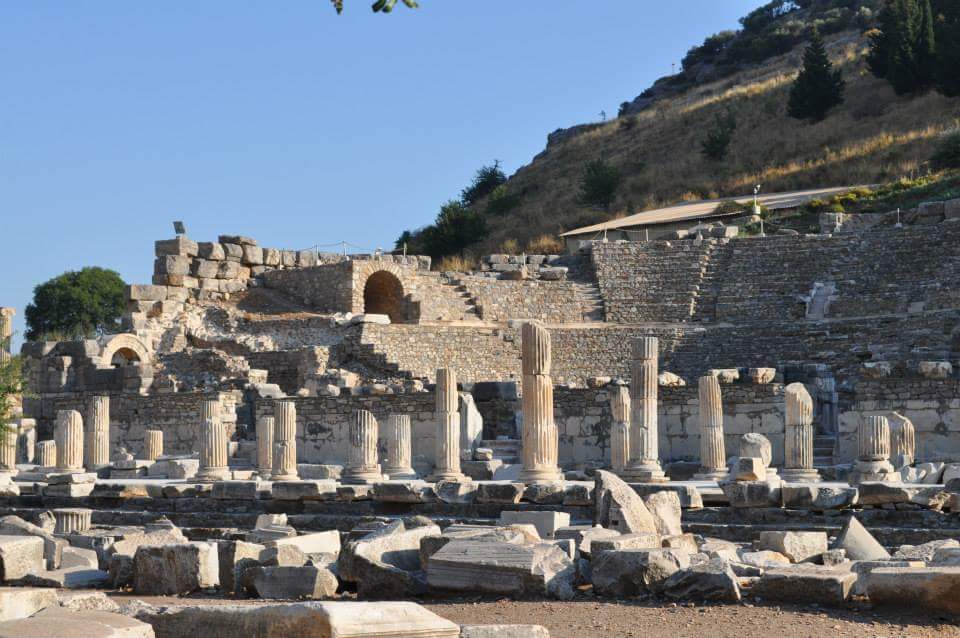
City Hall at Ephesus by Brooke Miller

Peter and Paul, the pillars of the Church, were clear that the only citizenship that counts is our citizenship in heaven. (Phil. 3:20) W are only “sojourners and exiles” in this world. (1 Peter 2:11)

Paul submitted to earthly authorities as though they had been established by God. (Rom. 13:1) He submitted to lashing by Jewish authorities five times! He appealed to his Roman citizenship, but, he clearly saw himself not as a citizen of this world. He was a citizen of the kingdom of heaven that is to come.

He used his Roman citizenship to gain an audience for the gospel among the Romans, to be an ambassador for Christ as he spoke to people in the public squares. He used his credentials as a Hebrew scholar to gain an audience for the Gospel in the synagogues.

Paul submitted to the processes and protocols of Roman and Jewish authorities. He recognized their earthly authority over him. He appealed to that same authority, not for his own advantage, but for the purpose of advancing the kingdom of God.

When we get involved in politics in the 21st century, do we submit to the authorities established by God as Paul did? Paul boasted of his lashings. Paul used his Roman citizenship, not to get out of prison, but to get to Rome to support the followers of Christ there.

Do we count ourselves, first, as citizens of heaven? Paul longed to be with Christ. He used his time on this earth to advance the kingdom of God while he longed for the day when he would put off his perishable body and put on immortality.

Do we use our earthly citizenship not for our own advantage, but to advance the Kingdom of God? When we fight for tougher laws and tighter borders and the right to walk around without masks, are we fighting for the kingdom of God?

Paul said what needed to be said for the sake of the Gospel, but he accepted the earthly consequences of his focus on heavenly things. Paul lived in an earthly world that was hostile to him and everything that he stood for. He submitted to the world’s authority, but he did it in obedience to the authority of God for the advancement of the Gospel, the good news of the coming of the kingdom of God.

Sometimes, I wonder whether we resist authorities that to advance our earthly objectives and appeal to political power and influence to secure our earthly advantage. I wonder how often we have it all wrong.

What are our priorities? To whom do we owe our ultimate allegiance? What are our ultimate goals? Are we seeking to advance the kingdom of God at all costs, including the cost to ourselves and our own position in the world?

Paul used his station in life as a Jewish scholar and a Roman citizen not for his own benefit, but for the benefit of the kingdom of God, to gain audience in front of people, and to spread the gospel. How do we use our station in life, our political power and religious knowledge? To whose benefit are our actions accumulating?

Are we fighting to protect and preserve our own families, communities and country in this world only to lose sight of our citizenship in heaven? Are we striving to save our lives only to lose our souls?

These are questions, not accusations. God knows the heart. I pose these questions in my own heart as write them.

There Is Now No Condemnation, but Go and Sin No More.

When Jesus said, “Neither do I condemn you,” it isn’t the end of the story.

I have been thinking lately about the phrase, “Do not go on sinning.” These were the words Jesus spoke to the woman caught in adultery after he rescued her from her accusers. We forget about them, perhaps, because of the force of the rest of the story.

The Pharisees brought her to Jesus one day and challenged him: “’Teacher,’ they said to Jesus [with a hint of affected deference, I imagine], ‘this woman was caught in the act of adultery. The law of Moses says to stone her. What do you say?’”

They were trying to trap Jesus into saying something they could use against him, but Jesus was not shaken or disturbed by the dilemma they posed him. He stooped to write in the dust with his finger.

The awkward silence was broken finally by a demand for an answer. Jesus obliged,

“Alright, but let the one who has never sinned throw the first stone!”

John 8:7

Significantly, Jesus didn’t deny what the Law says. His answer implied agreement with the judgment of the Law, but his answer turned the table on the accusers and focused attention on them.

His answer is reminiscent of apportion of the prayer that Jesus taught his followers to pray and of a segment of the Sermon on the Mount:

“And forgive us as we forgive those who trespass against us.”

Matt. 6:12

“[I]n the same way you judge others, you will be judged….”

Matt. 7:2

The pregnant silence continued again, as Jesus returned to writing in the dust with this finger. This time, the demands for an answer slipped away with the accusers, one by one, leaving alone with the accused woman.

The focus of the encounter had shifted dramatically from the adulterous woman to her accusers. Their self-righteous smugness turned to bitter disappointment and shame as Jesus put them in their place.

Now alone with the woman, Jesus asked her, “Where are your accusers? Didn’t even one of them condemn you?”; “No, Lord,” she replied. “Then, “Neither do I,” Jesus said.

This seems to be the perfect way for Jesus to end the story. The accusers of the adulterous woman were sinners too. When Jesus said, “Let the one who is without sin cast the first stone”, none of them could do it. They knew they would be condemning themselves. What Jesus wrote in the sand must have hit home with them.

The story would be perfect if it ended there, right? Jesus, the Lord and Savior of the world, says he doesn’t condemn the adulteress woman either!

But that isn’t the end of the story. The story ends with Jesus adding, “Go and sin no more.” (John 8:11)

Those words hang there now for me, as I imagine they did for the woman.

What wisdom and command of the situation Jesus had shown! The pompous self-righteousness of the religious leaders who used this poor woman as a ploy to back Jesus into a corner was deflated. The public humiliation and shame she must have felt was heaped back on her accusers in divine vindication. The gentleness with which he treated her and affirmed her value is beautiful.

But, when the men had left, and she was alone with Jesus, he left her with the instruction, “Go and sin no more.”

Jesus didn’t condemn her, but Jesus didn’t release her to go back to the lifestyle and choices she had made to that point. Why not?

The words, “go and sin no more”, haunt me as I think about myself and how easily I fall into sinful attitudes and stumble. It would so much easier if Jesus hadn’t tagged those five words on to the end of this story!

Continue reading “There Is Now No Condemnation, but Go and Sin No More.” →

The Living Water Is a Gift from God to All Who Ask

I was reading in the Gospel of John the story of the encounter with Jesus by the Pharisee, Nicodemus, followed story of the encounter with Jesus by the “woman at the well”. (John 3 & 4). The two stories are classic examples of the ubiquitous use of figurative (non-literal) language in the Bible.

There are literal meanings, and there are figurative meanings, and there are many layers of meanings throughout Scripture. Just as we cannot perceive figurative meanings while limiting ourselves to literal interpretations, we cannot perceive spiritual things while limiting ourselves to natural, physical explanations.

In the story of Nicodemus, Jesus stretches the Pharisee’s imagination with the statement, “[U]nless one is born again he cannot see the kingdom of God” (John 3:3) which I explored in a previous post, Don’t Wonder at the Saying, “You Must Be Born Again”. In very next chapter in the Gospel of John, Jesus stretches the imagination of a Samaritan woman at a well, when he says,

“[W]hoever drinks of the water that I … give … will never be thirsty again… [becoming] … a spring of water welling up to eternal life”

John 4:14

These are two completely different statements that get at the same reality – a spiritual reality that Jesus offers to those who believe him and receive what he has to offer. Before we go a little deeper, though, first we need to consider the context.

In John 4, after the encounter with Nicodemus, who came to Jesus at night (likely because he didn’t want to to be seen by his fellow Pharisees), Jesus left Judea (where he had been Baptizing people) because the Pharisees had gotten wind of what he was doing.

Continue reading “The Living Water Is a Gift from God to All Who Ask” →