Redeeming Diversity, Equality, and Inclusion

DEI has become a weaponized, pejorative term.


Diversity, Equality, and Inclusion (otherwise known as DEI) has become a pejorative label for the “evils” of progressives that is a target of the Trump administration in their take down of government as it existed when Donald Trump took office. I don’t want to talk about politics. I want to address something to the Church in America. Something I think we need to think about prayerfully in these times.

I have been through a DEI session as a mandatory component of my professional continuing education. My experience is limited, so I discount it, but it will serve my purpose of introducing the subject I want to address.

Honestly, I would characterize the DEI session I went through as cringy. It was uber sincere, preachy, and not a little condescending. I also didn’t think it was very effective for these and other reasons. Well-intentioned, maybe. I will give it the benefit of the doubt, but I am afraid it rubbed me the wrong way – privileged white man that I am.

I can see how people outside the church might feel about the uber sincerity, preachiness, and condescension of Christians. It can be … well, cringy. I find it ironic that the progressive world (it seems to me) has overtaken the Church in self-righteous condescension, preachiness, and overall cringe in its own beliefs that it appears to be trying to cram down the throats of people it views as less than.

But, I digress. I want to take a step back and re-examine the ideas of diversity, equality, and inclusion. I am not going to do a deep dive, but I want to recapture these words that have been hijacked by political operatives and used alternatively as political bludgeons and pejoratives.

Diversity was created by God when he confused the languages of the people. God confused their languages because the people had unified together with one common language to make a name for themselves and to resist God’s instruction to be fruitful and multiply over the earth. God “confused the language of the whole world” to scatter people around the world as He originally intended. (Genesis 11:1-9)

From this, we see that God is in control, and He has a plan. Well, He is still in control, and He still has a plan. People are either working with Him, or they are working at cross purposes to His plan.

As Christians, we don’t ever want to be working at cross purposes to God! Diversity was God’s idea going all the way back to Genesis, and He shows where He is going with it in Revelation. This is the vision He gave John to share with the world to let us know His end game:


“After this I looked, and there before me was a great multitude that no one could count, from every nation, tribe, people and language, standing before the throne and before the Lamb. They were wearing white robes and were holding palm branches in their hands.  And they cried out in a loud voice:

“Salvation belongs to our God,
who sits on the throne,
and to the Lamb."

Revelation 7:9

God’s plan is to bring all the nations, tribes, and languages back together in all their diversity! Every different nation, and every different tribe, in all their different languages – diversity. But, they will be unified in their worship of the Lamb who sits on the throne. (Notice, it isn’t the Lion of Judah who appears on the throne, but the Lamb of God.)

God celebrates the diversity He created by gathering all the nations, tribes, and tongues together from around the world where they were scattered. Diversity is not pejorative. It is something God created in His wisdom that we can celebrate as we worship Him in one voice and many tongues.

If we pray authentically as Jesus taught us, we pray, “Our Father, who is in Heaven, hallowed be your name. Your kingdom come and your will be done on earth as it is in Heaven!” If we are praying for God’s kingdom on earth – now – as it is in heaven, we cannot really mean that if we do not embrace the diversity that God created on earth.

Continue reading “Redeeming Diversity, Equality, and Inclusion”
Can Christians Be Patriotic?

Christians should view themselves fundamentally as citizens of a kingdom that is not of this earth


Concerns about “Christian nationalism” have been raised in recent years from the political left. Some people in Christian circles, and specifically conservative Christian circles, have pushed back on those concerns and criticisms. At the same time, however, concerns about Christian nationalism have been voiced from within Christian circles, even from within conservative Christian circles.

The conversation has arisen, perhaps, because of the way that Donald Trump has courted Christians in his campaign to “Make America Great Again”. Many Christian voters have embraced Trump and his campaign slogan.

I am thinking about this in the context of a question raised about Christians being patriotic to John Dickson on a recent episode of the Undeceptions Podcast. (See Question Answer XIII at abut the 42 minute mark.) The person who raised the subject referenced the Bonhoeffer movie, observing that the issues for the church seemed to come when the church stopped thinking what it means to be a Christian and started thinking about what it means to be a German Christian.  

The question is, “Should Christians be patriotic?”

Putting the question in terms of patriotism, rather than nationalism, presents a slightly different twist on this conversation. “Christian nationalism” has become a pejorative term, but patriotism is seemingly more neutral and non-pejorative. At the same time, many people accused of Christian nationalism would likely say they are only being patriotic.

So, is patriotism ok for a Christian?

I like the fact that this question was put to John Dickson, an Australian who has no dog in the American political fight. Though he currently teaches at Wheaton College in Illinois, he approaches the issue from outside the roiling turmoil of American politics.

The question was also posed by a non-American listener to the podcast who was concerned about the way patriotism “potentially dehumanizes others and makes them seem lesser because they are not of our race”. He expressed concern about the mistreatment of refugees and others of different background to our own.

The “glaringly obvious” theological view proclaimed by Jesus and the New Testament writers, responds Dickson, is that Christians should view themselves fundamentally as citizens of a kingdom that is not of this earth. (Jesus said, “My kingdom is not of this world.” (Jn. 18:36); Paul said, “[O]ur citizenship is in heaven.” (Ph. 3:20); and Peter called Christians “sojourners and exiles” in this world. (1 Pet. 2:11) In my view, that means that none of us have a dog in the earthly political fight – ultimately.

Thus, we should “be shaped by the values of God and not the values of any particular nation”, according to Dickson. He observes that this admonition is everywhere in the teaching of Jesus, beginning with the first public words spoken by Jesus in the Gospel of Matthew, which we call the Sermon on the Mount. He summarizes,

“Everything in the Beatitudes [in the Sermon on the Mount] seems to stand against the nationalistic mindset of dominating others…. Blessed are the poor in spirit, for theirs is the kingdom of heaven. Blessed are those who mourn, blessed are the meek, for they will inherit the earth. Blessed are the merciful; blessed are the peacemakers; blessed are those who are persecuted because of righteousness for theirs is the kingdom of heaven [paraphrasing the Beatitudes]. The contrast with the nationalistic spirit of the day couldn’t be more striking.”

JOhn Dickson in Episode 146 of the Undeceptions podcast

Dickson urges us to consider the Beatitudes in light of the Roman domination of the world at the time and the Jewish expectations at that time. These are some song lyrics written in the 2nd Century BC by a Jewish author:

“See, O Lord, and raise up for them their king, the son of David,
At the time known only to you, O God, that he may reign over Israel your servant.
Gird him with strength, to shatter unrighteous rulers;
To purge Jerusalem of the nations that trample her down in destruction;
To expel, in wisdom and righteousness, sinners from the inheritance;
To smash the sinner’s pride like a potter’s vessel….”

Psalms of Solomon 17:21-23

This Jewish author’s sentiment is full of what we might call nationalistic pride. Contrast that sentiment with the words of Jesus. The meek inheriting the earth seems like a far cry from shattering unrighteous rulers. As John Dickson explains,

“Jesus is demanding that his followers live by the values of the future kingdom over the values of any particular present nation.”

JOhn Dickson in Episode 146 of the Undeceptions podcast

Everywhere Jesus went, he proclaimed the coming of the kingdom of God. (Luke 8:12) The kingdom of God (and being ready for it) is the subject of most of the parables Jesus told. He also announced that the kingdom of God is here now (in our midst), but he sad it is like a mustard seed, the yeast in bread, or a treasure buried in a field.

The kingdom of God now is not (yet) the ruling authority. It is here, but it has not taken over. It is emerging, but it is not yet what it will be. When that time comes, however, everyone will know it; and people need to be ready for it, or they will miss it and be left out.

The message of the kingdom of God – that it has come, but is yet to come fully – is consistent with the instruction of Jesus that the meek will inherit the earth. We do not rule in the kingdom of God presently with might and power; we “rule” by denying ourselves, but taking up our crosses, and by allowing God to rule and work in our hearts to conform us to Himself.

The Jews who expected their Messiah to come at the time of Jesus did not recognize Jesus because they thought he would be their champion, empowering them to shatter the nations that oppressed them and smash the pride of (more) sinful nations. They failed to recognize their own sinfulness and the promise to Abraham, which was to bless all the nations through Abraham’s descendants. (Genesis 12:3, 18:18, 22:18)

They were too full of nationalistic pride to see what God was doing, consistent with the very promise God made to the them – to bless all nations. As we will see, this is a key issue, and it is something we need to contend with, lest we enter into the error of the First Century Jews

Continue reading “Can Christians Be Patriotic?”

Who is My Neighbor? And Who is a Neighbor to Me? The Discomfort of Grace.

Grace is exercised among people who are not like you, who challenge you, who are uncomfortable to be around.

I have often touted the Unbelievable Podcast on Christian Premiere Radio in the UK, and I do it again here. I recommended the episode on Philip Yancey live Q&A on faith, doubt and the future of the US church: Saturday 19 March 2022. Much was discussed in the episode that I could write about, but one thing stands out above the rest to me this morning. Philip Yancey said,

“It’s easy to find a church, to gravitate toward a church, where people look like you, and smell like you, and vote like you.”

Most of us go to churches like that. It’s a human tendency to gravitate toward people with whom we have the most connections, to settle in with people with whom we have the most in common, to spend time with people most like us, but Yancey says,

“That’s not the way to exercise grace. Grace is exercised among people who are not like you, who challenge you, who are uncomfortable to be around, people who are immoral. That’s where to exercise grace.”

Such a radical statement challenges most of us, I think. I am guilty of settling into churches where I feel most comfortable, but what if God wants me to engage in a church, or in groups, or with people with whom I feel uncomfortable? Would I be open to that possibility?

Jesus often urged people to love their neighbors. When I think of my neighbors, I think of the people in my neighborhood who I know and spend time with. If you are like me, you probably think immediately of your neighbors you know, but what about your neighbors you don’t know?

Jesus knew that people tend to favor those who are like them when he told the parable of the Good Samaritan. (Luke 25:30-35) In the parable, an unidentified man is attacked by robbers, stripped of his clothes, beaten and left for dead. (Luke 25:30) Three people come along and see him lying there: a priest, a Levite, and a Samaritan.

The priest and the Levite were the people most like the man who asked the question that prompted the parable. He was an expert in the Law of Moses, a Jewish leader.

He actually began with a more esoteric question: “What must I do to inherit eternal life?” Jesus turned the question on him, asking “What is written in the Law?” (Luke 25:25-26)

When the man responded, “‘Love the Lord your God with all your heart and with all your soul and with all your strength and with all your mind’; and, ‘Love your neighbor as yourself,'”, Jesus answered anti-climatically, “You have answered correctly…. Do this and you will live.”

That might have been the end of the conversation, but the expert in the law “wanted to justify himself”. Perhaps, he wanted affirmation that he was reading the law correctly. Perhaps, he wanted Jesus to acknowledge his deep moral thinking. Perhaps, he wanted to prove his expertise in the Law. Whatever he was thinking, he asked, “[W]ho is my neighbor?” (Luke 25:29)

The man may have wanted Jesus to engage him in a deep theological discussion, but Jesus deflected the attempt with the parable. The expert in the Law wanted to make it difficult and complicated, but Jesus kept it simple.

The man is specifically identified as an “expert in the Law”, and the initial question and follow up question read to me like he was wanting a deeper, philosophical conversation with Jesus. He didn’t really want a simple, straightforward answer. He wanted to debate, but Jesus wouldn’t go there with him.

I am also relatively certain that the answer Jesus gave him was not at all what he expected. It likely cut him to the quick – both he and and the wider audience who was listening in.

Continue reading “Who is My Neighbor? And Who is a Neighbor to Me? The Discomfort of Grace.”

Jonathan Haidt and the Erosion of American Democracy by the Corrosive Waters of Social Media

Something went terribly wrong, very suddenly. We are disoriented, unable to speak the same language or recognize the same truth.

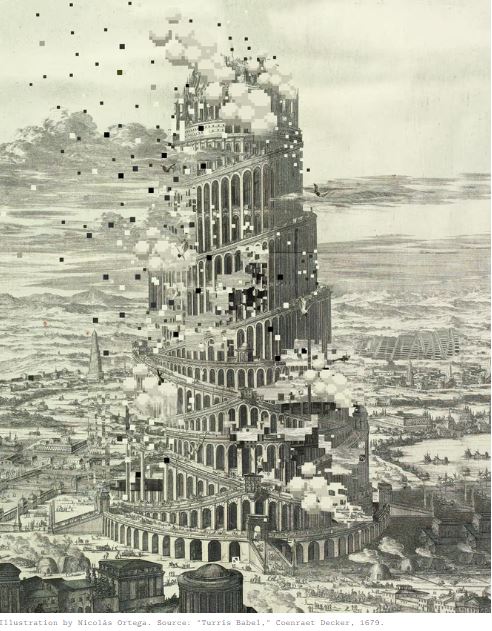
Courthouse Towers and Tower of Babel. Moab, Utah

Jonathan Haidt wrote this week in the Atlantic, “The story of Babel is the best metaphor I have found for what happened to America in the 2010s, and for the fractured country we now inhabit.” He says,


“Something went terribly wrong, very suddenly. We are disoriented, unable to speak the same language or recognize the same truth. We are cut off from one another and from the past.”

I resonate deeply with this.

Haidt observes that we are “becoming like two different countries claiming the same territory, with two different versions of the Constitution, economics, and American history.” Many people talk about the tribalism of our times, but Haidt suggests that tribalism isn’t the most accurate description of what is going on. Haidt finds the clearest understanding of the polarization of our times in the story of the Tower of Babel:

“Babel is not a story about tribalism; it’s a story about the fragmentation of everything. It’s about the shattering of all that had seemed solid, the scattering of people who had been a community. It’s a metaphor for what is happening not only between red and blue, but within the left and within the right, as well as within universities, companies, professional associations, museums, and even families.”

Haidt focuses blame on social media. He identifies 2011 as “the year humanity rebuilt the Tower of Babel” with Google Translate symbolically bridging the confusion of different languages. He says (for “techno-democratic optimists”), “[I]t seemed only the beginning of what humanity could do.”

Around the same time, Zuckerberg proclaimed “the power to share” a catalyst to transform “our core institutions and industries”. He may have been prophetic, but I doubt he envisioned such a corrosive change.

Haidt, something of a social scientist, himself, says, “Social scientists have identified at least three major forces that collectively bind together successful democracies: social capital (extensive social networks with high levels of trust), strong institutions, and shared stories.” Social media substantially weakens all three of these fundamental building blocks of a cohesive society.

It started harmlessly with the sharing of personal information to stay connected, but it quickly morphed into a kind of personal performance and branding platform. Along the way it developed into powerful weaponry at the fingertips of anyone and everyone at once.

The “Like” and “Share” buttons became commodities of individual enterprise and personal combat. Algorithms exposed (and exploited) the emotional currency of heightened individuality and the power of anger.

“Going viral” fed the hopes of Internet junkies like the possibility of a jackpot snares gambling addicts in its steely fingers, and the stakes were just as high. Haidt says, “The newly tweaked platforms were almost perfectly designed to bring out our most moralistic and least reflective selves. The volume of outrage was shocking….” The rapidity and its ability to spread was more virulent than COVID, or the plague.

Haidt lauds the framers of the Constitution for designing a republic built on “mechanisms to slow things down, cool passions, require compromise, and give leaders some insulation from the mania of the moment….” Haidt recalls Madison’s warning of “the innate human proclivity toward ‘faction’” so “inflamed with ‘mutual animosity’” that people are “more disposed to vex and oppress each other than to cooperate for their common good.’”

Haidt recalls also that Madison warned of a human tendency toward “factionalism” that can fan “the most frivolous and fanciful distinctions” into passions that ignite our most violent conflicts. Social media has ultimately proven him right.

Thus, Haidt says, “Social media has both magnified and weaponized the frivolous,” chipping away at our trust. The loss of trust makes every decision and election “a life-and-death struggle to save the country from the other side”.

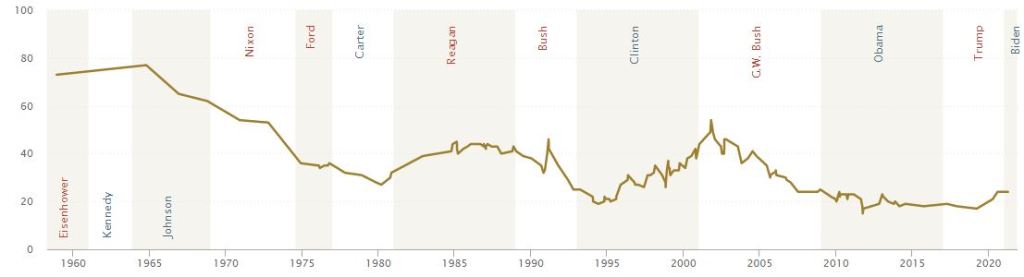
The sagging number of people who have faith in their elected officials hangs at an all time low. In my lifetime, the United Sates of America has gone from a high of 77% trust in the federal government (1964) to a low of 17% in 2019. (See Public Trust in Government: 1958-2021, by PEW Research May 21, 2021)

Social media has corroded trust in government, news media, institutions and people in general. Some claim that social media may be detrimental, maybe even toxic, to democracy, which requires “widely internalized acceptance of the legitimacy of rules, norms, and institutions” for survival. “When people lose trust in institutions”, says Haidt, “They lose trust in the stories told by those institutions.”

Insiders have been warning us of “the power of social media as a universal solvent, breaking down bonds and weakening institutions everywhere”, while offering nothing in return but the chaos of utter freedom and will. Haidt references movements like Occupy Wall Street, fomented primarily online, that “demanded the destruction of existing institutions without offering an alternative vision of the future or an organization that could bring it about”.

We have become a society of “people yelling at each other and living in bubbles of one sort or another”, says former CIA analyst Martin Gurri, in his 2014 book, The Revolt of the Public. The people behind the social media giants may not have intended such a result, but they have “unwittingly dissolved the mortar of trust, belief in institutions, and shared stories that had held a large and diverse secular democracy together”.

Haidt claims he can pinpoint the proverbial fall of the American Tower of Babel to the intersection of “the ‘great awokening’ on the left and the ascendancy of Donald Trump on the right”. Haidt doesn’t blame Trump for the fall; he merely exploited it. Trump proved that outrage is the currency of the post-Babel economy in which “stage performance crushes competence” and Twitter overwhelms newspapers and the nightly news, fracturing and fragmenting the truth before it can spread and take hold.

“After Babel”, Haidt says, “Nothing really means anything anymore––at least not in a way that is durable and on which people widely agree.” Haidt is particularly morose on the prospect of overcoming the rapid dissolution of the American democracy. Unfortunately, I share his pessimism. How did we get here? How do we move forward?

Continue reading “Jonathan Haidt and the Erosion of American Democracy by the Corrosive Waters of Social Media”

The New Religious Tribalism in Modern America According to Tara Isabella Burton

The new spiritual movements in the US are “religions of the Internet”

I recently read a review by Chris Smart on the Solas blog of the book, Strange Rites, by Tara Isabella Burton, published by Public Affairs, New York 2020. My thoughts come third hand, but I found enough meat to chew on (hopefully) in the review to warrant some attention.

The author of the book is an American, though she establishes some objective distance through her Oxford education in the UK. Only about five percent (5%) of people in the UK attend church on Sundays, and the trend in the US is moving in that same direction.

Into the vacuum that is growing with nones in the US are rushing other objects of our religious impulses. This seems to be the focus of the book, analyzing the places religious impulses are taking modern Americans as they drift away from Christianity.

If Protestantism that has dominated the religious landscape in the US in the past is a religion of the printed book, the new spiritual movements in the US are “religions of the Internet”. That remark certainly doesn’t surprise me, though I had not thought of it that way.

The Internet is larger than life in our world. It has replaced encyclopedias and asking our parents (or even your doctors) for information. It eats up our spare time more completely than the television did in my youth and the radio did in my father’s youth.

The Internet is everywhere. It never leaves our sides. We turn to it feverishly at all hours of the day and night. We can’t wait to communicate with it, and we constantly check it for validation through its communication with us.

Chris Smart, summarizing Burton’s observations, describes our preoccupation with the Internet as a search for transcendence in which people are “looking to create meaning, purpose and community through new rituals”. Those “modern rituals” are exploited and perpetuated by big business.

Some of the largest big businesses are the purveyors of community and connectivity on the Internet. They help to lead people with the breadcrumbs of their own preferences to tribes that are personally tailored for them. Our new temples are the echo chambers of our own inclinations and the tribes to which they tend to lead.

Continue reading “The New Religious Tribalism in Modern America According to Tara Isabella Burton”