The Fibonacci Sequence: Common Descent or Common Design?


Ever heard of the Fibonacci sequence? It is a sequence of numbers where each one is the sum of the previous two numbers. The sequence runs 0, 1, 2, 3, 5, 8, 13, 21, 34, and so on. What’s fascinating about the Fibonacci sequence is that when you make squares the size of the numbers, […]

via A Spectacular Sequence — God does not believe in atheists

I spent the weekend at a fair talking to people about science and faith. While some believe the two topics are incompatible with each other, I beg to differ. The compatibility of science (and math) and faith is the theme of the article I have reblogged here. (Please take some time to read it at the link above.)

The article got me thinking about some conversations I had or overheard at the fair. We usually post a question and invite people to vote on it. The question on Sunday was this: Do humans and apes share a common ancestor? The question draws people who want to weigh in, and sometimes it sparks conversation.

In more than one conversation triggered by a “yes” vote on our question, people cited for support the commonalities between apes and humans for evidence of common origin. Indeed, the commonalities can be seen at almost every level, from body design to DNA.

It’s a reasonable argument, but common ancestry isn’t the only reasonable conclusion to be drawn from the evidence, as the article I have reblogged observes. The evidence could be explained by common design.

As an example, the article linked above notes:

The “Fibonacci spiral” is found everywhere. It is to be seen in plant leaves, pine cones, seashells, pineapples, ferns, daisies, artichokes, sunflowers and even galaxies. It’s in the arrangement of seeds on flowers. It’s in starfish. It’s in the cochlea of your inner ear, which is not simply a spiral shape, it’s the actual Fibonacci spiral, with the exact number sequence.

The Fibonacci spiral is present in our bodies, as it is present in things as diverse as plants, shells and galaxies. The Fibonacci spiral is even present in storm patterns. So it seems fair to ask: are the commonalities we observe evidence of common descent? Or evidence of common design?

If you will indulge me a moment, the commonality of the Fibonacci spiral in animate things and inanimate things are diverse as shells, galaxies, and weather patterns is more suggestive of common design than common descent. Common descent might account for the appearance of the Fibonacci spiral in living things, but common descent does not explain the presence of the Fibonacci spiral in non-living things. Common design, however, can account for the repetition of the Fibonacci spiral in animate and inanimate, living and non-living, things.

The growing field of Evolutionary Developmental Biology has identified “toolkit genes” that are “turned on” to direct changes in certain ways. The toolkit genes are present, but when and where they are triggered determines the direction of the change in the organism. These scientists have also identified “developmental bias” that makes some changes “easy” and other changes impossible to occur. These things channel evolution in certain directions, making evolution something other than random.

Scientists in the field of epigenetics are seeing similar things. They have observed that environmental stressors can trigger mechanisms in the genetic code on or off. The mechanisms are programmed in, but they get are triggered by outside forces. Epigenetic “tags” can be passed down so that the environmental stressors (experiences) of ancestors can affect the traits of the next generation. The mechanisms are nonrandom; they are built in, and they are triggered by environmental pressures. They see “phenotypic plasticity” built into living organisms that allows a single genotype to produce different phenotypes (forms) depending on the environment.

The toolkit genes, developmental bias, epigenetic tags, phenotype plasticity, and other observable mechanisms are coded into the DNA, epigenetic materials, and other components of cells in living things to direct changes in those living things over time that we have called evolution. The evolution we see today (and which always existed) is not driven by purely random mutations as we once thought.

The ways that living organisms change over time is driven by embedded determiners. Environmental and “experiential” factors trigger these mechanisms, which cause the change to occur in predetermined directions. It is not random in the way we previously thought.

All of these modern discoveries are changing our understanding of how living organism change and adapt over time. All of these discoveries make our understanding more consistent with the idea of common design, and they open the door wider than previously thought to the idea of a common Designer.

As Stephen Meyer postulates in his book, Return of the God Hypothesis: Three Scientific Discoveries That Reveal the Mind Behind the Universe, whenever we see complex design, especially interactive design like DNA, epigenetic materials, and the panoply of interdependent mechanisms in cellular structures, we need to ask: what is the most likely explanation for that communicative complexity? What models do we see in our experience that can account for that? Meyer says there is only thing that can account for that complex interworking of communicative expression, and that is a mind. Nothing else in the universe that we have been able to observe produces that kind of interactive complexity built into a functional entity.


A Cosmic Wrench in Our Power Grid

Thoughts on scientific, technological and moral advancement and religion.


The podcast, Unbelievable, with host, Justin Brierley, is becoming a favorite food for thought. I just listened to Steven Pinker vs Nick Spencer: Have science, reason & humanism replaced faith? Pinker is an atheist professor of Psychology from Harvard, and Spencer is billed as a member of “the Christian think tank, Theos”. The subject was “Pinker’s recent book ‘Enlightenment Now’, addressing his claim that science, reason and humanism are the drivers of progress in the world, not religion”.

As with most of the episodes I have listened to, this one was a very civil and respectful “debate”, really more of a dialogue, on the respective points of view. This civility and respect sets Unbelievable apart from more reactive “discussions” of controversial topics.

In this particular discussion, the focus was on Pinker’s optimistic view of humanism bolstered by science and technology echoing the familiar theme that we are progressing as a species as we free ourselves from religion with the aid of science and technology carrying us forward. Pinker minimizes the influence of religion on the enlightenment and the sudden advancement of science that accompanied it, while Spencer argued that the influence of religion is what fundamentally motivated and shaped those movements.

Spencer agreed with much that Pinker says about the progress of modern man, though he disagrees that science has shaped the moral advances we have experienced. He says that the value of the individual and sanctity of human rights is at heart a religious concept. He even points out that Pinker has to resort to the religious term, sacred, to describe these concepts as some evidence of the religious influence.

I have long toyed with the notion that we are not as advanced, morally, as we think ourselves. The 20th Century was the bloodiest of all centuries. Characteristic of the 20th Century was the genocidal bloodshed and cruelty of the atheist regimes under Stalin, Mao Tse Tung, Pol Pot and others. Some would add Hitler to the hit list of atheist genocidal despots, but that point is often argued, with religionists foisting Hitler on the atheists, and the atheists pushing him back on the religionists.

Hitler is somewhat of an enigma, generating an almost religious following marked by a personality that modeled a religion-like fervor. Pinker and Spencer debated whether Hitler was influenced by Darwinism, with Pinker countering that Hitler despised Darwin.

Though the truth of Hitler’s motivations my remain a mystery, and despite the unprecedented genocides perpetuated in the 20th Century, Spencer agreed with Pinker that we have progressed morally into the 21st Century. We generally exhibit a higher morality, however you slice it, (at least in the western world) in modern times than ever before, and this higher morality tracks scientific and technological progress.

As the two men carried on the conversation about the relative influences of religion and scientific and technological advancement on that progress, some thoughts occurred to me that I hadn’t considered before. I would agree with Spencer that religion (principally Judeo-Christian principles in the west) has largely carried us to this place where, ironically, we are finding no more need of God.

This perspective, also, flows from those same Judeo-Christian roots that holds out human pride as the principal problem (sin) of humankind. Having achieved a degree of independence and comfort through the advancement of technology, we believe “can do this” on our own (to paraphrase the testosterone influenced enthusiasm of my former teenage boys).

Continue reading “A Cosmic Wrench in Our Power Grid”

Discussion on Science and the Bible

What do the science and the Bible have in common? Some thoughts from a physicist.

Michael Gillan Interview with Jeff Zweerink

Since I was in college and first read the Bible in a world religion class, I have found the Bible to be uniquely layered in its meaning and personally intimate at the same time. It was like no other book I read, and still is.

I read the Bible for the first time in a World Religion class, so I read it in light of and comparison to the other major world religion texts. In that comparative study, I found the Bible to be exceptional in its depth of meaning, intricacy and nuance.

My religion professor took the position (I later found out) that all roads lead to the top of the same mountain. He didn’t favor one text over another, least of all the Bible. He presented all the texts to be read on their own merit, letting them “speak for themselves”.

This is the way I approached them. I was a seeker, not knowing where truth was to be found, but assuming that all world religions contained nuggets of the ore. I viewed philosophy and great literature the same way, seeing them as deposits of truth to be explored and mined for their value.

I have to say that I found myself becoming a bit of a skeptic about science. I now understand that the skepticism would have been more appropriately leveled at scientists, who often acted (and apparently believed) as if science has a corner on truth and that all truth should be viewed through a scientific lens.

I have since learned that this “scientism” is a caricature – an exaltation of science beyond the scope and limitations of science and what we can and should expect of science. Science is the study of the natural world – matter, energy and motion. Science cannot tell us why we appreciate beauty, for instance, or even what beauty is.

But, I have also learned that science is beautiful in itself. Science unveils some of the most beautiful and wondrous facets of the universe we live in.  That we can even “do” science is beautiful and wondrous in itself!

Following is an interesting interchange between physicists about science and the Bible. I hope you enjoy it as much as a I did.

Does the Bible Speak to the Age of the Universe?

Will the entrance exam to get into heaven depend on your understanding of the age of the universe?

Photo by Chris A. Fraley

The age of the Earth is a hot button topic for Christians today. Science suggests that the Earth is old, but a large segment of western Christianity has put down big stakes on the claim that the Earth is young. We have to be careful here that this tension doesn’t overshadow the Gospel.

To be fair, it isn’t all western Christianity. It’s American Christianity where the age of the earth has become almost a litmus test in some circles for belief in God. But is it a good litmus test? Does the Bible speak to the age of the universe?

Frank Turek observes that we have to make assumptions when we talk about the age of the universe. (See The Bible and the Age of the Universe) For instance, when we measure the universe by the speed of light, the calculation shows that the universe is 13.8 billion years old. If we assume the speed of light has not changed since the earth was created, then the earth is 13.8 million years.

But, “Is that a good assumption?” asks Turek. What do you think? Does the Bible have answers for these kinds of questions? Read on if you want to know.

Continue reading “Does the Bible Speak to the Age of the Universe?”

Inspiration or Artifice? Faith and Reason

From a presentation by Francis Collins at the Veritas Forum at the California Institute of Technology

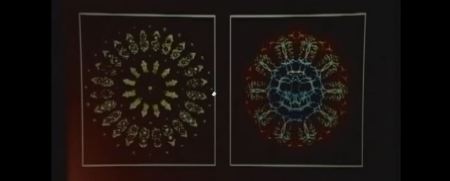
Take a close look at the two images. What do they represent? We might say that one image represents science and the other represents religion (or faith). But which is which?

The images are similar, but one of them is manmade, and the other is something we find in nature. Do you know which is which? Is the manmade image the scientific one or the spiritual one?

I will answer these questions; at least I will answer them as they were described in a presentation given by Francis Collins, the manager of the Human Genome Project, at a Veritas Forum at Caltech University in 2009. In the process, we will explore the chief question examined by this eminent scientist: whether science and faith are compatible.

Continue reading “Inspiration or Artifice? Faith and Reason”