The Reconciliation of Science and Religion

By Brooke Ekstrom
By Brooke Ekstrom

The reconciliation of science and religion may seem unlikely to some. Though the Renaissance period grew alongside the Reformation, and advancements in science during that time were largely pioneered by men of faith, science began to deviate from faith during the Enlightenment period. I suppose that the divergence of science and faith that began in the Enlightenment period is somewhat like the Protestant movement separating from the Catholic Church.

As one grew alongside the other, however, and both having roots in the same soil, it is inevitable that separation cannot be complete or total.

To the chagrin of modern materialists, the connection cannot and will not be severed.

Many atheists would of course embrace the idea that science can falsify religious claims. However, if this is the case, then religion may fall within the purview of science. The claim that religion and science may overlap is a claim that atheists have fought vigorously in the courts to reject. The reason for this is that if science can falsify religious claims, then it is also conceivable that it can give evidence for the truth of religious claims.

It is also maintained that science deals only with the physical world as its subject matter. While this is a methodological statement, many believe that science only deals with the physical world because that is all that exists. However, this is not a statement of science; instead, it is a philosophical statement that can neither be verified through the senses nor falsified through reason. Alvin Plantinga, J.P. Moreland, and several other philosophers of science have written extensively on this understanding of science. The problem with this materialistic criterion is that it fails its own test. That is, definitions are not physical, concepts are not physical, and meaning is not physical, and these things are what the materialist uses to define science. Therefore, if definitions, concepts, and meaning exist, then not everything that exists is physical.

Of course one could believe that non-physical reality exists, but claim that science merely deals with the physical attributes of the world. That is all well and good, but would merely suggest that religion and science do not talk to each other. Yet, as shown above, one could clearly use science to show certain religious beliefs to be false. And, as I also mentioned earlier, if one can used scientific fields to disprove religious claims, science may also be used to justify the beliefs of many religious claims.

From the blog post, Is Science the Enemy of Religion?, written by Shannon Holzer.

The Exclusivity of Truth

We cannot take the position that all religions are getting at the same truth unless we claim the kind of superior knowledge that we say no one has a right to claim.

On the Right Road - Ellen Posledni
On the Right Road – Ellen Posledni

Most people are not comfortable with atheism. They believe (know?) there is something greater than us, a cosmic Being or some Divine Truth. They intuitively know that the universe did not form itself out of nothing. But many people are also not comfortable with the exclusivity of religious propositions, especially in this post modern, pluralistic world.

In my opinion, the statement that all religions are equally true just doesn’t hold up. I say this having studied world religions in college and being a religious nerd for the last 40 years.

There are some similarities among religions at the surface, and there are some shared principles, but the ultimate, fundamental propositions of the various religions cannot be aligned with each other. Each of them has principals that are exclusive of other principals of other religions.

Most people who are realistic and honest (in my opinion) don’t attempt to say that all religions are true, in this ultimate sense, because it simply isn’t a tenable position, but that thought creates a dilemma. It makes us uncomfortable in the increasingly pluralistic world in which we live.

Continue reading “The Exclusivity of Truth” →

Catholics, Pentecostals and the Body of Christ

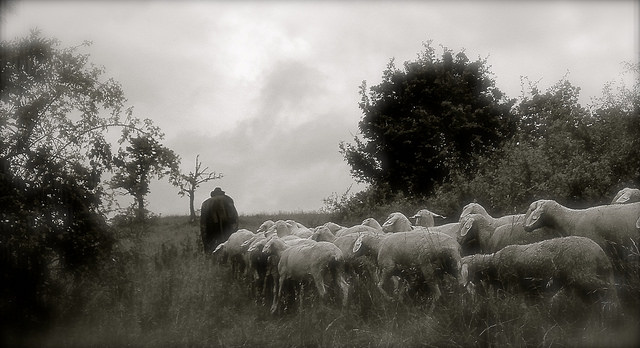
God’s sheep hear His voice. God knows His own. They sit in the whole spectrum of churches on any given Sunday morning or Saturday night, and some of them do not visit churches very often at all.

A Sheperd by Lauri Heikkinen

The article, A Classic Pentecostal Encounters Charismatic Catholics, takes me back to the early days of my Christian walk. I was raised Catholic, but I found little attraction to church as a child. We went to church religiously, a practice I later came to appreciate about my parents, but there seemed to be nothing in it for me. I even felt uncomfortable in church.

I went through some very rebellious teen years, wandering lost through the haze and fog induced by alcohol and drugs, drifting to the edge of the precipice, before I woke to the emptiness that I had inexplicably been embracing. That was not my conversion, but just the beginning of walking in a new direction.

Fast forward just a short while to college where I entered like a kid in a candy store with a new found passion for knowledge and truth. I thought I had left religion behind. Actually I did (and have never returned). What I did not realize is that I would discover the life that religion seemed to enshroud like an empty tomb. Continue reading “Catholics, Pentecostals and the Body of Christ” →

Theology, Science, Dreaming and Waking

Pitting the scientific myth against the theological Christian myth

76900149_2ab4dc13e3_o


I am a great fan of C.S. Lewis. Not that I agree with everything he has written, I love his genius and insight that is marked by a truly Renaissance journey through all of the great classical literature, philosophy and rational, scientific discourse. He approaches Christianity from the opposite shore and provides a view that most churchgoers would never otherwise get.

I recently read his short essay (Is Theology Poetry?) that is published with the Weight of Glory and other addresses by Harper One. In classic Lewis style, he starts off with a very obscure, nuanced question (that few, if anyone, would even think to explore) and, from the seeming pedantry and narrow beginning, he opens up the discourse about half way through into a sweeping view of an eternal truth that is absolutely breathtaking. Continue reading “Theology, Science, Dreaming and Waking” →

Are Reason & Faith in God Contradictory Terms?

Looking for a Sunset

I began taking notes on a series of hard questions posed to Tim Keller by some heavy hitting interviewers that is posted to the Veritas Forum. I thought I would take my notes and create a series of quick answers to these hard questions, but I got sidetracked by the first question: Aren’t faith and reason contradictory terms?

The question took me back to college when I first began to wrestle with this question.

Implied in that question is an assumption that the only rational conclusion of reason is disbelief in God. Reason is defined by Merriam Webster as “the power of the mind to think and understand in a logical way.” Faith is defined as the “strong belief or trust in someone or something.”

Note that faith is not defined in relation to evidence or reason, and this common definition of faith is not antithetical to evidence of reason either.

Reason (logic) depends on a premise, and premises are often tautological. Many premises are susceptible of proof, but many are not. The premise that the natural world is the totality of all reality is a premise many believe to be true, but it is not susceptible of proof (at least not scientific proof, unless one believes that science, which is limited to the study of the natural world is capable of proving that nothing other than the natural world exists though it is limited to the study of the natural world).

Continue reading “Are Reason & Faith in God Contradictory Terms?” →