St. Augustine on the Literal Meaning of Genesis

How Augustine read Scripture in light of experience and reason.


People cite the great church father, Augustine, in defense of the view that the earth is only thousands (rather than billions) of years old. Indeed, I believe this was (more or less) Augustine’s view, based on the science and knowledge that was available to him in the 5th Century when he lived. Augustine believed the earth was young.

That isn’t the end of our understanding of Augustine, though. To understand Augustine, we might be aided by a basic review of the mythological, philosophical and scientific views that were prevalent in his world at the time.

According to my inquiry on Bing Co-Pilot, the mythology of the time didn’t attempt to date the age of the earth. Science (such as it was) also had not established a position. Philosophy, however, provided two opposing views.

The philosophical camps were led by Aristotle and Lucretius. Aristotle argued that the earth was eternal, and Lucretius argued that the earth formed relatively recently (based on a lack of records prior to the Trojan War). (The Trojan War dates to the 11th or 12th Century BCE.) Thus, the two competing views in Augustine’s day were 1) eternal earth or 2) young earth. There was no inkling in Augustine’s time that the earth might be very old, but not eternal.

Interestingly, Aristotle’s view of an eternal earth shifted to an eternal universe, and that view became the accepted scientific view that lasted well into the 20th Century. This was Einstein’s view when he developed the Theory of Relativity.

The past eternal view of the universe was only debunked and rejected by the scientific consensus in the second half of the 20th Century, and then only very reluctantly. (Even now, some scientists demonstrate a desire to find support for a past eternal universe, but support for that view seems to get thinner and thinner as time goes on.)

In the uncertain stew of mythology, philosophy, and science in the 5th Century, Augustine acknowledged that a literal, 6-day reading of the creation story in Genesis is not an irrational interpretation. That is basically how he put it.

He didn’t endorse that view, however. He thought the better view was that the “days” in Genesis 1 do not correspond to earthly (24 hour) days. Even in his exploration of a “literal” reading of Genesis, Augustine incorporated allegorical nuance.

Augustine did not believe that “literal” and “allegorical” meanings were mutually exclusive, and neither did most of the early church fathers. What Augustine and the early church fathers meant by the “literal” meaning of Scripture was what the people who wrote the original words literally meant and how the audience to whom they communicated understood them.

In this effort to understand what the writers meant, the early church fathers assumed that the original meanings included metaphor, symbolism, and literary devices. None of the early church fathers (that I am aware of) argued for the modern sense of strict literalism in the interpretation of Scripture.

Though most early Christians believed literally in the historicity of the biblical accounts (to use a modern term), they also accepted the richness of allegorical meaning in Scripture at the same time. In fact, the metaphorical meaning of Scripture was assumed to be the deeper, more spiritually significant meaning.

Augustine (along with Clement of Alexandria and Origen) ultimately rejected the calendar-day view of the Genesis creation story in favor of instantaneous creation with a kind of day/age view of the creation passage in Genesis. The great Jewish theologians, Philo and Hilary of Poitiers also took this view that God created the earth instantaneously.

We should recognize that the day-age view that Augustine and others preferred was probably not the consensus, but it also wasn’t considered heresy. The theology and the philosophy were unsettled, and science had not yet developed as we know it. The Church allowed for robust disagreement on the age of the earth, because it was not considered essential doctrine.

I should stop here, at the risk of pointing out something you already know, and look at the meaning of the Hebrew word, יוֹם (yom). This word is translated into the English word, day, in Genesis 1. As with most Hebrew words, yom has many nuanced meanings and applications, both literal and figurative. The various meanings include:

  • Day, as opposed to night
  • Day as a division of time
  • Day as defined by evening and morning
  • Day as in a time (like harvest)
  • Day as in an age or epoch of time

In addition to the definitions, most Hebrew words have both literal and figurative meanings and applications. Thus, Augustine’s position that the days in Genesis can be read to mean an “earthly” or “ordinary” day did not exclude the idea of applying them more figuratively. That duality is consistent with the way Hebrew words and Hebrew language works. This built-in literal/figurative duality of Hebrew words informed the thinking of the early church fathers.

Augustine is famous for preferring allegorical readings and applications of Scripture. In his early two-volume work on Genesis in which he took issue with the Manicheans, Augustine explored the position that the days in Genesis are seven epochs of redemptive history corresponding with seven stages of the Christian life. (See Did Augustine Read Genesis 1 Literally? by Gavin Ortlund citing De Genesis contra Manichaeos 1.23.35-1.25.43, in Augustine, On Genesis, 62-68.)

When Augustine set out to write a “literal” interpretation of Genesis, he didn’t mean what people today might think he meant. Even his “literal” reading of Scripture was not strictly literalist. It was an attempt to understand what the original writers (literally) meant and what their audience understood it to mean.


Science in St. Augustine’s day was not advanced enough to weigh in on the age of the earth, but Augustine was a strong proponent of understanding facts and objective truth. The science of his day, for instance, had settled the spherical shape and circumference of the earth. That the earth was round and even the size of the perimeter of the earth was well established and understood among academics since before the time of Christ. (It is purely a myth, for instance, that Columbus had to convince people the earth was not flat.) Augustine’s view of scientific knowledge and its relationship to Scripture is what I want to highlight here.

Continue reading “St. Augustine on the Literal Meaning of Genesis”

Diving for Pearls in the stories of Dustin Kensrue and Mark Driscoll

Dustin Kensrue’s music is as good as ever, but it comes with the melancholy of what used to be.


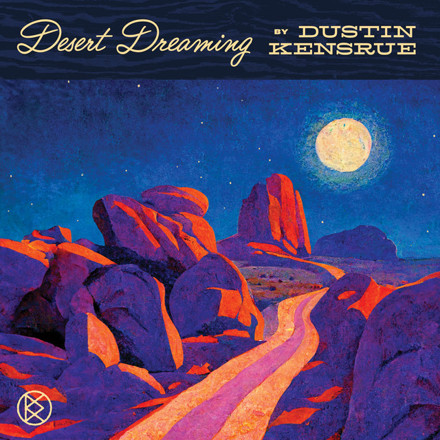
I recently spent some time listening to Dustin Kensrue’s new album, Desert Dreaming. I like his music, and the new album is good. The first song I heard, though, reminded me of the rumors that he has walked away from orthodox Christianity:

When I left town, I was swept up
With the visions of a man from Galilee
Along the way, I lost my bearings
I got swallowed up by sins of certainty

The heart of sedona

The words to this song triggered a desire to research the truth. Kensure was an impactful Christian musician who wrote the worship album of the year not to many years ago. I wondered, therefore, why he walked away (if indeed he did).


I learned that Kensrue was a former worship leader for Mars Hill, the failed church that rose to the heights of evangelical influence with many campuses, only to collapse with the failings of its erstwhile leader, Mark Driscoll.

Listening to the song, Heart of Sedona, off Kensrue’s new album, Desert Dreaming, gave me pause. The words seem to confirm the rumor, and the story seems all too familiar lately.

His music is as good as ever, but it comes with the melancholy of what used to be. Or maybe it never was. It’s hard to know how to process the deconstruction of someone else’s faith.

Given the back story (involvement in a failed church movement), I suspected his “deconstruction” (and many other artists who seem to have followed a similar path) may be symptomatic of some malady that has infected Evangelical Christianity.

My entre into Kensrue’s story begin with the article, It’s Not Enough: Dustin Kensrue’s Turning Away, which is where I learned that Kensrue was intimately involved in the toxic environment of the Mars Hill church movement led by Driscoll, a controversial and polarizing personality.

I had heard of the rise and fall of Mark Driscoll and the Mars Hill Church, but I did not jump on the curiosity bandwagon when people associated with Christianity Today produced the podcast, The Rise and Fall of Mars Hill. I only heard about it, and I had listened to a discussion of the podcast on another podcast. Therefore, I finally felt a need to hear it firsthand to gain some perspective.

The podcast describes the talent and bravado of Mark Driscoll, who was also polarizing and toxic and seemingly proud of it. Driscoll was staunchly reformed in his theology with a cultish personality and a flair for the dramatic. He attracted people on the edges of faith in the notoriously countercultural Seattle area. I summarized some of my thoughts on what I learned in Keeping It Real for the Church: Talent in Tension with Character)

I have also gone back, now, through the tweets highlighted in the article I noted above, and I have poured over Dustin Kensrue’s Twitter (X) feed to gain further insight. These things give me additional food for thought in considering the “deconstruction” of Dustin Kensrue as it relates to the American Evangelical Church.

Though I have spent considerable time researching these things, my thoughts remain preliminary and exploratory. I am not certain that I have gained sufficient perspective to be clear or certain of any conclusions, but all this seems to confirm my sense that the story is symptomatic of a problem with the American Evangelical Church.

In fact, the original article I found, itself, seems to be symptomatic of issues in the American Evangelical Church. These issues may also be reflected in current American culture, affected as it is by social media. I apologize for the length of this article, but I am afraid I do not do much more than scratch the surface here.

Continue reading “Diving for Pearls in the stories of Dustin Kensrue and Mark Driscoll”

The Limitations of Science and Logic are Human


A theme I return to time and again is the finiteness of human beings and the limitations we face as finite beings. I wrote on this subject the year I started blogging, as you can see in the article I am reblogging here:

It’s not that “science” (the methodology and concept of it) or logic are necessarily flawed. It’s that human capability is limited. In science, we don’t know what we don’t know, so all we can is do is the best we can with what we know.

In logic, we must start with premises we can’t prove. We can test those premises, and we can construct syllogisms that hold together, but those syllogisms are only as helpful as the premises that lead to a logical conclusion. If the initial premise is wrong, our logical construct is useless.

The Bible, Christ and Culture: Biblical Critical Theory as a Framework for Critiquing Culture

Letting the Bible frame and critique culture requires us to be aware of our cultural milieu


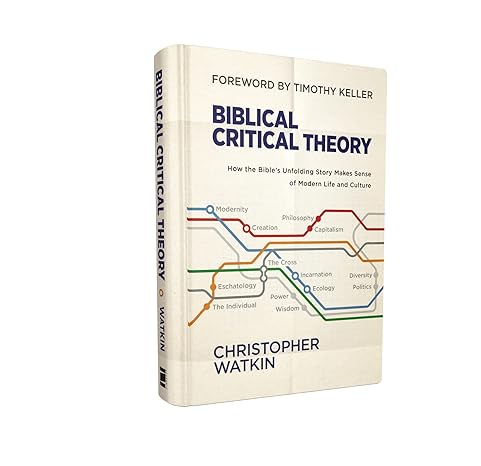
I am listening to a discussion of a new book by Christopher Watkin, Biblical Critical Theory: How the Bible’s Unfolding Story Makes Sense of Modern Life and Culture, dealing with culture on the Truth over Tribe podcast. Watkin’s premise for the book is that we should use the Bible to frame our critique of culture, but the reality often is that we frame and interpret the Bible through our cultural lens.

As an aside, I love the title of the book. “Critical theory” is part of our modern cultural vocabulary and milieu. Though many Christians recoil from the invocation of that term, it is the language of our times Watkins uses it to capture the attention, and he uses it as a springboard to take us back to the Bible, which I think is brilliant.


The discussion on the podcast focuses on the definition and meaning of culture, starting with the reality that culture pervades most of our lives and our thinking. Watkin notes that we see God working in and through cultural environments in the Bible, yet the thrust and message of Scripture is multicultural (and countercultural).

What appears to be exclusive is revealed to be inclusive. God works in the cultural milieu, but the message is not bound by it nor bound to it.

A multicultural theme is baked right into the fabric of Scripture, including the influence of three different languages that make up the biblical writings. This theme is borne out by the glimpse God gave John of the end of the Story. If we lift our eyes to see the horizon for all Christians off in the distance, this is what we see:

I looked, and there before me was a great multitude that no one could count, from every nation, tribe, people and language, standing before the throne and before the Lamb. They were wearing white robes and were holding palm branches in their hands.

Revelations 7:9

Our destination, the mansion with many rooms that Jesus spoke about, is filled with multicultural people worshipping God from every nation tribe and tongue crying out in unison, “Holy, Holy, Holy is the lamb!” From this we see that God does not negate culture or ethnic differences. (He confused our languages and scattered us after all.)

But, we also have to recognize that the trajectory of Scripture and God’s plan revealed in Scripture brings us to unity in Christ. Jesus broke down the walls of division (Eph. 2:14), and the thing that unites us is Jesus.

Watkin cautions that Scripture is not entombed in culture, but it takes root in culture. It spreads out to all cultures: Jesus told the disciples to spread the message in Jerusalem, Judea, Samaria, and to the ends of the earth. Thus, the Gospel speaks to all cultures, calls people out of all cultures, and provides the promise of redemption to all cultures.

Indeed, Christianity began as a near, middle eastern movement which spread into the Roman Empire: north, south, east, and west. It spread into the culture of northern Africa and southern, central, and northern Europe, It spread to Asia minor and further east. This spread happened extremely quickly, within a generation of the death of Jesus, and it continues to spread today. The center of Christian growth today is predominantly in the southern Hemisphere.

The roots of Christianity go back to Abram, whose family heritage and land was rooted in the area known today as Iraq. Abram traveled west to Asia Minor, and then south into the Levant at God’s calling and this promise:

“I will make you into a great nation,
    and I will bless you;
I will make your name great,
    and you will be a blessing.
I will bless those who bless you,
    and whoever curses you I will curse;
and all peoples on earth
    will be blessed through you
.”

Genesis 12:2-3

The emphasis added is mine. From the beginning, God called Abraham to be a blessing to all peoples on the earth! Paul picked up on this theme when he said:

Understand, then, that those who have faith are children of Abraham. Scripture foresaw that God would justify the Gentiles by faith, and announced the gospel in advance to Abraham: “All nations will be blessed through you.” So those who rely on faith are blessed along with Abraham, the man of faith.

Galatians 3:7-9

and

 So in Christ Jesus you are all children of God through faith, for all of you who were baptized into Christ have clothed yourselves with Christ . There is neither Jew nor Gentile, neither slave nor free, nor is there male and female, for you are all one in Christ Jesus. If you belong to Christ, then you are Abraham’s seed, and heirs according to the promise.

galatians 3:26-29

Jesus is the seed (descendant) of Abraham through whom this promise is spread to all peoples of the earth. The center of Christianity began in the Middle East, but it quickly found cultural centers in northern Africa, Asia Minor, and southern and eastern Europe. For much of the history of the church, Europe became the center of western Christianity, but Christianity flourished in in all parts of the world.

Christianity and its roots grew up embedded in culture. Christianity was born at the crossroads of culture where east, west, north, and south met with overlays of Hebrew, Babylonian, Persian, Greek, Roman, and Egyptian influences (to identify the major ones). Thus, culture is part of the story

Watkin cautions, though, that people who are immersed in their own culture don’t realize how influenced they are by it. Like a fish in water compared to a bird in the air, we don’t recognize how different our cultural environment is compared to people in other cultural environments.


This is the challenge for us today, just as it was a challenge for all generations, in all times, and in all places before us. We need to be absorbed in Scripture and allow the Holy Spirit to critique and frame our culture through Scripture, and not the other way around.

Continue reading “The Bible, Christ and Culture: Biblical Critical Theory as a Framework for Critiquing Culture”

The Problem of the Intelligibility of the Universe

The Milky Way

The most incomprehensible thing about the universe is that it is comprehensible.” Albert Einstein

I am intrigued by the stories of peoples’ journeys, especially of their thought journeys. Some are more intriguing than others. The story of Pat Flynn fits squarely into the more intriguing category. (See the Side B Stories Podcast – Episode 78 – Science, Philosophy, and Reality – Pat Flynn’s Story)

Patrick Flynn has an educational background in philosophy. He embraced naturalism at an early age, but he encountered philosophical problems with naturalism when he read people like HL Menken and Frederick Nietzsche. These problems led him to seek answers that might provide a more coherent view of reality.

I am not going to try to summarize his whole story. You can listen to him describe his thought journey at the link in the first paragraph. I just want to focus on one aspect of his journey from atheism to theism.

Flynn’s journey took him from atheism to theism through the medium of philosophy. This process was intellectual for him, and not experiential. He became convinced of theism, first, before he even told his spouse, because he knew she was not particularly fond of religion.

He didn’t dive into Christianity after he became convinced of theism. He explored Eastern religions, first, perhaps because he had a good friend who was Indian. When the Eastern religions didn’t solve the philosophical problems posed by naturalism, he reluctantly began to explore Christianity.

One of the big issues Flynn had with atheism was the lack of explanation for the fact the universe is intelligible. Digging further, Patrick Flynn found that the fundamental, core commitments of science fit much better with theism than with atheism.

Continue reading “The Problem of the Intelligibility of the Universe”