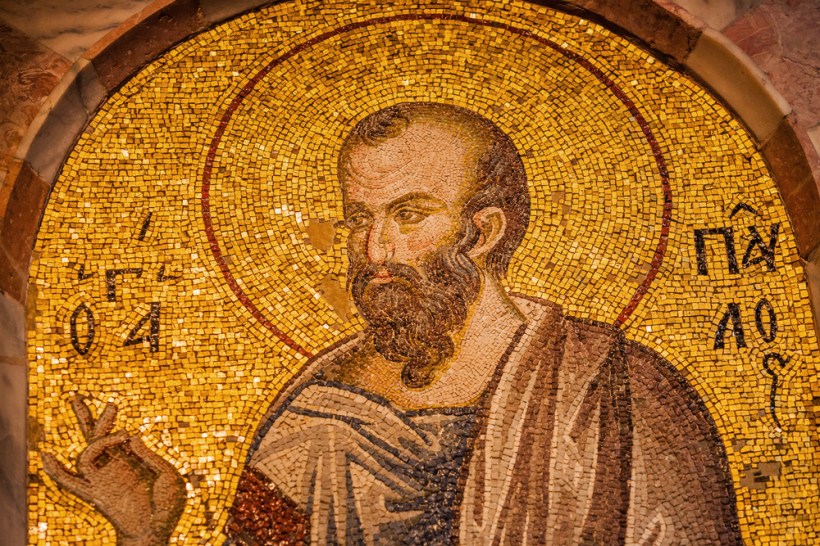
People today don’t give Paul (or Jesus or the Bible) enough credit for “forward thinking”. We like to think that modern man has pulled himself (and herself) up by the bootstraps, a notion that emerges from our modern view of ourselves, of beings that have made ourselves after a long, doggedly determined climb out of the primordial slime.
Paul is often called patriarchal and even misogynist. He is blamed for the “backward thinking” that prevails in some areas of the church. Bronze age ideas and norms, they say, enslave the church in primitive thinking that quashes the rights of more sophisticated modern people.
There are dozens of examples in Scripture that this isn’t true. When we read the Scripture through a modern lens and don’t understand or appreciate the context of the time when it was written, we fail to appreciate the radical nature of Scripture.
I have written on these things many times in the past, but my attention is drawn to one example today. In his letter to the Galatians, Paul wrote:
“[I]n Christ Jesus you are all sons of God, through faith. For as many of you as were baptized into Christ have put on Christ. There is neither Jew nor Greek, there is neither slave nor free, there is no male and female, for you are all one in Christ Jesus. And if you are Christ’s, then you are Abraham’s offspring, heirs according to promise.
“I mean that the heir, as long as he is a child, is no different from a slave, though he is the owner of everything, but he is under guardians and managers until the date set by his father. In the same way we also, when we were children, were enslaved to the elementary principles of the world. But when the fullness of time had come, God sent forth his Son, born of woman, born under the law, to redeem those who were under the law, so that we might receive adoption as sons And because you are sons, God has sent the Spirit of his Son into our hearts, crying, ‘Abba! Father!’ So you are no longer a slave, but a son, and if a son, then an heir through God.” (Galatians 3:26-4:7)
Let’s unpack this a bit, and I think you will see what I am talking about. First, we need to consider the context of the time in which this letter was written. Then we need to look closely at what Paul is saying.
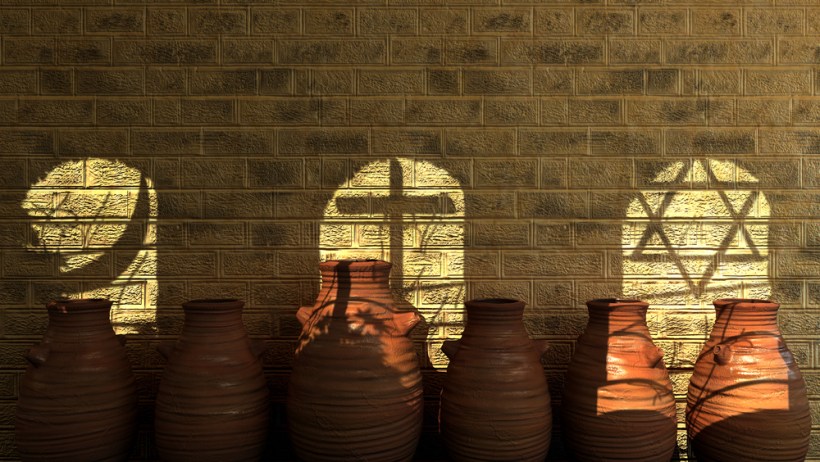
Os Guinness talks about differences between Christianity and other religions in an interview with Justin Brierley a few years ago. He made a statement that Christianity is the only “traveling religion”.
He observed that Hinduism began in India and remains primarily in India. Buddhism began in India and remains primarily in India and Eastern Asia. Islam began in the Middle East and remains primarily in the Middle East. Christianity, however, began in the Middle East. Then it moved to Europe; and then it moved to North America; and now Christianity is growing fastest in Africa and Latin America and Asia.
While I think Guinness overstates the case little bit, he got me thinking about the how the major world religions have spread. For instance, Islam, which rivals Christianity in numbers, grew very rapidly during the life and immediately after the death of Muhammad. It spread throughout the centuries into Europe and down into Africa and more recently across Southern Asia.
Islam rivals Christianity in its “travel” around the world, but the spread of Islam happened very differently than the spread of Christianity. This is the significant fact, in my opinion – not so much that Christianity has traveled through all the world like no other religion. (Though it has.)
I recently read a blog post by Brett Lunn, on his blog, Capturing Christianity, titled Why Everyone Should Believe that the Gospels are Reliable. If it were that easy, everyone would believe the Gospels are reliable. But, he makes some good points, and one in particular that sparked my interest.
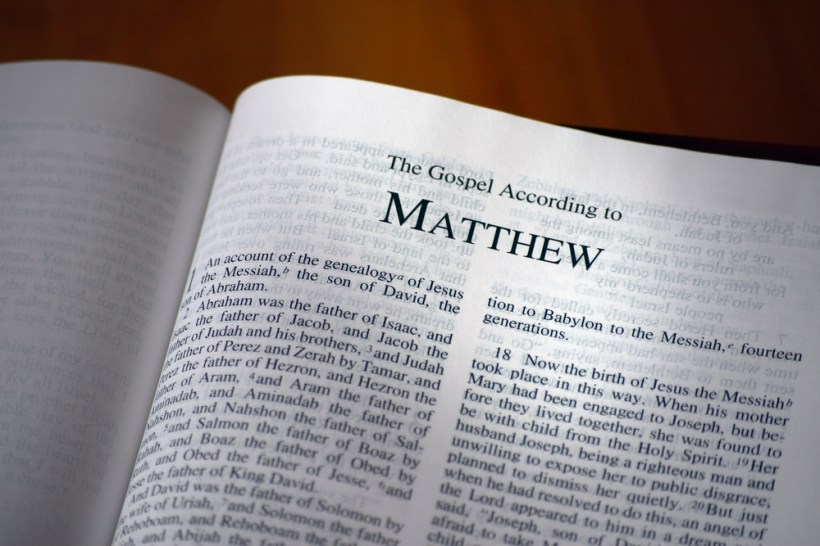
The Gospels, of course, refer to the books we know as the Gospels according to Matthew, Mark, Luke and John. The earliest copies of those writings don’t actually contain a reference to authorship, which has occasioned a great deal of modern conjecture about who really wrote them. I say “modern conjecture” because the authorship wasn’t questioned for centuries.
In fact, the earliest charge from anyone raising a question about the authorship of the Gospels was advanced in the 4th Century by Faustus. Augustine, the great writer, thinker and theologian took on the skeptic, Faustus, with the response, “How do we know the authorship of the works of Plato, Aristotle, Cicero, Varro, and other similar writers but by the unbroken chain of evidence?”[1] With the Gospels, we have a history of acceptance that they are authentic writings of the men to whom they are ascribed all the way up to the 4th Century. That’s a pretty good chain of title.
Further, it’s not as if the writings didn’t actually identify the authors, as people suppose. They did identify the authors, but the identification was in the titles (not in the text), and they didn’t uniformly identify the authors in exactly the same format. Some said, “Gospel according to….”, and some simply said, “According to….” Much ado about nothing?
Another criticism is that the Gospels weren’t written by the most officious people. John, of course, was a close disciple of Jesus, and so was Matthew, but Matthew was kind of suspect. He was a tax collector, and tax collectors for the Roman government were persona non gratis in the Jewish outskirts of the Roman Empire. Couldn’t a disciple with better credentials have authored a Gospel?
Mark and Luke aren’t even disciples! Luke was a companion of Paul. He wasn’t even Jewish; he was a gentile! He wrote in the Greek style of the highly educated, using Greek expressions, instead of Hebrew ones. We know him chiefly through Paul’s letters: Luke the doctor (Col. 4:14) who was the last companion to remain with Paul before his death (2 Tim. 4:10-11) among other references.
And Mark? He was a companion of Peter. He was also a companion of Paul, being described as a missionary with Barnabas and Paul (John Mark) in whose house many gathered to pray. Paul also asks for Mark to come to him in the same letter in which he laments that Luke is the only person still with him. (2 Timothy 4:11) Peter referred to Mark as his son, which most scholars take to mean a term of honor and endearment. (1 Peter 5:13)
Mark also had a falling out with Paul at some point, however. (Acts 15:36-39) Luke was a Gentile. Matthew was a despised tax collector. Couldn’t even a fledgling religion come up with credible scribes of the central story?
Sure, if Christianity was nothing but a religion concocted by the imaginations of men. Frankly, why would anyone choose this cast of characters?
I think the answer is that no one would have chosen these guys, and the story wasn’t made up. These are the men who reported what they saw, what they heard and what they knew to be true from firsthand accounts. The truth is kind of like that. It isn’t neat and clean like a story someone made up. It is what it is.
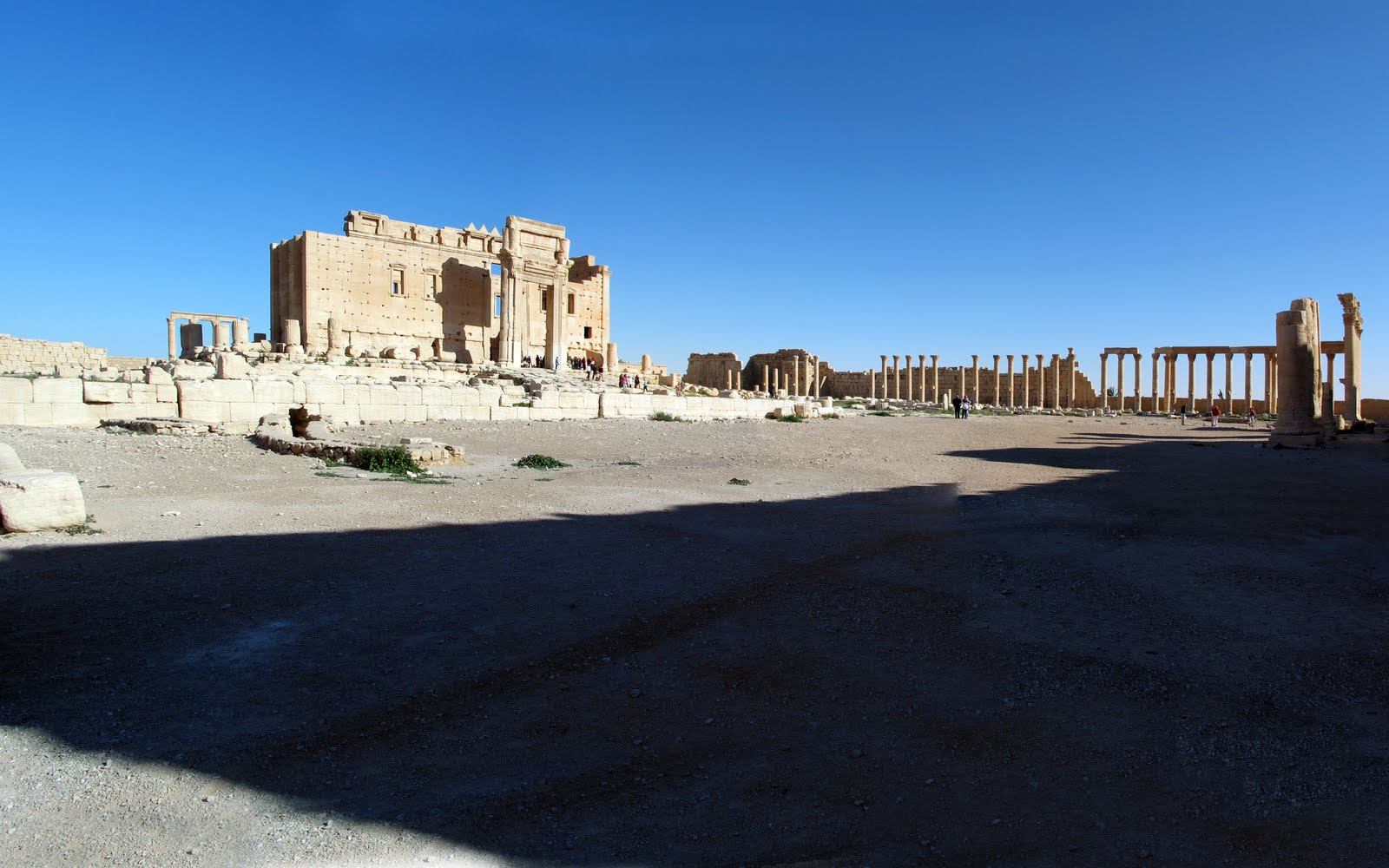
Sometimes things we read in the news hit close to home, even from halfway around the world in an ancient, foreign land. A friend from college has a personal connection to the ruins of the temple in the Palmyra Valley of Syria. He visited there and took the photos I have published in this blog with his permission. He describes the Valley, sitting about 125 miles north-east of Damascus, Syria, in the desert, as it appears above, “a welcome relief after weeks, months on the road” for the people traveling the Silk Road from the east.
The “peaceful place… filled with memories” was no longer peaceful and filled with pleasant memories when I began this piece. I started this blog article years ago, when ISIS was at it’s public height. I don’t know how things stand today. The news has moved on, leaving whatever ravages that continue and desolation that remains out of the pubic eye.
“‘Among the great cities of antiquity, Palmyra is comparable only to Petra in Jordan, Angkor Wat in Cambodia, and the Athenian Acropolis in Greece,’ argues GW Bowersock, professor emeritus of ancient history at the Institute for Advanced Study in Princeton.””(quoted in Isis’s Destruction Of Palmyra: ‘The Heart Has Been Ripped Out of the City’ by Stuart Jeffries in the Guardian Sept. 2, 2015)
In light of fond reminiscences of a peaceful time, relationships developed between disparate brothers and sisters who shared good will and the historic significance of this desert oasis along the ancient Silk Road, the utter sadness and ache of the loss of the ruins is deep and vacuous. And more so now that my part of world has largely forgotten the devastation that exploded in front of the world’s eyes just a few short years ago.
In the Atlantic, the headline read with finality, An Ancient Temple in Palmyra Is Destroyed. “Reports of the site’s destruction come just days after the Islamic State killed Khaled Asaad, an 82-year-old Syrian expert on Palmyra who refused to divulge the location of artifacts despised by the militant group [and coveted for the booty they would bring]. Asaad had run Palmyra’s antiquities department for 50 years.”
“The taking of the historic city of Palmyra by Islamic State represents ‘the fall of a civilisation’, according to Syria’s antiquities chief Maamoun Abdulkarim. Speaking to Reuters today, he said: ‘Human, civilized society has lost the battle against barbarism. I have lost all hope.’” (Mark Woods Christian Today Contributing Editor 21 May 2015)
Temple at Palmyra by Steve Murray
Barbaric, incomprehensible, brutal, evil, criminal, atrocity …. Words fall short. No regard for history, culture, art, life …. The ISIS militants did not even have regard for their own lives, and the wrought unspeakable destruction and the taking of precious life in the Venice of the Sands.
Christians, humanists, peaceful Muslims, people of all stripes condemn what ISIS has done. The destruction of the ancient ruin of Palmyra is a war crime. The killing of Khaled al-Assad, the curator and protector of the Palmyran antiquities, is an atrocity of the worst order. He gave his life to protect those beautiful, ancient ruins…, but the ruins were destroyed with him. The various reactions to the crime and atrocity are understandable and expected.
The worldwide reports emphasized a common theme: the harsh clash of religious fundamentalism with civilized society is characterized by destruction and violence. “ISIS did not merely blast apart old stones—it attacked the very foundations of pluralistic society.” (The Rubble of Palmyraby Leon Wieseltier in the Atlantic Sept. 4, 2015). Indeed, ISIS displayed the worst of religion – the worst of humanity.
The destruction of ancient historical artifacts and buildings is nothing new, of course.
“In this iconoclasm – literally, the destruction of religious icons and other images or monuments for religious or political motives – Isis has its place in a rich history of destruction. Moses reduced the Golden Calf, made from Israelites’ golden earrings, to dust. Centuries later, the 93 carved relief sculptures of the life and miracles of the Virgin Mary in Ely Cathedral’s lady chapel, were hacked off during the Reformation. In between Moses and the mutilation of Ely was something called the Iconoclastic controversy in the history of the Eastern or Byzantine Christian church. Between AD 726 and 843, the then emperors of Byzantium believed icons were not only a reversion to the pagan idolatry of the ancient Greeks and Romans, but that their existence was the chief obstacle to the conversion to Christianity of Jews and Muslims, to both of whom the image was anathema. Iconoclasm, then, is by no means only an Islamic thing.” (quoted in Isis’s Destruction Of Palmyra: ‘The Heart Has Been Ripped Out of the City’ by Stuart Jeffries in the Guardian Sept. 2, 2015)
As we reel in sadness and righteous anger (something the irreligious seem to have learned well from the religious in recent times) over the destruction of such significant ancient preserves, there is a greater loss. Ross Burns, adjunct professor of ancient history at Macquarie University in Sydney, Australia, whose life is devoted to the preservation, study and appreciation of antiquity, appropriately recognized,
“[T]here are more important considerations in Syria in 2015 than the preservation of ancient monuments. ‘The physical damage to monuments has to be assessed against the scale of the human tragedy….’” (Id.)
The 1600’s was also a time of great corruption in the church itself. The church was the largest employer in the land. It had great power, and it was corrupt. The vast majority of people, including clergy, were ignorant of Scripture. According to the experts on the Unbelievable podcast, many clergymen didn’t even know the 10 commandments. This was a very dark period in church history, the culmination of centuries of church/state alliance that twisted the Gospel to serve the power of kings and popes who lived like kings.
Tyndale was influenced by Martin Luther who also a rebel that opposed the church consensus and power structure of the day. Tyndale was influenced by John Wycliffe who a century before had translated the Bible into middle English, but the church opposed the “unauthorized” translation and rejected it. The church even declared Wycliffe a heretic after his death, and many of the Wycliffe Bibles were burned and not widely distributed.
Tyndale made it his life’s mission to translate the Bible into English for the common man. Though Wycliffe had already done that, the Bible was still virtually inaccessible to the vast majority of people, and even clergy were ignorant of it. He suffered exile for his efforts and was eventually arrested, jailed, convicted of heresy, executed by strangulation, and his body was burned at the stake.
We celebrate Tyndale now as a martyr for the faith who took up his cross and followed Christ even unto death, a leader of the reformation that led believers out of the corruption of the organized religion of his day.
He and other “rebels” paved the way for the Bible to be made available worldwide in every language spoken on earth. Tyndale now is the name of a major Christian publishing company. Luther is the namesake of a major church denomination. Wycliffe is the name of the organization that translates the Bible into the rarest languages of the farthest flung tribes of the world.
Just as Jesus opposed the Pharisees and Sadducees in the 1st Century, Tyndale opposed the popes and bishops in the 16th Century. Just as the Pharisees and Sadducees sought to stop Jesus and had him arrested, tried, convicted and executed for spreading the Gospel, the popes and bishops tried to stop Tyndale, had him arrested, tried, convicted and executed for translating the Bible including the words Jesus preached into English.
The main opposition to Jesus, and Tyndale, came from the religious leaders. Those religious leaders employed the power of the state to oppose the spread of the Gospel (in Jesus’s case) and the spread of the translation of the Bible into English (in Tyndale’s case).
When Pilate asked, “Shall I crucify [Jesus]?”, the chief priests said, “We have no king but Caesar!” (John 19:15) I think about these things in light of the current religious and cultural climate.
Tyndale was viewed as a rebel and, a renegade, a heretic. He opposed the status quo, including the status quo within the church. He was despised. He was opposed by the church. He could not even return to his homeland, England, for fear of his life, and he eventually lost his life to the church and state authorities of his day
Today, the church and state are no longer joined in power as in Tyndale’s day. Many modern Christians in the United States rue the loss of power and advantage, while modern secularists would like to negate completely all influence of religion on society. If Hilary Clinton had been elected, instead of Trump, most Christians feared an incremental loss of power and influence in the affairs of our nation. Christians have embraced Trump as the man to fight the tide of growing secularism and maintain Christianity in that position of power and influence.
But is that a good thing? We all know of the challenges, difficulties and even persecution of the church that result from state government that is opposed to the church, but history suggests that the confluence of state power with church governance leads to corruption of the church. Would we rather accept corruption in the church to avoid challenge, difficulty and persecution?
Listening to Tyndale’s story, makes me wonder, “What about the church today is like the church in Tyndale’s time?” What influence lingers or has crept in to modern Christianity that will cause future believers to look back and wonder at the corruption of the 21st Century church?
Who are the heretics of our time who will be hailed as heroes in future generations?

 Os Guinness talks about differences between Christianity and other religions in an interview with Justin Brierley a few years ago. He made a statement that Christianity is the only “traveling religion”.