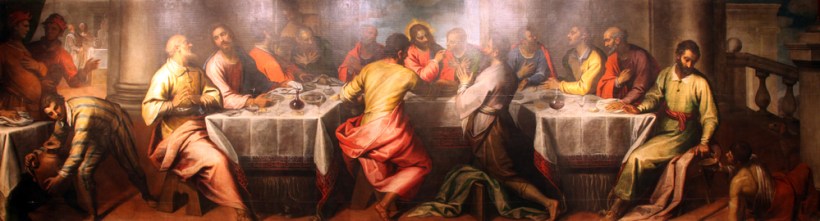
The Cup of the New Covenant Poured Out for Us


Imagine being a close friend of Jesus in the 1st Century, reclining at the table with him, eating a meal. It’s been a roller-coaster three years! Your whole world is buzzing about him. He is absolutely the talk of the town.

You are still not quite sure what all he is talking about, but you have come to believe in him. If he is not Messiah your ancestors have talked about for many generations, he is certainly a prophet. Maybe he really is the Messiah?!

Your people have held on to hope for hundreds of years of returning to former glory. This Roman rule is not the way it is supposed to be. God rescued your ancestors out of the land of Egypt, and He gave them the promised land. God drove out all the inhabitants of the promised land before them. He could do it again! Certainly, He would do it!

When Jesus rode into Jerusalem on that donkey, it seemed almost so real you could taste it. This really seems to be it! The people are behind him. Everyone is waiting to see what’s next. A new day for Israel seems to be right around the next corner!

But, you never know with Jesus. He is anything but predictable, and he says some really weird things sometimes. Hard things. You don’t completely understand what he is getting at when he talks about the Temple being destroyed and rebuilt in three days. What does that have to do with anything? All of those statements about being the Bread, and the Living Water and the Vine….

As you sit at the table, the talk is excited. It is Passover. Expectation in the air. This Passover is particularly poignant with all that has been going on, but Jesus is quiet.

Not that it’s unusual for Jesus to be quiet at times. They had gotten used to it. He often went off by himself, and he would often seem to drift into deep thought, especially lately.

Jesus had left all of you instructions about preparing the Passover meal. No one knew where Jesus was, but everything was left for you as he said it would be. He finally showed up and watched as you finished. You didn’t really notice his silence until he finally spoke as everyone was finally reclining at the table.

Jesus was obviously waiting for just this time. His voice carried a certain weight to it. More than usual. There was a firm, but calm, urgency to his words. The excited tones of the men around the table fell immediately quiet as Jesus opened his mouth to speak. Continue reading “The Cup of the New Covenant Poured Out for Us”

For She Loved Much


The story begins with a prominent community leader inviting Jesus to a party at his house.  (Luke 7:36) Jesus went, of course, because that’s what Jesus did. He didn’t refuse anyone who gave him an invitation.

Jesus was most often found on the streets, in parks or local cafes engaging in small groups with impromptu crowds, but he was equally comfortable in larger, more formal crowds at churches, colleges and public meeting halls with politicians, priests, academicians. Jesus wouldn’t refuse any request to meet and be with people wherever he went. So Jesus went to the party.

Jesus had risen quickly to popularity. No one really knew that much about him, where he came from or what his credentials were, but anyone who was anyone knew about him by now. Many people wanted to meet him. He would be a draw to Simon’s party.

Of course, people alternately loved him or hated him. Few people were neutral about Jesus. Some people hung on every word he spoke, while others questioned everything, wondering what his intentions were, skeptical of everything he said or did.

We don’t know much about the particular party to which Jesus was invited or the host of the party, other than this name, Simon, and the fact that he was a prominent man in the community. One of the few things we really know about the party is the scandal that took place there.

Simon was a well-known leader in his community. His home was open to friends and neighbors. He was generous with his prominence, wealth and lifestyle. He loved to entertain. Inviting Jesus would be a hip thing to do, given the grass roots popularity  of Jesus.

Inviting Jesus might would be viewed as scandalous by some of Simon’s peers, but he considered himself to be different than them. He fancied himself more open-minded than that. He wasn’t afraid of a little controversy.

But Simon wasn’t at all ready for what would happen next. While his home was an open invitation to friends, colleagues and neighbors, no one who was not of a particular type would dare, surely, to enter those halls dedicated to showing off the influence, prominence and wealth to which Simon had attained. People who had not attained, or at least aspired to attain, a certain stature certainly wouldn’t think of it…. or would they?

Continue reading “For She Loved Much”

The Observation of an Atheist Historian: What Makes Christianity Stand Out Among World Religions


The radical quality of the love of Jesus stands out over and above all other examples. I have written on this before (the Christian expression of the Golden Rule compared to other religions). Most other world religions express some concept of the Golden Rule, but not in the way that Jesus did.

Other world religions state the Golden Rule in a limited way, such as not doing things to others that you would not want them to do to you. It’s the idea of refraining from doing evil. Under that concept of the Golden Rule, we simply need to avoid doing evil to our neighbors. There is no compulsion to do good to them. Ignoring your neighbor would be perfectly acceptable on this less golden iteration of the principal.

Most major world religions do not express the Golden Rule positively, as Jesus did: do unto others what you would have them do unto you. In this statement of the principal, doing unto others is an affirmative duty. Simply refraining from doing them evil is not the concept of the Golden Rule expressed by Jesus.

Jesus made this clear in the parable of the Good Samaritan. The parable begins with a man who was robbed and left injured on the road. A priest and Levite (the priestly cast of Judaism) walked by the man on the other side of the road, ignoring him, while a Samaritan (an outcast to Jews) crossed the road to tend to the injured man. The good Samaritan was the example of the person who demonstrated love for a “neighbor” because he didn’t just ignore the injured man lying in the road.  The idea of the Golden Rule that Jesus expressed includes an affirmative duty to do good.

To be fair, some religions come close to an affirmative expression of the Golden Rule, which I affirm in the previous blog piece, but there is one additional expression of the Golden Rule that stands alone: that is the concept of loving even our enemies and doing good to those who intend evil toward us.

I think of these things as I pause from listening to Douglas Murray in a discussion with Esther Riley on the Unbelievable? podcast with Justin Brierley, the host. (See Douglas Murray and Esther O’Reilly – Christian Atheism and the search for identity. The video is embedded below.)

Douglas Murray, an atheist and openly gay man, makes the observation that most Christian tenets can be found in other cultures, save one: that is the principal that of loving and forgiving even our enemies. Loving and forgiving our enemies is the ultimate statement of the Golden Rule.

Even when we have enemies who intend to do us harm, and even when they actually do us harm, Jesus says, “Forgive them.” The conversation got into some recent examples of that expression of love and forgiveness that I will explore.

Continue reading “The Observation of an Atheist Historian: What Makes Christianity Stand Out Among World Religions”

Opening the Door to Forgiveness

The part of us that opens the door to forgive others opens the door to forgiveness.


I recently wrote about how our wounds provide a model for how we relate to God and understand Him, the hurts we receive from others. That post was inspired by Tim Keller who said, “The way we distribute mercy says a lot about how we relate to God.” Because God forgives us as we forgive others (Luke 11:4), our forgiveness is tied into how we see God, understand Him and relate to Him.

The two keys are 1) how we understand God’s love and 2) how we understand our own sinfulness. Both of these perspectives are measured best by the cross, by the example of God shedding all of His power and privilege to become human, and being found in human form, submitting Himself to His own plan by sacrificing Himself on the cross for our sake. (Phil. 2) We can understand our own sinfulness in relation to the cost of redemption – the life of God’s son (God in the flesh); and we can measure God’s love by the same standard.

God loved us to much that He gave His life for us. By the same token, the extreme cost of the life of Jesus is the measure of the depth of our sin. We have been forgiven much!

Our understanding of the greatness of God’s love for us, and the great depth of our sin, helps us in understanding why we need to forgive others. If God loved us so much, we are free to love – and compelled to love – others by the same measure. In more mundane terms, if our sin was so great that Christ had to die for us to redeem us, we can certainly forgive the lesser sins others have committed against us.

In fact, to bring this home, we can only be forgiven to the extent (by the measure which) we forgive others. Our forgiveness and our forgiveness toward others is inextricably linked. Perhaps, this is because Jesus and the Father (and the Spirit) are one, and Jesus calls us to be one with them (Him). (John 17:21) We can’t be one with God if we harbor unforgiveness toward others!

In some sense, then, forgiveness is formulaic. Jesus has stated for us a kind of “law of forgiveness”. Not much different, really, then a law of physics, He is telling us, “This is how it works.”

How do we, then, go from intellectual ascent and academic understanding to real life? I like the way NT Wright puts it when he says that the bit (part) of us that opens the door to forgive others opens the door to forgiveness for ourselves.

Continue reading “Opening the Door to Forgiveness”

How Our Wounds Help Us Understand God

How we deal with our wounds is a model for how we relate to God.


In the prayer Jesus taught his disciples, he taught them to pray, “Forgive our sins as we forgive those who sin against us.” (Luke 11:4) Jesus illuminated that prayer with the parable of the unforgiving servant (Matthew 18:21-35), after Peter asked him how often we must forgive those who sin against us. In the parable, the master forgave the great debt the servant owed him, but the servant demanded payment of the small debt someone else owed him. At the end of the parable, the master says to the unforgiving servant, “Should not you have had mercy on your fellow servant, as I had mercy on you?”

I have been listening to Tim Keller a lot lately. Keller says, “How we deal with our wounds is a model for how we relate to God.” He adds that “’the mercy rule’ demonstrates that God distributes His forgiveness through people. He forgives us as we forgive others.”

It isn’t that we mete out forgiveness to others so much that God metes out forgiveness to us based on how we deal with our wounds from other people. God, apparently, has built into the fabric of His universe the principle that we are forgiven to the extent we forgive. It’s like a law of physics in the moral and spiritual world.

In addition, Keller says, “The way we distribute mercy says a lot about how we relate to God.” When Peter asked how many times must we forgive?” He offered what he undoubtedly thought was a generous amount: Seven times. You have undoubtedly heard the statement: Fool me once, shame on you; fool me twice, shame on me. This sentiment is not a new one. Sometimes we say, “three strikes, and you’re out!” Peter upped the ante generously to seven times, probably thinking that surely seven times is good enough.

But Jesus said, “No, seventy times seven!” We should forgive people exponentially more than we think! In fact, the real point of what Jesus was saying is that we shouldn’t keep tabs. We should always forgive… if we want to be forgiven.

Ultimately, though, we can’t understand this unless we begin to understand God.

Continue reading “How Our Wounds Help Us Understand God”