I did not decide to vote until I approached the turn off to head to my home from my office. I wasn’t excited about voting this time, and I put off the decision to vote until the last second. A sense of obligation convinced me to make the short detour to my local polling place.
Even so, I punted on my vote for a president. I couldn’t pull the switch for red or blue. I just didn’t have it in me.
I know I am not alone in the way I felt this election season. A Relevant Magazine article published October 8, 2024, reported on survey results indicating that 41 million Christians did not plan to vote in this election. They are my tribe, and I was one of those 41 million.
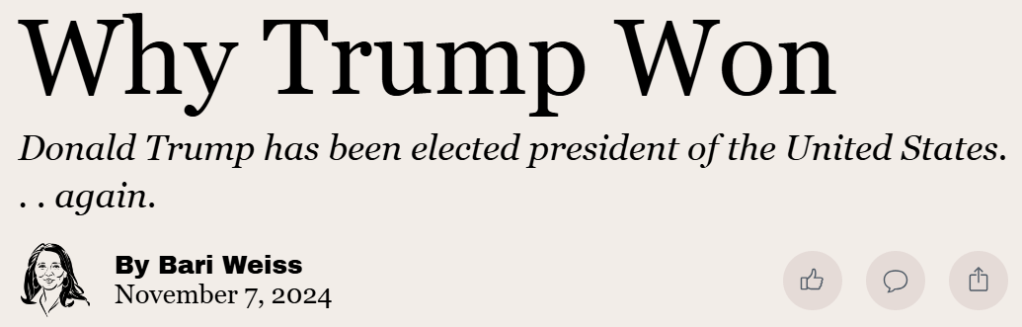
A dialogue with a long time friend (who probably doesn’t see the world as I do) about why the election results turned out as they did inspired me to do some post-mortem review of the election. I chose a trusted source for that analysis: Bari Weiss, a former NY Times reporter who has established her own news outlet, the Free Press.
I spent some time today listening to the latest podcast episode on Honestly, with Bari Weiss, Why Trump Won. Bari Weiss is lesbian and liberal. Her panel of experts included a transgender woman, Brianna Wu, and her conservative representative was Batya Ungar-Sargon. Senior Editor of the Free Press, David Svadnik rounded out the panel.
I like to say, “Truth is truth”, and I appreciate people who are able to put aside their agendas and biases and speak to truth. We all have them (agendas and biases), but there is something highly valuable about the effort to cut through those personal values that motivate us and be honest about the way things really are.
Bari Weiss started the discussion with statistics from CNN exit polls that show Trump won about 13% of black voters in 2024 (up from 8% in 2020), and Trump won 45% of Latino voters (up from 32% in 2020.) She noted that Trump improved on his 2020 votes almost everywhere.
This seems to be at the center of the story of this election. Weiss says, “It’s indicative of a massive countrywide political realignment.” It was a “Republican landslide”, and the question we should be asking is, “Why?”
I am not sure how to write about the things that I believe God has laid on my heart today. I will start, though, by explaining the combination of things that give rise to my thoughts, and I will try my best, relying on the leading of the Holy Spirit and whatever wisdom I have, in humility and full reliance upon the grace of God, to address these things that weigh on my heart today
My thoughts rise out of a combination of my daily scripture reading and regular podcast listening. I have been reading through the New Testament on a year long plan created by the Bible Project. I am in Romans 14 today. These are some excerpts from Romans 14 that stand out:
“Now receive the one who is weak in the faith, and do not have disputes over differing opinions…. “Who are you to pass judgment on another’s servant? [speaking of followers of Christ as servants of God]…. “But you who eat vegetables only – why do you judge your brother or sister? And you who eat everything – why do you despise your brother or sister? For we will all stand before the judgment seat of God…. So then, let us pursue what makes for peace and for building up one another.”
Romans 14:1,4, 10, 19
I have not reproduced the entire Chapter here to be efficient with space, but I encourage anyone who wants to dig in deeper to read all of Romans 14. I have added emphasis where the text has spoken to me.
Paul’s example of eating meat vs. not eating meat is one that doesn’t divide people in churches today, though it might divide vegans and vegetarians from “meat eaters” in our contemporary secular society. (What we eat and our religiosity about it has divided people, I guess, for 2000 years.)
“One person believes he may eat anything, while the weak person eats only vegetables. Let not the one who eats despise the one who abstains, and let not the one who abstains pass judgment on the one who eats, for God has welcomed him.”
Romans 14:2-3
Frankly, people tend to become divided over just about anything and everything. Paul uses the example of eating and of sacred days to illustrate his point about not despising and not judging each other when we have disagreements:
“One person esteems one day as better than another, while another esteems all days alike. Each one should be fully convinced in his own mind. The one who observes the day, observes it in honor of the Lord. The one who eats, eats in honor of the Lord, since he gives thanks to God, while the one who abstains, abstains in honor of the Lord and gives thanks to God.”
Romans 14:5-6
Paul says that each of us must give account to God for our own lives. Each of us must follow our own consciences that guide us with the help of the Holy Spirit, and we need to allow space with an attitude of grace for other people to work out their own salvation with fear and trembling in the same way.
Of course, we also have the Holy Spirit to guide us. How our own consciences and the Holy Spirit guide us is a bit of a mystery, though. They are not the same things. We have the Holy Spirit, but we also have our individual consciences. Paul references them both in his writings, and each plays a part in the way we understand and follow Christ in our lives.
The Holy Spirit, of course, is infallible, but our consciences are not.
And, that is the rub. We have this treasure in earthen vessels. We are finite beings, and our individual (and collective) perspectives are limited by the age we live in, the country and culture we are born in, our own abilities, experiences, and myriad factors that influence and shape us. How we internalize and process what the Holy Spirit “says” to us is going to vary from person to person and from people to people.
I recently heard someone say that we each approach Scripture from where we sit. People sit in difference “places” in respect to the Gospel at different times in history, in different cultures, and in different areas of the world. Experts in missions warn of the danger of unwittingly smuggling in our own human perspectives when we take the Gospel to different people groups.
The differences in perspective are not just factors for disparate people groups in far flung regions of the world. People in the seemingly homogenous sphere of the United States of America in the 21st Century are not so homogenous – even among Bible-believing, Jesus-loving people.
I’ll give you an example that stopped me in my tracks in 2016. Polls report that about 80% of people who identify as evangelical (which means white in political polls) voted for Trump, while 80% of blacks who attend church on a regular basis and are theologically conservative did not vote for Trump.
These are people who would largely agree with each other on traditional Christian values, but they “sit” in different places in respect to how they live out following Jesus politically. For white evangelicals, abortion is the political benchmark. For churchgoing blacks, racial and minority issues are paramount.
I should not have to say that God grieves all injustice and all sin. It’s easy to label each other “white supremacists” or “woke progressives” and miss the obvious fact that we all claim Jesus as our Lord and Savior. We all have the Holy Spirit to guide us, and we do the best we can from where we sit to follow the Spirit and our consciences.
Having listened to many black voices since 2016 (because I realized I was missing something), I learned that most black Christians believe that abortion is wrong. They believe in traditional family values, and they are at odds with the Democratic party on those issues. I also learned that a large segment of those “white evangelical’s” in political polls don’t even attend church more than once or twice a year, if that.
Another less controversial example from my own life illustrates what Paul talks about in Romans 14. I grew up in a family of responsible social drinkers. Family gatherings included a “cocktail hour” before meals, but I never observed family members getting drunk.
During my rebellious youth, and before I became a believer, however, I was a reckless, irresponsible drinker. I drank often and to great excess. When I became a Christian, I didn’t touch alcohol for many years, and I was tempted to believe that no one else should either.
My views on this subject have been tempered by the wisdom that comes with age and experience and the gentle grace of the Holy Spirit. Paul would say I was weak in my faith, and I admit that I became judgmental over it because I projected my weakness onto everyone else.
Paul says in Romans 14 that people who are weak in their own faith become judgmental. The danger of people who have a strong faith and a secure conscience is to despise those who are weaker. Paul urges us to resist both tendencies.
But, let me get to my point. I am increasingly concerned with judgmental attitudes over issues on a par with eating, drinking, and sacred days are doing damage in the modern Church. Paul would say that we need to focus our attention on “pursu[ing] what makes for peace and for building up one another.” Unfortunately, we spend far too much energy judging each other and tearing each other down.
This is nothing new, of course. Paul wrote an entire letter to the Church in Corinth that he led off with this exhortation:
“I urge you, brothers and sisters, by the name of our Lord Jesus Christ, to agree together, to end your divisions, and to be united by the same mind and purpose.”
Paul famously says in Roman 1:20 that people everywhere are without excuse in their denial of God and suppression of the truth because God’s invisible attributes and His eternal power and divine nature have been clearly seen and are understood through the creation. This is one of the most often quoted verses in the first couple of Chapters of Roman.
I have often quoted Romans 1:20 as a defense of the faith to unbelievers, but Romans 2:1 catches my eye today. It begins with same phrase, “Therefore, you are without excuse….” Except this verse is clearly directed to an audience of Roman believers.
I wonder how I have missed the parallel nature of this statement to believers. Just as nonbelievers are without excuse in their unbelief, Paul says believers are without excuse in a different sense:
“Therefore you are without excuse, whoever you are, when you judge someone else. For on whatever grounds you judge another, you condemn yourself, because you who judge practice the same things.”
Romans 2:1
I have to admit my own tendency to focus on Romans 1 and Paul’s statements that the world is without excuse, because God made himself known, and people in their depraved minds chose not to honor God, embracing sin instead. I tend to focus on the list of sins, including men and women trading natural relations for unnatural ones.
It seems that the world focuses on those things as well. Christians and non Christians alike, and this list of sins has become become a dividing line in the ongoing battle of a “culture war” that wages in the United States.
While Romans 1:20 and the list of sins that follow it seems to have captured our attention, I wonder today why we seem to glossed over what Paul says in Romans 2:1?
The parallel nature of the two verses demands some attention. We dare not focus on one half of the equation to the exclusion of the other half of the equation.
Paul says in Romans 1:14 that he is a debtor to Greeks and barbarians and to the wise and the foolish because the Gospel has the power for salvation. (Rom. 1:16) The righteousness of God is revealed in the Gospel from faith to faith. (Rom. 1:17)
Then, Paul says that the wrath of God is revealed against the ungodliness and unrighteousness of people who suppress the truth (Rom. 1:19) because God has made it plain to them…. Therefore, they are without excuse.
Paul doesn’t stop there, however, and neither should we. In Romans 2, Paul starts out saying that people who judge others are also without excuse! On whatever grounds we judge others, we condemn ourselves because we practice the same things.
This is a sobering statement, and one which we ignore to our detriment and the detriment of the preaching of the gospel.
Again, it’s important to note that Paul is talking to the believers in Rome. He is not talking to heathens and barbarians and people who are given over to their carnal desires.
Five chapters later Paul talks personally about believers’ struggles with sin (Romans 7:15-20), doing the things we don’t want to do and not doing the things we know we should do. Paul is brutally honest about the fact that sin is still a problem for the believer. If anyone ways he is without sin, he makes God out to be a liar! (1 John 1:10)
Of course, believers should resist sin and learn to overcome it. This is a lifelong process, and we only overcome by the work of the Holy Spirit in us as we yield to His direction in our lives.
Yet, the holiest of people – Paul – admits to failing from time to time and giving into or returning to some form of sin. It doesn’t what what the sin is. The sin that causes us to stumble may be different for each one of us. That fact is that we sin, even though we don’t want to sin anymore.
The import of this for the believer, Paul is saying, is that we, should not adopt a judgmental attitude toward anyone. Not even to those who God has given over to their carnal desires. In judging others, we condemn ourselves, says Saint Paul. Paul also days,
“What business of mine is it to judge those outside the church? Are you not to judge those inside?”
1` Corinthians 5:122
The timing of this fresh revelation from my daily scripture reading is interesting. My social media feed has been full of judgmental tirades over the opening ceremonies at the Paris Olympics. I did not watch them, but I have certainly become aware of how everyone feels about those ceremonies, particularly Christians.
I know I am late to the discussion, but I have resisted the temptation to jump into the fray. It seems there is much to be offended about, yet the parallelism of Romans 1:20 and Romans 2:1 gives me pause. The judgmentalism of offended Christians screams for a response.
“You must not blaspheme God or curse the ruler of your people.”
Exodus 22:28 NET
These words from Moses were quoted by Paul when he was accused of insulting the high priest, Ananias. (See Acts 23:12-35) Paul had been hauled in front of the high priest when a mob of Asian Jews saw Paul in Jerusalem and sought to kill him for the things he was saying.
The Roman authorities had to employ an army of soldiers to save Paul from the mob, and the Romans gave him his day in court with the Jewish council and high priest. When Paul got a chance to speak, he said, “Brothers, I have lived my life with a clear conscience before God to this day.”
Paul barely spoke the words of introduction before the high priest ordered Paul to be struck on the mouth. Paul responded, saying, “God is going to strike you, you whitewashed wall! Do you sit there judging me according to law, and in violation of the law you order me to be struck?”
That is when the mob accused him of insulting “God’s high priest”, and Paul acknowledged, “You must not speak evil about a ruler of your people.”
Some commentators have suggested that Paul really didn’t know he was in front of the high priest. When he found out, he apologized immediately.
Other speculate that Paul’s remarks were sarcastic. Maybe this was a backhanded compliment, false deference, a subtle challenge to the high priest’s authority, suggesting that he was not really God’s ruler.
In the Greek, the word translated “know” can also mean appreciate. So perhaps, Paul was saying he didn’t appreciate the fact that he was in front of the high priest when he said what he said. Perhaps, his outburst was a momentary lapse, and his response was an apology.
Whatever the actual nuance of the situation was, I take Paul at his word that he respected the words of Moses about respecting authority and God’s sovereignty that allowed rulers to rule. Paul would later write:
“Let everyone be subject to the governing authorities, for there is no authority except that which God has established. The authorities that exist have been established by God.”
Romans 13:1
This is all by way of introduction to the things I want to write about today: the politics of the Church and of people who call themselves by the name of Christ. The disrespectful and polarizing political rhetoric of our times is understandable, given the tensions, emotions and level of disagreement in our country, but I maintain that the rhetoric of the Church and the people of God should be different.
This morning I watched two different videos about Donald Trump in the aftermath of the assassination attempt that came within millimeters of ending his life. Such an experience would sober the hardest of self-made men. Trump experienced the proof of the reality of personal mortality and the razor line between alternate fates.
The first video I might have ignored, but for the source. Capturing Christianity is a YouTuber who manages a thoughtful and circumspect apologetic presence online. He interviews good people and engages in civil conversation with people who disagree with him. I am attracted to people like that.
The video purported to be about a prophecy predicting the assassination attempt on Donald Trump. I don’t run after so-called prophecies. I am immediately skeptical when I see anyone claiming to be a prophet or to have some message from God.
With that said, I do not completely dismiss the idea that God could speak to or through anyone. If we believe anything in the Bible, we have to accept that God has spoken to and through people in the past. I also don’t see anything in the Bible that indicates God can no longer do that if He chooses to speak to or through people in the present.
I believe that skepticism is the right posture from which to consider any claimed prophecy, but I believe we also have to acknowledge and respect Paul’s admonition:
“Do not quench the Spirit. Do not despise prophecies, but test everything; hold fast to what is good.”
1 Thessalonians 5:19-22 (ESV)
The title of the video is, Viral Trump Prophet Now Admits THIS. I don’t like clickbait headlines either, though I admit to being persuaded to click on them sometimes. When I do, my Spidey senses are always tingling, expecting to be disappointed by another bait and switch or overblown story that has little to no factual support, is (likely) full of misinformation and disinformation, and (maybe) even outright misleading information. I have seen it too many times.
I respected the source, however, so I clicked.
The 15-minute video walks through a purported prophecy published by one, Brandon Biggs, four days before the assassination attempt. Mr. Biggs seems very sincere and forthright, but many people can be sincerely and forthrightly wrong. I will let you discern for yourself:
The gist of the Capturing Christianity take is that Biggs got some things wrong, though he accurately predicted the assassination attempt.
Of course, anyone could predict an assassination attempt. I have personally heard people speculate that such an attempt might be made, given the current, polarized and tensely emotional political climate.
The video commentary includes clips of what Mr. Biggs claims he saw in a vision and his interpretation of it. Some of what he saw and reported days before the incident are generally accurate to the events that occurred. In particular, he saw a bullet whiz past Trump’s right ear. He saw blood coming from Trump’s right ear, and he saw Trump down on his knees.
As the commentary points out, anyone might predict an assassination attempt, but the details of this vision are remarkably close to what actually happened. The bullet didn’t whiz past the left ear. It didn’t whiz past the top of the head, or chin, or cheeks, or neck or chest. It whizzed past Trump’s right ear.
Biggs added that Trump’s eardrum was ruptured and that he was “radically born again”. This is where the reality differs. Donald Trump’s eardrum was not ruptured. We also have no way of knowing what happened in Donald Trump’s mind or heart.
The central point of the commentary focused on Mr. Biggs’s “admission” that he added to what he saw in the vision. Biggs says that he didn’t see the bullet pierce Trump’s ear, but he saw the blood coming from the ear. He also mentioned seeing sonic waves behind the bullet, as in the movie, Matrix.
(I am reminded in this comment that prophets are people who perceive things in the context of their culture, experience, and understanding. Food for thought as we read the Old Testament prophets – not that Brandon Biggs should be compared to an Old Testament prophet.)
Briggs admits that he assumed the bullet somehow caused Trump’s eardrum to burst. He added that part, because it seemed like be a logical conclusion to him from what he believed he saw. What he saw, and what he assumed are two different things.
I believe Biggs was sincere and forthright, as I said above, and he was humble in explaining these things. He wasn’t defensive. He didn’t seem intent on defending himself. In fact, he was apologetic and called himself “immature” in not recognizing the difference between what he saw and what he assumed.
So much for these basic facts. They aren’t what I want to focus on here.
As I stated just three days ago, the original prophecy about Trump being President (in 2011) and the miraculous escape from death this week (even if we admit God’s hand in the prophecies and the saving of Trump’s life) do not mean that Trump is God’s man and that Christians should uncritically support him in whatever he says and does.
Paul said we need to “test everything” (1 Thess. 5), so I think that is exactly what we should do. Some people may say that I am vacillating, but I am not. I am keeping an open mind in taking a closer look.







 Navigating by Faith