Is the Darwinian Paradigm Exploding?

The Cambrian Explosion isn’t the only evidence of the sudden appearance of life forms.

Alright, I admit the title of this short article is a bit provocative, but I got your attention. I would actually say the Darwinian paradigm is going through something more like an evolution. The explosions are not in the paradigm, but in the facts that have been slowly uncovered in the fossil record since Darwin championed the evolutionary paradigm.

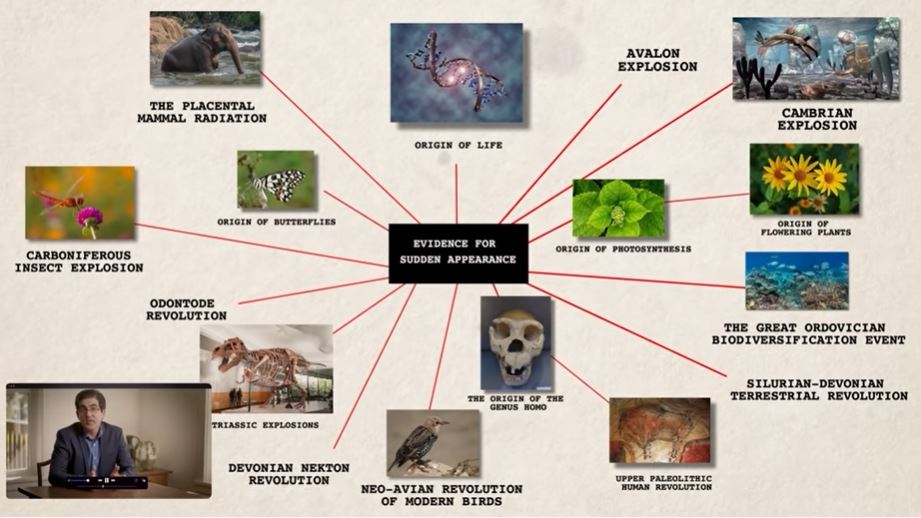
The short video at the end of this article produced by Science Uprising alludes to a number of “explosions” that elude a Darwinian explanation. Paleontologist Günter Bechly, summarizes,

“The phenomenon of sudden appearances in the fossil record is not just an exceptional case, but actually is a pattern that is found everywhere.”

The obvious example is the Cambrian explosion in which most of the phyla that exist today appeared in the blink of geological time, in a mere five to ten million year window. Charles Darwin, himself, acknowledged the problem the Cambrian Explosion posed for evolutionary theory, but he expressed confidence that future fossil discoveries would fill in the gaps and provide evidence of the precursors to the Cambrian life forms.

Since Darwin’s day, the gaps have not been filled by subsequent discoveries. Rather, the gaps have widened, as Stephen Meyer recounts in his book, Darwin’s Doubt. To make matters worse for the Darwinian paradigm, the Cambrian Explosion isn’t the only evidence of the sudden appearance of life forms. Other examples are numerous, including:

Technical scholarship is replete with the recognition of explosions (radiations or revolutions) of insects, fish, birds, dinosaurs, mammals, and the “big bang theory of human evolution” with no credible transitions in the fossil record. Many scientists, though continue to look for the precursors and clues to plug in the evolutionary gaps.

It seems that the evolutionary paradigm, which arose abruptly and transformed science overnight, is very slow in adapting to new information as it is uncovered. Not that we should be overly critical of the painstakingly slow progress. Science is slow and methodical with intention.

Explosions, though, such as the relatively sudden rise of Darwinian theory, may give way to equally sudden corrections, kind of like the mass extinction events that give way to new “radiations” or “revolutions'” in life forms. For more on the “time crunch” facing evolution, watch the short video that follows.

10 Fundamental Truths about Creation on which Christians Can Agree

Science and faith have been at odds with each other in the United States since before the Scopes Trial. Rather, should I say that people of science and people of faith have been at odds. I don’t believe there should be (or is) any real tension between science and faith.

Issues arise in the way people integrate or separate the two areas of discipline. Issues arise in the assumptions and presumptions people make about science and faith and how people interact (or don’t interact) with them.

The subject of creation among people of faith has also been fraught with much tension in the last 10-20 years (at least). People separate broadly into young earth and old earth camps. People in the old earth camp separate into groups informed by creationism, theistic evolution or a third way defined as “intelligent design”. The “gap theory” is another way to approach these issues – combining old universe and young earth principles.

Many people just don’t know where to fall on the spectrum of possibilities. Not many of us are so well-informed on the science and expert in our biblical exegesis that we can sort it out confidently for ourselves. We might wonder to God, “Is this going to be on the test?”

Of course, there is no test to get into heaven. Jesus took the test and passed it for all of us! The only test to get into heaven is what we do with Jesus. Do we embrace the gift of salvation that God offered us in Christ? Or do we reject it?

Still, the tension over how we should view creation, evolution, science and faith is real. It can cause quite a bit of consternation and doubt. Some people even wonder if people in different creation can fellowship with each other.

In a recent presentation that Krista Bontrager gave to the Chicago Chapter of Reasons to Believe with which I am affiliated, she reminded us of the call to unity in faith: “In essentials, unity. In non-essentials, liberty. In all things, charity.” I think she is right that we should be mindful of these things, not just i n this area.

More practical and helpful than that, though, she introduced to us ten (10) foundational points on the subject of creation on which all Christians should be able to agree. By focusing on the points of agreement, we can put our differences into better (more manageable) perspective.

Following are the ten (10) fundamental beliefs that unite Christians on the subject of creation:

Continue reading “10 Fundamental Truths about Creation on which Christians Can Agree”

What Was God Doing with Time and Eternity?

Why would God set up the universe so we would be cognizant of time?

The Christian understanding of God is that of “the” ultimate (maximal) Being, the architect and creator of everything (all that is seen and unseen as we say). God is the First and the Last. Reality does not exist outside or apart from God. Space/time (the universe we know) was created by God.

Christians also believe that God is transcendent (other) from the universe He created. When the writer of Hebrews says “the universe was formed at God’s command” and “what is seen is not made out of what is visible”, he is saying that God initiated the material universe from His immaterial, preexisting being by His command (will) out of nothing.

Nothing?

Yes, no material thing.

This is hard for us to grasp. It suggests that God is, in essence, immaterial – like unembodied mind or pure consciousness or something like that. It’s a mystery. We can’t go back prior to the beginning and “see” what reality or God was like, but we understand that the material universe had a beginning, which means that God is something other than material.

The beginning of the universe is confirmed by science. The universe began from the point of singularity that can be calculated with mathematical precision. Before that point, which we can trace to the millisecond, we can go no further. This is a boundary beyond which our exploration of the material universe cannot go.

God, therefore, exists “outside” (transcendent from) the space/time continuum that we know as the universe. He is somehow different and distinct from it. As best as we can determine, He is timeless and immaterial

This concept of God differentiates Christianity from all the Eastern religions and from all forms of pantheism and paganism. God is not part of His creation, though He can be (and is) intimate and present in all of it.

Though we may struggle to know “what God is like”, we can know something of God through the material reality He created in the same way we can know something of an artist from the art he creates. Knowing something about the artist from his works, though, isn’t the same as knowing the artist himself.

We are not left completely in the dark. Paul says that God made Himself evident in the world He created. (Rom. 1:20) The fact that something exists instead of nothing suggests a creator God. We can know something of God by the very fact that He the universe that is separate and “other” than Himself.

In a material world, we have to strain to find mutuality with “others”. It doesn’t come naturally. We are very conscious of our separateness – from each other and our creator – so much so that we have some difficulty connecting (emphasizing) with others, and we are tempted to believe we have no creator.

Not being of the same “substance” as God (timeless and immaterial – what Paul calls “heavenly” or “spiritual”), we know the material world much more intimately than the realm in which God exists (not that He doesn’t also exist in this material realm – though He transcends it). Yet, being made in God’s “image” suggests that we also have some ability to connect with His immateriality in some sense.

I say these things in preface to my thoughts today, which come from the Old Testament: the book of Genesis, and the book of Ecclesiastes. My thoughts begin with the beginning:

“And God said, ‘Let there be lights in the expanse of the heavens to separate the day from the night. And let them be for signs and for seasons, and for days and years….'”

Genesis 1:7

This isn’t the actual beginning, but very close to it. It is the first thing God does after creating “the heavens and the earth” (which is the Hebrew expression that means the universe). His first act of creation after forming the material universe was to call into existence “lights in the expanse of the heavens”, and He did it for a purpose.

(Not that these separate aspects of creation were necessarily a linear progression in the sense of completely separate “acts” of God. We might read these passages that way, but it isn’t the only way to read them.)

What was the purpose for which God established lights in the expanse of the heavens? To separate day from night and for signs, seasons, days and years – to establish measurements of time.

Interesting…. God wouldn’t need those things to measure time. What is time to God? He is timeless! Being all-knowing, God also (presumably) wouldn’t need material objects to be able measure time. So, why did God create ways to measure time?

It seems obvious that He created the tools for us to be able to measure time, and, therefore, God wants us to to be able to measure time.

We don’t really question our need to measure time. We just do it. We take time for granted, and our “need” to measure it.

But why?


It seems God set up the universe that way so that we would be cognizant of time, and we are, in fact, very cognizant of time. It seems to be there must be a purpose for it.

Continue reading “What Was God Doing with Time and Eternity?”

God’s Order for Living Beings, Human Beings and His Grand Design

“Then God said, ‘Let the earth bring forth living creatures after their kind….'”

I am starting a new Bible reading plan for the year, beginning in the beginning: in Genesis. Reading through the rich text of Genesis again I am seeing some things I hadn’t noticed before. Consider the following (with my emphasis added):

“Then God said, ‘Let the earth sprout vegetation, plants yielding seed, and fruit trees on the earth bearing fruit after their kind with seed in them‘; and it was so. The earth brought forth vegetation, plants yielding seed after their kind, and trees bearing fruit with seed in them, after their kind; and God saw that it was good.

Genesis 1:11-12

“God created the great sea monsters and every living creature that moves, with which the waters swarmed after their kind, and every winged bird after its kind; and God saw that it was good. And God blessed them, saying, “Be fruitful and multiply and fill the waters in the seas, and let birds multiply on the earth.’

Genesis 1:21-22

“Then God said, ‘Let the earth bring forth living creatures after their kind: cattle and creeping things and beasts of the earth after their kind‘; and it was so. God made the beasts of the earth after their kind, and the cattle after their kind, and everything that creeps on the ground after its kind; and God saw that it was good.”

Genesis 1:24-25

Then God said, ‘Let us make man in our image, after our likeness. And let them have dominion over the fish of the sea and over the birds of the heavens and over the livestock and over all the earth and over every creeping thing that creeps on the earth.’ So God created man in his own image, in the image of God he created him; male and female he created them. And God blessed them. And God said to them, ‘Be fruitful and multiply and fill the earth and subdue it….'”

I color-coded the various provisions that form the pattern that informs my thinking today. The provisions in each color correspond with the other provisions of the same color.

Now, let me see if I can put all my thoughts together in a coherent whole.

First of all, God ordered (in the sense of designed) all living beings to multiply after they own kind. We see this everywhere in nature: apple trees bear seeds that grow into new apple trees; asparagus plants bear seeds that grow into new asparagus plants; lions beget lions; polar bears beget polar bears; yellow polka dotted salamanders beget yellow polka dotted salamanders; bluefin tuna beget bluefin tuna; and purple finches beget purple finches.

This is the order of living things. Not only that, but we now know that something (call it evolution or something else) works powerfully within living beings to reproduce and even to adapt with changes over time.

Every living thing bears seed or otherwise reproduces more of its kind. Human beings included, but only humans are made in the image of God. (Hold that thought.)

God “blessed” the living things He created, saying, “Be fruitful and multiply” and fill the earth. (Gen. 1:22) He also blessed man who He made in His own image, and gave similar orders: “Be fruitful and multiply and fill the earth and subdue it….” (Gen. 1:28)

Note that God “ordered” (as in designed) the living things He created to reproduce after their kinds and to be fruitful and multiply, but God ordered (as in not only designed, but commanded) man to do the same. The difference is an important key to understanding what God is doing.

Unlike the other living creatures which are designed to reproduce and multiply after their kinds, humans have some agency in the matter. God designed them for the same purpose, but He also commanded them to do it because humans are created in the image of God who has agency – the ability to exercise will and to do (or not do) things.

Humans, of course, had no choice in their creation, but they do have choice in whether to “participate in God’s design” and how they would participate in God’s design. This choice was demonstrated in the one tree in the garden that was forbidden to them.

It was a real choice, and it had real consequences. It had to have real consequences or it wouldn’t have been a real choice. That choice was part of what it meant to be made in the image of God. Without the ability to choose, humans would have been just like the other living things God created. The ability to choose set humans apart.


As the story goes, humans ate the fruit of the one tree that was forbidden.

They exercised the choice God gave them. In eating the fruit of the tree of the knowledge of good and evil, humans opened up their world to all the ways they might choose to go against the order of creation.


Throughout Genesis 1, we read over and over again that what God did “was good” (Gen. 1:4, 10, 12, 18, 21, 25, 31). If what God designed was good, choosing to operate counter to that design would be evil (the opposite of good).

None of this is very revelatory so far, but I am getting there.

Genesis 1 reminds me of 1 Corinthians 15 where Paul says:

God gives [all living things] a body as he has chosen, and to each kind of seed its own body. For not all flesh is the same, but there is one kind for humans, another for animals, another for birds, and another for fish.

1 Corinthians 15:38-39

The order/design of life – of reality – is immutable. Life is ordered the way God created it, though humans have some choice (within limits) of whether to align with God’s design or to buck against it. Indeed, the story of the fall is the story of humans exercising that choice and of an adaptation that God built into His design to accomplish His ultimate plan.

Continue reading “God’s Order for Living Beings, Human Beings and His Grand Design”

Sy Garte: From Atheism to Agnosticism to Christianity

The assumptions of materialism he carried with him into the study of science were challenged by the science, itself


Sy Garte grew up in an atheist household. His ancestors for generations were atheists. His lateral relatives were atheists, and the people close to him in his life were atheists. He assumed atheism was normal. He didn’t question atheism or materialism as the basic assumptions of his life.

Sy Garte earned his Ph.D. in biochemistry and BS in Chemistry from the City University of New York. He has been a Professor of Public Health and Environmental Health Sciences at New York University, Rutgers University, and the University of Pittsburgh. He has written over 200 scientific publications in genetics, molecular epidemiology, cancer research and other areas, and he is the author of five books, and numerous articles published in Perspectives in Science and Christian Faith (PSCF) and God and Nature.  He is retired from a senior administrative position at the National Institute of Health. (See his biography at Biologos)

Wait a minute… articles on science and Christian faith?

He was an atheist and a scientist. So, what happened?

Well, Dr. Sy Garte has written a book about “what happened” – The Works of His Hands: A Scientist’s Journey from Atheism to Faith. I recommend the book, though this article more closely follows the interview embedded below, and it’s a pretty interesting story. I also added an interview of Sy Garte hosted by a once professed Christian turned hardcore atheist (the kind who isn’t content to allow other people to remain Christians) for an interesting exchange from two people who switched poles in their beliefs.

Continue reading “Sy Garte: From Atheism to Agnosticism to Christianity”