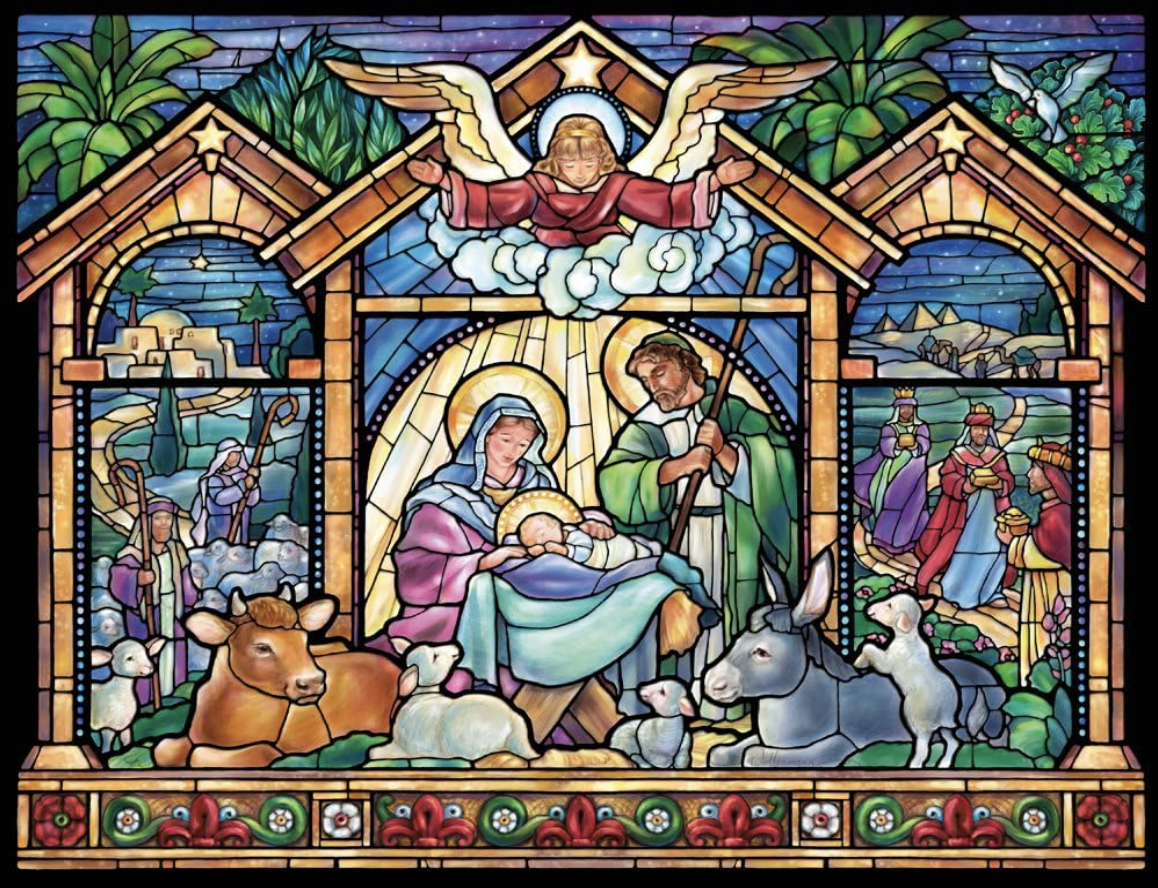
Of Shepherds, Angels, the Glory of the Lord, and the Christ Child Born in Humble Estate

At Christmas, we celebrate God coming to us and revealing Himself to us in human form to draw us to Him


“An angel of the Lord appeared to them, and the glory of the Lord shone around them, and they were terrified. But the angel said to them, ‘Do not be afraid. I bring you good news that will cause great joy for all the people. Today in the town of David a Savior has been born to you; he is the Messiah, the Lord.'”

Luke 2:9-11 NIV

This is a classic Christian text remembered at this time of year about the birth of the Christ child. The birth of Jesus in the town of David would have drawn the attention of 1st Century Hebrews who knew their Scripture. The significance of that understanding is preserved for us today by Luke, the traveling companion of Paul the Apostle.

Bethlehem was the birthplace and early home of King David, who is Israel’s most venerated and celebrated king. (1 Samuel 16:1, 1 Samuel 17:12). The prophet, Samuel, who presided over the coronation of David, foretold that God would establish from the lineage of David a kingdom that would last forever. (2 Samuel 7:12-16)

The prophet, Isaiah, lived about three centuries after David. Fourteen kings reigned between David and King Hezekiah, Isaiah’s contemporary. After a span of time longer than the United States of America has been a country, Isaiah repeated and expanded on what Samuel foretold:

“For to us a child is born,
    to us a son is given,
    and the government will be on his shoulders.
And he will be called
    Wonderful Counselor, Mighty God,
    Everlasting Father, Prince of Peace.
Of the greatness of his government and peace
    there will be no end.
He will reign on David’s throne
    and over his kingdom,
establishing and upholding it
    with justice and righteousness
    from that time on and forever.”

Isaiah 9:6-7

The prophet, Micah, a contemporary of Isaiah, He riffed on the same theme:

“But you, Bethlehem Ephrathah,
    though you are small among the clans of Judah,
out of you will come for me
    one who will be ruler over Israel,
whose origins are from of old,
    from ancient times.”

micah 5;2

According to the biblical chronology, these predictions of a coming kingdom and a king “whose origins are from ancient times” were declared 700-1000 years before the birth of Jesus. Those predictions were memorialized in the writings we identify with Samuel, Isaiah, Micah and others, and they were preserved for many centuries before Luke penned his own words tying them to the birth of Jesus of Nazareth, who was born in Bethlehem.

Though it was an ignoble birth by all accounts, we still remember back almost 2000 years now, recalling the prophecies declared from of old. We remember the birth of Jesus, lying in “humble estate” in a manger in the same space where the animals lived.

Hold that thought…. because today, I want to focus on the first half of the verse with which I introduced this article. The passage began with these words:

An angel of the Lord appeared to them, and the glory of the Lord shone around them, and they were terrified….

This may seem like a strange twist to the way I have started this article, but I will bring it back around. I think you will be glad to stick with me as I take seems like a left turn.

Continue reading “Of Shepherds, Angels, the Glory of the Lord, and the Christ Child Born in Humble Estate”

Christmas and the Transcendent, Imminence of God

Jesus is called Emmanuel, which means God, with us.


“If God is real, then He can be known.” This is the assertion made by Dr. Sharon Dirckx, who has a PhD in brain imaging from the University of Cambridge and has held research positions at the University of Oxford and the Medical College of Wisconsin. Dr. Dirckx does not say this lightly.

Dirckx grew up in a secular household, asking questions like “Why can I think? Why do I exist? Why am I a conscious being?” as a child. She was impressed with the “awareness of my own existence, of my own consciousness.” These questions led her on a lifetime quest.

Dirckx knew she wanted to be a scientist as a teenager. Her biology teacher gave her the book, The Selfish Gene, by Richard Dawkins. That book set the course of her thinking as a child “that we are just gene machines, that there’s just the material and that’s all that it means to be a human being.” She absorbed a materialistic worldview from Dawkins and the people around her.

“I arrived at university to study biochemistry assuming that we were material beings and that science and God were not compatible.”

Making Sense of Science and Faith – Sharon’s Story, By Sharon Dirckx, Jana Harmon,on September 13, 2024 Sharon DirckxeX-skepticSide B StoriesCSLI PodcastsJana Harmon

Dr. Dirckx achieved her dream of becoming a scientist, but her path deviated from the materialism she assumed and absorbed as a teenager. She is now the author of several books and a frequent speaker on the subject of faith in God. You can listen to her story on the eX-skeptic podcast embedded below.

I want to pick up and run with her statement: If God is real, then He can be known. I agree with her, but I believe many people make the mistake of thinking that God can be known on their terms. We make the mistake to think that if God exists, He exists within our own purview and within the limitations we experience as human beings that we can control on our terms.

He doesn’t. When we are talking about the creator God who made the universe, and all that is in it, including human beings and all of material reality, we are talking about a God who is transcendent. He is the uncaused causer and the uncreated creator. He is not found in his creation as if He was a component of it.

Such a God is said to be “outside” of the space/time continuum. The concept of such a God includes a spaceless, timeless, immaterial reality that is not contained within or limited by the material world.

Some quantum and theoretical physicists speak variously of consciousness that collapses the wave function of particles, Platonic or Mathematical Realism that imagines immaterial mathematical forms underpinning material reality, and Philosophical Idealism that imagines consciousness or mind-like properties out of which the material world emanates. These are non-theistic attempts to get at the idea that the material world is contingent, and immaterial reality is the fundamental building block of and force behind the universe and reality.

The most robust of these conceptions is the theistic one pulled out of the text of the 60 some writings by 40 some authors compiled in the work we call the Bible. If God is real, and He created the universe as these writings claim, with all of it’s immensity, and if He created life, including humans, He is completely different (Other) than us: God is transcendent.

Yet, people have always had some sense of this transcendent reality. Religious expression is among the oldest of the traces of human history we can find in the archaeological and written records we are able to find from our ancestors.

While we may tend to assume that all primitive humans believed in a panoply of Gods animating the material world, evidence exists to suggest that primitive people from diverse corners of the world believed in one, Creator God. This monotheistic conception of God may, in fact, by the oldest form of religious belief.

Perhaps, the pagan gods that inhabit the material world seem more accessible. They might make demands on our behavior, but they have no province over the thoughts in our minds, our wills, and our hearts.

That we would have a hard time finding a transcendent God and making sense of him is understandable. Imagine a living being the size of an electron viewing a human being from an electron’s vantage point: How does an electron-sized being make sense of a human being – or anything above the quantum level, for that matter?

The difference between a human being and a transcendent, creator God is much greater then the difference between an electron-sized being and a human being. For one thing, they are both part and parcel of the same material reality. The biblical conception of God understands that God transcends the material world.

To quantify this difference, we might imagine a human being compared to the infinitely vast space of the universe. Now add in the bit about God being completely “Other”: spaceless, timeless, and immaterial.

I maintain that such a God would need to reveal himself to us. How could we know such a God unless He revealed Himself to us?

I have written about this before. God must “stoop” to us to make himself known. We cannot “ascend” to Him.

Continue reading “Christmas and the Transcendent, Imminence of God”

The Errors of Our Ways: Science, Religion, and Racism

That Christians should have known better seems self-evident to us today. But, what of science?


Most people know well the checkered history of Christianity on racism, especially in the United States. Much less is said (and therefore known) on the checkered history of science on racism in the west. One reason for that difference in our collective memories is the Enlightenment narrative: that science rescued the world from Christianity. More on that below.

I am not writing today to criticize Christianity less or science more for the moral failing of the history of racism in America. I am writing to bring some clarity where a popular narrative muddies the waters.

I think most people can agree that American (and British) Christianity has a racist past, but we have short (and biased) memories on this score. History is replete with dominant people groups subjecting other people groups to slavery, genocide, and other atrocities. It wasn’t just Americans, or western civilization, or Christians that perpetuated the evil of slavery.

That we even call those things atrocities today is a credit to Christianity. The story of Jesus voluntarily dying at the hands of the dominant power of his day, urging his followers to live lives of self-sacrifice, and looking after the benefit of others as he did changed everything.

It took three centuries, but the cross eventually became the symbol of this religious movement characterized by self-sacrificial love.

Prior to the death of Jesus, the cross was the ultimate symbol of the exultant might of the dominant state over its subjects. Those in power determined the values of the society they ruled, and those values were imposed with Draconian force on those who lived under that power.  “Might makes right” was just the way the world was for most of history.

Tom Holland, in his seminal book, Dominion: How the Christian Revolution Remade the World, found the nexus for a radical change in the west in the crucifixion of Jesus. That event and the movement it inspired changed forever how the west (and now the rest of the world) views power and morality.


Tom Holland was an atheist When he did the research for this book. His area of expertise is Greco-Roman history. He was steeped in the brutish nature of the Roman world that championed power and elite, male dominance over all that was weak.

When he set out to trace his secular humanist values in western civilization, he knew there was some discontinuity between the Greco-Roman values he knew so well and his own, modern notions of basic human rights, so he was curious to locate the origin of that seismic shift.

His book, Dominion, traces our modern values from the roots where he found them in the history of western civilization. He found they go back to Jesus of Nazareth and the people who gave their lives to follow him.

The death of Jesus on the cross radically subverted the assumptions that ruled the world to that point. The Greco-Roman world that valued and honored power above all things gave way over time to the man who is claimed to be the Savior of the world who let himself be led like a lamb to his own slaughter. His life and message of self-sacrificial love became the bedrock for modern civil rights, human dignity, and the assumption that the powerful should shelter and care for the weak.

The criticism of Christians for racism and its worst manifestation – slavery – is deserved. Mostly because Christians “should’ve known better”. Of all people, Christians should have known better!

The water gets murky, though, in our modern memory because it has been influenced by a narrative that obscures the truth. The narrative that exposes the failing of Christianity often does so by directing attention away from the nonreligious world of reason and science, as if there is “nothing to see here.”

This view that rose to prominence during the Enlightenment is prevalent still today. It puts the full weight of condemnation for our failings on religion (and Christianity in particular). This is a false narrative, and, it obscures the truth and warps our perceptions that still persist.

There is nothing inherently wrong with science and reason. It is people who are flawed, and the flaws of people are not confined to science, or religion, or to any particular ideology or worldview. No ideology or worldview is immune.

Continue reading “The Errors of Our Ways: Science, Religion, and Racism”

Still Influenced by the Flesh? Division in Christ

What is your litmus test for who is in Christ? If you have a litmus test that is different than God’s standard, you need to put yours down!


I keep coming back to the theme of unity that Paul addressed in most of his letters. Christ tore down the dividing wall between Jews and Gentiles (Ephesians 2:14), and there is no longer any divisions in Christ: “There is neither Jew nor Gentile, neither slave nor free, nor is there male and female, for you are all one in Christ Jesus.” Galatians 3:28 (Emphasis added) Elsewhere Paul says,

“[T]here is no Gentile or Jew, circumcised or uncircumcised, barbarian, Scythian, slave or free, but Christ is all, and is in all.”

Colossians 3:11

We might add the major divisions we have today, like black or white, Republican or Democrat, liberal or conservative, capitalist or socialist, Palestinian or Israeli, American or Russian….

Did I lose anyone there?

Do you have a hard job believing that certain types of people can be considered Christians?

Are we not “all one in Christ”?

Of course, we need to define what is meant by “in Christ.”

According to John Piper, to be in Christ means to receive and embrace grace (1 Timothy 3:9) to be chosen by God (Ephesians 1:4), to be loved by God’s inseparable love (Romans 8:39), to be redeemed and forgiven (Eph. 1:7), to be justified and considered righteous (2 Corinthians 5:21), and to be a new creation. (2 Cor. 5:17) It means to be in relationship with God in Christ as sons and daughters, marked by God’s Holy Spirit.

“In Christ” means that we have a saving relationship with Christ in union with him:

Being one with Christ, means that those in Christ should be one with each other also. The one thing that binds us together is Christ Jesus. We may be very different from each other in many ways, but we are one if we are, indeed, in Christ.

It doesn’t matter how many differences we have with each other. If we are (indeed) in Christ, we are unified in Christ. Thus, it should not be surprising that Paul urged the Corinthians to be unified:

“I appeal to you, brothers and sisters, in the name of our Lord Jesus Christ, that all of you agree with one another in what you say and that there be no divisions among you, but that you be perfectly united in mind and thought.”

1 Corinthians 1:10

No divisions among you! Be united in mind and thought.

How do we do that? What keeps us from being united?

Continue reading “Still Influenced by the Flesh? Division in Christ”

Still Influenced by the Flesh: Jealous Much?

To avoid jealousy and dissension we need unity in the basics of our faith


The following words were Paul’s assessment of the Corinthians when he wrote to them in the letter we call 1st Corinthians:

“[Y]ou are still influenced by the flesh. For since there is still jealousy and dissension among you, are you not influenced by the flesh and behaving like unregenerate people?”
1 Corinthians 3:3 NET

Paul admonished the Corinthians for having jealousy and dissension among them. What Paul meant in that phrase (jealousy and dissension) may not be exactly as you imagine, however. Of course, I will explain.

First of all, though, we need to understand that Paul wrote this letter to the Christians at Corinth. He was writing to people who were born again who were “still influenced by the flesh” , causing those Christians to behave “like unregenerate people”.

Christians today are also still influenced by the flesh, and we sometimes act like unregenerate people. And, that’s not okay!

God’s plan for you is to be conformed to the image of Jesus Christ (Romans 8:29) who is the “the exact representation of [God’s] being”. (Hebrews 1:3) God had same plan for the Corinthian Christians, and He has the same plan for all Christ followers today.

If I have time and focus enough, I will make this a series. Today, though, I want to focus on the influence Paul specifically identified the Corinthians – jealousy. (If you read the whole letter, you find that jealousy wasn’t the only issue, but it’s the one Paul leads with.)

The word translated as jealousy in this verse is ζῆλος, ου, ὁ (zelos), meaning eagerness, zeal, rivalry. (Biblehub) It is an onomatopoeic term that mimics the sound of water bubbling over from heat. It may even derive from the Greek world, zéō (“to boil”).

Zeal comes from the same root word (), which means “hot enough to boil”. This word can be used in the positive or the negative. It can be used metaphorically with many emotions such as boiling anger, burning love, burning zeal, etc.

A person who burns with zeal for God is exhibits a positive form of zelos, but a person who burns with zeal for idols exhibits a negative form of zelos. Burning passion for one’s spouse can be good (unless it gets possessive), but burning passion for someone else’s spouse is not good.

Paul pairs zelos with ἔρις, ιδος, ἡ (eris) in the verse quoted above, which means strife and is often translated as contention, strife, wrangling, or quarreling. It means to have a contentious spirit. Thus, zeal (zelos) with a contentious spirit (eris) is how Paul assesses some people in the church in Corinth.

That kind of zeal is caused by the influence of the flesh. That kind of zeal, Paul says, is unregenerate behavior, and needs to stop. So, what is Paul specifically talking about?

Paul is talking about the quarreling among them over who they follow: “One of you says, ‘I follow Paul’; another, ‘I follow Apollos’; another, ‘I follow Cephas’; still another, ‘I follow Christ.'” (1 Cor. 1:12) He comes to the point again in Chapter 3 when he says, “Are you not acting like mere humans? For when one says, ‘I follow Paul,’ and another, ‘I follow Apollos,’” are you not mere human beings?”

Stop and think about that for a moment…. Don’t we still do that in the 21st Century, too? Paul says that this kind of attitude is worldliness; it is acting like “mere infants in Christ” (1 Cor. 3:1); it is acting as of we are unregenerate.

If we are going to take Paul (and God) seriously, we should not allow ourselves to burn with a contentious spirit that leads to dissension with fellow Christians. With that in mind, let’s take a deeper dive into what I believe Paul is saying.

Continue reading “Still Influenced by the Flesh: Jealous Much?”