Timing the Walls of Jericho

Image ID:73289745 Copyright: Buurserstraat38
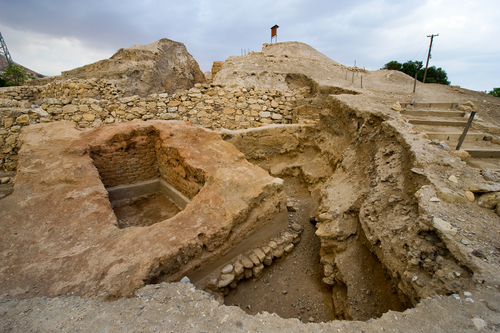
Old ruins in Tell es-Sultan better known as Jericho the oldest city in the world

I recently attended a conference at which Ted Wright, an archaeologist, presented information related to the exodus of the Jewish people from Egypt and the later conquest of the area of Canaan. Ted Wright has participated in the excavation of Jericho and Khirbet el-Maqatir, thought to be the modern location of the city, Ai, mentioned in the Bible. One thing that Ted Wright said, which has stuck with me, is that modern archaeology continues to affirm people, places and other information contained in biblical accounts.

As an example, Ted Wright recounted the story of an archaeologist, John Garstang, who excavated Jericho in the 1930’s. Garstang concluded that the site dated to 1400 BC, consistent with the biblical account (John Garstang, “Jericho and the Biblical Story,” p. 1222.):

“In a word, in all material details and in date the fall of Jericho took place as described in the Biblical narrative. Our demonstration is limited, however, to material observations: the walls fell, shaken apparently by earthquake, and the city was destroyed by fire, about 1400 B.C. These are the basic facts resulting from our investigations. The link with Joshua and the Israelites is only circumstantial but it seems to be solid and without a flaw.”

Ted Wright observed in his talk that most of the battle in modern archaeology is not whether places, like Jericho, really existed, or the happening of events, but rather the timing of when they existed and happened. Continue reading “Timing the Walls of Jericho”

When Sin Crouches At the Door

depositphotos Image ID: 39910063 Copyright: ectorass

“If you do well, will you not be accepted? And if you do not do well, sin is crouching at the door. Its desire is for you, but you must rule over it.” Genesis 4:7

We know the story of Cain & Abel. They were the sons of Adam & Eve. They both offered sacrifices to God. Cain gave an offering from “the fruit of the ground”, and Abel of the “fat portions”[1] from the “firstlings”[2] of his flock. (Genesis 4:3-4) All was good, right?

Well, no. God “regarded” Abel’s offering, but didn’t “regard” Cain’s offering, and that is when the problem started. Cain became angry[3], and his “countenance fell”. (Genesis 4:4-5) We know the rest of the story: Cain ends up killing Abel.

Lest we be tempted to think that we don’t need to pay attention to the details of this story because we aren’t like Cain – we would never kill anyone – consider these words of Jesus:

“You have heard that the ancients were told, ‘You shall not commit murder’ and ‘Whoever commits murder shall be liable to the court.’ But I say to you that everyone who is angry with his brother shall be guilty ….” (Matthew 5:21-22)

Anyone who has ever been angry with another person, might do well to consider the details of the story of Cain and Abel.

Continue reading “When Sin Crouches At the Door”

Jumping from the Precipice

Without a heart that is willing, we cannot know God.

depositphotos Image ID: 72688071 Copyright: nanka-photo

If anyone’s will is to do God’s will, he will know whether the teaching is from God or whether I am speaking on my own authority. (John 7:17)

Jesus spoke these words after his own brothers expressed their skepticism about who Jesus appeared to be suggesting he was, the long awaited Messiah from God. (John 7:2-5) He spoke these words to a crowd that was also largely skeptical, wondering who he really was. Some were saying he was a good man, but others were claiming that he was leading people astray. (John 7:12)

I keep coming back to this verse (John 7:17) since I heard Dr. Rosaria Butterfield give her testimony of her journey from liberal, lesbian professor who was highly critical of Christians and Christianity to becoming a believer and later a pastor’s wife and having a ministry of her own.

In her world of academia, she was used to doing research and coming to conclusions before being willing to put her faith in a proposition. That is the academic process.

As she was listening to a sermon after having spent many months becoming friends with a pastor and his wife, reading the Bible, and considering the evidence for Christianity, she made a life changing realization. She was approaching Christianity academically. She was not willing to believe until all of the facts were lined up and could be reduced to a certain answer.

When she heard this sermon in which the preacher read John 7:17, she realized that she had it all backward. Continue reading “Jumping from the Precipice”

God Chooses Us So We Can Choose Him

Whoever abides in me and I in him, he it is that bears much fruit….

depositphotos Image ID: 438054 Copyright: ingridhs

“You did not choose me, but I chose you and appointed you that you should go and bear fruit and that your fruit should abide….” (John 15:16)

That seems to settle it. We did not choose Jesus. Jesus chose us. He also appointed us that we should go and bear much fruit and determined that our fruit should “abide”. There doesn’t seem much for us to do. God, the vinedresser, will do His work and cause us to beat fruit.  Right?

But then, why did Jesus direct his followers, “Abide in me”? That is a command, and a command requires a response. A response requires volition. Volition requires the exercise of the will, and that suggests we have a choice to make.

So whose choice is it?

So let’s be clear about this. We didn’t choose Jesus. He chose us, and he chose us to bear fruit… but then He asks us to do something.  He says that we must abide. We don’t bear fruit if we don’t abide:

“As the branch cannot bear fruit but itself, unless it abides in the vine, neither can you, unless you abide in me. Whoever abides in me and I in him, he it is that bears much fruit, for apart from me you can do nothing.” (John 15:4-5)

We can’t bear fruit apart from Jesus; we can only bear fruit if we abide in him.

But lest we think that we are left to our own devices, now that Jesus has chosen us, He makes it clear our abiding in Him isn’t enough! He must abide also in us.

Clearly, the relationship is reciprocal.

This is all well and good, but how do we abide in Jesus?

“If you keep my commandments, you will abide in my love, just as I have kept my Fathers commandments….” (John 15:10)

Taking it a step further, Jesus adds:

“This is my commandment, that you love one another as I have loved you. Greater love has no one than this, that someone lay down his life for his friends. You are my friends if you do what I command you.” (John 15:12-13)

After God chooses us and appoints us to bear fruit, we must abide in Him and allow Him and His word to abide in us. This requires doing on our part. We are not passive in this process. We must keep God’s commands, and that means loving others by laying down (laying aside) our own lives.

We must do all of this to beat fruit, which is what God appointed us to do.

And here is the kicker: if we don’t abide in Jesus, we die because a branch can’t live apart from the vine. It withers and dies when it is disconnected from the vine. It’s good for nothing but to be burned. (John 15:6)

So – Jesus chooses us out of the world, but we have to engage Him in that choice by exercising our own choice to abide in Him, by exercising our own choice of letting His word abide in us, by exercising our own choice to abide in love, which means following His example of laying down our lives for others.

Yes, Jesus chooses us … so that we can choose Him.

God’s Purpose is Accomplished – Even When People Reject Him

depositphotos Image ID: 1739451 Copyright: tockasso

Jesus said, “If I had not come and spoken to them, they would not have been guilty of sin, but now they have no excuse for their sin. Whoever hates me hates my father also. If I had not done among them the works that no one else did, they would not be guilty of sin, but now they have seen and hated both me and my father.”  (John 15:22-24)

These words convey a stark reality that is not pleasant to consider. We might assume that Jesus was speaking of the Jews when He spoke these words, but we would be wrong. Jesus was speaking of the “world”. Just before Jesus spoke the words quoted above, He said:

“If the world[1] hates you, know that it has hated me before it hated you.  If you were of the world, the world would love you as its own; but because you are not of the world, but I chose you out of the world, therefore the world hates you.” (John 15:18-19)

These are curious things coming from Jesus. The import of what Jesus says here is that the world is ordered in opposition to Jesus and God the Father. And even when people reject Jesus, God’s purpose is fulfilled.

In other places, we see Jesus saying very different things. For instance, Jesus said elsewhere, “God did not send his Son into the world to condemn the world, but in order that the world might be saved through him.” (John 3:17) So, we might be confused when we see Jesus implying that he came to hold people accountable for their sins.

Continue reading “God’s Purpose is Accomplished – Even When People Reject Him”