The Redemption of Korah: the Sons of Korah

I would rather be a doorkeeper in the house of my God than dwell in the tents of the wicked.


Have you ever heard of the rebellion of Korah? How about the Sons of Korah? The rebellion of Korah and the Sons of Korah have a connection with each other, and the connection is fascinating.

The rebellion of Korah occurred during the 40 years Moses led the nation of Israel in the wilderness following God’s miraculous deliverance of the people out of captivity in Egypt. Korah rose up during their time of desert wandering and rallied a group of people to oppose Moses.

Korah was a grandson of one of Levi’s three sons (Kohath). He was a Levite, which meant that he was involved in the Levitical duties of caring for the tent of meeting and the tabernacle where God’s “presence” resided in the midst of the people. The Levitical duties were sacred and honorific.

The Kohathites were specifically in charge of caring for the Ark of the Covenant, the table, lamp stand, altars, articles of the sanctuary and the curtain behind which the priests performed the sacred rituals God passed down to Moses. (Numbers 3) Unlike the other Levites who were allowed to transport their items in carts, the Kohathites were required to hand carry their items.

The Ark of the Covenant was particularly sacred, of course, but the Kohathites may have been jealous of the ease enjoyed by the other priests who didn’t have to hand carry the items for which they were responsible. We don’t know. The text doesn’t tell us.

The text does tell us that Korah and several others rallied 250 other men in public opposition to the authority of Moses. They claimed that all the people of Israel are holy, and they questioned why Moses and Aaron “exalted themselves” above everyone else. (Numbers 16:3) They might as well have said more pointedly, “Who put you in charge?!”

Moses responded by challenging Korah and his followers to put the issue before God. He said, “This is how you will know that the LORD has sent me to do all these things and that it was not my idea.” (Num. 16:28)

As the story goes, they gathered publicly before all the people in front of the Tent of Meeting, each man with incense burning in censors. This is how Moses and Aaron faced off with the contentious lot led by Korah. I am really not sure of the point of this faceoff. If anyone has any insight, post in the comments below.

In any event, God warned Moses, and Moses warned the crowd to stand back. When he finished talking, the ground opened up and “swallowed” up the 250 men rebels that supported Korah in his opposition to Moses. (Numbers 16)

The story stands as a warning to those who are not content with their place in the world and people who get jealous of others to whom God has given greater responsibility and authority. God chose Moses and Aaron to lead the people. By opposing God’s chosen leaders, Korah and his band of rebels were ultimately opposing God and God’s authority.

From this story, I assumed that Korah and his clan were wiped out. The text seemed to imply that all his family were included in the 250 agitators. It turns out that my assumption was wrong, however, because the “sons of Korah” appear many generations later, and their place in the history of God’s people is truly intriguing.

Now, for the “rest of the story”, as Paul Harvey used to say.

Continue reading “The Redemption of Korah: the Sons of Korah”

Focusing on Following Jesus in a Chaotic World

God continues to work out His purpose in history.


There is so much angst in the world today. First the corona virus and now the explosion of racial tensions. The political and worldview polarization we we have experienced in recent years have been magnified as political machines ramp up for another presidential election. It even threatens to pull the church apart.

I have recently written about black lives matter and white privilege from a biblical perspective, in an attempt to redeem those phrases from a biblical point of view.  I realize that those terms are loaded. The Black Lives Matter organization has a specific message and worldview that runs contrary to biblical principles at various points, but I tried to find the kernels of truth in those phrases through a biblical lens.

We run a risk in the church of getting off the narrow path of following Jesus by aligning ourselves too closely with a particular political platform, secular philosophy or other way of viewing the world that is not gospel focused. We also run a risk of falling off the narrow path the other way, by  reacting in opposition to everything a particular political platform, philosophy or worldview stands, just because some of it (or even most of it) is contrary to “off”.

Truth is truth, and truth is objective. No one person or particular view is apt to be absolutely true, because we are flawed beings with limited perspective. The likelihood of one person, one church, one theology being absolutely true in every detail is not likely.

At the same time, truth is truth. It is objective, and people can see it. That means that even people who may not acknowledge the truth of the gospel may, nevertheless, accurately see some aspect of the truth.

It’s like science, the facts and evidence must be interpreted. We are all looking at the same facts and evidence, but we do not all interpret it the same way. Still, the facts and evidence are the same. We continually discover new facts and evidence that alters our interpretations of the facts and evidence we previously knew, and we sometimes discover that what we thought we knew is not accurate.

God, of course, never changes. He is the same yesterday, today and forever. Our perspective, knowledge and understanding, however, is finite and limited, and that requires we adopt a posture of humility in our understanding.

God’s Word doesn’t change, but our perspective of it changes. Think of the radical change of perspective Jesus introduced to the descendants of Abraham! God became man, came to His own people, and they didn’t even recognize Him!

Continue reading “Focusing on Following Jesus in a Chaotic World”

King David’s Secret

All of David’s life was lived in relation to and in orientation toward God.

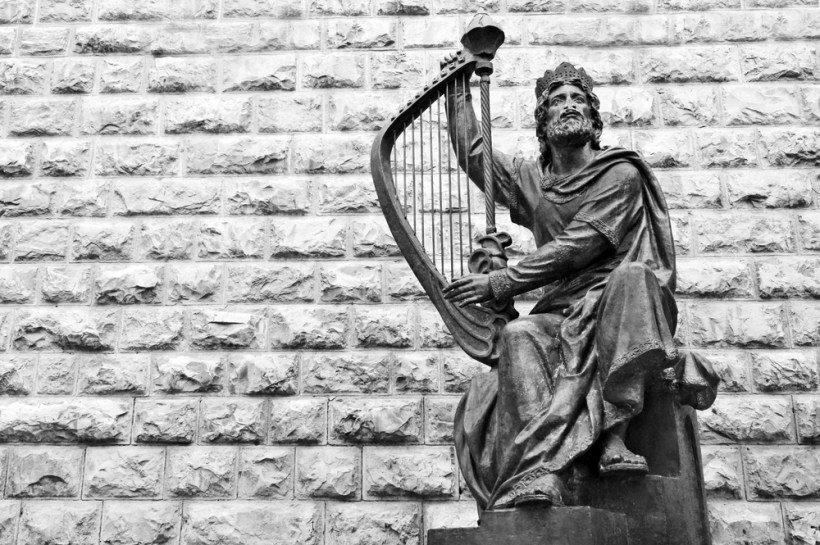
King David statue outside his tomb in Mount Zion Jerusalem, Israel.

I am reading through the Old Testament in my daily devotions on a plan that will take me through the Bible chronologically throughout the year. I have been reading through the books of Samuel and Chronicles that tell the story of David’s life, among other things, and I am reading some of the Psalms David wrote. Today, I read Psalm 18.

Psalm 18 is a song David wrote to the Lord “when the Lord delivered him from the hand of all his enemies and from the hand of Saul.” The reading plan I am following is chronological, and that would put this Psalm near the end of David’s life. The timing of if make the things that strike me about it all the more… well… striking.

The most striking thing about the Psalm (and David’s life) is that he implicitly and intimately trusted God. We see this in the first five verses:

I love you, Lord, my strength.
The Lord is my rock, my fortress and my deliverer;
    my God is my rock, in whom I take refuge,
    my shield and the horn of my salvation, my stronghold.
I called to the Lord, who is worthy of praise,
    and I have been saved from my enemies.
The cords of death entangled me;
    the torrents of destruction overwhelmed me.
The cords of the grave coiled around me;
    the snares of death confronted me.

David always turned to God. When he was overwhelmed, as expressed in this Psalm, he turned to God. When he was victorious, he turned to God. When he failed to live up to God’s standards, he turned to God, and when tragedy struck, he turned to God.

In everything David did, he was fully and intimately mindful of God. Here David said, “In my distress I called to the Lord; I cried to God for help.” (Ps. 18:6) All of David’s life was lived in relation to and in orientation toward God.

Continue reading “King David’s Secret”

The Non-Transactional Nature of Love

Love is more than something we do for God and others


1 Corinthians 13[1] was the subject of the sermon I watched this morning online. Perhaps, my favorite all-time chapter in the Bible. It’s a popular favorite, too, recited at weddings and funerals and known to people who aren’t particularly religious.

Some things that stand out to me from the sermon are these things: Love isn’t a feeling; it’s something you do. Talent, skills and giftedness are things we value, but they don’t require or demonstrate love. An eloquent and inspirational speaker without love is like a clanging gong or cymbal.

I liked the analogy of the guitar solo vs. a gong solo. Who would do that? No one does a gong solo. A gong solo is like talent without love. Nothing but noise.

Not even prophecy, or knowledge or faith that can move mountains is worth anything if I don’t have love. If I give everything I own away to the poor and give my body up to be burned at the stake (the ultimate religious sacrifice), but I don’t have love, I gain nothing.

As I think about these things, it occurs to me that love isn’t (just) something that we do. It’s certainly true that the love being described isn’t a feeling that comes and goes. Love is more like a commitment than a feeling in that sense, and it is (partly) something that we do; but it’s much more than that.

Continue reading “The Non-Transactional Nature of Love”

A Daily Rhythm of Seeking Intimacy with God

When the crisis blows over, will the new normal include daily Bible reading, prayer and meditation?


Nothing is normal about these times right now. Daily case totals and death tolls are front of mind, reminding us of the tenuous uncertainty of life. Though people may question the significance of the numbers, compared to cases and death tolls from the flu, for instance, the preoccupation of the world with this global pandemic labeled COVID-19 is a daily reminder of our own mortality.

Someone speaking of personal experience in World War I remarked, “There are no atheists in the trenches of Europe.” The same idea was echoed in World War II: “There are no atheists in foxholes.” Indeed, Impossible times and situations that snap us out of our comfortable mundane existence have that kind of effect on us.

I doubt that it’s true )that there are no atheists in foxholes). As a generalization, though, there is some kernel of truth there. Many a person who has no interest in God, turns to God in times like these.

YouVersion, the maker of a downloadable Bible app, recently reported on April 15, 2020, historic numbers of people accessing their app, the largest increase in engagement with their app in the last 6 weeks during this time of worldwide COVID-19 pandemic. A record 1.6 million prayers were added in just one month. They claim the pandemic has triggered a virtual spiritual awakening.

The app tracks downloads. When I first checked it, I saw it had been downloaded 421,462,195 times. I started writing this piece a day ago, and I am just getting back to it now. Not quite 24 hours later, the app has been downloaded 421,546, 815 times. That’s an increase of almost 85,000 in less than 24 hours!

With the spike in downloads of just one Bible app (among many), it seems that people really are turning to Scripture in this time of crisis and difficulty.

That leads me to wonder: when the crisis blows over, will people go back to their “normal” lives? Will the new normal include daily Bible reading, prayer and meditation?

Continue reading “A Daily Rhythm of Seeking Intimacy with God”