The Upside of Deconstruction

Deconstruction might not be the evil that some Christians may believe it is


Like many people, I suppose, I have been thinking about the phenomenon known as “deconstruction” since it has become popular to tell deconstruction stories in recent years. A deconstruction story is an “anti-testimony”; it’s a testimony of a journey from belief in the God of the Bible to non-belief in the God of the Bible.

Last summer, a high profile Christian worship leader and the guy who wrote the book urging Christians not to date (that created a generation of non-dating Christians) “deconstructed”. They walked away from their faith and publicly announced it, blogged about it, were interviewed about it and became celebrities of the walk away from faith movement.

Other notables come to mind as well, but I am not going to name them. That isn’t the point. I only recount these stories to demonstrate that “it’s a thing”, as my kids say.

Old timey religious folks used to call it “backsliding”. By that, they meant turning back to a sinful lifestyle, lured away by the temptation of sin. I remember people calling it “falling away”. By that we meant, losing faith, not being able to hold on to it.

Deconstruction seems to be a much more noble and honorable thing to do than backsliding or falling away. (I say that not without my tongue in cheek.) Deconstruction suggests that you had a hand in it. You didn’t backslide against your better judgment or let faith slip through your fingers; you rolled up your sleeves and dismantled your faith, and you found that it didn’t fit back together again.

It’s scientific, right? So it must be a good thing.

Deconstruction is popular, I believe, because skepticism is gaining in popularity. Scientists, like Neil de Grasse Tyson and pseudo-scientists, like Bill Nye, “the Science Guy”, have ridden that wave of popularity scaling away religious (and philosophical) ideas and replacing them with science, because (they say) science has all the answers.

Deconstruction is science, right?

I don’t buy it for a second that science and religion are incompatible, and neither do many scientists. I participated in a Zoom conference just this morning with a biochemist who is a believer. On the other hand, deconstruction might not be the evil that some Christians may believe it is. In fact, I think, deconstruction can be a good thing.

Continue reading “The Upside of Deconstruction”

The Cup of the New Covenant Poured Out for Us


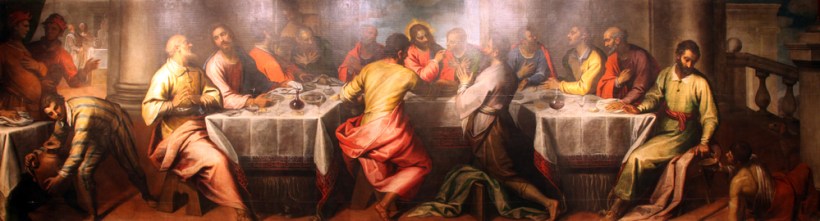
Imagine being a close friend of Jesus in the 1st Century, reclining at the table with him, eating a meal. It’s been a roller-coaster three years! Your whole world is buzzing about him. He is absolutely the talk of the town.

You are still not quite sure what all he is talking about, but you have come to believe in him. If he is not Messiah your ancestors have talked about for many generations, he is certainly a prophet. Maybe he really is the Messiah?!

Your people have held on to hope for hundreds of years of returning to former glory. This Roman rule is not the way it is supposed to be. God rescued your ancestors out of the land of Egypt, and He gave them the promised land. God drove out all the inhabitants of the promised land before them. He could do it again! Certainly, He would do it!

When Jesus rode into Jerusalem on that donkey, it seemed almost so real you could taste it. This really seems to be it! The people are behind him. Everyone is waiting to see what’s next. A new day for Israel seems to be right around the next corner!

But, you never know with Jesus. He is anything but predictable, and he says some really weird things sometimes. Hard things. You don’t completely understand what he is getting at when he talks about the Temple being destroyed and rebuilt in three days. What does that have to do with anything? All of those statements about being the Bread, and the Living Water and the Vine….

As you sit at the table, the talk is excited. It is Passover. Expectation in the air. This Passover is particularly poignant with all that has been going on, but Jesus is quiet.

Not that it’s unusual for Jesus to be quiet at times. They had gotten used to it. He often went off by himself, and he would often seem to drift into deep thought, especially lately.

Jesus had left all of you instructions about preparing the Passover meal. No one knew where Jesus was, but everything was left for you as he said it would be. He finally showed up and watched as you finished. You didn’t really notice his silence until he finally spoke as everyone was finally reclining at the table.

Jesus was obviously waiting for just this time. His voice carried a certain weight to it. More than usual. There was a firm, but calm, urgency to his words. The excited tones of the men around the table fell immediately quiet as Jesus opened his mouth to speak. Continue reading “The Cup of the New Covenant Poured Out for Us”

Time for a Re-Set: Repent and Return to God

I don’t believe that God caused the virus, but I believe God can use it to draw our our attention to Him


A friend of mine, my closest friend in college a dear brother in Christ, shared with me something a friend of his shared with him.  His friend claimed it to be a prophecy from God. I give it you as it was given to me. He said:

“In the wake of the panic-demic, a great national re-set will settle into the culture. We will witness clarifying ‘adjustments’ to what we value or hold dear. Healthy ones. Already this has served as a great sifting….. [W]e (collectively) have not lost much, though we have faced the specter close on the horizon. When the dust settles, we may be surprised to find ourselves in a much better place. Immunized perhaps by just a taste.”

Many people don’t believe that God gives people prophecies today as He did in Scriptural times. Indeed, if God does still do that, we should be careful to accept them. As Paul said then, “Do not despise prophecies, but test everything; hold fast what is good.” (1 Thessalonians 5:20-21)

Were all of the prophecies Paul was talking about then written down?

No. We have letters from Paul and other close associates of Jesus, but we don’t have the prophecies Paul was talking about to the Thessalonians. Those prophecies, I believe, were for them. They weren’t to be despised [ignored, treated as nothing and lacking value][i], but they were to be tested.

Testing prophecies means taking them seriously. The word for “test”[ii] here implies that the prophecies are to be put to the test, examined and proven by testing. This is not a skeptical exercise, as a 21st Century believer (or unbeliever) might suppose. The idea was to prove what is good.

Perhaps, our reluctance to think that prophecy is a way God still communicates to us today is based in our lack of understanding of what is meant by prophecy. We think of predictions of things to come. Indeed, the Old Testament is full of such prophecies. Jesus also predicted things.

Prediction and foreshadowing of future events is partially what prophecy can mean, that isn’t all that prophecy means. The Greek word translated “prophecy”[iii] can mean simply speaking the mind of God. Hopefully, your pastor does that when he preaches!

Prophecy does tend to have predictive elements to it, but that isn’t all that it is, and prophecy doesn’t have to be predictive. It can simply be admonishment, encouragement, provide comfort or otherwise speak the mind of God in a particular moment or circumstance. When we seek to comfort or speak a timely word to a friend, praying to God for wisdom, we are attempting to use the gift of prophecy.

Sometimes we fail. We kind of know it when we do. What we say falls flat. But sometimes, we feel the Holy Spirit in the words that are spoken that confirms we have hit the mark. This is prophecy.

Prophecy is a timely word, a fitting word, a word that resonates with Scripture in the moment. It’s a word that carries some weight in the moment such that it encourages, comforts, rebukes, corrects or has whatever affect the Holy Spirit gives it. If you are blessed to have a good preacher in your church, your preacher may speak the mind of God (prophesy) most Sundays.

Prophecy isn’t to be confused with the gift of teaching. Teaching is the gift of being able to pull the meaning out of a text and communicate it clearly. The gift of prophesy is the ability to make Scripture poignant and apply it in the moment providing direction for the future. A preacher with the gift of teaching and the gift of prophecy is a rare gift.

So, back to my friend’s friend.

I am not going to hang on what he said like Scripture. I don’t think that is the purpose of prophecy, and especially not since the time of Christ. Still, I take it seriously. It rings true to me.

Continue reading “Time for a Re-Set: Repent and Return to God”

A Call for Changing Priorities: Taking Hold of God’s Promise


In these present times, the corona virus threat looms large. Every day the number of cases and deaths rise, but we will get through this. We may not be able to see the end of it yet, and it might last longer than any of us hope, but we will get through it.

We might long, now, for life to return to normal, but I really hope it doesn’t.

The corona virus is a wake up call for everyone – for those who are vulnerable, and those who aren’t – because what we do doesn’t just affect ourselves. Our actions affect those around us. We are learning that lesson collectively.

The Bible puts it this way: if we sow the wind, we reap the whirlwind. (Hosea 8:7) We see the way it works out with the virus: one person can infect three, and three people can infect nine, and the spread of the virus spreads exponentially if we don’t take measures to arrest the unseen enemy of our bodies.

The same principles apply to sin. Our selfish, self-centered, self-absorbed, proud and arrogant sinful proclivities affect (infect) others, and the influence spreads.

It spreads to our children. It spreads to our spouses. It spreads to our co-workers, neighbors and people we contact inadvertently every day. What we do and what we say and the attitudes of our hearts, if they are informed, motivated and inhabited by the sinful nature within us, has unintended consequences … for ourselves and for others around us.

What we can’t see can and does hurt us and hurts others.

Continue reading “A Call for Changing Priorities: Taking Hold of God’s Promise”

Some Consolation in the Biblical Illiteracy of Modern American Christians


This piece I post not without some trepidation. I throw it out into the blogosphere nevertheless. For what it is worth.

I was listening to a podcast this morning by an atheist, turned Christian apologist, who commented that an “overwhelming number” of American Christians do not know what scripture says about key issues, including salvation. The comment stood out to me, so I googled it.

I found a Lifeway article that doesn’t focus on Christians, per se, but on Americans generally[1]. (We’re supposedly a Christian nation, right?) The article focused not on the content, but on how much of the Bible people have read. While the article didn’t focus on people who call themselves Christians, it began to paint the picture.

A whopping 53% of the people polled had read no more than “several passages” or “a few stories”. Twenty three percent (23%) had read no more than “only a few sentences”, and ten percent (10%) of the people polled hadn’t read a single word of the Bible.

I am not completely surprised, though I would love to see the percentage of those people who have a strong opinion about what the Bible says.

About fifteen percent (15%) of the people polled said they had read “at least half” of the Bible. Another twelve percent (12%) said they had read “almost all of it. Only twenty percent (20%) of the people polled said they had read all of the Bible, but only nine percent (9%) had read all of it more than once.

Clearly, we are not very Bible literate as a nation, though we have strong opinions on what we think the Bible says. That goes for people who have strong positive opinions and strong negative opinions.

Interestingly, I found an article written by a well-known atheist that suggests most Christians don’t understand the fundamentals of their faith.[2] He concludes, “This survey shows that a lot of people take on a particular religious label, not because they have a full understanding of what that faith believes, but for other more superficial reasons. Maybe their parents raised them in it. Maybe they were led to that religion by a friend. Maybe they attended a service and found it welcoming and inspiring.” Anecdotally, I see some truth in that statement.

It’s not just atheists making that observation. An article by the Barna Group, a Christian organization, finds that most churchgoers have “never heard of” the Great Commission.[3] Another article commenting on a similar survey concludes that most Americans are heretics and claims the results show that even “those who wear Christianity on their sleeve” … “Christmas-treed the survey, espousing all kinds of unorthodox views”.[4]

I found many articles by Christian leaders expressing concern about Bible illiteracy among people who consider themselves Christians (calling it a big problem[5], a scandal[6] a crisis[7] and an epidemic[8]), so it seems there truly are an “overwhelming number” of American Christians who do not know what scripture says about key issues – to circle back to where I started. And, where do I get off this feedback loop?

Continue reading “Some Consolation in the Biblical Illiteracy of Modern American Christians”