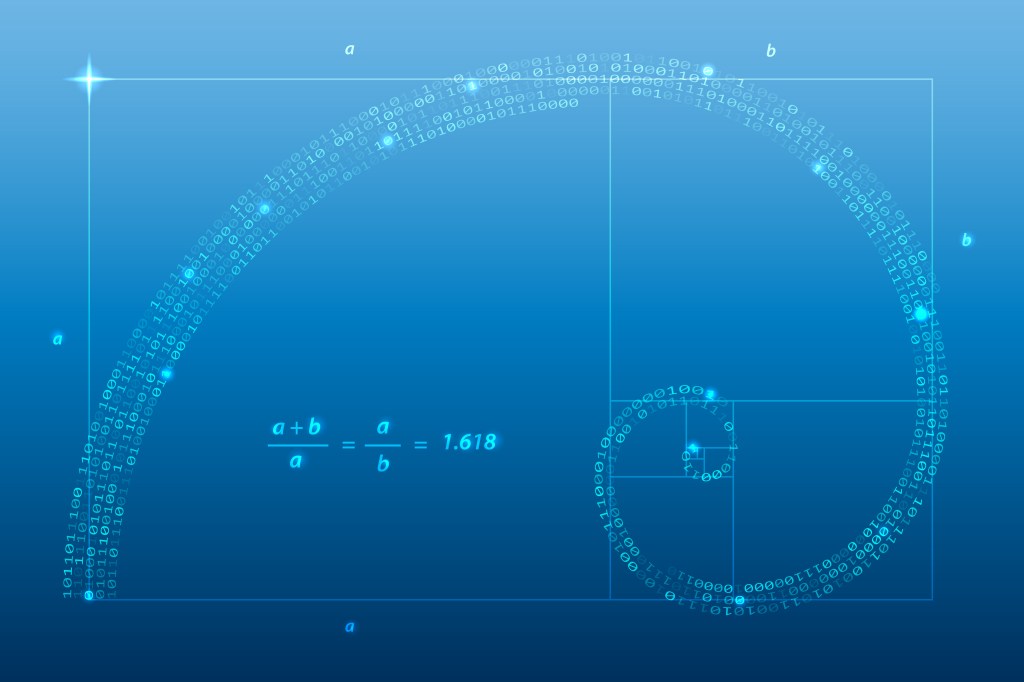
Where does order in nature and the cosmos come from? Stephen Meyer & Saleem Ali recently met up with Justin Brierly on the Unbelievable? podcast to discuss the nature of order in the universe. Saleem Ali’s focus on the comparison between natural order and human social systems in his book, Earthly, Order, is the backdrop for the discussion with Stephen Meyer, who wrote Return of the God Hypothesis.
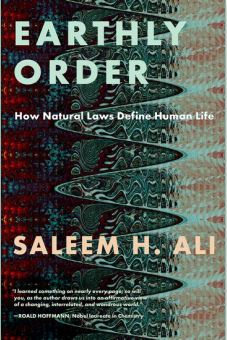
Saleem Ali’s book, Earthly Order: How Natural Laws Define Human Life, explores the linkage between natural order and societal order. He ultimately argues that mankind should synthesize social structures to match the order found in the natural world for the benefit of mankind and the environment in which we live. In reaching this conclusion, Ali devotes attentions to the beauty of natural order, which he sometimes calls design.
Saleem takes the consensus, scientific approach to the natural order. He assumes that natural order developed from the bottom up: that stars and planetary systems formed from initial cosmological constants present in the fabric of the universe at the instant after the “Big Bang” and that life formed spontaneously from inert matter into self-replicating molecules that grew exponentially more complex over time.
Saleem Ali is the Blue and Gold Distinguished Professor of Energy and the Environment at the University of Delaware. He has a B.S. degree in Chemistry and Environmental Studies from Tufts University, 1994, and M.S. degree in Environmental Studies from Yale University, 1996, and a Ph.D. in Environmental Planning, Department of Urban Studies and Planning from Massachusetts Institute of Technology, 2000. Stephen Meyer, who also wrote Signature in a Cell and Darwin’s Doubt, has degrees in physics and earth science from Whitworth College, 1981, and an M.Phil. in history and Ph.D. in philosophy of science from Cambridge University, 1987 and 1991.
In Return of the God Hypothesis, Meyer attempts to show that what we see in nature is better explained by a top down model of order. He argues that “specified complexity” defies a bottom up explanation, and begs for a top down approach. He claims that this is a not a “god of the gaps” argument. Rather, it is the natural conclusion to be drawn from what we observe: that the specified complexity we observe in the world always comes from a mind.
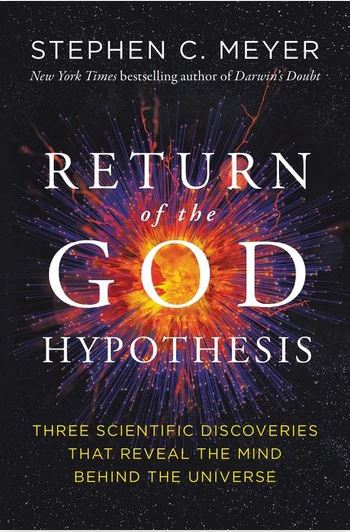
Meyer doesn’t necessarily chart new ground in the evidence or the methods he uses to reach his conclusions. He using principals consistent with good science and the evidence revealed by modern science to argue that they point in a different direction than the modern scientific consensus. He argues that the evidence we see in science is better explained by the conception of top down order and it points to a particular kind of top down order.
I am not going to attempt to describe either book more than what I know, most of which can be gleaned from the descriptions of those books and the descriptions provided by both gentlemen. I am also not going to attempt to get too deep into the conversation between Ali and Meyer. You can watch their interaction yourself if it piques your interest. (Linked in the photo below.)

Saleel Ali’s perspective is the one you have heard. It is the perspective that is included in every textbook (by law). It is grounded in the predominant view: that the universe is self-organizing, and life is self-replicating. His responses to Meyer reflect a carefully guarded reluctance to allow for intelligent agency in the design we see in the natural world.
Stephen Meyer and other people, some religious and some not at all, are questioning the propriety of that reluctance to allow for intelligent agency, or what we might simply call “mind”, in or behind the processes that created the universe and life in the universe. One argument in favor of that view is derived from the scientific experiments intended to show how life evolved on earth, says Meyer:
“I love these new approaches in the origin of life and the simulation experiments that are done to test them. I think that they are telling us something, though, about the importance of, as Thomas Nagel put it in Mind and Cosmos[i], that in addition to physical order there is a reality of consciousness and mind, and, we can see hints of that in life…. You see this actually in the origin of life simulation experiments that are conducted to test these new models, because the logic of simulation experiment is to try to reconstruct conditions that we think might have been present on the early earth, and then see what happens in the present. So our knowledge of those cause and effect processes that we see ensuing will help us reconstruct what might have caused life to arise on planet earth.”
These experiments are a kind of “reverse engineering” of the conditions that might have given rise to life from the inert chemistry of the primordial earth, assuming that life developed in that way. Reverse engineering requires an enormous amount of intentional effort and creative design. It also suggests that our efforts at reverse engineering proves an initial engineering that was also the product of intentional effort and creative design. Meyer continues:
“There is something that has emerged invariably from these experiments, and that is to get the chemistry to move in a life relevant direction, the chemist repeatedly has to impose constraints on what the chemical reactions would naturally do. If you have got reagent A and reagent B, and they are combined, they will make A/B, but they will make a whole slew of versions of A/B…. The chemist has to fish the A/B version three out of that gamesh of possibilities…. What the chemist is doing at that point is excluding some options, electing another…. [Often]what they will do is just buy the reagent that they want off the shelf that has already been purified by an intelligent agent. At each step along the way there is an impartation of information. If you exclude some options and elect others, you are imparting information into your simulation, and that information is invariably coming from the experimenter.”
The impartation of information, of influence, of direction is the activity of a “mind” – a causal agent. By agent, I don’t mean a compound that is, itself, a product of inert matter that always reacts according to its properties; I mean a “will” that is directed by “mind”. A billiard ball is inert until it is stricken by a person with a cue, and then it acts according to its properties and the laws of motion until friction causes it to slow and to stop. Meyer says:
“So, I think nature is actually telling us something. These simulations invariably require the imposition of intelligence to proceed in a life relevant direction. You have to ask, ‘What are they simulating?’ If this is something that is consistently arising in all simulation experiments, maybe they are pointing to a need for a top down explanation (explaining the origin of life) because all of the simulations require top down imposition of intelligence and information into the systems.”
These experiments intended to show the possibility that life might arise spontaneously, given the right conditions, are demonstrations of the importance of outside influence to cause it to happen – if indeed it can happen that way.
The famous Miller-Ulrey experiment still referenced in high school textbooks was heralded as proof of the concept. It comes woefully short, however, in demonstrating that life might have arisen out of a primordial soup. (I explored the limits of that famous experiment in What’s in Your primordial Soup?) In the Miller-Ulrey experiment, the experiment was done with elements that were not known to have existed in the early “primordial soup” of the earth at the time in which we know that life arose.
To be fair, though, they were just trying to show that it’s possible: that life can form on its own, given the right environment. On the other hand, it is a good example of the way in which an intelligent agent (the scientist) must jury-rig an experiment to try to produce the intended result he is trying to achieve.
Continue reading “What is the Basic Order of the Universe? Bottom Up? Or Top Down?”