The world is chattering about the Trump assassination attempt. Some people are gnashing their teeth, and others are thumping their chests and pumping their fists. I don’t want to rush to conclusions about anything. There is far too much of rushing to conclusions in our world – or reflexively doubling down on the conclusions we reached long ago.
The assassination attempt, however warrants some kind of response. No one is without some thoughts on the matter. My goal, though, is to be circumspect and seek perspective
As I write this, I recognize that Trump may likely become the next President of the United States – an unlikely two-time President. I also recognize the prophecies about the first Trump presidency and the prophecies predicting a second Trump presidency that did not come to fruition four years ago. They appear (to me) about to be vindicated in 2024.
If Donald Trump is elected for a second time, we must admit that these prophecies came true. The test of a true prophet and of a prophecy from God is whether the events predicted happen.
That isn’t the end of the story, however. Paul exhorts us to test everything and hold onto only what is good. (1 Thess. 5:21) The context in which these words were spoke is prophecies, among other things:
Do not quench the Spirit. Do not despise prophecies, but test everything; hold fast what is good. Abstain from every form of evil.
1 Thessalonians 5:19-22
What do we hold on to here? What is God saying, and what is God doing in these times
Does a second Trump presidency as prophesied mean that Trump is God’s anointed? Like David? Or Like Saul? Does it mean that the American church must put its uncritical allegiance behind Donald Trump, including all that he says, all that he does, every position he takes, and all that he stands for?
These questions are ways of asking, “What God is doing in our times?” And, maybe more importantly, “What should we be doing in these times?”
We need to be careful – to test everything. God has a way of doing things that we don’t expect and don’t understand. If we don’t believe that, we are not reading our Bible closely enough.
In Episode 20 of the Christian Atheist Podcast (Ethics (Part 3): the Origin on Ought), John Wise focuses on a primary difference between human beings and animals. Though humans beings are animals, human beings are qualitatively different than other animals in rational capacity, and the rational capacity of humans allows humans to exercise agency over the natural world. This unique human capacity to exercise rationality through agency is the focus of my thoughts today.
Human beings exercise their agency and rational capacity to change and redirect the laws of nature. Other animals can do this in very primitive ways, but the human capacity to manipulate nature through human agency, rationality, and ingenuity is light years beyond what other animals can do.
Of course, humans cannot do things that defy the laws of nature. Rather, human beings use their understanding of those natural laws to manipulate them.
Wise observes that the human ability to manipulate the laws of nature includes the ability to separate cause from effect to acheive a desired result. For instance, human beings have learned to breed various types of plants and animals to achieve results imagined by humans which would never likely have occurred in the natural world left to random, natural processes.
Human beings can exercise their rationality to imagine different effects and to manipulate causes to achieve those desired effects. In this sense, human imagine the effects they desire to achieve, and they manipulate the causes in the natural world to achieve natural effects by design that the natural world would not obtain randomly.
The world seems to act randomly, unless agency acts upon the world. The examples of agency acting on the world to achieve results that would not obtain without such agency are legion. All of human endeavor is replete with examples of agency imagined and initiated by humans to obtain designed effects that we desire.
Human beings are able to produce effects that would never have occurred in the natural world but for human agency manipulating the natural processes. In other words, human input redirects the natural processes to produce results that would not have occurred if the natural processes were left alone.
Our ability to separate cause from effect to achieve desired ends that would not occur in the natural world by manipulating those causes to achieve the effects we desire is an example of supranatural agency in the world. In other words, we are in and of the natural world, and we use our knowledge of the natural world to manipulate natural causes to create natural effects.
We do not suspend the laws of nature or violate the laws of nature to accomplish our desires ends. We use the laws of nature to achieve our desired ends – albeit, ends that would not have occurred but for our intervention.
Ocean liners and skyscrapers are things that do not occur through the laws of nature, but for human agency. Even so, human agency des not suspend or violate the laws of nature to create them. Human agency uses the laws of nature to create them.
These observations are a model for understanding God. The fact that laws of nature act in very rational ways that are predictable and dependable suggests design. The way the laws of nature act suggest an intelligent agency that set them in motion just so. We would call that intelligent agent God.
If God created the laws of nature, He would certainly know how to manipulate natural causes to achieve His desired effects. God would have much greater capacity than us to manipulate natural causes to achieve desired effects. Exponentially so!
Many skeptics, like David Hume, reject the idea of miracles because they assume that miracles violate natural laws. The foundational premise of Hume’s logic, though, is false. The God that created the natural laws would not need to suspend or violate those laws to obtain desired effects. God could manipulate natural causes to achieve His desired effects without the need to “suspend” or “violate” natural laws just as we do.
God’s knowledge of those natural laws and the possible effects that can be achieved through the manipulation of them is certainly greater than ours. Exponentially greater.
Many people have called phenomena they didn’t understand miracles, but subsequent discoveries about the way the natural world works have provided explanations to us of natural laws and how they work that we didn’t previously understand. Once we understand the laws at work on those phenomena, we no longer call them miracles.
A primitive intelligent being might think that human beings are violating natural laws to fly airplanes, for instance. We know this is not true, but a more primitive being may not understand the principles of natural laws being manipulated to achieve the end of flying a heavy chunk of metal through the air.
Just as we manipulate natural causes to create effects that do not occur naturally, God may do the same. Thus, what we call miracles may be nothing more than the manipulation of natural causes by God to achieve effects that would not ordinarily occur in nature without the involvement of an agent.
Just because the primitive being does not know the principles being manipulated does not mean that a violation of natural laws has occurred. In this same way, a human being, who is certainly a more primitive intelligent being than God, may not be able to know or understand the principles of natural laws being manipulated by God to achieve a result that we call a miracle.
We call occurrences miracles that we cannot explain based our understanding of natural laws. But our measure of understanding is constantly changing. For this reason, modern people often say they no longer believe in miracles (and, by extension, God). Experience shows that many things we didn’t previously understand we now understand, and they assume, then, that we will find explanations in the natural laws to explain all the things we do not presently understand.
I note that this belief is not necessarily warranted, nor can we prove it. People who make this assertion do it on the basis of faith in the human ability to know and understand the world.
Further, our mere understanding of the way natural laws work, does not negate the need for intelligent agency to achieve desired ends. It isn’t enough for us to think something up; we must exercise our agency to act on the laws of nature to achieve our desired ends. Our understanding doesn’t create anything.
Imagine Aristotle seeing a pilot entering into a Boeing 737 and taking off into the air. Aristotle did not know enough about the law of gravity or aerodynamic lift to generate a good explanation based on the natural laws that were understood at the time. He may have called it a miracle because it defied explanation to him based on the level of knowledge he had.
The more often Aristotle might have seen a Boeing 737 takeoff, the less likely he might have considered it a miracle, even if the phenomenon still defied natural explanation to him. In fact, we still don’t really understand aerodynamic lift. (See No One Can Explain Why Planes Stay in the Air, by Ed Regis, Scientific American, February 1, 2020)
It is such a common phenomenon today, however, that we take it for granted even though we don’t completely understand it. Understanding that such a thing as aerodynamic lift occurs allows us to manipulate it, even if we don’t fully understand it.
Even if we think we fully understand natural laws, we probably don’t. One big example is the Big Bang. We know what happened from the “point” of the Big Bang, but we know virtually nothing before that “point”. We also have no idea how life formed.
Even if we did know exactly how the first living cell or organism developed. Our ability to trace the process and understand it does not tell us how or why it developed in the first place.
More precisely to the point, our understanding doesn’t create anything (without exercising our agency to act on that understanding), and it doesn’t eliminate the need for agency in our world to achieve desirous (beneficial) ends.
In fact, our experience suggests just the opposite. Our experience tells us that fire happens only randomly and often destructively in nature. We have learned to create fire and use it beneficially by exercising our agency in light of our understanding of the causes of fire. Agency is required to manipulate the natural causes for beneficial effects.
Our own experience affirms this. If I leave may backyard to nature, nothing is likely to grow there that is particularly beneficial. I might find a wild strawberry plant or wild raspberry vine with very small fruit on it. If I am lucky. The vast majority of it will be weeds and undesirable plants.
If I plant a garden with seeds cultivated by human ingenuity over many years of gathering seeds from the right kind of plants and developing new, heartier and more fruitful plants, I can turn my backyard into a cornucopia of beneficial plants that will feed my family and my neighbors’ families. This kind of benefit requires my agency.
I have to plant it, water it, weed it, and maintain it with much care and intentionality. If I stop maintaining it, my garden will relatively quickly return to a tangle of undesirable plants that will choke out and eventually replace my desirable plants.
It requires my agency to develop a garden and to maintain it. Nature, left to its own devices, will not do that. This is our common experience.
If you like archaeology, as I do, you become aware that time and nature destroys all the improvements generated by human agency and endeavor over time. Whole cities are reduced to rubble over time, and rubble becomes overgrown with windblown sediments, scrub brush and weeds such that we do not even recognize that a city once existed there, but for some remnants we can find by digging up the site.
We have made much about evolution since Charles Darwin first championed it as a theory. Evolution (the gradual improvement of life forms over time (by whatever means it occurs)) runs counter to our common experience. The formation of life from nonlife (the complex from the simple) (by whatever means it occurred)) runs counter to our common experience.
Does that mean that evolution is not fact or that life did not arise from nonlife? Not necessarily, but our common experience does suggest that this did not happen by natural forces acting according to their laws. Our common experience demonstrates that complex, beneficial effects arising from natural causes occur through agency and intentionality.
Human endeavor obviously did not create evolution or the formation of life from nonlife. Most scientists concede the appearance of design in the mind-bendingly complex interaction of amino acids, DNA, epigenetic materials, mechanical processes and other features of a living cell. If evidence of design appears in the world that was not achieved through human agency, that fact leaves us with the suggestion that some other intelligent agency is at work in the world.
Go into all the world and tell the gospel to all creation
As I read through the New Testament this year as part of my daily reading plan, I have finished the Gospels, and I am well into the Book of Acts. As I read through the Gospels, I was mindful of the context in location, time period, and the history of the area and the people of Israel, surrounding nations, and the Greco-Roman world leading up to the time that Jesus walked the earth. I have also been mindful of the sweep of this history as it has played out since that time to the present day.
As a believer in the story of God revealing himself to human beings in this history that we continue to live into, I am also mindful that this time was pivotal. God becoming incarnate (taking on human form and fully living into His own creation), is the centerpiece of our story. It ties the story together from the beginning to the end that will play out into the future fulfillment of God’s ultimate plans.
Abraham and his descendants have been the focus of this story from the time that he heard God encouraging him to leave his family and homeland and strike out to a land God would show him, full of the promise descendants as numerous as the sands of the shores of the sea and the stars in the sky. But the story has taken an unexpected turn – unexpected, at least, for those descendants who have been living into this story for millennia by the time of Christ.
But it shouldn’t have been unexpected. That original promise to Abraham included blessing for all the nations of the earth. This was God’s plan from the beginning – from the creation of Adam and Eve and the command to “be fruitful and multiply.”
The covenant God made with Moses with those descendants of Abraham, however, took on a life of its own – at least as far as they perceived it. They were (more or less) faithful to that covenant. At least, they clung to that story despite their failings to be faithful and despite their myopic view of what God was doing.
It was myopic because they lost sight of God’s intention to bless the nations of the earth through them. This blessing was embedded into the original promise to Abraham, and it was always intended to be part of the story. Yet, they had lost that thread.
Thus, when God entered into the story to move it along and begin to work out the thread of His ultimate plan, they didn’t recognize Him. The people God chose through whom He would work out this plan unwittingly resisted it.
Yet, God in His sovereignty was not surprised by this. He used their resistance to move the story forward. Jesus knew this when he read from the Isaiah scroll in his hometown synagogue:
“The Spirit of the Lord is on me, because he has anointed me to proclaim good news to the poor. He has sent me to proclaim freedom for the prisoners and recovery of sight for the blind, to set the oppressed free, to proclaim the year of the Lord’s favor.”
Luke 4:18-19
When Jesus told them, “Today this scripture is fulfilled in your hearing”, they were not ready to receive it, though the fulfillment of it was long-awaited by them. Jesus knew their rejection of him would be the catalyst God would use to unfold the rest of the story:
“Jesus said to them, ‘Surely you will quote this proverb to me: ‘Physician, heal yourself!’ And you will tell me, ‘Do here in your hometown what we have heard that you did in Capernaum.’”
Luke 4:23
Jesus, the fullness of God in human form (Col. 2:9), knew he would die at the insistence of his own people, but this was meant to be.
“And being found in appearance as a man, he humbled himself by becoming obedient to death— even death on a cross!”
Pjilippians 2:8
God worked through this people He chose to prepare for the time He would enter the story, and their rejection of Him would be the turning point.
Episode 124 – Statement of Triumph – from the BEMA Podcast, with Marty Solomon and Brent Billings, inspires my writing today. It was the subject of discussion for the Saturday morning Bible study I have attended off and on with an exceptional group of men for several years.
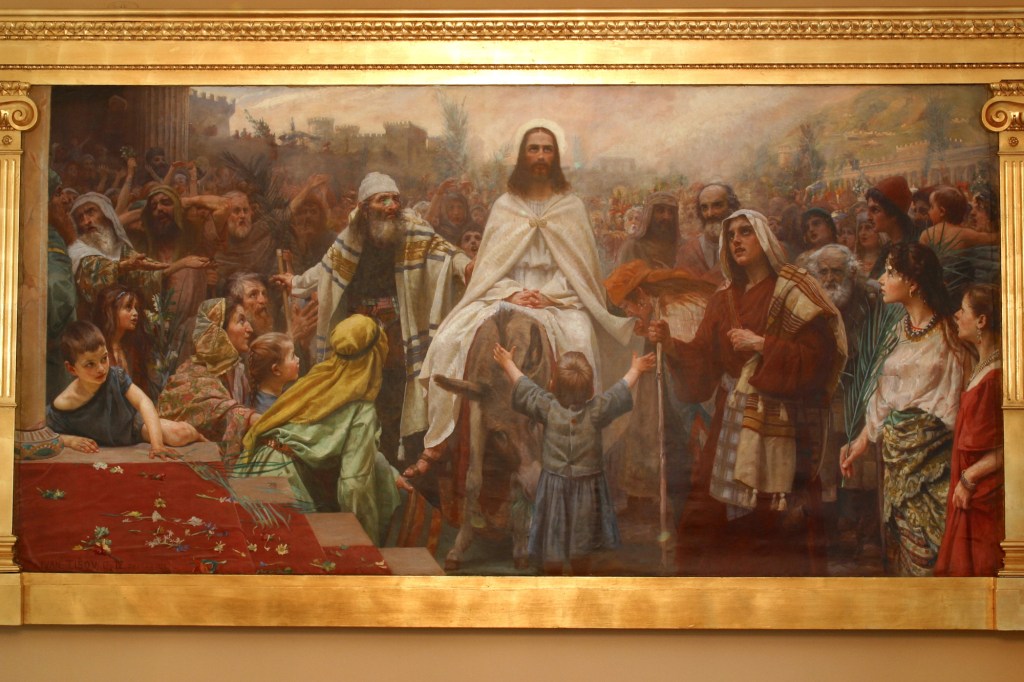
The subject was Matthew 21:1-11. The chapter heading in the NIV translation (which would not have appeared in the original text, because there were no chapter headings in the original text) is “Jesus Comes to Jerusalem as King”.
This is usually how we read it: a “triumphal entry”. We celebrate it as a triumph, and it was. But not perhaps in the way we tend to think about it. Certainly, not in the way the erstwhile followers of Jesus perceived it when it happened.
Marty Solomon sets the stage in the podcast, noting that Jesus rode into Jerusalem on a donkey during the week of Passover, an unusually tense time in this region of the Roman world. The uneasy tension arose in that time in that region because it was home to the only group of people in the Roman Empire who refused to worship the Emperor.
The Jewish people were stubbornly true to their God. Even so, Rome allowed the Jews to have their own ruler, Herod the Great. Herod was Jewish and powerful in his own right, but he was happy to be propped up by the Romans, and the Romans accommodated him to maintain stability in the region.
Even so, this small piece of real estate was problematic for Rome. It sat at the crossroads of the earth. The Hebrew people long inhabited it, but they were a headache for the Romans because of their entrenched religious traditions and unabated worship of their God.
When Herod the Great died, three of sons took over different areas of this land that Herod ruled as a vassal of the Romans. Herod Phillip ruled the north (Caesaria Phillippi). Herod Antipas ruled the middle region, and Herod Archelaus ruled in the south (Judea).
Archelaus only lasted two years, so Rome brought in its own ruler, Pontius Pilate (the Roman Bulldog), to maintain Rome’s control over the region. Pilate didn’t live in Jerusalem. Pilate lived in Caesarea Maritime (Caesarea, By the Sea), a city built by Herod to honor Caesar.
The week of Passover would have been a particularly tense time in Jerusalem, the Jewish holy city. Jews from all over were in town to celebrate the feast that remembered their great deliverance and triumph over the superpower of an earlier time, Egypt. The last thing that Rome wanted was for this celebration to get out of hand after rebel Jews got all fueled up with wine and remembrance of their former deliverance.
If there was any holiday that might make the Romans nervous in Judea, it was Passover. Zealots were always stirring up trouble, and Passover would be the most opportune time for a Jewish revolt against the Roman rule of this territory that the Jews long held out as their own. After all, the Jews still believed this land was to be theirs again through based on their understanding of prophecies about a military coup to be led by a messiah (savior) in the line of their once great King, David.
Every year at this time Pontius Pilate would head south from Caesarea down the coastal road to Joppa. He would head east from Joppa to make his way into Jerusalem. Pilate would enter Jerusalem from the west. He traveled with great pomp and a show of force, with an army of soldiers, trumpeters, heralds, banners, and pronouncements. Pilate would lead the way on a white stallion symbolizing Roman conquest and rule.
This show of power, of course, was intentional. I found the article, In Through the Back Door, September 24, 2022, by Terry Gau that describes these yearly processions made by Pilate into Jerusalem at the beginning of Passover week. He cites historians, John Dominic Crossen and Marcus Borg, in their book, Last Week, memorializing the historical and political context for the final chapter of Jesus’ ministry on earth. the procession is described this way:
“Traditionally, Pilate paraded into Jerusalem on the first day of Passover Week, entering the west gate – the front gate – with legions of chariots, horses, and foot soldiers, dressed for battle and armed with swords and spears. Rome’s authority would not be questioned. The majesty with which Pilate enters the front door of the city was meant to inspire awe and fear, respect and obedience.”
Marty Solomon says,
“You could have heard him coming from miles away. The message he wanted to send to the Jews was clear. ‘Don’t even think about it! Keep everything under control, or Rome will crush you!’”
BEMA Podcast, Episode 124
Pilate would stay in Herod’s palace in Jerusalem for the week until the festivities ended. Then he would go back to Caesarea. He wasn’t there to celebrate, though. He was there to ensure things didn’t get out of hand and to keep the peace.
During one Passover week under the rule of Pontius Pilate in Judea another procession took place. It may have even happened on the same day at the same time that Pilate was entering the City from the west. This procession took place on the east side of Jerusalem where Jesus, riding on a lowly young donkey with a small, rag tag bunch of unarmed disciples entered through the east gate – the back door to Jerusalem.
“This parade was just as carefully staged as Pilate’s entry into Jerusalem. It was a counter-procession, a different vision of what a Kingdom should be, a subversive action against the powers that ruled Jerusalem. Jesus’ humble, yet triumphal, entry into Jerusalem stood in contrast to the magnificence and brutality on display at the opposite end of the city. Jesus brings peace, while Pilate brings a sword.”
In Through the Back Door
This was the backdrop for episode 124 of the BEMA Podcast and of our discussion. I sit writing at a temporary table with one chair left in my house that is all but cleaned out and being readied for sale. My future is uncertain as I recount one of the most pivotal times in human history and the dealings of God with man and what it means for us, today.
If you are like me and most people I know, the parable of the workers in the vineyard is hard to understand and appreciate. This parable that Jesus told is recorded in Matthew 20:1-16. Jesus set the context of the parable with the statement,
“For the kingdom of heaven is like a landowner who went out early in the morning to hire workers for his vineyard. He agreed to pay them a denarius for the day and sent them into his vineyard.”
matthew 20:1-2
The context of this is a parable is the kingdom of heaven.
According to the parable, a vineyard owner hired some workers for the day to work in his vineyard. Those first workers began early in the morning, and they agreed to work for a denarius. The comments in the margin of the NIV translation notes that a denarius was the usual wage paid for a day’s work at that time. This makes sense so far.
As the parable goes, the vineyard owner went back out to the marketplace throughout the day, and he continued to solicit people to come work in the vineyard, saying, “I will pay you whatever is right.” And so, additional workers began working at 9:00 AM, at noon, at 3:00 PM, and again at 5:00 PM.
When the work day ended at 6:00 PM, the vineyard owner told his foreman,
“Call the workers and pay them their wages, beginning with the last ones hired and going on to the first.”
Mathew 20:8
Beginning with the workers who started at 5:00 PM, each one was paid a denarius. The workers who began at 3:00 PM were also paid a denarius, and so on.
When the workers who began the day early and worked through the entire day stepped forward, they expected to get more than the other workers. Each one, however, only received a denarius.
They naturally began to complain to the vineyard owner about the unfairness of the vineyard owner. Why should the workers who worked only an hour (or three hours or just half a day) receive the same compensation as the workers who worked all day? Doesn’t that seem unfair?
The early workers agreed to work for a denarius; they got what they agreed to work for; and a denarius was, in fact, the going rate of compensation for a day’s work. From that standpoint, the wage they were paid was fair, but why should a worker who worked for only one hour be paid the same wage?
The relative compensation seems patently unfair to us. Though the first workers got what they bargained for and got what was considered to be a fair wage, the later workers got the same wage for less work.
One thing I had not noticed before is that the point of this parable is to provoke our sense of fairness. How do we know that?
Go back and look at verse 8: Jesus says the vineyard owner specifically informed the foreman to pay the last workers first … in front of all the other workers. If he had paid the first workers first, they would have gotten what they expected, been satisfied with it, and left – not knowing that the later workers were paid the same wage. Instead, he made a point of paying the last workers first.
This parable “works” precisely because it offends our sense of fairness. It seems God expects it to offend us! But what does that say about God?









 Navigating by Faith