Without Leaving a Trace

I am as spiritual as the next guy. I try to be a good person. I don’t hurt anyone.

people
               Depositphotos Image ID: 15819245 Copyright: Kuzmafoto

via Daily Prompt: Trace

The crowd pushed and heaved to get a better view.

“This man, Jesus, was saying some crazy things, and people were just as crazy to believe it. I just happened to be in the area. I certainly wouldn’t go out of my way, but the spectacle caught my attention,” I said to guy next to me.

“I am comfortable with my life,” I told him. “I don’t need the drama. I don’t need to go chasing after every man who claims to have a direct line to God, and God knows there are many of them these days. They’re all crazy! They end up getting carried away with their own rhetoric. They make the Roman authorities nervous, and then they are thrown in jail or killed to make an example of them, and the crowd disperses. It always does.”

The guy next to me didn’t seem to hear what I said. He was listening to Jesus, so I listened for a few seconds.

“This guy Jesus is a good talker, isn’t he,” I said in case the guy might hear me this time. “The people hang on every word. He talks like he really knows what he is talking about, but no different than the last guy I guess. I didn’t really listen to him. Never really had the chance. More like, I wasn’t really interested.”

He looked at me only long enough to signal that he knew I was there, but he went on focusing on Jesus apparently wrapping up his message.

“Not that I’m not spiritual or anything,” I continued. “I am as spiritual as the next guy. I try to be a good person. I don’t hurt anyone. I’m certainly not like those guys this Jesus hangs around. Good for them, though. They need someone like Jesus to straighten them out. Maybe they will get their lives together.”

And, with that, the crowd began to break up and wander off. The guy next to me apparently left also. He was nowhere to be found.

“I guess this Jesus is done talking”, I thought. “Not sure what he was even talking about. I thought I heard someone say something about a miracle. Crazy! I would never get suckered like that.”

And the Son of God moved on without leaving a trace that He had ever been there, that I had ever encountered Him or ever heard anything He might have said.

The Descent and Ascent of Man

In thinking about the phrase, “descent of man”, coined by Charles Darwin, the subtlety and nuance of the play on words strikes me, but not in the way Darwin likely intended.

Image ID: 150736070 Copyright: claverinza

When Charles Darwin wrote The Descent of Man[i], the title was a play on words. In the context of the book, Darwin meant the word in the sense of “derivation from an ancestor”; “the fact or process of originating from an ancestral stock”; and/or “the shaping or development in nature and character by transmission from a source”.[ii] Descent, of course, can have a quite different meaning.

The word, descent, can also mean “the act or process of descending from a higher to a lower level, rank, or state”; “an inclination downward”; and/or “a downward step (as in station or value”), as in decline.

Darwin probably meant the word in this sense, also, in that philosophers and scientists and thinkers of all types before him had mostly viewed man standing apart from the rest of the natural world, standing above it (just a little lower than the angels). Darwin’s theory revealed man descending not from heaven, but descending (originating from ancestral stock) from lower life forms and ascending (evolving) from those lower life forms to the complexity the human species is today. This is the play on words.

In thinking about these things many generations after Charles Darwin coined the book title, in the context of all that has developed since his time, the subtlety and nuance of the play on words strikes me, but not in the way Darwin likely intended.

Continue reading “The Descent and Ascent of Man”

Fear, Love and the Spirit of God

Image ID: 86629260 Copyright: photoholic

The apostle, John, wrote, “Perfect love casts out fear.” (1 John 4:18) This was written by a man who, when the chips were down for Jesus, scattered in fear with the rest of the apostles. As Jesus tried to tell them of the need for him to die and be raised from the dead, something the apostles did not understand, he predicted they would all forsake him.

“You will all [i]fall away because of Me this night…. (Matthew 26:31)

Peter might have pumped his chest with bravado as he protested that others might leave Jesus, but he would never leave. (Matthew 26:32-33) But, Jesus knew better than Peter knew himself. He predicted that Peter, though swearing allegiance at that very moment, would deny him not once, but three separate times. (Matthew 26:34)

So great was the fear that overtook the disciples that they scattered after Jesus was taken by the Roman soldiers. Even Peter, who didn’t scatter, but stayed back to witness the interrogation, beatings, mocking and humiliation to which Jesus was subjected, denied that he knew him… three times.

Fear is a powerful emotion. It can overwhelm us and cause us to stumble from the path that we know is right. How do we overcome fear?

Continue reading “Fear, Love and the Spirit of God”

Timing the Walls of Jericho

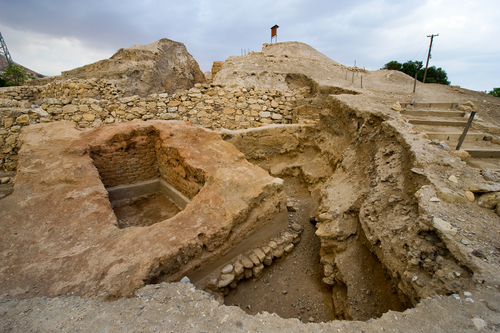
Image ID:73289745 Copyright: Buurserstraat38
Old ruins in Tell es-Sultan better known as Jericho the oldest city in the world

I recently attended a conference at which Ted Wright, an archaeologist, presented information related to the exodus of the Jewish people from Egypt and the later conquest of the area of Canaan. Ted Wright has participated in the excavation of Jericho and Khirbet el-Maqatir, thought to be the modern location of the city, Ai, mentioned in the Bible. One thing that Ted Wright said, which has stuck with me, is that modern archaeology continues to affirm people, places and other information contained in biblical accounts.

As an example, Ted Wright recounted the story of an archaeologist, John Garstang, who excavated Jericho in the 1930’s. Garstang concluded that the site dated to 1400 BC, consistent with the biblical account (John Garstang, “Jericho and the Biblical Story,” p. 1222.):

“In a word, in all material details and in date the fall of Jericho took place as described in the Biblical narrative. Our demonstration is limited, however, to material observations: the walls fell, shaken apparently by earthquake, and the city was destroyed by fire, about 1400 B.C. These are the basic facts resulting from our investigations. The link with Joshua and the Israelites is only circumstantial but it seems to be solid and without a flaw.”

Ted Wright observed in his talk that most of the battle in modern archaeology is not whether places, like Jericho, really existed, or the happening of events, but rather the timing of when they existed and happened. Continue reading “Timing the Walls of Jericho”

When Sin Crouches At the Door

depositphotos Image ID: 39910063 Copyright: ectorass

“If you do well, will you not be accepted? And if you do not do well, sin is crouching at the door. Its desire is for you, but you must rule over it.” Genesis 4:7

We know the story of Cain & Abel. They were the sons of Adam & Eve. They both offered sacrifices to God. Cain gave an offering from “the fruit of the ground”, and Abel of the “fat portions”[1] from the “firstlings”[2] of his flock. (Genesis 4:3-4) All was good, right?

Well, no. God “regarded” Abel’s offering, but didn’t “regard” Cain’s offering, and that is when the problem started. Cain became angry[3], and his “countenance fell”. (Genesis 4:4-5) We know the rest of the story: Cain ends up killing Abel.

Lest we be tempted to think that we don’t need to pay attention to the details of this story because we aren’t like Cain – we would never kill anyone – consider these words of Jesus:

“You have heard that the ancients were told, ‘You shall not commit murder’ and ‘Whoever commits murder shall be liable to the court.’ But I say to you that everyone who is angry with his brother shall be guilty ….” (Matthew 5:21-22)

Anyone who has ever been angry with another person, might do well to consider the details of the story of Cain and Abel.

Continue reading “When Sin Crouches At the Door”