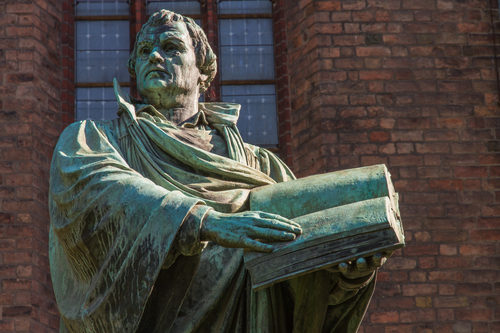
Today us Reformation day. I don’t really care about Halloween, so I figure I should say something about the Reformation.
You might call me a reformed Catholic. I grew up in the Catholic Church. When I encountered Jesus Christ, the living Son of God, who shed His glory to become a man, walked in obedience to His own purposes, died on the cross for our sins, and rose again from the dead, my life changed.
When I accepted Jesus Christ as my Lord and Savior, I left the Catholic Church for greener pastures. I have been involved with and visited many churches since then, and I am still looking for greener pastures. Along the way, I have learned that Catholics haven’t cornered the market on rigid structures and white-washed tombs.
The Christian response to the age old problem lies in the story of Adam and Eve. Created in God’s own image, they were given a choice but were forbidden from exercising it. Anyone with a modicum of understanding about human nature knows that forbidden fruit is a temptation that is hard to ignore. It should come as no surprise to us (or God) that Adam and Eve gave into the temptation and ate of the fruit.
God surely must have known that they would exercise that forbidden choice! Yet, he banished them from the idyllic “garden” He created for them and cursed the world, subjecting it to difficulty, pain, suffering and death. We are looking for a clue to the question that screams from our guts, “Why?!”
This indeed is the harsh reality in which we live. There can be no denying it. Recognition of this harsh reality is not uniquely Christian. It is a universal truth. The explanation of it is what differs. The atheist might simply say that we all die and “then worms will eat our bodies”. That’s just the way it is. The Hindu might say we suffer because of karma, and we all die, and die again, and again, and again, and again. The Buddhist might say we suffer only because we haven’t reached enlightenment because pain and suffering are just a figment of the unenlightened imagination. All worldviews must contend with the fact that we live in a less than idyllic world.
The Christian says we suffer pain and death because Adam sinned. “And we’ve been attending funerals ever since,” Clay Jones says; and “Only one thing is going to prevent you from watching absolutely every person you know die from murder, accident, or disease, and that will be your own death from murder, accident, or disease.” What a harsh sentence!
If the Bible is an accurate reflection of God and of reality, why in the world would God have cursed the ground and subjected His creation to futility?
The Apostle Paul tells us in his letter to the Romans that God subjected the world to futility “in hope that the creation itself will be set free from its bondage to corruption….” (Romans 8:20) This suggests that the choice that led man to corruption and the cursing of the world to futility was part of the plan all along. In this second half of “the story” we try to make some sense of it.
I am reading a book by Clay Jones called Why Does God Allow Evil? I highly recommend it. The “problem of evil” is one of the more challenging questions that we face in life, and difficulties struggling with that question have led many people to abandon or refuse to embrace faith in God.
Why does God allow pain and suffering? If God is good, how can He allow people to suffer? Why doesn’t God stop evil? If God exists, why does He allow evil to exist? These are just some of the variations of the problem of evil.
The problem of evil is a challenge for every worldview. Responses include that there is no God, and that’s just the way it is (a naturalistic world view); evil is just an illusion of unenlightened souls (a Buddhist or eastern view); evil is result of bad karma (Hindu); or evil is the result of rebellsion against God – sin (Christian). We all struggle with the conviction that things simply aren’t the way they ought to be. That Utopian disconnect urges us to ask, “Why not?”
I think, personally, that the Christian worldview makes the most sense of this question. It begins with the story of God and Adam and Eve. Whether the story is allegorical or historical, the answer involves God’s purpose in creating man, man’s finite, corruptible character (compared to God’s infinite, pure character) and a plan to develop this corruptible creature (man) who is created in God’s own image into a pure, loving relationship with God that is defined by God’s pure character, and not the corruptible nature of man.
I’m not a scientist, and I am not even “a science person”, though I have become much more interested in science as an adult than I was as a child. I am more of a philosophical and theological person. My background is English literature, world religions, and American jurisprudence (law).
We give scientists quite a bit of deference in our modern society, and so we should. They are peeling back the layers of this universal onion in which we live. Scientific discoveries are fascinating, life-changing and significantly valuable.
I would be quickly lost in the weeds in a discussion of science among scientists, but scientists are human. They have flaws, and they usually are not schooled in philosophy or theology.
For instance, Stephen Hawking is one of the most brilliant scientists of our age. In his book, The Grand Design, he says, “In a world in which a law like gravity exists, the universe can and will create itself out of nothing.”
This isn’t a statement of science; it’s a philosophical statement with theological impact. The question is: does it make sense?
I have written about the central importance of the resurrection of Jesus many times, but I come back to it again. Nothing could be more important. Of this Paul, was crystal clear in his writing.
If Christ has not been raised, then our preaching is in vain and your faith is in vain;
If Christ has not been raised, your faith is futile and you are still in your sins;
If in Christ we have hope in this life only, we are evolved people most to be pitied;
If the dead are not raised, “Let us eat and drink, for tomorrow we die”;
What you sow does not come to life until you die.
These are all statements made by Paul in his first letter to the people in Corinth.[1] These statements underscore and highlight the importance of the resurrection in Christian thought.
Jesus is the center of the Christian faith, and the gospel is at the center of Christianity and the resurrection is at the center of the Gospel. If Jesus was not raised from the dead, everything falls apart. The claims of Christianity are bankrupt because they rise or fall on this one point.
If Jesus was raised from the dead, Jesus is who he said he was and no other event in human history is more significant; no religion or philosophy lays a claim to hope in the present and the future like words of Jesus. Jesus truly is the “light of men”[2] and the “bread of life”[3].








 Navigating by Faith