From a presentation by Francis Collins at the Veritas Forum at the California Institute of Technology
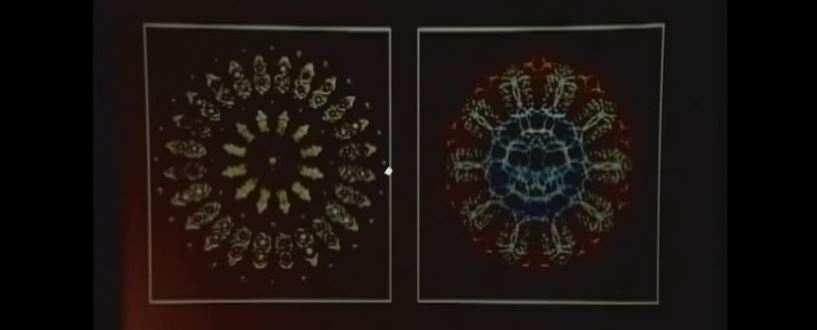
Take a close look at the two images. What do they represent? We might say that one image represents science and the other represents religion (or faith). But which is which?
The images are similar, but one of them is manmade, and the other is something we find in nature. Do you know which is which? Is the manmade image the scientific one or the spiritual one?
I will answer these questions; at least I will answer them as they were described in a presentation given by Francis Collins, the manager of the Human Genome Project, at a Veritas Forum at Caltech University in 2009. In the process, we will explore the chief question examined by this eminent scientist: whether science and faith are compatible.
Tim Keller[1] says there are no more important words in the prayer that Jesus taught us to pray then the first two words, Our Father.[2] The importance of these words is underscored by the way we reference The Lord’s Prayer. We sometimes call it “the Our Father”.
Why are these words so important?
Tim Keller says that these words frame our orientation toward God. He suggests that people either have a transactional orientation toward God or a family orientation. Most of us operate on a transactional orientation toward God and others at times in our lives. Some of us live there. Beginning a prayer by calling God, “Our Father”, orientates us the right way.
A transactional orientation is focused on what we must do in order to have a relationship, a connection, with other people. A transactional orientation focuses on what people (and God) can do for us. A transactional orientation is characterized by offering consideration[3] in order to get something in return.
When we have a transactional orientation toward God, we approach Him completely differently than the way Jesus taught us to pray. We come to Him looking for something for ourselves. We are focused on what we need and want. We feel like we have to offer Him something in order to get what we are seeking. A transactional orientation toward God turns prayer into bargaining.
When we have a transactional orientation toward God, we are not seeking God. We are seeking something from God.
The tree of life is mentioned only three places in the Bible. The first and most prominent appearance of the tree of life is in Genesis. The tree of life appears in Proverbs (three times) and again in the Book of Revelation (on either side of the “river of the water of life… flowing from the throne of God….”[1])
The tree of life was there in the beginning, and it will be reappear in the end. In between, where we are now, between Genesis and Revelations, we are presently cut off from the tree of life.
The tree of life obviously figures into God’s ultimate plan and purpose. But how? Where is the tree of life between the Garden of Eden and standing beside the river of the water of life flowing from the throne of God? Let’s take a look.
It wasn’t in reading books, listening to my professor or considering what other people said about the Bible and God; it was reading the Bible myself that led me to my enlightenment.
I have reflected and written about the fact that I was enamored by Buddhism in college, especially after a world religion class my freshman year but Buddhism is not where I found my enlightenment. I found enlightenment in reading the Bible.
I didn’t find enlightenment in reading what other people said about the Bible. I found enlightenment in reading the Bible myself.
I have written about the facial similarities of Christianity, Buddhism and oneness. They both place some emphasis on losing or denying one’s self and achieving oneness, but that is where the similarities end. In Buddhism, oneness with the cosmic essence of the universe is something we achieve. In Christianity, oneness with God is achieved in us as we submit to God and allow Him to take His rightful place in the center of our lives.
Whereas, Buddhism encouraged me to ignore myself, look past myself and to escape myself and all of my feeling, ambitions and ego into a cosmic forgetfulness of self, the Bible confronted me with myself. Reading the Bible was like having a one-on-one soul-searching conversation with a stern but loving Father who knew me more intimately and fully than I knew myself.
And then I met Jesus in the Gospels. I can only describe him as divine love incarnate. He is a figure like no other. Bold, daring, fearless, loving, brotherly, piercing, healing. He is everything we would expect a God, a father, a brother, a friend to be. (It wasn’t right away that I was introduced to and experienced the person of the Holy Spirit.) Continue reading “Lured by Buddha but Taken by Christ”→
Moderns have issues with miracles, but ancients did not. Many ancient histories reference miracles, and we do not discount them as histories for that fact. The miraculous element of the accounts of Jesus, however, are a basis on which many contemporary thinkers reject the claims of Jesus and claims about Jesus a priori.
Miracles are consistent with and flow from the nature and character of who Jesus claimed to be and who his followers claimed he was. If Jesus was God in the flesh, miracles are to be expected. The apostle John says that Jesus was the Word; he was with God in the beginning; He was God; and all things that were made were made through Jesus, the Word. (John 1:1-3) If the universe was made by and through Jesus, miracles are no big deal, and the resurrection is more than just possible.
This was thrust of the Gospels. The authority of Jesus resonated in his message and was attested by the miracles. Many moderns reject the message largely on the basis of the miracle claims because miracles are not allowed in a naturalistic worldview that dominates academia today. We can’t accurately judge what Jesus said, though, without being willing to suspend that disbelief, even if only to reach some understanding.








 Navigating by Faith