What is the Quantum of Proof Necessary to Believe a Biblical Account?

Believers are told to take the stories of the Bible in faith, Skeptics take the opposite view. There is evidence consistent with belief that the stories are true, but insufficient evidence to prove them beyond a reasonable doubt.

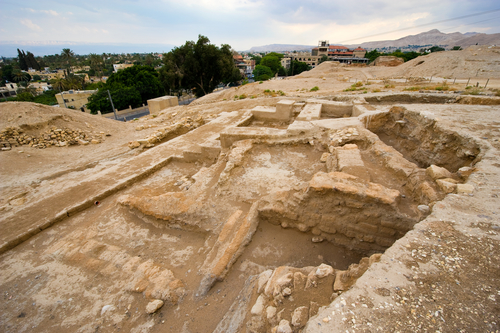
Ruins and remains in Tell es-Sultan, better known as Jericho, the oldest city in the world

I previously wrote a piece on the city of Jericho of biblical fame that was inspired by a presentation given by an archaeologist, Ted Wright, who excavated at tell es-Sultan, the modern site known formerly as Jericho. He commented that archaeology is not really divided over issues like whether Jericho existed. Rather, archaeologists differ on the chronology they find in the story of the stratified remains of prior habitation.

That issue of timing regarding the destruction of the city of Jericho was the focus of the previous blog. There is no doubt that Jericho was surrounded by a double wall of which the interior wall collapsed on the outer wall, forming a virtual ramp up into the city. The city was also clearly destroyed by a conflagration (fire). The only question is: when did those events that are evident in the rocky soils on the site took place?

The first archaeologist to dig at the site reached the conclusion that the city of Jericho was destroyed in the early bronze period, well before the Israelites may have come upon the heavily fortified City. According to the first assessment, Jericho had long been uninhabited by the time the Israelites arrived.

Subsequent archaeological digs revealed disputing conclusions. John Garstang found evidence in the 1930s that Jericho was destroyed around 1400 BC, exactly the time frame of the biblical account. Subsequently, archaeologist, Kathleen Canyon, came to the opposite conclusion, reaffirming the earlier opinion that the city was uninhabited by the time Joshua and his combatants came along. But wait… there is more.

The most recent archaeological findings, seem to suggest that the biblical timing is correct. Kathleen Canyon apparently ignored and failed to register the significance of Late Bronze period pottery that would not have been found in an area that was uninhabited by that time. Many factors that she missed reveal the error and suggest a date consistent with biblical chronology. (See Believers Score in Battle Over the Battle of Jericho, by John Noble Wilford, published February 22, 1990, The New York Times).

The story of the excavation of Jericho reveals how archaeology and interpreting what we find is sometimes highly influenced by what we believe about history. The same finding can suggest different conclusions, depending on what we are looking for (or not looking for). The difference as Ted Wright suggested, isn’t in the what, but the when.

The Bible, of course, has many fantastic stories in it. They are so fantastic, that many people simply find them incredible, as in not credible at all. Believers are told to take the stories on faith. Skeptics take the opposite view and reject them, hook, line and sinker (to turn a phrase). There is evidence consistent with belief that the stories are true, but insufficient evidence to prove them beyond a reasonable doubt.

Should modern archaeology require something more than reasonable doubt simply because the biblical accounts have a miraculous, religious bent to them?

Continue reading “What is the Quantum of Proof Necessary to Believe a Biblical Account?”

Justification by Faith

Whether there are 613 laws to keep or just two, who tend to view morality as a competition in which we compare ourselves to others.


In a previous blog post, I observed that Scripture reveals a progression from law to relationship to faith. In Habakkuk, the prophet said, “The righteous will live by his faith.” (Hab. 2:4) This statement in Habakkuk is the second half of a verse that contrasts “the proud one” whose soul “is not upright to the righteous one who lives by faith. The implication is that the righteousness is linked to faith and is contrasted to pride.

We see this theme continued in the New Testament:

“The righteous shall live by faith.” (Romans 1:17)


“Now it is evident that no one is justified before God by the law, for ‘The righteous shall live by faith.’” (Galatians 3:11)


“[M]y righteous one shall live by faith” (Hebrews 10:37)

And the reason that salvation is by faith (in the grace of God) is so that no one can boast.

“For it is by grace you have been saved through faith, and this not from yourselves; it is the gift of God, not by works, so that no one can boast.” (Eph. 2:9)

When Jesus summarized all the law and prophets in just two statements (love God and love your neighbor) he whisked us past the academic details of the law to the simple heart and spirit of the law. (Luke 10:25-27) If we think this simplification of the law makes it any easier on us, however, we should think again. At the same time Jesus simplified the expression of the law, Jesus upped the ante on us when he said that, if we even lust in our hearts, we have committed adultery. If we have even gotten angry in our hearts at our brother, we may have committed the sin of murder. (See Mathew 5:21-48)

Jesus made the law simpler and more difficult to follow at the same time!

Maybe this is because our ability to follow the law (to maintain God’s standard of morality) isn’t the key point. In fact, the point is our inability, in ourselves, to live up to God’s standard! Until we realize that we can’t measure up, we don’t measure up, we are depending on ourselves and our own efforts to “be right with God”. But we never can. Whether it’s 613 laws or just two principles, we fall short.

Our focus shouldn’t be on the laws and other people. On this horizontal level, we compare ourselves to others, and we judge ourselves and others in comparison. This is where pride and self-righteousness dwell, and the focus is, ultimately, on ourselves. Rather our focus should be vertical, on God and our relationship to him.

Continue reading “Justification by Faith”

A Progression from Law to Relationship

From over 600 laws, to a couple of dozen to just two principals, the progression in Scripture is from rules to relationship.


A friend recently commented on an article I wrote about hypocrisy in which I referred to “God’s standard” without defining what that standard is. Of course, defining God’s standard of morality isn’t that easy. My friend made this point when he said:

“If you asked 100 self-proclaimed Christians, you will get 100 different answers. There are over 30,000 denominations of Christianity… all bible-based. The notion of a singular Christian ‘standard’ doesn’t really exist. Example… is killing ok?… I can find verses in the bible both for and against.”

He is right on a cursory level, though he overstates the proposition. The World Christian Encyclopedia puts the number of denominations at 33,000, of which there are “6 major ecclesiastico-cultural mega-blocs”.  I would venture to guess, however, that 100% of them hold that murder is wrong.

While we might have virtually universal agreement on some things, and “consensus” on other things (perhaps, killing in self-defense), nuances will generate different answers among those different denominations, and individual Christians as well. We don’t all agree on topics like killing in war, capital punishment, abortion, etc.

Some disagreements are doctrinal (infant baptism or adult baptism). Some of them are conduct related. (Is it ok for Christians to dance? drink alcohol? or smoke?) Should Christians tithe? What is the standard of tithing? Is homosexuality a sin? If I walk past a homeless man on the street begging for money and don’t give him anything, is that a sin?

Most Christians agree on the ten commandments, but disagreement grows from there. We may not agree on the details of “God’s standard”, but virtually all Christians would agree that God has a standard of morality, regardless of whether we agree on what it is.

Still, it’s a fair statement to say that we shouldn’t be so glib as to assume some universal set of rules to which all Christians ought to subscribe – at least a universal statement of rules that we all confidently say is “the ” standard.

This got me thinking about morality from a Christian perspective, and it dawns on me that one of our failings is that we put too much emphasis on a set of standards that we can define. Yes, I think it is a failing, and I think Jesus would agree. Such a focus misses the point

Consider this: Moses gave us 613 laws; David summarized them in 15 laws; Isaiah reduced the summary to 11 laws; and Jesus reduced everything in the Law and the Prophets down to just two principles.

I am not sure that these figures are exactly right, but the point is that there is a progression in the Scripture. That progression goes from an intricate set of very specific rules to summaries of the law that get simpler and simpler – culminating in just two principles.

I believe this progression from many, very specific laws to just two principles correlates to the progression God wants us to make from law to faith.

Continue reading “A Progression from Law to Relationship”

When the Why Questions become Rhetorical

Why questions can be fruitful if they drive us to understanding, but they are fruitless if they become roadblocks to advancing our understanding.


I am not sure that I am up to the task of writing what I want to write, but I’m going to attempt it anyway. These thoughts occurred to me as I was listening to Justin Brierley interviewed by David Smalley. Brierley hosts the British show, Unbelievable! on Premiere Christian Radio, while Smalley hosts the atheist counterpart, Dogma Debate.

Both men are cut from the same cloth in the sense that they usually host people with opposing views, and they do it in a refreshingly even-handed, civil manner, giving deference and respect to both “sides” and both individuals. They are shining examples of open, intellectual discourse. I much prefer the informal and civil discussion to the formality and contrary tone of a debate.

Much of their discussion focused on the “problem of evil”. If God is all-good and all-powerful, why does He allow bad things to happen to people? Either He isn’t all-good, or He isn’t all-powerful. This is the classic problem of evil.

For David Smalley, the answer is either that “God doesn’t care, or God doesn’t exist”. If the answer is that God doesn’t care, David Smalley concludes, “God isn’t worthy to be worshiped”.

Many smart people, like Albert Einstein and Charles Darwin, have run their faith aground on these rocky shores.

As the two men discussed their respective views, and as Smalley questioned Brierley (because Brierley was the guest of Smalley in this show), I listened with interest and some mild frustration and disappointment. To paraphrase (and very poorly, I’m afraid), Smalley repeatedly asked unanswerable questions, and Brierley repeatedly tried to answer them.

I don’t blame either man. This is the condition of our finite beings. How can we know what we don’t know? The lot of a finite being is that we are left with some unanswerable questions and insufficient answers.

Continue reading “When the Why Questions become Rhetorical”

The Imago Dei

Each one of us bears the imprint of the Almighty God, and out of that one principal flows all the Law and the Prophets summarized in two commandments.


When Jesus was asked, “What is the greatest commandment,” he said “the greatest commandment is to love God with all your heart, with all your mind and with all your soul”. Jesus didn’t have to go any further. He had been asked what was the greatest commandment, and he answered the question, but he didn’t stop there. He offered a second greatest commandment, which is “to love your neighbor as yourself”. (Matthew 22:36-39)

Why did Jesus go further?

The significance of these two commandments that are the greatest of all is that you and I are made in imago dei – the image of God. Moreover, this revolutionary idea, that we are created in the image of God, is unique to the Judeo-Christian worldview.

The point is further illustrated elsewhere in the same Chapter of Matthew in a confrontation between pupils of the Pharisees, who were sent to challenge Jesus by asking him whether it is lawful to pay taxes to Caesar. They were trying to trap him with a question for which there was no good, politically correct, answer, but Jesus was not deterred by their ill will.

Rather, Jesus requested a coin. Someone produced a denarius (a Roman coin) for him. Ravi Zacharias describes the interchange that ensued this way.

“He held the coin out to [the man who gave it to him], and he said, ‘Whose image is on this?’ The man said, ‘Caesar.’ Jesus said, ‘Give to Caesar that which belongs to Caesar, and give to God that which belongs to God.’ The man should have had a follow up question, and the follow up question should have been, ‘What belongs to God?’ and Jesus would have said, ‘Whose image is on you?’”

Continue reading “The Imago Dei”