The Jesus We Meet in the Gospels

 (c) Can Stock Photo
(c) Can Stock Photo

I didn’t want to read the NY Times article, What Religion Would Jesus Belong To, by Nicholas Kristof.[1] Just as I suspected, the article lacked a deep understanding of Christianity. It lumps Christianity together with other religions of the world in a pluralistic mush. I don’t know the depth of the author’s understanding of Christianity, but it didn’t show in the article (though he claims a conservative Christian background).

Still, the article makes a good point… and I shouldn’t be so reluctant to admit it.

American churches don’t reflect “the Jesus we meet in the Gospels”. Never mind that the author’s proof is another NY Times article complaining of the Christians of the Republican Party.[2] The author seems to equate Jesus with the current political and moral landscape, as if Jesus would condone it, as if the modern American church is the exact representation of Jesus. If the modern American church doesn’t accurately reflect the Jesus we meet in the Gospels, it isn’t a reflection on Jesus; it’s a reflection on the modern American church. Continue reading “The Jesus We Meet in the Gospels”

Buddha, Jesus and Oneness

I believe there is truth to be found throughout the world, in every religion, philosophy and culture, but I only see one source that pulls all of those truths together into a cohesive whole

 (c) Can Stock Photo

How many people have claimed to be God and have people wondering for centuries whether the claim is true? The list is short! While many people have claimed to be God or a god, most of them have only left people wondering what they were smoking or what the diagnosis is!

I often recall the World Religion class I took in college and the fact that Buddhism was particularly attractive to me at that time. I entered that class thinking that truth could be found in many places, all around the world, in all religions, philosophies and cultures. I still think there is truth to that statement. After all, truth is truth wherever it is found.

At the same time, I hear people say that all religions are essentially the same or that they are all the same in essence. I didn’t find that to be true when I studied the word religions in college (though that was my professor’ suggested the same sentiment’s thesis), and I don’t find it to be true now. While there are some similarities and themes that run through many if not most of the world religions, the differences are significant and fundamental. A comparison between Buddhism and Christianity will serve as an example.

Continue reading “Buddha, Jesus and Oneness”

An “Other” View of Christianity

it is more intellectually honest to acknowledge the different worldviews and social practices, including the resulting necessity that there is a choice to be made to determine which is more truthful than the others

© Can Stock Photo Inc. / Bialasiewicz

I began my college career with a World Religions class that exposed me to the major world religions. My professor boasted a Christian upbringing and background, but he was more of a universalist than a Christian in his theology and philosophy. The class focused more on the religions other than Christianity than Christianity, partly, I suppose, because most people sitting in a World Religion class in a small liberal arts college in Iowa already were acclimated to Christianity.

Western Civilization was another class I took. Western civilization, not surprisingly, dominates and colors most of the history of American thought since the United States is predominantly an extension of Greek, Roman and western European philosophy and ideology. My Jewish religion professor put that in context for me one day in a class on the Old Testament when he asserted that Judaism has roots in Eastern religion and civilization. (I was a thesis away from being a religion major.)

I will not repeat the context or expand on the details of that proposition. I have forgotten most of the details anyway. The take away I want to chew on with this piece is that we make assumptions about religion and the world based on how we have been acculturated and “indoctrinated” by our culture. Listening to the perspectives of “others” provides us valuable, different perpectives, even on the things with which we are familiar (like Christianity).

Continue reading “An “Other” View of Christianity”

Islam & Christianity Through a Former Muslim’s Eyes


I am going to do something a little different in this blog. I often weave other people’s presentations and thinking into my articles, but, in this one, I am going to lay out another’s person’s presentation in its entirety.

No one topic, perhaps, in all the world today has demanded more of the world’s attention than the happenings involving radical Islamic terrorists.  This article is not going to attack Muslims; neither is it going to defend them. Rather, if you will listen to each of the segments, it will help you to understand Islam and Christianity in comparison to each other from the viewpoint of a man raised a devout Muslim of Islamic missionary parents.

Continue reading “Islam & Christianity Through a Former Muslim’s Eyes”

The Idol of the Mind

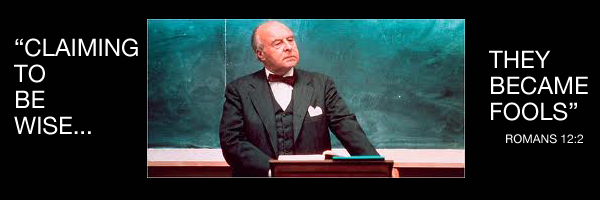
Wise_Fools


I listened to a lecture on materialism yesterday. Materialism is a predominant worldview that informs many people who adopt a view of science that conflicts with faith. A materialist worldview sees no purposeful principles in nature, no designing influence, no God, no inherent moral or ethical laws and ultimately no meaning in life. The world, in essence, is arbitrary and capricious. It is “governed” by unguided processes and chance.

When I woke this morning, I began thinking about government. I am an attorney, and I represent local governmental bodies. One cardinal rule that applies to governmental bodies in the United States is this: they can never be arbitrary or capricious. Every law must have a rational basis and (at a minimum) an articulable reason for every law. If no rational basis exists for a law, it will be determined unconstitutional and void because it is arbitrary and capricious.

Ironic, is it not, that we would govern ourselves by such a standard and not believe in purpose, meaning, intelligent design, God or inherent ethical and moral laws. We govern ourselves by reason and design, but many of us believe we live in a world that has no reason or design.

Continue reading “The Idol of the Mind”