I tried to set the stage for what it means to follow Jesus in Babylon with a prior post: God’s Ways: a Primer for What It Means to Follow Jesus in Babylon. It is a kind of running start – a view from 40,000 feet. The purposes of God establish the context for understanding how we follow Jesus in Babylon.
Jesus, of course, did not live in Babylon during the 30-some years he walked the earth. I am speaking figuratively here. Jesus urged people to follow him, to live as he did and to “walk” as he walked – to be imitators of Jesus as he was an imitator of God the Father. We follow Jesus wherever we are.
Most people reading this blog don’t live in Babylon either, as in the ancient city. Rather, Babylon is symbolic of our lives in this world. Just as the exiles found themselves living as foreign people in a foreign land filled with foreign gods, followers of Jesus today are aliens and strangers in this world living among people who do not bow down to our God.
When Jeremiah wrote to the Jewish exiles in Babylon right after they were taken captive, right after they lost everything (their homes, their lives as they knew them, the Temple around which their community was organized), his words would have been difficult to receive.
“Thus says the Lord of hosts, the God of Israel, to all the exiles whom I have sent into exile from Jerusalem to Babylon….”
Jer. 29:4
That God “sent” them into exile would have been a painful reminder of all the warnings of the prophets leading up to the final siege of Jerusalem, captivity, and long march to Babylon. Jeremiah had their attention, though. The unthinkable that Jeremiah had long been predicting actually happened.
In that context, this is what he said:
“Build houses and live in them; plant gardens and eat their produce. Take wives and have sons and daughters; take wives for your sons, and give your daughters in marriage, that they may bear sons and daughters; multiply there, and do not decrease. But seek the welfare of the city where I have sent you into exile, and pray to the Lord on its behalf, for in its welfare you will find your welfare.”
eremiah 29:5-10
I don’t think we can emphasize enough the timing of these words: this was the very beginningof the exile. They just lost everything. They just got there. Their future was uncertain. Though they had some hope of returning to their homeland (because the prophets who warned them of the exile also predicted their return), their hope was faint at this point.
I assume that most of the people reading this blog are not exiles, though many hundreds of thousands of people are refugees in this modern world. Even those of us who are not refugees are not “of this world” if we belong
In the rest of this blog, I will relate those words Jeremiah wrote to the exiled Jews in ancient Babylon to our lives in our modern “Babylon” today, and I will add in the warning, and the encouragement, that Jeremiah gave in the letter that are also instructive to us today. I believe Jeremiah’s words of instruction are how we should follow Jesus in Babylon.
Jeremiah wrote a letter to the Jews in Babylon. The Jews were exiled by God’s doing. He has been warning them about it regularly. Then, it happened. I am sure they were stunned anyway. Jeremiah opens his letter saying:
“Thus says the Lord of hosts, the God of Israel, to all the exiles whom I have sent into exile from Jerusalem to Babylon….”[i]
Jeremiah 29:4
God put you and I where we are, also. What God says to the Babylonian exiles then is instructive for us today, wherever we are.
I am going to break what Jeremiah says down and apply it to our world today, but first we need to set the stage. We need to step back and consider the big picture.
“From one man he made all the nations, that they should inhabit the whole earth; and he marked out their appointed times in history and the boundaries of their lands. God did this [marking out our appointed times and where we live] so that [we] would seek him and perhaps reach out for him and find him, though he is not far from any one of us.” (Acts 17:26-27)
Nothing in all of human history has caught God off guard. God saw the sweep and the details of that history from before time. He also knew you.
He knew where you would be born. He knew the hairs on your head. He knew the smiles and frowns on your face, your thoughts and every word that would slip from your mouth before they were even said. (Echoing Psalm 139)
God saw the United States of America, and all the nations of the world before they were established, their course in history and their demise. What we call future isn’t future to God. He exists outside of time. He existed before time began to tick. He exists now, and He exists in our future.
God is orchestrating the people, the times, the events in history for one end. John caught a glimpse of that end when he saw people of every nation, tribe and tongue gathered around the throne of the Lamb. (Rev. 7:9) Has Paul described God’s plan and purpose this way,
Romans 8:20-23
My commentary
The creation waits with eager longing for the revealing of the sons of God.
All creation is in on the purposes of God and is waiting for the fulfillment of God’s plan
For the creation was subjected to futility, not willingly, but because of him who subjected it,
Our present conditions are part of God’s plans and part of the ultimate purposes of God to be accomplished in the world He set in motion
in hope that the creation itself will be set free from its bondage to corruption and obtain the freedom of the glory of the children of God.
God’s plan and purpose is for creation to be freed from the present futility to which He subjected it as we obtain the freedom of becoming His children.
For we know that the whole creation has been groaning together in the pains of childbirth until now.
It was so from the beginning. When Eve fell in the garden, God increased her pain in childbirth….
And not only the creation, but we ourselves, who have the firstfruits of the Spirit, groan inwardly as we wait eagerly for adoption as sons, the redemption of our bodies
When we are born again, by faith in God’s grace, and receive the Spirit, we taste the fruit of the life God offers and look forward to our ultimate redemption.
God’s Ultimate Plan
God marked out the appointed times in history of all the peoples of the earth and the boundaries of their lands throughout time, and that history is part of the larger creation that is waiting in eager expectation for the plans and purposes of God to be worked out in us and, ultimately, in creation. We are part of that plan.
We are at the center of the plans and purposes of God, who made us. Of all the creatures God created, we alone are created in His image. The creation waits eagerly for us to engage in that plan and purpose of God – each one of us and us, and us collectively.
Like the people of Judah in Babylon, we find ourselves exiles and strangers in the earth (1 Peter 2:11), if indeed we have been born again, born from above. When we are born again, we are born of the Spirit (John 3:1-21) by which we gain entry to the kingdom of God, which kingdom is not of this world. (John 18:36).
“But to all who … receive him, who [believe] in his name, he [gives] the right to become children of God, who [are] born, not of blood nor of the will of the flesh nor of the will of man, but of God.” (John 1:12)
When we receive Him, He gives us “the right to become children of God”. Though God knew us and “chose us in Him from before the foundation of the earth” (Eph. 1:4), He gives us, at the same time, the right (exousia, the right or authority) to become His children – it isn’t a forgone conclusion – at least not from our perspective.
We have to receive it, to begin with, and to believe (trust and commit to) it. In more popular parlance, we have to walk in it. Indeed, Jesus calls us as disciples to follow after Him, to “walk” the way he walked, to live as he lived. Paul says it this was:
So if there is any encouragement in Christ, any comfort from love, any participation in the Spirit, any affection and sympathy,complete my joy by being of the same mind, having the same love, being in full accord and of one mind.Do nothing from selfish ambition or conceit, but in humility count others more significant than yourselves.Let each of you look not only to his own interests, but also to the interests of others.Have this mind among yourselves, which is yours in Christ Jesus,who, though he was in the form of God, did not count equality with God a thing to be grasped,but emptied himself, by taking the form of a servant,[c] being born in the likeness of men.And being found in human form, he humbled himself by becoming obedient to the point of death, even death on a cross.” (Philippians 2:1-8)
Jesus is no longer with us to demonstrate in person how to walk as he walked, but we have Scripture and the Holy Spirit as our guide. Indeed, all Scripture “is God-breathed” (inspired), and it is useful for teaching, rebuking, correcting and training in righteousness”, so that we can be “thoroughly equipped for every good work”. (2 Timothy 3:16-17) The people who first heard these words would have thought primarily of what we call the Old Testament.
What we find in Jeremiah’s words to the people of Judah exiled in Babylon are instruction for those of us today who are exiled as aliens and strangers in this present world (if indeed we have truly been born again). What he says may not fit the modern Church narrative and example, though – or at least the poplar notion of what that is.
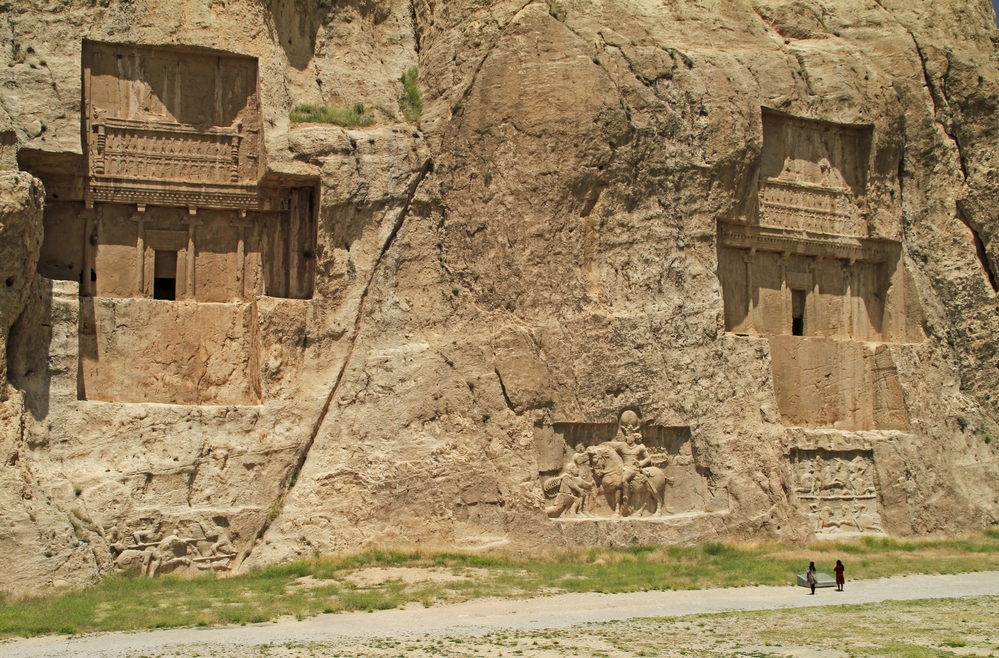
The graves of the Persian kings Darius and Xerxes near Persepolis, Iran
I am finding a wealth of subject matter in Tom Holland’s history of western civilization, Dominion: The Making of the Western Mind. Of particular interest is the place where he starts his history of the west – with Darius, the great Persian conqueror of the Assyrian and Babylonian empires in the east.
It seems that Holland’s candid explorations of history have fascinated him as much in tracing the threads of his childhood fantasies about ancient history as in busting the myths that arose as part of those childhood fantasies. Below he describes the busting of one of those myths – that the Greeks fought off the evil Persians from the east to save the west:
In Persian Fire: The First World Empire and the Battle for the West, which focuses on the Persian incursion into Greek territory, Holland realized that the Spartans were no champions for freedom, and the Persians were no moral monsters comparatively. In fact, the Persians were the ones motivated by what they believed were moral callings – something that would have been a completely foreign concept to the Greeks.
Darius and the Persians during his reign believed in Ahura Mazda, the Zoroastrian supreme, creator God. When I was in college, I learned in my World Religion class that Zoroastrianism was the first monotheistic religion. I had my doubts then about that statement, as I do now (see The Roots of Modern Ethics in the Ancient Near East), but the fact is that monotheism developed in the ancient Near East. Not in the west.
The first reference to Ahura Mazda appears in the Behistun Inscription by Darius. Darius reigned from 522 BCE until his death in 486 BCE. While Holland uses more “traditional” historical sources for Dominion, Hebrew Scripture intersects with Persian history in this time period.
Before Darius, the nation of Judah was exiled to Babylon when Nebuchadnezzar II conquered Jerusalem in 587 BC. The Prophet, Jeremiah, describes the siege of Jerusalem (Jer. 39:1-10 & 52:1-30), and Nebuchadnezzar is mentioned throughout the first four chapters of Daniel, who was one of the exiles from Jerusalem in Babylon.
Though Nabonides succeeded to the throne after Nebuchadnezzar, his son, Balshazzar, was left in charge in Babylon for ten years while Nabonides was away on an archaeological expedition. Balshazzar is mentioned in Daniel, chapters 5, 7 and 8. Daniel mentions his death, which occurred after Cyrus II (Cyrus the Great) conquered Babylon (539 BC). Nabonides was also killed on his return to Babylon that same year.
Cyrus conquered Babylon while the Hebrews were exiled there, and the Hebrews were still exiled in Babylon when Darius 1 (Darius the Great) took over as the king in 522 AD. Again, the biblical reports intersect with the more “traditional” archaeological and historical sources.
Though Jeremiah 29:11 is often quoted as a stand-alone verse, the context of it dramatically enriches its meaning. The context also reveals meaning that we would miss if we didn’t understand the circumstances in which these words were spoken. This is the main message of the first installment of this three-part series – The Plans God Has for Us – Part I.
When we read the following words, we should be mindful of the context:
“’For I know the plans I have for you,’ declares the Lord, ‘plans to prosper you and not to harm you, plans to give you hope and a future.’” (Jeremiah 29:11)
Aside from the fact that we often ask God merely to bless our own plans, not considering (or taking seriously) that He has his own plans for us, this verse is often quoted with anticipation of some immediate or not-too-distant hope and future in our own lives. The context suggests, however, that we should understand the much “bigger picture” and context the import of this verse that extends far beyond the immediate and near future circumstances of our own lives.
Consider that the prophet, Jeremiah, lived and served God during the last four decades leading up to the exile of the people of Judah to Babylon, including the beginning of that exile period. Jeremiah’s life and prophetic ministry spanned from the 13th year of the reign of King Josiah (627/626 BC) through the siege and capture of Jerusalem by the Babylonians in 586 BC and beyond.
These were doom and gloom years in which an ominous, dark cloud of loomed over Judah, and it eventually swallowed them up in the form of the siege of Jerusalem and march into Babylonian exile. Most of Jeremiah’s ministry focused on warning God’s people of this impending fate.
Jeremiah wasn’t a popular prophet (not that prophets are known to be popular). He was imprisoned, and his life was threatened multiple times during the course of his ministry. People didn’t like or receive well the drumbeat of warning that he pounded.
The Book of Jeremiah reveals a prophet whose life was full of emotional angst. The people of Judah didn’t want to hear what he had to say, and they were openly hostile to his message. He was faithful to God in spite of the unpopularity it brought him. He often lamented the hard-heartedness of the people and their refusal to take heed.
“Jeremiah found himself addressing a nation hurtling headlong toward judgment from God. The Israelites may have feared the future as the outside powers drew near, but rather than respond with humility and repentance, the people of Judah primarily lived as islands unto themselves, disregarding both the Lord’s commandments and the increasing danger that resulted from their disobedience.”[i]
Because Jeremiah’s ministry stretched over the 40 years just before the Babylonian conquest of Jerusalem and exile, the main theme of the Book of Jeremiah is judgment. Jeremiah 29:11 is quoted from a letter Jeremiah wrote to the Babylonian exiles after the judgment he had been proclaiming for four decades finally came to pass.
The larger context is the chronicle of the history of God’s people from the covenant God made with them in the Sinai Desert to the time of Jeremiah was approximately 900 years, and it was marked by ongoing disbelief and disobedience, culminating in the Babylonian exile. The immediate context is 40 years of Jeremiah warning God’s people of God’s imminent judgment and their refusal to listen or change their ways. In that gloomy scenario in which that judgment finally came to pass, Jeremiah writes:
“’For I know the plans I have for you,’ declares the Lord, ‘plans to prosper you and not to harm you, plans to give you hope and a future.’” (Jeremiah 29:11)
As we look at the entire letter from Jeremiah to his exiled brethren and consider its application, then and now, the nuances of Scriptural meaning and application to our lives becomes more poignant. We will do this in The Plans God Has for Us – Part III.
~~~~~~~~~~~~
[i] See Insight for Living, Jeremiah, by Charles Swindoll.




 Navigating by Faith