Understanding the Hiddenness of God: Insights on the Nature of and Mystery of God

God is not a physical being like we are in this material world

The “hiddenness of God” is a reality that causes some people to doubt the existence of God. If God is so great and so loving, why is He hidden to so many people? If God really exists, why isn’t God plainly evident to everyone? If God desires everyone to know Him, what’s the problem?

I have many thoughts about this dilemma, and I have written on the hiddenness of God many times before. Today, however, I want to highlight some thoughts that come through comments by an Australian YouTuber, Confident Faith, on a conversation between Jordan Peterson and Bishop Barron.

They discuss the nature of God – what kind of “being” God is. We naturally approach the idea of God from our human perspective. A person might wonder, “How can we even know what kind of a being God is?” Especially, if we are not even sure God exists!

But, we can know what kind of a “being” a God who could have created the Universe may be. Our reason suggests to us that a God who is capable of creating the time, space, and matter that comprises the Universe must be separate from and “other” than the reality of the Universe. Such a creating God must exist in a reality that is not contained within the Universe.

If we might think of the Universe as a box, we might say that boxes don’t simply for or create themselves. A box maker (who is not a box) creates them. Thus, we can intuit that Universes don’t form or make themselves. A Universe maker is required who is contained within a Universe.

If the box (or universe) is all we know, it’s hard to conceive of something outside the box (universe). It’s exceedingly hard for us to conceive of reality other than the basic units of time, space, and matter that comprise the physical Universe in which we live. Therefore, we have an exceedingly difficult time wrapping our minds around the idea of a Creator of those who is not contained within the reality of our Universe.

Even my attempt to describe the problem is inadequate, as the only reality we know is a physical one (comprised of that same time, space, and matter). For a God to have created those things and to have formed them into the Universe, that God would have to have been timeless, spaceless, and immaterial (not contained within that box), yet present with it.

I know that many people believe that a thing can create itself. Stephen Hawking famously said, “Because there is such a thing as gravity, the Universe can and will create itself from nothing.” This is a box creating a box analogy. Hawking is essentially saying that the substance that makes up the components of the box (Universe) self formed and self organized into a box (Universe).

I, personally, find it harder to believe that the Universe created itself than to believe that God, who exists “outside” time, space, and matter, created the Universe.

This fundamental difference in approach and perspective is the Continental Divide on the issue of the existence of God. A person who is unwilling or unable to consider anything “outside” the bounds of the time, space, and matter that comprise the Universe is going to be utterly incapable of “seeing” (grasping, conceiving, or even allowing for) the possibility of God.

But, this way of thinking is not foreign to any of us. In fact, it’s most natural for us to think this way, because all we know is the box (Universe) in which we live.

In dealing with this dilemma, Bishop Barron goes back to the ancient text in Deuteronomy when Moses asked God, who should I say sent me. Barron says that Moses was basically asking, “What kind of a being are you?” In doing this, Moses is trying to put God into categorical terms.

God’s response was, “I am who I am!”  God is saying that He cannot be categorized as we categorize things in this Universe. This response points Moses to outside the box (Universe). This means, says Barron,, “God is not a being, but Being, itself.”

If we follow down the path of Moses’s questioning, we inevitably end up as an atheist. If we insist on putting God into categorical terms, like the time, space and matter we can touch, see, feel, and measure, God remains a mystery. We can’t touch, see, feel, or measure God because He is not comprised of (or limited by) physicality (time, space and matter), and, therefore, God is not a categorical object in the world.

Augustine called God the “Prius” – the thing that is prior to being, itself. God is that upon which the categorical world depends. God is not the highest being (as we often conceive Him to be), the highest being is still just a being; rather, God is the essence of being.

I like the way Confident Faith wraps up these things. He says,

“God is not a physical being like we are in this material world. For example, humans, animals and plants are all physical beings in this physical world. However, the pitch of God’s existence is infinitely higher. He is not physical like we are. He is Spirit. God does not exist somewhere in this physical universe. You won’t find him hiding behind some distance galaxy way out on the known limits of the known universe. Likewise, you won’t find Him hiding somewhere in the subatomic realm. It’s foolish to expect or demand that God be found in this way…. God is not just one being among many in this world. God is the very source of being.”

We are finite; God is infinite. We are contingent and caused; God is non-contingent and uncaused. We are physical, but God is Spirit. Therefore, Confident Faith says,

“Taking these factors into account, it’s reasonable to hold that God’s existence in nature will always, to a degree, be a mystery or hidden from us.”

The hiddenness of God, therefore, is a function of the difference between a box maker and the things in the box. We are a “thing” in the box of this Universe, and God “outside” of it. We are constrained by our physicality, and God is not constrained by physicality because God is Spirit.

Our ability to grasp and to understand such a God, therefore, requires us to let ourselves think outside the box of this Universe. We have to be willing to think outside the box to be able to begin to gain some understanding of God.

I have embedded the short YouTube video on this subject below, but I will close with a few other passages in the Bible the speak profoundly of the nature of God. These passages reveal that God’s hiddenness has purpose, that God knew what He was doing in creating the world the way He did, and His “hiddenness” from us is part of that purpose.

“God is spirit, and those who worship him must worship in spirit and truth”

John 4:24

The God who made the world and everything in it, being Lord of heaven and earth, does not live in temples made by man, nor is he served by human hands, as though he needed anything, since he himself gives to all mankind life and breath and everything. And he made from one man every nation of mankind to live on all the face of the earth, having determined allotted periods and the boundaries of their dwelling place, that they should seek God, and perhaps feel their way toward him and find him. Yet he is actually not far from each one of us, for

“‘In him we live and move and have our being’;

as even some of your own poets have said,

“‘For we are indeed his offspring.’

Acts 17:24-28

Paul recognized in his address to Greek philosophers in the passage quoted above the “hiddenness” of God, such that we must “seek” Him and “feel [our} way toward Him”. I believe, as some have objected, that God could have made himself plainly evident to us, but He chose not to do that.

I believe the reason He chose not to reveal Himself plainly to us is to give us space to seek Him because we want to, not because we must. If God was plainly evident, what choice would we have?

I believe that God is not looking for automatons that are programmed to obey. God wants us to know Him and to love Him authentically. He does not desire that we merely believe in Him; He desires a reciprocal relationship with us. but A clue to this lies in the words of James:

Even the demons believe—and shudder!

James 2:19

The demons have no doubt that God exists, but they hate God, and they “bristle” at the thought of God!

In the event a person might be tempted to think that the hiddenness of god is unfair, we have these promises:

Ask and it will be given to you; seek and you will find; knock and the door will be opened to you. For everyone who asks receives; the one who seeks finds; and to the one who knocks, the door will be opened.

Matthew 7:7-8

 Behold, I stand at the door and knock. If anyone hears my voice and opens the door, I will come in to him and eat with him, and he with me.

Revelation3:20

God may be “hidden” to us, but He desires to be “found”. He promises that He will reveal Himself. We can’t be half-hearted about it, however.

 You will seek me and find me when you seek me with all your heart.

Jeremish 29:13

An Interview with Dr. Bruce Greyson on Near Death Experiences, Part 2

If you lose your fear of dying, you also lose your fear of living.

A woman dies and her spirit arises.

I have done two articles on Dr. Michael Guillen’s treatment of near-death experiences (NDEs) based on his podcast (Science + God with Dr. G}. Guillen is an astrophysicist who taught physics at Harvard and earned his degrees from Cornell University under the tutelage of men like Carl Sagan and Fred Hoyle.

He is no slouch when it comes to science, and it was his “beloved science” led him to question the materialistic worldview he assumed to be true. As his worldview expanded with the quantum entanglement of scientific discoveries that pushed those once fixed boundaries out of his comfort zone, he began a journey that eventually led him to faith in a Creator, God.

Dr. Guillen’s current interest in NDEs is understandable. It didn’t take much convincing for Dr. Guillen to determine that NDEs are real. His interviewee in episode #48 of the podcast, Dr. Bruce Greyson, on the other hand, was puzzled, but initially dismissive, when he encountered an NDE in patient. He didn’t have room in his materialistic worldview for NDEs, but the curiosity of his scientific mind propelled him forward.

Greyson is the Chester Carlson Professor Emeritus of Psychiatry and Neurobehavioral Sciences at the University of Virginia. You can listen to the interview here on the story behind the study of NDE’s, which became Dr. Greyson’s academic pursuit.

Dr. Greyson has studied NDEs, now, for about 50 years, and the data he has accumulated is significant. In this second article on the interview of Dr. Greyson, I want to begin with the question posed by Dr. Guillen to Greyson: whether the near-death stories people tell are “all over the map”? Greyson did not hesitate with his response:

“They are not all over the map. There are similarities in what people tell us, not only between different individuals but between different cultures and religions. A lot of people tell the same stories. We find near-death experiences from people in Ancient Greece and Rome that sound like they could have happened yesterday.”

These consistencies have been categorized over many years by researchers like Greyson.

As a scientific study, researchers have tried to correlate NDE’s with physical, environmental factors, such as oxygen deprivation and over-stimulation by drugs. Greyson says, however, “We don’t find any correlations at all.” His current conclusion after 50 years of research is that environmental factors don’t appear to explain NDEs.

The consistencies from person to person and culture to culture over the span of time leads Greyson and other NDE researchers to view them as a singular phenomenon. Greyson says the same characteristics of NDEs reoccur over and again regardless of who has experienced them. Gender, ethnicity, cultural background and religiosity (or the lack thereof) don’t seem to factor into NDEs. “Atheists describe the same things as Catholics do,” says Greyson.

Commonalities in the NDE experience, however, may not be as intriguing to Dr. Greyson, the psychiatrist, as the common outcomes. The most interesting outcome to him, he says, is the effect NDEs have on the people who experience them.

Dr. Greyson says, “I make my living trying to help people change their lives, and it’s very difficult to do.” The NDE experiences that take a few seconds or a few minutes at most “totally transform someone’s attitudes, beliefs, values, and behavior,” which leads Greyson to conclude, “That’s a powerful experience!”

The data shows that NDEs are a universal phenomenon. Greyson won’t speculate whether NDEs indicate some universal reality, something universally going on with physical bodies, or something that is a universal psychological trait. He is cautious to say, “We don’t know the answer to that.”

As Greyson continues with the interview, I am impressed that his scientific training and skepticism familiar to his materialistic worldview guide him forward in this field that might tempt another person to run wild with imagination. He is careful not to speculate, but he is candid about the things that appear to be evident from the volume of data, even if they cannot be explained by his worldview.

Continue reading “An Interview with Dr. Bruce Greyson on Near Death Experiences, Part 2”

Drinking Living Water & Embracing the Unseen: of Science and Faith

My inspiration this morning comes from “the woman at the well” and Galileo. They are separated by about 1500 years, but their stories resonate together for me this morning.

The theme is inspired by the questions: “How should we read Scripture?” and “How should we understand science and faith?” Those questions were relevant over 2000 years ago; they were relevant 500 years ago; and they are still relevant today.

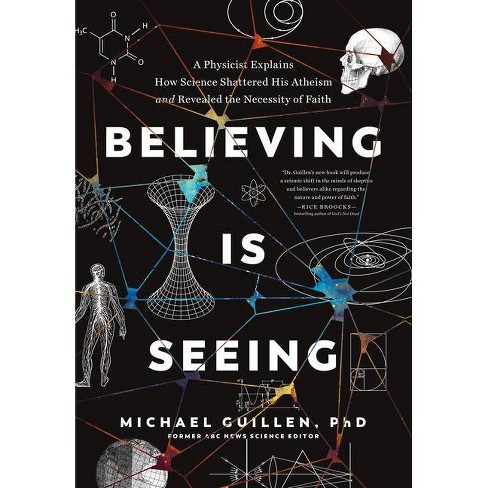
Michael Guillen, in his book, Believing is Seeing, reveals how logical and trans logical thinking are different tools, and each have a place in the intellectual toolbox. Logic is necessary to understand simple, “trivial” truths, but “profound” truths, he says, require trans logical thinking.


We err to apply logic to every problem. Simple matters are the province of logic, but complex matters require trans logic. As much as we might want to keep complex matters simple, we cannot gain insight into many complex matters without a willingness to go beyond the familiar confines of simple logic.

Guillen recognized the necessity to stretch beyond simple logic to more complex, trans logical thinking, among other things, in the realization that dark matter and dark energy make up 95% of the universe. In other words, 95% of the universe is invisible to us! (p. 9)

If we insist on limiting ourselves to things that we can see, touch, feel, smell, and hear, we must give up on 95% of the universe. If we want to explore outside the boundaries of what we can see, we need to adopt more robust, trans logical thinking.

Trans logical thinking is not anti logic, but it isn’t as linear as logic, and it may require holding things in tension that may seem contrary on their face. Classical physics and quantum physics are good examples of things we believe are both true, but which seem to be contradictory on their face.

If we are not willing to give up on 95% of reality, we must be willing to adapt. We must let go of our insistence that everything be reduced to what we can affirm with our senses and to what will fit into simple formulas and logical constraints. We need to think outside the box.

Guillen sees a parallel in the “stretching” that scientists must do to grapple with the unseen world at the edges of simple science and the revelation of the Bible of more “spiritual” things:

“’What no eye has seen,
    what no ear has heard,
and what no human mind has conceived’ —
    the things God has prepared for those who love him—
these are the things God has revealed to us by his Spirit.”

1 Corinthians 2:9

What the Spirit of God can reveal to us is somewhat similar to the stretching the scientist must do in his thinking to understand things like dark matter and dark energy, quarks, quantum entanglement and other mysteries of science that defy Aristotelian logic and conventional principals. For people who like to live with their feet planted solidly on the ground and with certainty anchoring their beliefs, the prospect of revelation by God’s Holy Spirit is like a black hole. We dare not venture too close for fear of being sucked into a black hole.

Yet, God not only invites us in; He insists that we venture close to understand Him.

“The Spirit searches all things, even the deep things of God. For who knows a person’s thoughts except their own spirit within them? In the same way no one knows the thoughts of God except the Spirit of God. What we have received is not the spirit of the world, but the Spirit who is from God, so that we may understand what God has freely given us. This is what we speak, not in words taught us by human wisdom but in words taught by the Spirit, explaining spiritual realities with Spirit-taught words.”

1 Corinthians 2:10-13

The difference between logic and trans logic in science and the study of the edges of the physical world have application to the metaphysical world in the encounter of the woman at the well with Jesus. I will lay out the similarities I see below.

Continue reading “Drinking Living Water & Embracing the Unseen: of Science and Faith”

Why Did God Subject the World to Futility?

Photo by Ken Gortowski

I want to focus on the following statements Paul made in his letter to the Romans:

“[T]he mind set on the flesh is hostile toward God; for it does not subject[i] itself to the law of God, for it is not even able to do so…. 

Romans 8:7

“[C]reation was subjected[ii] to futility[iii], not willingly, but because of Him who subjected it, in hope that the creation itself also will be set free ….”

Romans 8: 20-21

Life and death, the universe and all the “stuff” that is, ever was and ever will be are “in God’s hands”. That is another way of saying that God created everything. God is timeless and immaterial and has created all that is material out of nothing, including us.

But the material world, the world as we know it, is passing away (1 John 2:17), even from the moment it was created! That’s what science (the second law of thermodynamics) tells us also. The world has been has been “winding down” since the “Big Bang”.

Paul’s statement about the “futility” to which the world has been subjected suggests that futility is part of God’s ultimate plan, because it was done “in hope”.

If that doesn’t add up for you, I don’t think you are alone. I have been puzzling on it for awhile. What possibly could be the plan?

The trite response that “God’s ways are not our ways” falls short. We want to know, though perhaps it’s true that we may never completely understand. Still, I have some ideas that are informed by Scripture that I will try to lay out in this article.

Continue reading “Why Did God Subject the World to Futility?”

Interplay of the Word and the Spirit

God works through “the word” He gave us through the writers of the New Testament, along with His Spirit working in us to guide into truth.

Depositphotos Image ID: 36662225 Copyright: alexraths

I recently heard a Sermon on Matthew 3:15. The verse was posited for the proposition that believers in Christ should be baptized as a public expression of faith in obedience to God. This is a pretty fundamental proposition that most Christian denominations would advocate in some form or another.

In Matthew 3, John the Baptist has been preaching repentance, turning to God and baptism to make the way for one who “is coming soon who is greater than I am – so much greater that I’m not worthy even to be his slave and carry his sandals”.[1] This was Jesus, of course. Then we are told that Jesus went to Galilee to the Jordan River to be baptized by John, and John tried to talk him out of it, saying, “I am the one who needs to be baptized by you….”[2] This is the context in which Jesus makes the statement that was the focus of the sermon.

The New Living Translation of the Bible was used for the textual reference. I tend to use the ESV and NASB translations because they are more literal. They are word for word translations, rather than phrase for phrase (or idea for idea) translations, like the NLT. The word for word translations tend to be considered more accurate and more authentic to the original text. These are things I was thinking as I listened to the message, and I wondered what difference a more literal translation would make.

Continue reading “Interplay of the Word and the Spirit”