Reflections on Gauging the Light and the Dark

Though we have the greatest intellectual and cognitive faculties of any other creature in the world (that we know), we are limited in our knowledge and ability to understand.

Depositphotos Image ID: 80301160 Copyright: SergeyNivens

I’ve heard the following Chinese parable a couple of times. It’s on my mind today:

An old farmer who had an old horse for tilling his fields. One day the horse escaped through the fence. When the farmer’s neighbors sympathized with the old man over his bad luck, the farmer replied, “Is it bad luck? Good luck? I don’t know?”

A week later the horse returned with a herd of wild horses from the hills. This time the neighbors congratulated the farmer on his good luck. His reply was, “Is it bad luck? Good luck? I don’t know?”

The next day, when the farmer’s son attempted to tame one of the wild horses, he fell off its back and broke his leg. The neighbors came around again and commiserated with the old farmer about his very bad luck, but the farmer’s reaction was, “Is it bad luck? Good luck? I don’t know?”

Some weeks later the army marched into the village and conscripted every able-bodied youth they found there. When they saw the farmer’s son with his broken leg they let him off. Now was that good luck? Or was it bad luck?

We like to jump to conclusions, and we have a tendency to jump to those conclusions pretty quickly. We do this even with ultimate, worldview positions. We have a tendency to want to measure everything by the tools that are convenient and familiar to us, but sometimes we need to be willing to venture off from the light of our comfortable positions into the darkness of unfamiliarity to gain a bigger perspective.

Continue reading “Reflections on Gauging the Light and the Dark”

Inspiration or Artifice? Faith and Reason

From a presentation by Francis Collins at the Veritas Forum at the California Institute of Technology

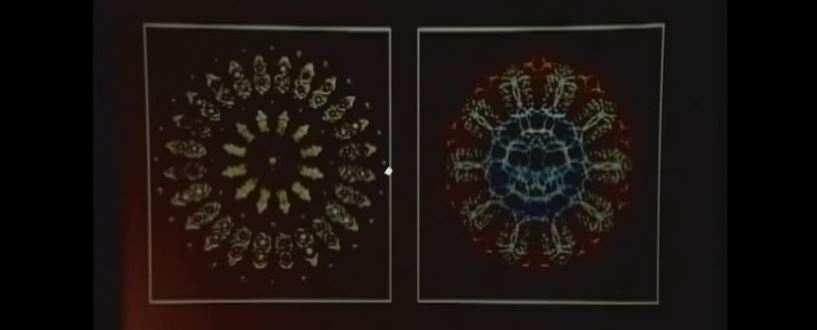
Take a close look at the two images. What do they represent? We might say that one image represents science and the other represents religion (or faith). But which is which?

The images are similar, but one of them is manmade, and the other is something we find in nature. Do you know which is which? Is the manmade image the scientific one or the spiritual one?

I will answer these questions; at least I will answer them as they were described in a presentation given by Francis Collins, the manager of the Human Genome Project, at a Veritas Forum at Caltech University in 2009. In the process, we will explore the chief question examined by this eminent scientist: whether science and faith are compatible.

Continue reading “Inspiration or Artifice? Faith and Reason”

The Ends of Science and Beginning of Faith

“A great scientist, even like Stephen Hawking, if he had to admit a creator, it would be unavoidable, he would have to seek him because he is a great scientist.”

Photo by Ted Wright near Grandfather, NC

I recently listened to a conversation between Ravi Zaccharias and Professor David Block. Professor Block is currently the director of the Cosmic Dust Laboratory at the University of the Witwatersrand in Johannesburg and a Professor in the School of Computational and Applied Mathematics. His accomplishments speak for themselves.

David Block was elected as a Fellow of the Royal Astronomical Society of London when he was 19. Block had a paper (on relativistic astrophysics) published by the Royal Astronomical Society in London when he was 20. Block has a Master of Science degree in relativistic astrophysics and a PhD that focused on the morphology of spiral galaxies. He has participated as a visiting research scientist at Australian National University, the European Southern Observatory in Germany, Harvard University, the California Institute of Technology and the Institute for Astronomy at the University of Hawaii and other places.

And there is more. Professor Block has been featured on the cover of the prestigious scientific journal, Nature, twice. He won the NSTF-BHP Billiton award in 2013 for “outstanding contribution to SETI through Communication for Outreach and creating Awareness over the last 5 years – sponsored by the South African Agency for Science and Technology Advancement (SAASTA)”. He wrote a book for which two Nobel Laureates wrote the preface.

US astronomer, John Kormend, says, “David Block is to South Africa what Carl Sagan was to American astronomy – his pioneering discoveries are reshaping astronomical paradigms….” David Block was the person to accompany Stephen Hawking and introduce him when he met Nelson Mandela.[1]

These things are relevant when considering the conversation he had recently with Ravi Zaccharias. He isn’t just some self-important Internet pundit. He is highly respected for his science, and he is a Christian.

In that context, Block says, “A great scientist, even like Stephen Hawking, if he had to admit a creator, it would be unavoidable, he would have to seek him because he is a great scientist.”

Continue reading “The Ends of Science and Beginning of Faith”

When Scientists Stray From Science

Some people today have made the mistake of using scientific methodology that is limited to the study of the natural world to conclude there is no reality but for the natural world.

Depositphotos Image ID: 151533714 Copyright: avemario

Methodological naturalism is the basic approach of science. Since science is the study of the natural world, the methodology of science is limited to the parameters of the natural world. Methodological naturalism is theologically neutral.

So what does that mean?

On a very fundamental level, it simply means that science is the study of the natural world, and, therefore, science is limited to naturalistic methodology. Science is limited to the observations of matter, energy, space, and time.

Another way of putting it is that science has no preoccupation with anything that is super natural. Science is limited to a focus on the natural world. Science doesn’t bother itself with anything but the natural world (though scientists might stray beyond it).

Science does not and cannot comment on anything but the natural world (though scientists often do), because the natural world is the focus of science. It’s as simple as that.

None of this should be in the least bit earth-shattering. Confusion arises, however, when we begin discussing the supernatural, the metaphysical, the theological, and the philosophical realms in relation to science.

There are those scientists, for instance, who have recently suggested that the advance of science today has done away with the necessity of philosophy. People like Lawrence Krauss and Neil deGrasse Tyson have made statements like that, though they have both backed off of those initial statements more recently. It’s important to understand that those statements, themselves, are philosophical in nature, and not scientific.

To suggest that science has done away with the necessity for philosophy is to ignore the limitations placed on science in its very methodology. Science, itself, is not philosophical, but evidence from science can support premises that are philosophical, and scientists may draw philosophical conclusions from scientific facts.

Science may inform philosophy, but it can never replace philosophy. To think otherwise is to exalt science beyond its natural parameters (pun intended) and to fail to appreciate the difference between science and philosophy.

Continue reading “When Scientists Stray From Science”

There Is No Proof of God?

Where does our sense of self, love, purpose and inclination to worship come from?

Photo from RV Fine Photography

A popular skeptical notion about spiritual things is that there is no proof of God. But is that a reasonable statement?

What does the skeptic mean by proof? Does he mean strict proof, mathematical proof or proof beyond a doubt? If that is what the skeptic means, then the skeptic will always remain a skeptic, because that kind of proof is unattainable.

There is nothing inherently bad or wrong in being skeptical. Skepticism or doubt is not a sin as some might suppose. “Doubting Thomas” was a disciple of Jesus after all! Honest skepticism is not a problem. In fact, honest skepticism is healthy; it drives us to test truth claims and weed out falsity.

The demand for strict proof that God exists, however, is not honest skepticism. While we might attain to some proof beyond a “reasonable” doubt, strict proof, mathematical proof, or proof beyond any doubt is impossible. I will try to explore why that is in this blog article.

Continue reading “There Is No Proof of God?”