Thoughts on the Great Commission: Our Finite Tendency to Miss What God is Doing in Our Time

What are we missing? What dogmatic understanding have we clung to that is correct in some aspect, but not completely accurate?

Go into all the world and tell the gospel to all creation

‭As I read through the New Testament this year as part of my daily reading plan, I have finished the Gospels, and I am well into the Book of Acts. As I read through the Gospels, I was mindful of the context in location, time period, and the history of the area and the people of Israel, surrounding nations, and the Greco-Roman world leading up to the time that Jesus walked the earth. I have also been mindful of the sweep of this history as it has played out since that time to the present day.

As a believer in the story of God revealing himself to human beings in this history that we continue to live into, I am also mindful that this time was pivotal. God becoming incarnate (taking on human form and fully living into His own creation), is the centerpiece of our story. It ties the story together from the beginning to the end that will play out into the future fulfillment of God’s ultimate plans.

Abraham and his descendants have been the focus of this story from the time that he heard God encouraging him to leave his family and homeland and strike out to a land God would show him, full of the promise descendants as numerous as the sands of the shores of the sea and the stars in the sky. But the story has taken an unexpected turn – unexpected, at least, for those descendants who have been living into this story for millennia by the time of Christ.

But it shouldn’t have been unexpected. That original promise to Abraham included blessing for all the nations of the earth. This was God’s plan from the beginning – from the creation of Adam and Eve and the command to “be fruitful and multiply.”

The covenant God made with Moses with those descendants of Abraham, however, took on a life of its own – at least as far as they perceived it. They were (more or less) faithful to that covenant. At least, they clung to that story despite their failings to be faithful and despite their myopic view of what God was doing.

It was myopic because they lost sight of God’s intention to bless the nations of the earth through them. This blessing was embedded into the original promise to Abraham, and it was always intended to be part of the story. Yet, they had lost that thread.

Thus, when God entered into the story to move it along and begin to work out the thread of His ultimate plan, they didn’t recognize Him. The people God chose through whom He would work out this plan unwittingly resisted it.

Yet, God in His sovereignty was not surprised by this. He used their resistance to move the story forward. Jesus knew this when he read from the Isaiah scroll in his hometown synagogue:

“The Spirit of the Lord is on me,
    because he has anointed me
    to proclaim good news to the poor.
He has sent me to proclaim freedom for the prisoners
    and recovery of sight for the blind,
to set the oppressed free,
to proclaim the year of the Lord’s favor.”

Luke 4:18-19

When Jesus told them, “Today this scripture is fulfilled in your hearing”, they were not ready to receive it, though the fulfillment of it was long-awaited by them. Jesus knew their rejection of him would be the catalyst God would use to unfold the rest of the story:

“Jesus said to them, ‘Surely you will quote this proverb to me: ‘Physician, heal yourself!’ And you will tell me, ‘Do here in your hometown what we have heard that you did in Capernaum.’”

Luke 4:23

Jesus, the fullness of God in human form (Col. 2:9), knew he would die at the insistence of his own people, but this was meant to be.

“And being found in appearance as a man,
    he humbled himself
    by becoming obedient to death—
        even death on a cross!”

Pjilippians 2:8

God worked through this people He chose to prepare for the time He would enter the story, and their rejection of Him would be the turning point.

Continue reading “Thoughts on the Great Commission: Our Finite Tendency to Miss What God is Doing in Our Time”

Comments on Why God Became Incarnate and Died for Our Sins

Daniel Mann does a good job of explaining Why Christ, as God Incarnate, Had to Die for Our Sins. In reading his explanation, my mind goes to statements like God’s “transcendent love” and “total abhorrence for sin”, God’s “righteousness” and “divine forbearance” for sin, and the price that had to be paid “to satisfy God’s righteous character”.

Daniel describes his own reaction to these concepts formerly, as a non-Christian. He felt God was a “deceiving sadist” until one day he realized that Jesus was God incarnate, that God did not merely sacrifice a created being – God sacrificed Himself in human form!


Indeed, that is the central point of Christian belief, which is described beautifully and poignantly in Paul’s letter to the Philippians (2:5-8):

In your relationships with one another, have the same mindset as Christ Jesus:

Who, being in very nature [form of] God,
    did not consider equality with God something to be used to his own advantage;
rather, he made himself nothing
    by taking the very nature [form] of a servant,
    being made in human likeness.
And being found in appearance as a man,
    he humbled himself
    by becoming obedient to death—
        even death on a cross!

These things would be small consolation, also, if not for the victory on the other side of the cross (Phil. 2:9-11)

Therefore God exalted him to the highest place
    and gave him the name that is above every name,
that at the name of Jesus every knee should bow,
    in heaven and on earth and under the earth,
and every tongue acknowledge that Jesus Christ is Lord,
    to the glory of God the Father.

That Jesus was fully man and fully God incarnated into a man is key to the understanding of Christianity. That God is three “persons” in one is also key, as it provides some explanation how God can incarnate Himself into the form of a man and die (in human flesh), though God remains self-existent and eternal, the Creator (and not a created being).

Not that there is no mystery in this. I concede this is hard for creatures who are limited dimensionally to wrap our heads around these ideas.

Finally, it explains how (and why) death to Jesus in the flesh had no power over him. As God incarnate, death “could not hold him”. (Acts 2:24)

But, I am not writing to clarify these aspects of Christian doctrine. I want to focus on Daniel Mann’s personal revelation that Jesus was God incarnate, and his death was voluntary – God sacrificing Himself, and not God sacrificing some created being.

This realization made all the difference for him. When he really understood this distinction, he began to see the love of God that was demonstrated in that act of self-sacrifice – something God did not have to to, but He did it for us because He loves us.

Other people, I know, are not convinced. Indeed, if a person understands Jesus to be human only, and not God incarnate, the story makes no sense.

Another stumbling block is God’s “abhorrence for sin” and the need to satiate a “righteous” God. These Christian concepts are foreign territory for many people. Why, if God is so loving, does He demand sacrifices for sin?

Continue reading “Comments on Why God Became Incarnate and Died for Our Sins”

What Are We Missing in the Story of the Garden of Eden?

Why did God place the tree of the knowledge of good and evil in the garden and forbid Adam to eat it?


Once again, I am reading the epic of Eden by Sandra Richter. She takes the orthodox, traditional position that Eden was perfect, man fell, bringing God’s creation down with him, and God is redeeming man with creation so that man will live forever in perfection, again, after redemption is complete. I am indebted to her and other scholars, and I greatly appreciated her book.

I wrote recently, on the question, Was the Garden of Eden Really Perfect? With due respect to Sandra Richter, I am leaning in the direction of no, the Garden of Eden wasn’t perfect. I explain my thinking in the article linked in this paragraph, and today I want to explore something that may be missing from the traditional narrative (at least as I understand it).

Today, I am posing some questions that occur to me as I continue to read through Sandra Richter’s fine book. Why did God place the tree of the knowledge of good and evil in the garden? Did God know men would eat from it? What is the point of the fall and the long road back to redemption?

I don’t claim to have all the answers, or at least not all the right answers. We may not know, and may never know, the answers in their nuanced details. I think that is ok, though we should strive to know as best as we can.

Maybe some things are not meant for us to know; or at least we are not meant to know that we know. We have a strong tendency to become proud and self-righteous and to start relying on our own understanding, rather than remaining humble before God and our fellow man.

Yet, I think God wants us to seek to understand. “It is the glory of God to conceal things, but the glory of kings is to search things out.” (Proverbs 25:2) Thus, my article today is an attempt at better understanding God’s redemption story and searching out these things.

Surely, God had purpose in placing that tree in the garden, right? God is sovereign and all-knowing, right? Thus, I think the questions I pose today are good for us to consider.

Continue reading “What Are We Missing in the Story of the Garden of Eden?”

The Surprising Context of the Idea that God’s Ways Are Not Our Ways, and God’s Thoughts Are Not Our Thoughts

How many times have you heard someone say, “God’s thoughts are not our thoughts, and His ways are not our ways”? Think about the context in which those words tend to be spoken….

The death of a loved one, a difficult time you are going through, plans that don’t work out, change you long for doesn’t happen, or unexpected change throws your life into chaos: these are the kinds of circumstances in which these words are often spoken.

Bad things are happening, or the good things we hope for seem never to come. That’s when someone says, “You know, God’s ways are not our ways.” The implication is that we should trust Him anyway, and that is good advice, but it’s often not very comforting in the moment.

Speaking those words in those kinds of circumstances also takes them completely out of the context in which they were spoken by the Prophet, Isaiah, whose words they are:


“Seek the Lord while he may be found; call to him while he is near. Let the wicked one abandon his way and the sinful one his thoughts; let him return to the Lord, so he may have compassion on him, and to our God, for he will freely forgive. 

“’For my thoughts are not your thoughts, and your ways are not my ways.’ This is the Lord’s declaration. ‘For as heaven is higher than earth, so my ways are higher than your ways, and my thoughts than your thoughts.'”

Isaiah 55:6-9 CSB


Until today I had not considered these verses in the context of the previous two verses. Or in the context of the whole chapter, for that matter. In fact, Isaiah 55 begins with the words, “Come, all you who are thirsty!”[i] I encourage you to read all of Isaiah 55, which I have provided at the end of this article.

But the focus of this article is the two verses spoken right before the enigmatic words of comfort that we often hear: “For my thoughts are not your thoughts, and your ways are not my ways.”

These verses are spoken in the context of encouragement to seek God and return to him so that God may have compassion on you, for God freely forgives. This is the context for the statement that God’s thoughts are not our thoughts, and His ways are not our our ways.

The implication here is that God forgives where we are not likely to forgive. God has compassion where we fail to have compassion. God freely forgives where we have much difficulty forgiving, and He has compassion when we would not have compassion.

That God’s thoughts are higher than our thoughts is often mentioned in the context of things we do not understand about life, such as the death, tragedy, catastrophe, and hopelessness. We think of the negative things that happen to us and the good things for which we hope that never seem to come about.

While it’s true that God sees things we do not see, and He has purposes that He is working out in history, throughout the earth, and even in our own loves that we do not understand, Isaiah’s statement that God’s way are not our ways, and His thoughts are not our thoughts, was not spoken in that context at all.

God’s thoughts are not our thoughts because He has compassion that we do not have and do not understand! God’s ways are not our ways because God freely forgives those who turn to Him.

Thank about that: This means that God is much more compassionate and forgiving than we understand or give him credit for.

We sometimes fixate on God’s judgment. We struggle with God’s wrath and the problem of pain and suffering in the world. In these contexts is when we heard it said that God’s thoughts are higher than our thoughts, and His ways are higher than our ways.

God is much more compassionate and forgiving than we understand or give him credit for

The real import of these versus, however, it’s not that God is mysterious in some dark and tragic way, but that God is mysterious in a compassionate and forgiving way!

We may actually have more difficulty understanding the compassion of God, than the wrath of God sometimes. We may have more difficulty understanding the forgiveness of God than the judgment of God. We may not like the idea of God’s wrath or judgment, but we somehow grasp it in a twisted kind of way, even if only to hold it against him.

Yet, we sometimes struggle to understand His great compassion and forgiveness.

Why would God empty himself of His glory, give up His divine privileges, make Himself nothing (Phil. 2:7), and enter into His creation in the most vulnerable way? Why would He humble Himself in that way and be obedient like a servant (Phil. 2:8) to submit himself to the worst that his own creation could do to Him? Humiliating and excruciating death on a Roman cross!

And then, after all of that, the words of Christ, who was God Incarnate, spoken as he died on a Roman cross are the most mysterious thing we could ever imagine:” Father forgive them, for they know not what they do.” (Luke 23:34)

Continue reading “The Surprising Context of the Idea that God’s Ways Are Not Our Ways, and God’s Thoughts Are Not Our Thoughts”

Take a Risk to Prepare Room for God in Your Life

If you won’t leave what you’re guarding to see what God is doing, then what you are guarding is your god.

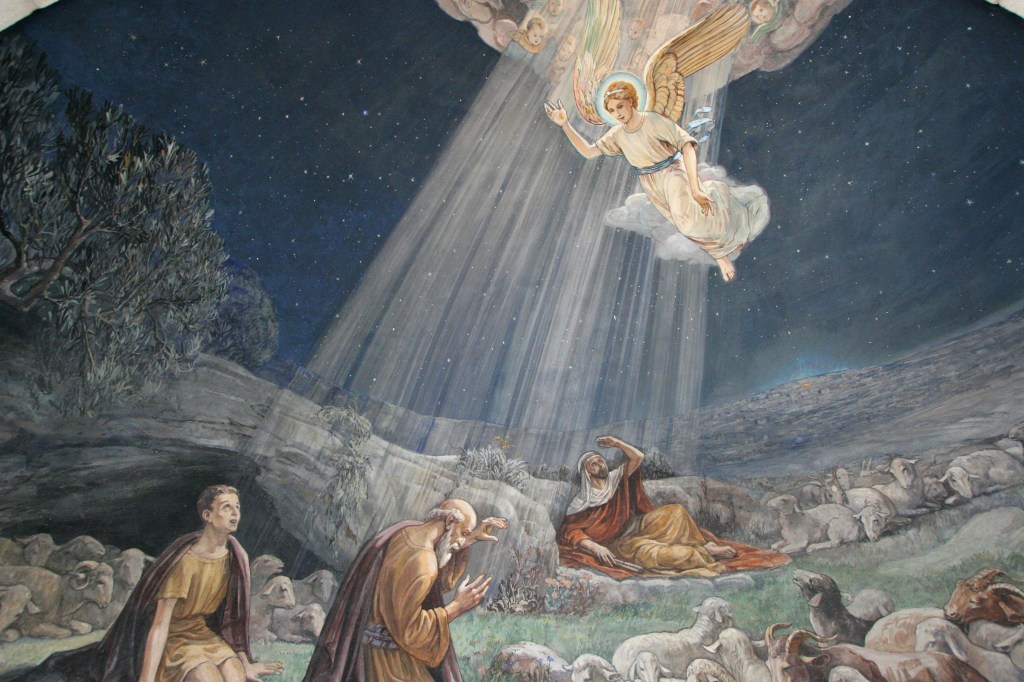
An angel of the Lord visited the shepherds and informed them of Jesus’ birth, Bethlehem, Church at the Shepherds’ Fields

My inspiration today comes from the sermon at church.[1] Very little of my material in this blog is original. If I am being perfectly candid, none of it is. After all, there is nothing new under the sun!

The sermon today was on the shepherds who left their fields in response to the message they received from an angel to seek out and visit the Christ child who was born near them in a manger used to feed animals.[2] If we are tempted to think that the purpose of this story in Luke’s Gospel is the miraculous appearance of an angel to these shepherds, I believe we would be wrong.

The story of the shepherds follows right on the heels of the story of Joseph and Mary traveling to Joseph’s ancestral home, Bethlehem, for a census that was being taken. While they were there, Mary gave birth to Jesus. Luke concludes that story with this seemingly insignificant statement:


“Then she gave birth to her firstborn son, and she wrapped him tightly in cloth and laid him in a manger, because there was no guest room available for them”.

Luke 2:2:7


We have the wrong picture in our heads if we are imagining a guest room in an inn. Mary and Joseph went to Joseph’s ancestral community where his family was gathering from wherever they were scattered. They may not have known their extended family members well, but they likely stayed in one of their homes.

The guest room in the home would have been upstairs, and it was already taken by the time they arrived, so they were forced to stay on the ground floor of the home with the animals. The manger was a food trough. Their accommodations were not the least bit inviting.

The smell of animal dung, urine, and straw hung in the darkness of the cold, dank air. The animals slept or chewed their cud. There was no fanfare for God who was had just entered His own creation in the humblest of circumstances.  

Meanwhile, an angel suddenly stood before a watchful group of shepherds in the outlying hills of Bethlehem. The abrupt apparition broke the silence like lightning from the sky. They were alarmed, but the angel calmed them. “Do not be afraid”, the angel said.


“Look, I proclaim to you good news that will be for all the people: Today in the city of David a Savior was born for you, who is the Messiah, the Lord.”

Luke 2:10-11


The angel added the instruction that they would find a sign: a baby wrapped tightly in cloth, laying in a manger. (Luke 2:13) Nothing seems special about this sign. A little unusual, maybe, that the child would have no other place to lay. Perhaps, though, the shepherds heard echoes of these words in the angel’s statement:


“Therefore the Lord himself will give you a sign: The virgin will conceive and give birth to a son, and will call him Immanuel.”

Isaiah 7: 14


An inkling from the Prophet Isaiah may have just dawned on them when “a multitude of heavenly host” appeared with the angel praising God and saying:


“Glory to God in the highest heave, and peace on earth to people he favors.”

Luke 2:14


They were moved. The angel encouraged them to “look” for themselves, and they didn’t hesitate. They decided among themselves “to go see”. (Luke 2:15)

We might be tempted gloss over the scene and fail to consider their circumstances. They were shepherds, and their job was to watch over the sheep. Sheep are prone to wander off. Even if they don’t stray, they are sitting ducks for large predators like lions, wolves and bears. Guarding the sheep was their livelihood.

The shepherds risked losing the sheep to leave them. They risked the sheep wandering off or being attacked if they left them. They risked losing their jobs.

The shepherds were menial laborers, dispensable and easily replaceable, but when the angel encouraged them to go see, they didn’t hesitate. They responded and went.

The word, “see”, is emphasized in this passage. They responded and saw for themselves. They experienced God for themselves. They didn’t just listen and ponder; they went and saw for themselves.

As I reflect on this, I note that they might have missed the Messiah if they didn’t respond right away. It occurs to that, when God prompts us, perhaps not as dramatically, how we respond is critical. Whether we respond at all, and how promptly we respond, may be a matter of whether we encounter God… or not.

Continue reading “Take a Risk to Prepare Room for God in Your Life”