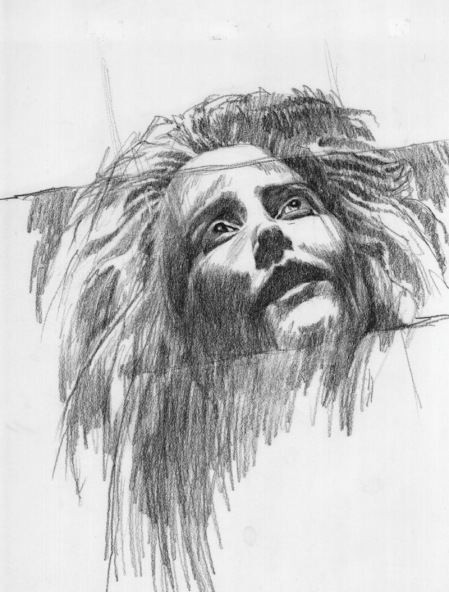
Another Look at God In Light of the Evil in the World (Postscript)

The sufferings of this present time are not worth comparing with the glory that is to be revealed to us.

Self Portrait by Joni Eareckson Tada

This is a postscript to a series of blog posts that, frankly, could go on. It follows what was to be the conclusion of a series on the problem of evil – Another Look at God in Light of the Evil in the World (Part 4). Why does evil occur and God doesn’t prevent it? If God is God, and He is all-powerful and all-loving, why does He allow evil, pain and suffering?

I do need to bring this to a conclusion, but I have some “final” thoughts. I also have some experiences to relate: not mine, but of someone who knows pain and suffering better than I.

But first, we have to admit that, if God is God, and if He cares, and assuming He could prevent the pain and suffering in the world, why doesn’t He? It’s a legitimate question!

If Jesus didn’t rise from the dead, I believe we would not be talking about him still in the 21st Century. There would be no point in Christianity whatsoever. He would have fallen into obscurity as just another idealistic dreamer whose fate, like all the other ill-fated dreamers who ever lived, seals our doom as a people, as a species on this planet.

But if Jesus did rise from the dead, no over feat in the history of mankind is more important or more significant. We can’t just dismiss it.

Continue reading “Another Look at God In Light of the Evil in the World (Postscript)”

Another Look at God In Light of the Evil in the World (Part 4)

God is intimately acquainted with the pain and suffering we experience. The God of the cross who knows and understands our suffering can be trusted.


I have tackled the problem of evil – why is there pain and suffering in the world if God is good and all-powerful? – in a series blog posts, beginning with an introduction, followed by Part 1, Part 2 and Part 3. The impetus for the blog posts comes from the explore God discussion that was happening at over 800 churches in the Chicago area over the winter of 2019. The series of blog posts was more specifically inspired by the discussion of The Problem of Evil and Suffering on Veracity Hill between Kurt Jaros, the host, and John Peckham from Andrews University

The problem is easy enough to state, but it’s difficult to resolve, if, indeed, there is a resolution. Although not every religion maintains that God is personal, volitional, all-powerful and all-good, the problem of evil. Not every world religion faces the problem head on. Buddhism, for instance, posits that evil doesn’t really exist; it’s an illusion.

I have been exploring a Christian response to the problem, but it’s all pretty academic unless and until we are overwhelmed by evil, pain and suffering in our own lives. At the point of real evil, pain and suffering, an academic response doesn’t seem to satisfy.

Just last week, in the midst of thinking through the issues and writing the blog series, a tragedy of overwhelming proportions happened right in the city where all my kids went to school. An apparently disgruntled employee on the cusp of being fired from his 15-year position at a local manufacturing plant in Aurora, IL, opened fire on employees in the plant, killing five of them and wounding six other people, including six police officers responding to the alarm that went out. The youngest victim was a 21-year old college intern who started his internship in the HR department that day.

When a person is reeling from pain and suffering that hits close to home, especially from such a senseless, intentional and indiscriminate act of violence, the academic answers ring hollow and fall flat.

Without letting go of any of the attributes of God that are revealed in the Bible, we can work through the problem intellectually and logically to a solution, as I have tried to do in the summary that is contained in the previous blog posts. In some ways this solution is like the theory of gravity for Christianity. We can understand it, but knowing the cold, “scientific” facts are no consolation after falling off a cliff.

What remains, after we have worked through an intellectual solution to the problem, is the emotional, existential weight of the problem of evil. This is where we live. The weight of the problem of evil is hard to shake, quite frankly, when the pain and suffering becomes personal. When we come face to face with evil, pain and suffering in the world in our personal lives, an intellectual response isn’t enough.

This is exactly when people turn to religion and to God for comfort and answers…, or turn away. If all that Christianity has to offer is an academic response, what is the use?

Continue reading “Another Look at God In Light of the Evil in the World (Part 4)”

Victims of Abuse Find Comfort and Healing in Christ


Unfortunately, the world today is full of people who have suffered abuse at the hands of other people. For reasons we may not fully understand, victims of abuse often become abusers, themselves. The abuse begets abuse, and the cycle may continue for generations.

The abuse may take the form of parent to child, spouse to spouse, boss to employee, slave owners to slaves, and even governments can wiled oppressive control over the people subject to their authority. People in positions of power abuse people in positions of vulnerability. We haven’t advanced all that much as beings for eons. In some ways, we might have become more sophisticated about the abuse, but the abuse continues, generation after generation.

The Jewish people of Judea, modern Israel and Palestine, were oppressed and abused by the Roman government in the First Century when Jesus walked the earth. Jesus began his public ministry by reading from the prophet Isaiah,

“The Spirit of the LORD is on me, because he has anointed me to proclaim good news to the poor. He has sent me to proclaim freedom for the prisoners and recovery of sight for the blind, to set the oppressed free….” (Luke 4:18, quoting from Isaiah 61:1)

But he certainly wasn’t concerned only with the oppressive rule of the Roman government. He was concerned about all people everywhere who suffer abuse. Continue reading “Victims of Abuse Find Comfort and Healing in Christ”

Carried Off to Babylon

We are half-hearted creatures, fooling about with drink and sex and ambition when infinite joy is offered us.

Panorama of partially restored Babylon ruins and Former Saddam Hussein Palace, Babylon, Hillah, Iraq

“Behold, the days are coming, when all that is in your house, and that which your fathers have stored up till this day, shall be carried to Babylon. Nothing shall be left, says the Lord.” (Isaiah 39:6 ESV)

This is a follow up blog piece to Here Today Gone Tomorrow. The story of King Hezekiah, and Isaiah Chapter 39, is, illustrative of our tendency to hold on to things in this world and in this life contrary to what God intends for us. Jesus speaks to God’s intention when he urges us to lay up our treasures in heaven, and not to focus on accumulating treasures on earth.

Hezekiah was a pretty good king as kings of Judah go. Many of those kings turned away from God to idol worship and other behaviors influenced by the pagan culture of the nations around them. These were the people who were never completely driven out of the Promised Land as God instructed. The people and their kings became corrupted by those influences and succumbed to them.

The descendants of Abraham, Isaac and Jacob split into two camps early on after the people rejected the rule of judges and wanted kings like the nations around them.  They split into the nation of Israel and the nation of Judah.

By the time King Hezekiah came around, the nation of Israel had been overrun, captured, and exiled to Babylon. During Hezekiah’s reign the people were hanging on by a thread, with the threat of Babylonian exile dangling like the sword of Damocles over the remnant, Judah, that remained in Jerusalem.

In Hezekiah’s fourteenth year as king, Sennacherib, the king of Assyria, attacked all the fortified cities of Judah and captured them, but for Jerusalem. King Hezekiah responded to this threat by turning to God. He prayed, and, as the story goes, 185,000 troops of the Assyrian king died in the camp overnight, sparing the City of Jerusalem from certain doom. (Isaiah 37)

Hezekiah turned to God when circumstances were dire and his death was imminent. Like most of us, though, the King was short-sighted. He focused on the immediate, protecting himself for the remainder of his short life.

Continue reading “Carried Off to Babylon”

From Abandonment to Acceptance

Abandonment


I began posting the stories of people whose lives have been dramatically changed from a myriad of different backgrounds when they entered into a personal relationship with God. That was 2015, and I have continued to post these stories from time to time as I came across those stories thought to seek them out.

I haven’t really thought much about it, other than the fact that these stories are compelling, and I felt they needed to be shared. In 2018, however, for the first time one of these pages of stories was the most “read” page on the site. For that reason, I think it makes sense to began sharing the stories as part of the regular blogging that I do.

If there is one thing that stands out to me it is this: There is an amazing consistency in all these stories. Though these stories literally span the gamut of human experience, of people with widely divergent backgrounds in almost every imaginable way, they all ring true to the same theme.

The common denominator is the person of Jesus Christ. These stories are personal evidence that Jesus rose from the dead two millennia ago, and lives on through the Holy Spirit, whom He promised, who continues the work Jesus began in the flesh.

The apostle Paul told a crowd of Greeks and Romans at the Areopagus in Athens many centuries ago that God desires that we would seek Him, reach out for Him and find Him, “though He is not far from any one of us. ‘For in him we live and move and have our being.'” (Acts 17:27-28) These stories are evidence of the truth of those words that are as vitally true today as they were in Paul’s time. 

The writer of the letter to the Hebrews said, “Jesus Christ is the same yesterday and today and forever.” (Hebrews 13:8) John, the apostle who was perhaps closest to Jesus of any follower, said that Jesus was in the beginning with God (John 1:2); all things were made through Him (John 1:3); and that all who receive Jesus have the right to become children of God. (John 1:12) Jesus, Himself, said, “Before Abraham was, I Am!

He lives today, and the stories of people who have encountered him continue daily, weekly, monthly and yearly. The stories on the page linked below are of people who have experienced abandonment in their lives but found acceptance in God through Jesus Christ.

via Abandoned