God’s Work Within Us

CS Lewis wrote the following bit in a letter written approximately one year before the end of his life:

“The whole problem of our life was neatly expressed by John the Baptist when he said (John, chap 3, v. 30) ‘He must increase, but I must decrease.’ This you [may] have realised. But you [may be]  expecting it to happen suddenly: and also expecting that you should be clearly aware when it does. But neither of these is usual. We are doing well enough if the slow process of being more in Christ and less in ourselves has made a decent beginning in a long life (it will be completed only in the next world). Nor can we observe it happening. All our reports on ourselves are unbelievable, even in worldly matters (no one really hears his own voice as others do, or sees his own face). Much more in spiritual matters. God sees us, and we don’t see ourselves. And by trying too hard to do so, we only get the fidgets and become either too complacent or too much the other way.
“Your question what to do is already answered. Go on (as you apparently are going on) doing all your duties. And, in all lawful ways, go on enjoying all that can be enjoyed—your friends, your music, your books. Remember we are told to ‘rejoice’ [Philippians 4:4]. Sometimes when you are wondering what God wants you to do, He really wants to give you something.
“As to your spiritual state, try my plan. I pray ‘Lord, show me just so much (neither more nor less) about myself as I need for doing thy will now.’”[1]

I cite CS Lewis often in what I write. He seems to capture so much of what it means to be human in God’s world, illuminating God’s grace in us and in the world as God works out our salvation, the author and perfecter of our faith.

These words Lewis wrote are so much more poignant that they were written toward the end of his life. Gone is the impetuous, tottering confidence of youth in working salvation out, replaced by the steady, trusting confidence of old age that God is working within.

As I survey a thousand times I have failed God in working out my salvation, I find solace in the hope and faith that God is working within me. I don’t always see it. Sometimes my sin overshadows any light I see in me, but God’s gentle light always shines through that darkness… when I turn to Him.

Often my inclination is to turn away. I fear His wrath. I am disappointed in myself. I think I should be better than that. I don’t want to bow at His feet. Yet again. How many times? How many times!

And I recall that nothing is hidden from God. Nothing. We stand, sit, lie, walk at all times under the gaze of an infinite God. Nowhere I can go, even into the deep recesses of my own heart, away from God. Even if I block myself from the inner chambers of my own heart, yet God is there.

God, save me from myself! I can only hope and trust that You will, as You have said, because I am utterly unable.

~~~~~~~~~~~~~~~~~~

[1] CS Lewis in a letter to Keith Manship from The Collected Letters of C.S. Lewis, Volume III (September 13, 1962)

Thanksgiving Thoughts 2019


This week, while my college age children were home for Thanksgiving, I had a conversation with my 20-year old daughter.  Like the youth of every generation, she is keenly aware of the mistakes of the past, my generation, the Baby boomers, in particular.  I can’t argue with her on that.

Still, my daughter is growing up in a post-modern that is, perhaps, more critical of the past than any generation in recent history.

I remember growing up in the sixties and seventies and being keenly, as well, aware of the mistakes of my parents’ generation. There were demonstrations, riots, anthems of angry youth and more. No generation in recent history, perhaps, was as vocal about the mistakes of their elders than my generation. The Civil rights movement, the Equal Rights Amendment, anti-war demonstrations, the sexual revolution, burning the flag and burning bras: social upheaval was the everywhere in the public and private conscience of my generation.

It’s ironically fitting, I suppose, that my daughter feels the same way about that very generation that blazed the trail for her.

But things have progressed far beyond the protests of my generation. Her generation rejects not only tradition, as we did; they reject history. They doubt the traditional historical narratives are true. They doubt the validity of history itself.  Skepticism and protest may be the only thing that survives. Truth assertions are not to be trusted.

How can we know truth at all in a post-modern world? Even the truth they feel in their gut? If post-modernists are being honest, they can’t! The same doubts, skepticism and criticisms eventually turn inward. They can’t even be sure of the truth they think they know. Such is the angst of this generation.

Continue reading “Thanksgiving Thoughts 2019”

Though Every Man Be a Liar

The flaws of humanity that exist in the church negatively affect people and are a stumbling block for many.


In Romans 3, Paul asks whether a lack of faith nullifies God’s faithfulness. It’s a rhetorical question that Paul answers this way: “Even if everyone else is a liar, God is true.” (NLT)

Our faithlessness, of course, doesn’t make God faithless. Our actions don’t change God’s character. Though every man be a liar, still God is true.

This is the backdrop to this piece that is inspired by the interview of Lisa Gungor and Alisa Childers by Justin Brierley on the Unbelievable? podcast.

Alisa Childers and Lisa Gungor both grew up with evangelical Christianity. They were both Christian musical artists. They both went through a period of doubt and “deconstruction”. Alisa Childers emerged from that period of deconstruction with her faith intact, stronger than it was before, while Lisa Gungor has evolved into a progressive Christian – holding on to the title “Christian”, while letting go of nearly everything that distinguishes Christianity from other religions.

Of her own experience, Childers says that the flaws and errors in her construct of God, scripture and doctrine were removed in that process of deconstruction and replaced. Instead of giving up on Christianity, she doubled down in her testing of the faith. What could not stand up to the scrutiny, she let go. What remains is a solid foundation.

While the church, and people generally, seem to fear doubt, and shy away from it, the Bible actually encourages us to meet doubt head on. Paul urges us to “test everything” and “keep [or hold fast] what is good”. (1 Thessalonians 5:21) This is the route Alisa Childers took when faced with doubt and challenges to her faith.

More to the point of this article, though, Childers observes that many people who go through “deconstruction” of their faith often cite the behavior of the church, and the people in the church, as a primary reason for leaving the faith. It might be hypocrisy, judgmental attitudes, failure to live up to “Christian standards”, ignorance of modern science, an adherence to a blind faith that refuses to admit facts that are contrary to their understanding of Scripture.

Or worse – it might be experience with the ugliness of sin that we expect should not be present in the church. Church people can be cliquey and unapproachable. Church people can be greedy, petty, quick to get angry, lustful and worse – even church leaders. The evidence of sexual abuse and pedophilia that has come to light in Baptist churches recently reveals an ugly underside to quintessentially evangelical churches that hadn’t before come to light.

I would add that non-church people level similar complaints at the “the church” as former church people who have left.  The reasons they give for not going to church, or being “religious”, or having faith in God include apparent hypocrisy, negative personal experiences and bad behavior of church going Christians.

While people may give other reasons for “not believing” or not having faith, the examples of people who hold themselves out to be Christians is almost always one of the reasons given, if not the most compelling reason given by people who don’t consider themselves (or no longer consider themselves) “Christian” (at least in the sense of born again, evangelical (whatever that still means) Christianity).

To this point, I am reminded of what Paul says, “Though every man be a liar, still God is true!” Let me explain.

Continue reading “Though Every Man Be a Liar”

The Plans God Has for Us – Part III

Even in the midst of the very Judgment of God, God desires to bless us! He is every appealing to us to listen to Him and respond to Him. 


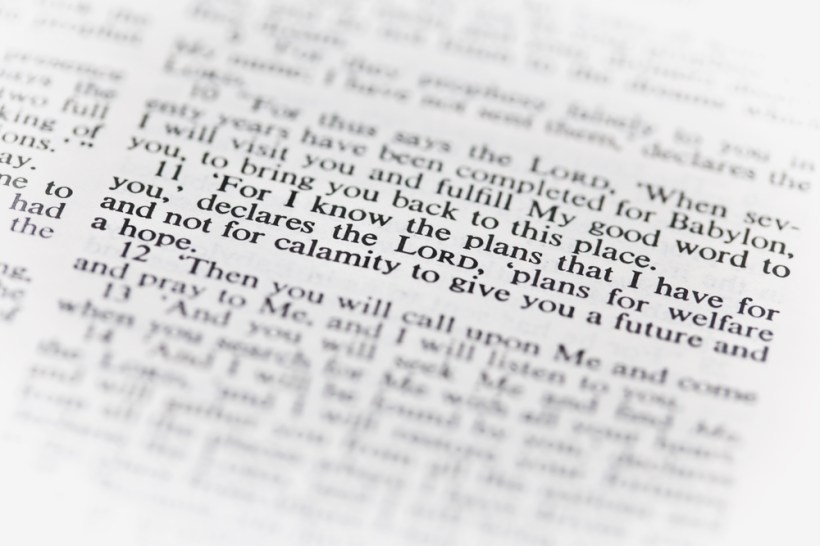
In the previous two blog posts on The Plans God Has for Us, we considered the fact that the often-quoted verse about the plans God us for us – plans to prosper us and to give us hope and a future (Jeremiah 29:11)[1] – should be viewed in historical context. (Part I) That historical context was the 900-year history of disbelief and disobedience of God’s people ending in 40 years of warning of impending judgment that culminated in the judgment coming to pass with the Babylonian conquest of Jerusalem and exile. (Part II) In this post, I will try to draw some conclusions in the application of this verse and relevance to our modern lives.

This letter was the message of God through the prophet, Jeremiah, to God’s people that He gave them at the very beginning of their exile. In this letter, God tells them that they will remain in exile for 70 years![2] In fact, this shocking statement – you will be here 70 years – is the statement that immediately precedes the famous verse we all know:

“’For I know the plans I have for you,’ declares the Lord, ‘plans to prosper you and not to harm you, plans to give you hope and a future.’”

In a sense, God is telling them, “I’ve got good news and bad news. The bad news is that I have imposed my judgment on you, and it will last 70 years. But the good news is that I have plans for you, good plans to prosper you and to give you hope and a future.

Thank about it: 70 years….

In an age in which the average life expectancy was about 35 years, that’s two generations! For the vast majority of the exiled people, this meant their lives would end in captivity. What kind of hope and future is that?!

The United States has been a country for less than 250 years, and our oldest ancestors in this country (unless you are Native American) go back only 400 years. The people of Judah had roots in their land going back almost 1000 years!

These were dire times, and this people had just lost everything. But even in the midst of this horrific circumstance, we need to look carefully at what God is saying. Just before announcing that this judgment thing is going to last 70 years, God gives them instructions:

“This is what the Lord Almighty, the God of Israel, says to all those I carried into exile from Jerusalem to Babylon: ‘Build houses and settle down; plant gardens and eat what they produce. Marry and have sons and daughters; find wives for your sons and give your daughters in marriage, so that they too may have sons and daughters. Increase in number there; do not decrease. Also, seek the peace and prosperity of the city to which I have carried you into exile. Pray to the Lord for it, because if it prospers, you too will prosper.’”[3]

Imagine the 40 years of warning and the weight of that impending doom on those who actually took it seriously. As with most things we fear, the fear is worse than the reality.

During this time of judgment in exile in Babylon, God says to them, basically, “Don’t despair! Go about your lives. Embrace the circumstances into which I have brought you. Live life. Make plans. Bless those around you, seek to better the community in which you find yourself, and I will bless you.”

Even in the midst of the very Judgment of God, God desires to bless us! He is ever appealing to us to listen to Him and respond to Him.

Continue reading “The Plans God Has for Us – Part III”

A Life Transformed


I stumbled on the video a few years ago that was posted in March of 2015 by Maz, a woman who was raised in a radical, abusive home. She had just become a Christian, against her families’ wishes, and she feared for her life. Though she filmed the video alone, she spoke in hushed tones. The weight of her plight was evident in her demeanor, yet she was willing to face the consequences for her commitment to Christ. You can watch it for yourself below.

The video was hauntingly beautiful in its testament to the life changing reality of an encounter with God in Christ. Her own father sought to have her beheaded. The emotion of the moment was raw and real. She was leaving a testament to her love for God, knowing that her life might not end well.

I wondered about her and prayed for her years after she posted the video. She posted another video about a year later, and she was still doing well. She had matured some in her faith, but the darkness of her past and the threat that hung in the air seemed still present.

I searched a few times for a follow up video after that, wondering what became of her. Did she survive? Was she ok? Was her faith as vibrant after time had passed as the day she posted that first video?

Today, I don’t have to wonder anymore. I had subscribed to her channel. Today as I was going through my YouTube subscriptions her video that she did in March of 2019 was there on my computer. I watched it, and what a gloriously different demeanor she has now! She radiates the love of Christ.

See and listen for yourself her story in the first video. Her original story is amazing and compelling. She had trouble putting her encounter in words, but the love of Christ she experienced was overwhelming. She knew little about Christianity, but she knew the risen Lord.


Continue reading “A Life Transformed”