Is Intelligent Design a Science Stopper?

Is intelligent design more of a science stopper than the evolutionary paradigm?

I listened to an episode of the Unbelievable! podcast from 2011 that was rebroadcast recently. Stephen C. Meyer was on with Keith R. Fox MA, MPhil, PhD, professor of Biochemistry, Principal Investigator (Nucleic Acids) at University of Southampton in the UK and Associate Director of the Faraday Institute for Science and Religion, Cambridge. The topic was Meyer’s groundbreaking book, Signature in the Cell, and the origin of life.

Keith Fox and Stephen Meyer are both professing Christians. Fox holds dogmatically to the evolutionary paradigm and does not believe intelligent design is an appropriate framework for scientific inquiry. Meyer maintains that intelligent design is a better explanation and is warranted by the science.

I will not attempt to explain everything they discussed, as I would require much more space than a blog article and more time than my schedule might allow at the moment. I encourage you to listen to the whole discussion if this article piques your interest. (You could also read the book.)

I want to focus on one point Steven Fox made about the intelligent design argument: that intelligent design is a “science stopper”.

He explained that he believes the promotion of intelligent design as an explanation for the origin of life would stop further scientific inquiry and frustrate science. It will effectively inhibit further inquiry as to how the origin of life occurred, says Fox. If we conclude that “intelligence did it” (a kind of God of the gaps argument), science would grind to a halt.

Meyer didn’t address the point immediately or directly. The discussion went off in a different direction, but I found myself unwilling to let it go.

“Why would intelligent design be a science stopper?” The statement begs for a response.

Fox claims that invoking the intelligent design explanation stops the process of asking questions, but he didn’t explain why. I have heard the statement before, but the statement is conclusory, and does it really follow?

I understand the anecdotal evidence of certain people who have advocated a kind of blind faith approach to the Bible and science issues, but that’s only a segment of the population of people who call themselves Christians. It’s not the majority, and they don’t have any influence over people who do science (Christian or non-Christian).

Implicit in that response is, perhaps, the thinking that we have done biological science very well on the evolutionary paradigm for about 150 years. It works. Let’s not mess it up.

I can appreciate that.

A person might also observe, correctly, that the focus of science, narrowed many years ago, focuses on purely natural processes. Science is not concerned with the supernatural. Let theologians think about God, but the scientists should focus on the natural world (the “non-overlapping magisterium” approach).

I understand that science is limited to the study of nature and natural processes. Science has nothing to do with theology (though theology was once considered the Queen of the sciences). Science has nothing to do with philosophy (though many scientists don’t appear to know the difference between science and philosophy, and that is a problem).

I am only speculating that these kinds of thoughts are behind the resistance against considering intelligent design as a competing paradigm to evolution. I understand them, but I would like to push back.

The objection to intelligent design seems to be an extension of the “God of the gaps” argument.

It incorporates the same assumption – that belief in God stifles and stymies science, but I don’t believe it’s a good assumption, and I don’t believe that the evidence warrants that conclusion.


Continue reading “Is Intelligent Design a Science Stopper?”

The 2020 Census and the Breaking Down of the Dividing Walls of Hostility

Fundamentally, Christians should align with Christ, and nothing else.

The 2020 Census reveals a story of changing demographics in the United States. It should hardly come as a surprise that the story is diversity. “Over the past 10 years, people who identified as Hispanic, Asian or more than one race accounted for larger shares of the population….”[1]

I suspect we could say the same thing about many a decennial census over the history of the United States. During the history of this country, from one census to another, we can trace the movements of people, including the Spaniards and Portuguese, the English and French, the German, the Irish, the Italian, the African, the Chinese, the Poles, and on and on.

I grew up learning that the United Stated of America is a melting pot. The news of the 2020 Decennial Census is simply the continuation of the same story that is America. It is an uniquely American story, though rhetoric in the 21st Century might suggest otherwise.

The new census may reveal a plot twist of sorts, though: a “pivotal moment”. Whereas the American story of the past was primarily an European story, the plot is tending toward greater diversity. The population of “people of color” are increasingly “younger and growing more rapidly” then their traditional American counterparts with Eurocentric origins.

The population growth since 2010 “was made up entirely of people who identified as Hispanic, Asian, Black or more than one race”. We can speculate on the reasons for this major shift, but the fact remains that people of color are increasingly making up a larger percent of the population, and that trend will surely continue.

My thoughts, as always, turn to the impact on the Body of Christ and how the Church is responding… and should respond… to the times. These times are a changing, crooned Bob Dylan in my youth….. But then, they are always a changing.

Continue reading “The 2020 Census and the Breaking Down of the Dividing Walls of Hostility”

The End of Stubborn Piety, and a New Beginning.

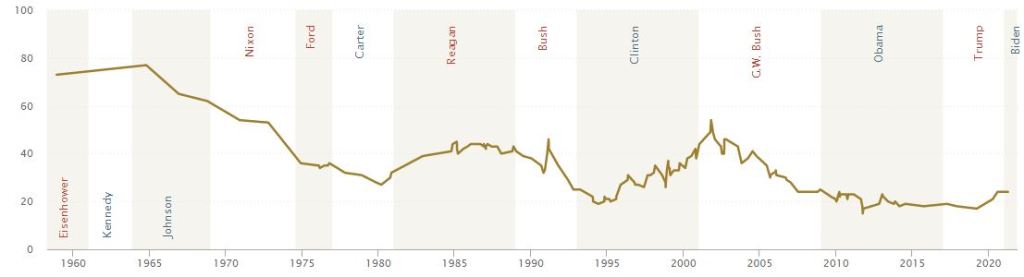
“[R]ising anxiety, suicide, and deaths of despair speak to a profound national disorder….”

Donald Trump with Jerry Falwell, Jr. at Liberty University in Virginia

I just read Three Decades Ago, America Lost Its Religion. Why? By staff writer for the Atlantic, Derek Thompson. I find The Atlantic to be full of insightful articles, even when I don’t wholeheartedly agree with them. This article is no exception.

Thompson recalls those enlightened 19th century pundits who predicted the death of God and advances in “scientific discovery and modernity” that would lead to widespread atheism. Thompson is a skeptic, himself. While Europe has largely gone the way the pundits predicted, The United States has resisted that prognostication – at least until recently.

Thompson blames “America’s unique synthesis of wealth and worship” and “stubbornly pious Americans” for the United States not going with the flow of the Enlightenment ascent of man from the superstitious dark ages into the light of science and reason.

While the rest of the western world has been drifting away from religious affiliation, and religion altogether, the United States seemed impervious to those forces working on the rest of the western world – until recently. Things began to change in the United States in the 1990’s, and that trend continues.

The article borrows heavily from Christian Smith, a sociology and religion professor at the University of Notre Dame, for figures and figurings of the reasons why. The shift is clear, though, and the statistics bear it out, that religious affiliation and interest in religion in the United States is waning and going the way of the rest of the western world.

“According to Smith, America’s nonreligious lurch has mostly been the result of three historical events: the association of the Republican Party with the Christian right, the end of the Cold War, and 9/11.” Smith goes on to provide some explanation for how these “events” have triggered the change. He says,

“The marriage between the religious and political right …. disgusted liberal Democrats, especially those with weak connections to the Church. It also shocked the conscience of moderates, who preferred a wide berth between their faith and their politics.”

Thompson’s article got me thinking. He is right about the trend away from religion in the United States. We don’t need data to tell us that. The “nones” are increasing while the committed believers are decreasing. That these observations come from “outside the camp” doesn’t make them false.

Thompson’s explanations for the reasons why this is may be more of a mixed bag. He (naturally) views the changes through a naturalistic lens. He may be right about some of the cause and effect, but he (naturally) isn’t likely to see the more spiritual side of those things.

I “grew up” spiritually during the mid to late 80’s when the marriage between religion and the political right was consummated. I fell out of step with it, and lost track of it, when I went to law school in 1988. Apparently the honeymoon went well.

I count myself (even today) as an evangelical (though I search for a different label). My spiritual upbringing included the experience of the courting of the religious right of the Republican Party. (Or was it the other way around?)   

Law school, however, challenged even my most sacrosanct connections, and the cares and concerns of fatherhood and providing for a growing family distracted me from other relationships. It was all I could do to hold onto God during this time, and the truth is that He mostly held onto me.

Perhaps, that was a blessing in disguise, as I didn’t grow into the religio-politico affiliation that seems to characterize a large segment of the evangelical church today. I am a more distant observer of that relationship today, so I think I have some objectivity left.

I agree (partially) with Thompson’s assessment that the congruence of the religious right and the political right changed the political landscape. It also changed the religious landscape. Perhaps, more than we might care to acknowledge.

Continue reading “The End of Stubborn Piety, and a New Beginning.”

Pulling at the Threads of the Christian Paradigm that Uniquely Influenced the Western World

Down at the bedrock of modern, western values remains a Christian foundation.

Galleries under the central arena of the Colosseum in Rome, Italy

I read Tom Holland’s new book, Dominion, about a year ago, and I have written about it a few times. Many Christians would not think to read a history about Western Civilization by a self-described secular humanist (once atheist, perhaps now agnostic) historian.

Most non-Christians are likely to be uncomfortable with the chronicle Holland describes of the radically influential role that Christianity played in the development of Western Civilization, providing the foundation, in fact, for secular humanist ideals. When Holland dug down to the bedrock of modern, western values, he was surprised himself to find them anchored on a Christian foundation.

Holland did not set out to write a Christian apologetic, and he seems to remain somewhat uncertain how to process what he “discovered”. What he found, though, changed his mind about Christianity. He gives a brief explanation in the following clip:

Though Holland has had a turnabout on his view of Christianity, he finds himself caught in an odd position wrought by the unexpected discovery that his lifelong, secular humanist values flow from the radical catalyst of Christian influence and remain embedded ubiquitously in its very fabric. The awkwardness of his current position is evident in his interviews and discussions about the book.

Christians and secular thinkers, alike, wrestle with his book. Holland doesn’t hide any warts, and he doesn’t pull any punches. Neither does he obfuscate the thoroughly paradigmatic shift in Western thinking that Christianity worked into a society that once proudly and unashamedly championed strength and privilege over the poor, the weak, and the lowly.

Holland exposes the metanarrative developed during the Enlightenment and thereafter that belies the foundation on which the Enlightenment structure was built. Far from advancing the progression of human values, the Enlightenment threatened to undo the distinctly Christian concern for the poor, weak, and lowly while attempting to wrest western civilization from the hold of the Divine. Humanism saved the Christian ethic, albeit divorced from Christ.

Consider the full title of Darwin’s great tome which staked out the ground of a scientific (and social) revolution free from God’s interference:

“The Origin of Species by means of Natural Selection or the Preservation of Favoured Races in the Struggle for Life”

The title of Darwin’s book championing the evolutionary paradigm, harkens back to the Greco-Roman value system that despised the poor, the weak and the lowly. That value system did not just turn a callous eye at wanton and discriminate cruelty, it cheered on the strong while they snuffed out the weak. It was national sport!

The very reason the full title never “stuck” (I now believe) is due to a fundamental, pervasive, and thoroughly entrenched counter-value of the intrinsic worth of human life that is uniquely Christian in its source.

The intrinsic value of all human life, from the greatest to the least, from the wisest and strongest to the weakest and most imbecilic, from the fittest to the most infirm, is traceable to the Christian belief that all human beings are made in the image of God. That the survival of the fittest did not take hold as a western social or ethical value is attributable to the deeply ingrained Christian ethic that survived yet, despite the efforts to eradicate its God from modern equations.

Modern humanists may attempt to recast Darwin into a humanistic mold, but the idea of “social Darwinism” bears his name through no model of random, unguided selection. According to John G. West, Charles Darwin, himself, set in motion the inertia for eugenics, among other things, that were associated with social Darwinism:

Darwin himself in The Descent of Man provided the rationale for what became the eugenics movement, and how the vast majority of evolutionary biologists early in the twentieth century were right to see negative eugenics as a logical application of Darwin’s theory.

While the defense of Darwin against the charge of social Darwinism has largely succeeded in popular and polite company, the very title of the Origin of Species (by means of Natural Selection or the Preservation of Favoured Races in the Struggle for Life) belies the success of that effort. The fact that the full title is merely a parenthetical today is evidence only of a concerted rescue campaign.

Christian values survived despite the Enlightenment coupe, not because of it. Humanism today assumes the evolutionary paradigm for its science alongside the uniquely Christian paradigm of intrinsic human value. That the two assumptions do not fit well together seems to be lost on modern minds.

Continue reading “Pulling at the Threads of the Christian Paradigm that Uniquely Influenced the Western World”

God’s Plans Are Bigger than We Often Perceive, and He is Working Them Out Sometimes Despite Us

God promised Abraham, “In you all the families of the earth shall be blessed”.

In the service this morning, the message was about Joseph. As often happens, I saw something I hadn’t seen before. The depth and nuance and intricate tapestry that is Scripture often works that way.

I will get to the point, but first, I need to build the backstory. Most readers know of Joseph, so I will be brief. Joseph was the youngest of the 12 sons of Jacob. Jacob was the son of Isaac, the famous son of Abraham. Abraham was the man of faith to whom God gave the following promise:

Go from your country [land] and your kindred and your father’s house to the land that I will show you. And I will make of you a great nation, and I will bless you and make your name great, so that you will be a blessing. I will bless those who bless you, and him who dishonors you I will curse, and in you all the families of the earth shall be blessed.” (Gen. 12:1-3 ESV)

I added the emphasis and will come back to it. In the meantime, we need to recall that Joseph was betrayed by his brothers, who were jealous of him. They plotted to kill him and left him for dead in the bottom of a well.  He was “rescued” by a passing caravan that sold him into slavery in Egypt.

We could say much about the story of Joseph, but I want to fast forward. Joseph’s life teetered on the edge of utter desperation. He experienced a series of very high highs and very low lows. God ultimately blessed Joseph and elevated him to the second most powerful position in Egypt because of Joseph’s faithful use of the gifts and wisdom God gave him.

Many years after his brothers left him for dead, Joseph superintended a massive grain storage plan for Egypt that positioned his “adoptive” country to weather a long, severe famine and provide food for all its people and other nations besides. That same famine prompted his brothers to travel to Egypt when they were on the verge starvation and desperation.

When they arrived and got inline to buy grain, they had no idea they were appearing before their brother, Joseph, but Joseph recognized them and asked them to go back to Canaan and bring his father, Jacob, back down to Egypt with them.

Joseph’s brothers, his father and the whole tribe returned to Egypt. When they returned and finally realized the powerful man who sent them for their father was Joseph, they were ashamed. They also feared retribution against them for their betrayal, but Joseph was gracious and gave them favorable living conditions until Jacob died.

This is the point of the story that was addressed in the service today. Joseph’s brothers were fearful, still, that he held a grudge after Jacob died and would pay them back for their betrayal. (Gen. 50: 15) They didn’t immediately go to Joseph. Instead, they sent a message to Joseph containing instructions their father, Jacob, gave them to say to Joseph: “’I ask you to forgive your brothers the sins and the wrongs they committed in treating you so badly.’” (Gen. 50: 17)

Much could be said about the fact that they sent their father’s instructions to them, rather than their own, delivering own, heartfelt message to their brother, Joseph, but this story isn’t about them. It’s about Joseph.

“Don’t be afraid. Am I in the place of God? You intended to harm me, but God intended it for good to accomplish what is now being done, the saving of many lives. So then, don’t be afraid. I will provide for you and your children.” (Gen. 50:19-21 ESV) (Emphasis added)

Continue reading “God’s Plans Are Bigger than We Often Perceive, and He is Working Them Out Sometimes Despite Us”