
Most people know well the checkered history of Christianity on racism, especially in the United States. Much less is said (and therefore known) on the checkered history of science on racism in the west. One reason for that difference in our collective memories is the Enlightenment narrative: that science rescued the world from Christianity. More on that below.
I am not writing today to criticize Christianity less or science more for the moral failing of the history of racism in America. I am writing to bring some clarity where a popular narrative muddies the waters.
I think most people can agree that American (and British) Christianity has a racist past, but we have short (and biased) memories on this score. History is replete with dominant people groups subjecting other people groups to slavery, genocide, and other atrocities. It wasn’t just Americans, or western civilization, or Christians that perpetuated the evil of slavery.
That we even call those things atrocities today is a credit to Christianity. The story of Jesus voluntarily dying at the hands of the dominant power of his day, urging his followers to live lives of self-sacrifice, and looking after the benefit of others as he did changed everything.
It took three centuries, but the cross eventually became the symbol of this religious movement characterized by self-sacrificial love.
Prior to the death of Jesus, the cross was the ultimate symbol of the exultant might of the dominant state over its subjects. Those in power determined the values of the society they ruled, and those values were imposed with Draconian force on those who lived under that power. “Might makes right” was just the way the world was for most of history.
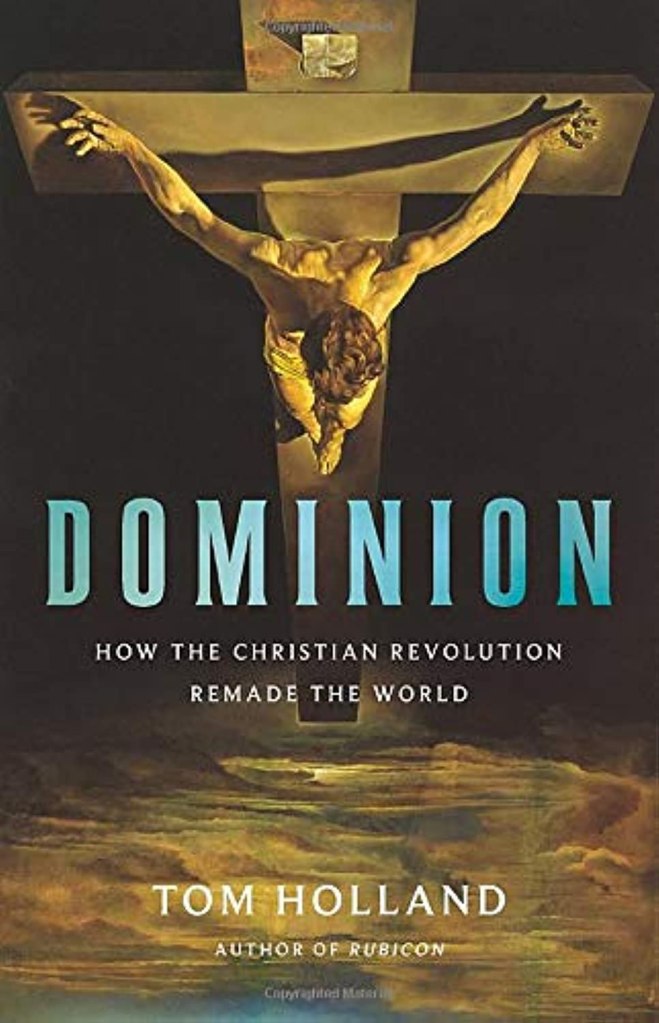
Tom Holland, in his seminal book, Dominion: How the Christian Revolution Remade the World, found the nexus for a radical change in the west in the crucifixion of Jesus. That event and the movement it inspired changed forever how the west (and now the rest of the world) views power and morality.
Tom Holland was an atheist When he did the research for this book. His area of expertise is Greco-Roman history. He was steeped in the brutish nature of the Roman world that championed power and elite, male dominance over all that was weak.
When he set out to trace his secular humanist values in western civilization, he knew there was some discontinuity between the Greco-Roman values he knew so well and his own, modern notions of basic human rights, so he was curious to locate the origin of that seismic shift.
His book, Dominion, traces our modern values from the roots where he found them in the history of western civilization. He found they go back to Jesus of Nazareth and the people who gave their lives to follow him.
The death of Jesus on the cross radically subverted the assumptions that ruled the world to that point. The Greco-Roman world that valued and honored power above all things gave way over time to the man who is claimed to be the Savior of the world who let himself be led like a lamb to his own slaughter. His life and message of self-sacrificial love became the bedrock for modern civil rights, human dignity, and the assumption that the powerful should shelter and care for the weak.
The criticism of Christians for racism and its worst manifestation – slavery – is deserved. Mostly because Christians “should’ve known better”. Of all people, Christians should have known better!
The water gets murky, though, in our modern memory because it has been influenced by a narrative that obscures the truth. The narrative that exposes the failing of Christianity often does so by directing attention away from the nonreligious world of reason and science, as if there is “nothing to see here.”
This view that rose to prominence during the Enlightenment is prevalent still today. It puts the full weight of condemnation for our failings on religion (and Christianity in particular). This is a false narrative, and, it obscures the truth and warps our perceptions that still persist.
There is nothing inherently wrong with science and reason. It is people who are flawed, and the flaws of people are not confined to science, or religion, or to any particular ideology or worldview. No ideology or worldview is immune.
Continue reading “The Errors of Our Ways: Science, Religion, and Racism”







 Navigating by Faith