Loneliness, Singleness and the Church Family

Some values evident in the original church family have been lost over the years in western culture


Rebecca McLaughlin, in her book, Confronting Christianity: 12 Hard Questions for the World’s Largest Religion, made an observation that inspires my article today. I am indebted to Rebecca McLaughlin and to the many serious Christian thinkers who have plowed ground that make it easy for me to walk the paths after them.

In this book, about a third of the way into the ninth chapter (Isn’t Christianity Homophobic?), McLaughlin talks about loneliness and singleness in the church. She digs up some nuggets that seem to have gotten lost in our modern culture.

She observes that western traditions have developed over the years that have plowed under values that once informed the early church. A tradition of rugged individualism and self-determination that is, perhaps, unrivaled anywhere in the world, is inbred into our American culture. Our suburban lifestyle is uniquely American, with our manicured lawns separated from our neighbors by fences and hedges. These are, perhaps, the gentrified remnants of farmstead claims staked by American pioneers against predators, weather, enemies and neighbors alike.

We circle the wagons today around the family unit that has come under “attack” from secular constructs of village-raised children and re-imagined family structures designed to fit societal mores that clash with us. These changes have caused conservatives and Christians to double down on the traditional, American family construct.

Traditional, though, is normative, and norms change. Not more than 150 years ago families looked different than they do today. In fact, they looked a little more like the modern family than the average person might realize.

Not long after the first generations of immigrants reached the shore of the New World, families and communities of families began to migrate across the country, south, west and sometimes north, clearing areas for homesteads. The fluidity of family compositions can be traced from one decennial census to the next. Not may households remained static from one 10-year census to the next.

My father, who researches genealogies, shines some historical light on the norms of the frontier movement in writing books about those migrations. From census to census to census, stories are told of dynamic changes in family structures.

Family units were ever changing in the combination of husbands, wives, children (both minors and adults), extended family and sometimes even strangers. Family often included a grandparent, niece or nephew, neighbor or border.

Children were born; children died; children moved away and moved back. Spouses died. New spouses moved in, or neighbors moved in who helped with the children and then became spouses… or not. Extended family members, neighbors and strangers, too, moved in and out of family units.

Census records reveal the consistency of flux as frontiers were blazed across this country. One of the many challenges of doing genealogical research through the 19th Century is determining the relationships of the people in those households from one decennial census to another and tracing the changes from decade to decade. 

The end of trailblazing and the Industrial Revolution, however, began to affect the composition of family units. Trailblazing gave way to communities, and factories grew up in those communities.

Workers migrated to the fixed location of a factory, and they became grounded and less mobile in their vocations. Family structures became more static and defined in the process. These and other influences formed the mold of the “traditional” American family.

What we assume to be the traditional family unit today is of relatively recent vintage. The Little House on the Prairie is more of a sentimental, re-imagining of the way it was than raw history reveals.

Even then, we get a hint of an interdependence of community that was much more intimate in generations past than our anemic sense of community today. This is true even with more distance separating homesteads than a thin veil of fences and hedges separating suburban lots.

The distance that separates people in modern western life, however, might as well be miles. We live as if we don’t need our neighbors, and we largely don’t even know them. Those fences and hedges might as well be walls.

In that sense, McLaughlin digs up the back-filled soil of modern western culture to uncover an ancient value that has been plowed under by the progress of western development. When St. Paul spoke about the virtue of singleness, he did so in a culture and time when family and community were quite unlike our own – values that we have relatively recently lost.

Continue reading “Loneliness, Singleness and the Church Family”

Where Is God in the Messiness of the Church?

I have never participated in a perfect church and have never met a perfect person, yet I believe in a God who is perfect and who is perfecting us, His people.


Toward understanding and healing the wounds of the church, I write this blog piece. The context is the very public struggles of two mega-churches in the Chicago are where I live. Last year, Bill Hybels resigned as the head of Willow Creek Church, after allegations of misconduct came to light. Just today I read about James MacDonald deciding to step down from leadership of the Harvest Bible Church in the wake of a lawsuit and allegations of poor leadership.

The two situations are different, though they both involve allegations against longtime leaders of two of the largest and most prominent churches in the Chicago area. Bill Hybels is accused of inappropriate relationships with women in the church. MacDonald is accused of mismanagement of money, heavy-handed leadership and related allegations. Both situations expose the nature of the human side of the church and the prevalence of sin in the church, even at the leadership level. (The Catholic Church is not alone in this respect.)

In the 1980’s, I became involved in a church that I thought, at the time, was the “perfect” church. It was a vibrant engaging church community. Worship was spirit-led and dynamic. The leadership was charismatic and inspiring. The church community was tight-knit and familial. This church had planted many other churches that were also thriving and growing. I spent 6 years there and knew the church intimately.

It wasn’t as perfect as I first thought, of course. People are people, even people who go to church. Within a year of my leaving to pursue what I believed God was directing me to do next, the church was splintering, disintegrating and falling apart. My pastor, the man who married my wife and I, divorced his wife within a few years of our leaving. Neither he nor his wife are involved in a church today (as far as I know).

We were devastated. This was over 25 years ago, and it still puzzles me. The coming apart at the seams of this church that I viewed as a model of what churches should be impacted me more than I would care to admit.

I realize now that I had invested more of my spiritual capital in the church and its leaders than I should have.

A friend of mine, a fellow church-goer, has been struggling with issues in his church – the leadership in particular. I have listened to him, recognizing the disappointment and disillusionment in his voice. Though I don’t know the details of the issues he has had with the leadership, I do know that he feels cut adrift; he is hurt; his faith is shaken. He has stopped going to church. He isn’t sure he can trust Christians anymore, and he is struggling to make sense of his experience. I can relate.

We left the last church we attended because of leadership, trust and personality differences that affected the people to whom we were closest in that church. Our friends were financially and personally hurt by leadership in the church. We felt we needed to stand with our friends and support them as they drifted away from the church, unable to remain in a church led by people who could not be trusted with their spiritual well being.

These are just the experiences I have had, but I don’t think I am alone in having difficult and painful experiences in churches and with the leadership of churches. Church is a messy business.

Many people turn away from the church and even from Christianity because of similar experiences. How many times have you heard someone say they don’t go to church because Christians are hypocrites? And the fact is that Christians are hypocrites!

But that shouldn’t be the end of the story.

Continue reading “Where Is God in the Messiness of the Church?”

And God Said

God is a communicator, and He made us for communication with Himself.


The parallels between Genesis 1 and John 1 are obvious. Genesis 1 reads:

In the beginning God created the heavens and the earth. (Genesis 1:1)

John 1 reads:

In the beginning was the Word, and the Word was with God, and the Word was God. He was with God in the beginning. Through him all things were made; without him nothing was made that has been made. (John 1:1-3)

These parallels convey the idea that God is “verbal” by His very nature, and He communicated the universe into existence. Indeed, the creation story as it unfolds in Genesis bears this out:

  • And God said, “Let there be light,” and there was light. (gen. 1:3)
  • And God said, “Let there be a vault between the waters to separate water from water.” (Gen. 1:6)
  • And God said, “Let the water under the sky be gathered to one place, and let dry ground appear.” (Gen. 1:9)
  • Then God said, “Let the land produce vegetation…. (Gen 1:11)
  • And God said, “Let there be lights in the vault of the sky to separate the day from the night….” (Gen. 1:14-15)
  • And God said, “Let the water teem with living creatures, and let birds fly above the earth across the vault of the sky.” (Gen. 1:20)
  • And God said, “Let the land produce living creatures according to their kinds…” (Gen. 1:24)
  • Then God said, “Let us make mankind in our image, in our likeness….” (Gen. 1:26)

It’s interesting, isn’t it, that a plural pronoun is used for God in Genesis 1:26. To be verbal by nature, communicative by His very essence, God must have relationship within Himself. In John 1, we read that “the Word was with God, and the Word was God”, and then John goes further to say this:

The Word became flesh and made his dwelling among us. (John 1:14)

Of course, he is talking about Jesus – God who became like us, the creatures He created in His own image. Of God and Jesus, John said,

“He came to that which was his own, but his own did not receive him. Yet to all who did receive him, to those who believed in his name, he gave the right to become children of God….” (John 1:11-12)

Continue reading “And God Said”

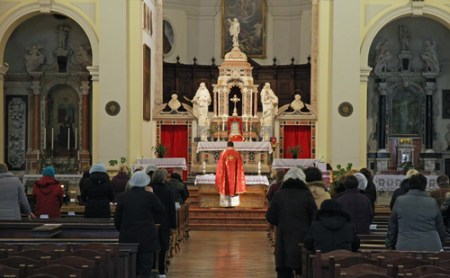
Ritual, Spirit and Truth

Depositphotos Image ID: 23471738 Copyright: ChiccoDodiFC

I was raised Catholic. I say that often. Not that it is a bad thing. It’s just my experience. During my time in the Catholic church, through my childhood and early adulthood, I had no connection with God. I can’t lay the blame for that at the feet of the Catholic Church. That was just where I was.

When I became a Believer, when I accepted Christ as my personal Lord and Savior, my life changed. I also began to see the Catholic Church in a different light. I was never into the ritual and observance, which is a major component of the Catholic Church. Not that other denominations and religions don’t have central religious rituals. All religions have ritual observances and traditions.

Those ritual observances and traditions are not, in themselves, bad, but they can create a facade that hides emptiness, darkness and sin. They can create an appearance of piety with no spiritual reality behind them. They can be more superstitious than spiritual, like stroking a rabbits foot for good fortune. In these and other ways, ritual observances can become a substitute for relationship with God.

Continue reading “Ritual, Spirit and Truth”

Daily Prompt: Brassy

Jazz concert
       depositphotos Image ID: 38371383 Copyright: wangsong

via Daily Prompt: Brassy

  • sounding like a brass musical instrument; harsh and loud.
  • tastelessly showy or loud in appearance or manner.

When a brass section plays along in harmony with a band, it can be a magical, musical experience. Those bold, brassy tones blending together in tight harmonies, complimenting the melodies and, sometimes, doing the solo thing – at the right time of course – are beauty in sound.

Everything is beautiful in its place, and its time. (Ecclesiastes 3:11)

Musicians will affirm that “chemistry” is important in a musical group. Each person must be attuned to the other and to the whole and, at the same time, be focused on his or her own contribution. This is multitasking at its finest! When the chemistry is there, it is a wonder to behold. When it isn’t, it just falls flat.

Continue reading “Daily Prompt: Brassy”