Rascals for God

Relationships are more important than the things we have

Young Girl with Pigtails Grinning - smWe visited a church today. The pastor invited some of local youth theater kids to lead worship. It was a small, but sweet congregation. The kids did a great job, just being themselves, and singing their hearts out, which is what they do. God has gifted them with musical talent, good voices and really good friends, and they aren’t afraid to share their talents.

Everyone in the church today was blessed.

The sermon was on a parable not often referenced found at Luke 16:1-9:

Jesus told his disciples: “There was a rich man whose manager was accused of wasting his possessions. So he called him in and asked him, ‘What is this I hear about you? Give an account of your management, because you cannot be manager any longer.’ “The manager said to himself, ‘What shall I do now? My master is taking away my job. I’m not strong enough to dig, and I’m ashamed to beg—I know what I’ll do so that, when I lose my job here, people will welcome me into their houses.’ “So he called in each one of his master’s debtors. He asked the first, ‘How much do you owe my master?’ “‘Nine hundred gallons[a] of olive oil,’ he replied. “The manager told him, ‘Take your bill, sit down quickly, and make it four hundred and fifty.’ “Then he asked the second, ‘And how much do you owe?’ “‘A thousand bushels[b] of wheat,’ he replied. “He told him, ‘Take your bill and make it eight hundred.’ “The master commended the dishonest manager because he had acted shrewdly. For the people of this world are more shrewd in dealing with their own kind than are the people of the light. I tell you, use worldly wealth to gain friends for yourselves, so that when it is gone, you will be welcomed into eternal dwellings.

What a weird parable! The manager is called “dishonest”; but he is commended for his “dishonesty”?

The clue to unlock the meaning is in the opening line: the rich man was critical of the manager for wasting “his” possessions. The phrase “his possessions” on first blush means the rich man’s possessions, but use of the pronoun, instead of “rich man” or “manager”, leaves open the possibility that they could be the manager’s possessions. Jesus doesn’t clarify.

The parable only makes sense when we understand that God is the rich man, and we are the manager. The possessions are God’s, but we are entrusted with them. We have nothing that doesn’t originate from God. The gifts (talents) we are born with are from God. Even the things we work hard to “earn” ultimately come from God. God created the universe out of nothing, and everything that exists, including the gift of life, was created and given to us  by God.

God gives everything to us; and, ultimately, we “can’t take them with us”, as the saying goes. We are only the managers of the stuff we have.

The manager in the parable is commended for using the “worldly wealth” to gain friends. The manager knew that he was only a steward of the things the rich man left him, and those things would eventually be taken from him, so he used those things wisely to build relationships for the future. Jesus commended the manager and said he will be “welcomed into eternal dwellings.”

A clear implication of this parable is is that relationships are more important than the things we have. The things we have are temporal. They are subject to rust and rot, but relationships are lasting.

The “moral of the story” comes several verses later:

“No one can serve two masters. Either you will hate the one and love the other, or you will be devoted to the one and despise the other. You cannot serve both God and money.”  (Luke 16:13)

The most important relationship we have is with God, and a relationship with God is more important than money. We can’t take money with us when we die. Money and possessions will only benefit us while we live. They are ours to manage during our lives. If we use the things we accumulate only for our own benefit, the benefits are only enjoyed (if at all) during our lives.

This isn’t God’s purpose for us. God isn’t happy when we choose the temporal over the eternal.

He also gives us good things to share with others. Sharing our talents and wealth with others is what God wants us to do.

Jesus said it a different way when he told people to store up treasures in heaven where moths and vermin cannot destroy them and thieves cannot steal them. (Mark 6:19-20) If we use our riches for ourselves only, we have our reward, but it is a temporary reward. It’s of no use to us when we die. It is “here today, gone tomorrow”; or maybe more accurately, we are here today, gone tomorrow.

Using our money to bless other people, and thereby build relationships, is the eternal work of God. I don’t believe this principle applies just to money: substitute any other “possessions” (gifts) innate or “earned”, like musical talent, property, whatever it is. If we use what we have on ourselves, we have ultimately wasted and squandered those treasures away. If we use what we have to bless others, we have God’s blessing and we will be welcomed into eternal dwellings!

As pastor Mark Flory Steury said in his sermon, the manager was a “rascal”. He used what the rich man left him to endear himself to the people who owed debts to the rich man. We all owe debts to the rich man (God). The manager collected payments that might not have been paid if the manager had not offered the “discount”. When we use our gifts for other people, we only build relationships with other people, and we “collect” from them thankfulness to God for the generosity that is shown.

Jesus told us to do unto others as we would have them do unto us. He said whatever we do for the least among us, we do for God. When people are filled with gratitude for the things we do and the generosity shown to them, are they not also being thankful to God ? Jesus said they would know us for the love that we show to one another, and that love points to God. When we use what we have for the benefit of others, we store up our treasures in heaven – we are rascals for God.


Six Attributes of Success

Five lessons in success from an Olympic Champ and one bonus.


In my last post, I passed on a blog article about 9 Ways a Theater Degree Trumps a Business Degree. Next in line is five Characteristics of a Successful Wrestling Mindset from Gene Zannetti, a sports psychology expert.

I have always said that the lessons learned in wrestling [or whatever sport or pursuit one chooses] translate to success in life. If a person learns to translate the lessons learned in childhood play to adulthood endeavors, and indeed “life” itself, that person will be successful. If that transition is not made, the richness of those experiences is lost and the experiences become only faded memories.

Wrestling is a particularly lesson rich sport. I learned two of the most profound lessons of my life through wrestling: 1) once you start something, you should finish it; and 2) don’t be afraid to fail. I think I have somewhat successfully instilled those attributes in my children. The memories of past triumphs (and unfortunately past failures) really fade in comparison with the life lessons that were learned through blood, sweat and fears I experienced through wrestling, and I carry them with me, as part of who I am, today.

Just two days ago, Jordan Borroughs won his 65th senior (Olympic) level match and with it his third consequetive world or Olympic title. He has never lost in senior level competition. Unknown to anyone but his coaches, Jordan severely injured his ankle in practice on August 22nd. He had surgery the next day. Two plates and five screws were implanted into his ankle, and he could not wrestle until the day he stopped out on the mat for the World Tournament on September 18th. The traits that make Jordan Burroughs a success come shining through in the interview with Flowrestling right after he came off the mat.

Jordan Burroughs describes in that Flowrestling interview the “five characteristics of a successful wrestler mindset”. These five things translate to a successful person mindset in whatever you do. Continue reading “Six Attributes of Success” →

Being Honest about Who and What

Photo by Amanda Leutenberg

Part one of two – let’s be honest about the who and what of our underlying presuppositions…

“[Christ] told us to be not only ‘as harmless as doves,’ but also ‘as wise as serpents.’ He wants a child’s heart, but a grown-up’s head. He wants us to be simple, single-minded, affectionate, and teachable, as good as children are; but He also wants every bit of intelligence we have to be alert at its job, and in first-class fighting trim.” C.S. Lewis ~ Mere Christianity

Many believe that people must check their intelligence at the door of faith in order to be a Christian. Certainly atheists and agnostics think so, but believers also act as if intelligence is something that must be discarded or even worse, not to be trusted.

A read through the Bible, however,  reveals that God is as concerned about a person’s mind as He is about a person’s heart. In fact, the mind and the heart are often mentioned together. (See Matthew 22:37; Mark 12:30 and Luke 10:27)

If we believe in God, and believe He created the heavens and the earth, then we can trust the intellect He gave us. In fact, if He gave it to us, does He not expect us to use it?

Continue reading “Being Honest about Who and What” →

Bias is Revealed in What we Consider and Fail to Consider

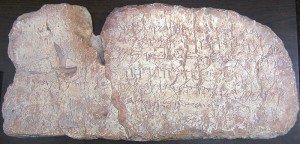
Siloam Tunnel inscription records
Siloam Tunnel inscription records when workers from the 8th Cent. B.C. met when digging from opposite directions. The inscription is now located in the Istanbul Archaeological Museum

When skeptics claim that Bible believers are biased, they are right. The truth is we all are biased, skeptics included. Some may be more aware of their own bias than others, but we all have our biases.

I am fascinated with stories of people who had one “bias” at one time and changed to the opposite “bias”. It happens both ways: atheist to believer/believer to atheist. Someday I will explore the similarities and the differences in those stories. There are some common threads, but that is a topic for another day. Continue reading “Bias is Revealed in What we Consider and Fail to Consider” →

A City Set on a Hill in a Foreign World

Our end goal is not ultimately to rehabilitate an earthly city or country, but to enter into a heavenly City of which the designer and builder is God.


One Sunday I recall the pastor deviating from the planned sermon to observe that Christians today sometimes act as if God is not in control. We do this by complaining about politics, our country, the world, etc. Sometimes when the Spirit leads, we need to stop from our planned way and consider what God is saying. If we don’t, we might miss God.

There is a segment of the church that believes and acts like the USA is God’s country, a Christian nation. I think this is where many Christians allow politics into their theology at a grave danger to pure religion, which James reminds us “to look after orphans and widows in their distress and to keep oneself from being polluted by the world”. (James 1:27)

Yes, the founding fathers were “Christians”; and the country became a haven, a promised land, early on for people escaping religious persecution in England and other places. I love the fact that our country was founded on Biblical ideals, among other things, with honor for God. The freedom of religion and freedom of expression in the USA make this country great, the envy of much of the world, though not understood by much of the world as well.

Many hundreds of years before Jesus the Israelites were God’s chosen people. They were chosen out of all the people groups in the ancient Middle East on the basis of Abraham’s faith, and a promise was made to him that the whole world would be blessed by his progeny.

The promise of God to the people (Abraham and his descendants) to whom He chose to entrust that promise prepared the way for Jesus, the Messiah, except Jesus came with a plan and a message they did not expect. He came to his own, and his own knew him not. The Israelites were dug in, resting on the assumption that they alone were God’s chosen people. Many of them missed the boat. They rejected the Son of God because they had their own expectations and were not in tune with what God was doing.

We know the rest of the story, at least where the narrative continues today. God’s plan was to introduce the Christ for all people through the platform of the message entrusted to the Jewish people, who preserved that message and protected it. But many of them missed it. God does not always work as we expect Him to work.

We might say the Jews became nationalistic in their religion, and they missed the fact that God intended to bless the whole world. Yes, Jesus came to his own, but he also came to all who would believe on him. The new wine came, and the old wine skin could not contain it.

Continue reading “A City Set on a Hill in a Foreign World” →