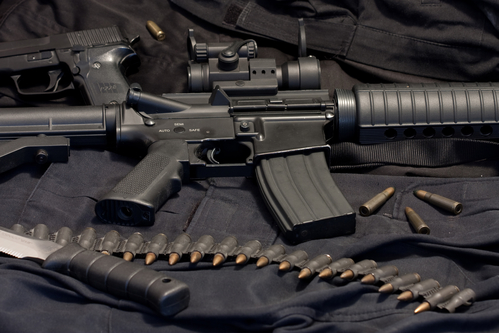
God Talk about Guns

I don’t see anywhere in the teaching of Jesus or of the apostles the principle of defending each other by force.

Depositphotos Image ID: 11354851 Copyright: Rajen1980

As time goes on, I have been more diligently and more earnestly aware of the assumptions we tend to make as Americans, and as American Christians, that may not supportable biblically. We tend to make certain assumptions, but we don’t question those assumptions or test them against Scripture. If anything, we work to make Scripture support our assumptions, rather than subject our assumptions to Scripture.

This is a human tendency, of course. I am not picking on Americans. I am one. I just know more about how Americans think than other people, so I can speak to it more definitely.

On the issue of gun control, I am finding a distinct disconnect between the popular Christian responses, the realities and what Scripture suggests. The popular Christian responses, at least among white evangelicals, of which I am a member, is something like this: guns don’t kill people. We don’t need more gun control; people need God (among other things).

That is a truism of course. People do need God, but that doesn’t really help to address an obvious issue that is utterly unique to our country of all the countries in the western world. We have a problem, and we should be able to acknowledge it.

As Christians, we could also say that it isn’t a gun problem; it’s a sin problem. That is right as well, but that also doesn’t help us. Does that mean we should ignore it? Condemn it but do nothing about it? (After all, people are getting what they deserve because all have sinned.)  Do these responses seem right to you?

They shouldn’t! Yes, people need God, and the root of all human problems is sin, but we can set back offering nothing but sayings and platitudes and be considered followers of Jesus who had a reputation of getting into right into the place where people lived, right in the middle of the ugliness of sin, and engaged people where they were, healing and delivering people as He went. If Jesus is our example, we can’t sit on sidelines without doing something.

“What good is it, my brothers, if someone says he has faith but does not have works? Can that faith save him? If a brother or sister is poorly clothed and lacking in daily food, and one of you says to them, ‘Go in peace, be warmed and filled,’ without giving them the things needed for the body, what good is that? So also faith by itself, if it does not have works, is dead.”[1]

Continue reading “God Talk about Guns”

The 2nd Amendment, Freedom & Responsibility

Second Amendment to the Constitution
Depositphotos Image ID: 173296888 Copyright: zimmytws

If faith without works is dead, then our thoughts, prayers and condolences are meaningless at some point if we aren’t willing to take some action to address the societal problem of school shootings and mass shootings in general. What is the Christian response to these tragedies? Is the 2nd Amendment greater than the 6th commandment (though shall not murder), the greatest commandment (to love God with all our hearts, souls and minds) and the second greatest commandment (to love others as ourselves)? How do we balance the 2nd Amendment with God’s commandments? Are guns really the issue? Below is an article with some thoughts to consider as we mourn the victims of another school shooting.

via The 2nd Amendment, Freedom & Responsibility


Where is Our Confidence and Focus?

In Paul’s day, and I suggest in ours, the influences we most need to be concerned about are the religious ones in our own midst!

Depositphotos Image ID: 15807997 Copyright: Kuzmafoto

Paul, the man Jesus “recruited” face to face after His death and resurrection to be the apostle to the Gentiles, was concerned about the purity and integrity of that Gospel. He had every reason to be proud of his accomplishments and heritage as a Jewish Pharisee, a scholar and leader of the highest order, but counted them all rubbish for the sake of the Gospel. Paul did not boast in his accomplishments; he boasted in Christ.

At the same time, Paul was keenly concerned with bad influences creeping in to the little pockets of believers that Paul oversaw and nurtured. We see this concern in most of his letters, including the letter to the Philippians, which I have been reading the last couple of days. Paul says in Philippians 3:2-7:

“Look out for the dogs, look out for the evildoers, look out for those who mutilate the flesh. For we are the circumcision, who worship by [in] the Spirit of God and glory in Christ Jesus and put no confidence in the flesh—though I myself have reason for confidence in the flesh also. If anyone else thinks he has reason for confidence in the flesh, I have more: circumcised on the eighth day, of the people of Israel, of the tribe of Benjamin, a Hebrew of Hebrews; as to the law, a Pharisee; as to zeal, a persecutor of the church; as to righteousness under the law, blameless. But whatever gain I had, I counted as loss for the sake of Christ.”

This got me wondering: Who might Paul be talking about today?

Continue reading “Where is Our Confidence and Focus?”

Of Kings, the Gospel and Political Expediency

What is the fruit of the Holy Spirit? What does loving your neighbor look like? These are not idle questions. These are questions that will separate sheep from goats.

Depositphotos Image ID: 55708003 Copyright: prometeus

Over the weekend, I posted a simple message on Facebook: presidents don’t say things like that. I am referring to the “sh*thole nations” statement of course. That simple post spawned hundreds of comments, and many of the comments were from Christians defending Trump, or at least not denouncing what Trump might have said.

Durbin might have mistaken what Trump actually said. It’s possible. It’s highly likely that Durbin was motivated by his dislike of Trump and by political objectives when he reported what he claimed Trump said. While it’s possible that Trump didn’t say those words, at least not exactly as they were reported, it also doesn’t really matter.

It’s one thing to question the veracity of Durbin’s report, but it’s another thing to defend or overlook what was claimed to have been said. If he said what he is accused of saying, we shouldn’t be defending it.

I find the continued, unquestioned support for the president, no matter what he says or does, by the Christian community to be disturbing. Are we following Christ? Or are we following a political party? I can’t tell.

Some of the things that have been said include the following: 1) yeah but look at the good that he is doing; or 2) he’s not perfect, he’s a flawed human being;  or 3) other presidents have said much worse, and 4) all presidents have said things in private meetings that they would not say in public (to repeat some of statements I have seen).

Those statements may be accurate (or not), but regardless of that, let’s look at these things from a Gospel perspective.

Continue reading “Of Kings, the Gospel and Political Expediency”

Donald Trump, Fruit and Wolves in Sheep’s Clothing

We have no business judging those outside the church but are instructed to judge those within the church.


Paul wrote to the believers in Phillipi:

“Let your manner of life be worthy of the gospel of Christ… standing firm in the spirit, with one mind striving side by side for the faith.” (Philippians 1:27)

Paul’s earnest instruction to the Philippians was that their “manner of life” (conduct) be worthy of the Gospel of Jesus. The Greek word translated “manner” means, among other things, “recognized as fitting”.[1]

Paul is talking about what we see in people, the outside appearances. In essence, Paul is saying let your conduct and the way people perceive you match the fruit of the Spirit that is working within you.

The fruit of the Spirit is “love, joy, peace, patience, kindness, goodness, faithfulness, gentleness, self-control….”[2]

Jesus warned about false prophets, adding that we would know them by their fruits.[3] In contrast, Jesus said the world would know us by our love[4], which is the greatest of the fruits of the Spirit.[5]

In this context, how do we, as Christians, respond to the things that Donald Trump says and does? Why do we defend him? Why have we tied our destiny to him? What does the fruit look like that hangs from his tree?

Continue reading “Donald Trump, Fruit and Wolves in Sheep’s Clothing”