The Descent and Ascent of Man

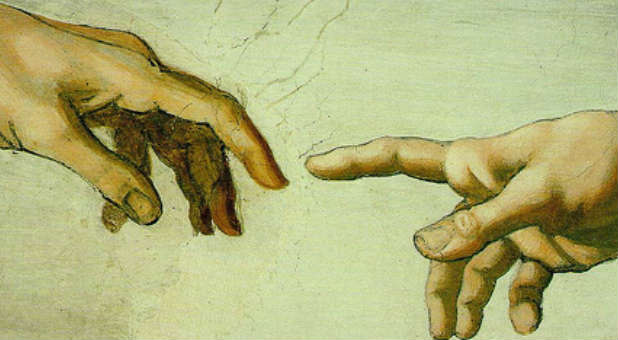
In thinking about the phrase, “descent of man”, coined by Charles Darwin, the subtlety and nuance of the play on words strikes me, but not in the way Darwin likely intended.

Image ID: 150736070 Copyright: claverinza

When Charles Darwin wrote The Descent of Man[i], the title was a play on words. In the context of the book, Darwin meant the word in the sense of “derivation from an ancestor”; “the fact or process of originating from an ancestral stock”; and/or “the shaping or development in nature and character by transmission from a source”.[ii] Descent, of course, can have a quite different meaning.

The word, descent, can also mean “the act or process of descending from a higher to a lower level, rank, or state”; “an inclination downward”; and/or “a downward step (as in station or value”), as in decline.

Darwin probably meant the word in this sense, also, in that philosophers and scientists and thinkers of all types before him had mostly viewed man standing apart from the rest of the natural world, standing above it (just a little lower than the angels). Darwin’s theory revealed man descending not from heaven, but descending (originating from ancestral stock) from lower life forms and ascending (evolving) from those lower life forms to the complexity the human species is today. This is the play on words.

In thinking about these things many generations after Charles Darwin coined the book title, in the context of all that has developed since his time, the subtlety and nuance of the play on words strikes me, but not in the way Darwin likely intended.

Continue reading “The Descent and Ascent of Man”

God Chooses US

The Scripture presents to us a tension between the necessity of free will and the certainty of God’s sovereignty.

Creative Commons photo from Flicker

God lets us choose Him: “But to all who did receive Him, to those who believed in His name, He gave the right to become children of God.” But that isn’t the beginning of the story – or the end of it.

God chooses us. He gives us the right to become children of God[i], and He made that choice before the foundation[ii] of the world. We become the children of God not by blood descent, not by the will of parents or anyone else – maybe not even by our own will – but by God’s choice.[iii]

I do not have a systematic theology. I am not a theologian, and my understanding of systematic theology is limited, but free will has always seemed self-evident to me. It also seems eminently biblical. God created us in his own image[iv], and a primary characteristic of God is agency. We see in the story of Adam and Eve that God gave us agency too, by giving them dominion over the animals of the earth and in the choice to eat of the fruit of the tree of the knowledge of good and evil.

The freedom to choose is also a necessary condition of love. God is love[v], and he created us in His image to reflect Him, to glorify Him and to love Him.

The point of an image is to image. Images are erected to display the original. Point to the original. Glorify the original. God made humans in his image so that the world would be filled with reflectors of God. Images of God. Seven billion statues of God. So that nobody would miss the point of creation. Nobody (unless they were stone blind) could miss the point of humanity, namely, God. Knowing, loving, showing God.[vi]

God created us to love him. Therefore, we must have agency/free will in order to be able to reflect back His love as He intended.

But there is another side to this. There is not only what we call faith; there is grace. There is God’s unmerited favor. God chooses us. We call this predestination and attribute it to God’s sovereignty

Continue reading “God Chooses US”

How Do We Know God is a Personal Being?

Science, the study of physical world, can’t explain the cause of the universe based on initial conditions and natural laws because the universe, itself, is the first physical state.

Depositphotos Image ID: 146490813 Copyright: SergeyNivens

Many people are not willing to trust the Bible. They are not sure whether God exists or who, or what, God might be. We can start with that simple question: who or what is God?

I like the way Dr. William Lane Craig addresses the question. He explains that the conclusion is reached in at least three different ways.

Continue reading “How Do We Know God is a Personal Being?”

Did Nature Cause Itself?

 (c) Can Stock Photo


I haven’t heard anyone say specifically that nature caused itself, in so many words,(other than the Hawking axiom about the laws of gravity causing the universe), but that is the question begged by any assertion that God doesn’t exist. Anyone who maintains that nature and natural causes are the beginning and the end of all reality is begging that question: did nature cause itself?

Perhaps the greatest obstacle to the assertion that nothing supernatural exists is the Big Bang. The Big Bang is accepted science. The evidence is very compelling, though it wasn’t received well when it was first postulated. The thought that the universe was not eternal and had a beginning was thought to be “repugnant” and to “betray the very foundations of science”.[1]

This is because a beginning to the universe suggests that the universe had a Beginner. The initial reluctance to accept the Big Bang has long ago changed, however, as the evidence has accumulated. Stephen Hawking proved it mathematically, but struggled with the implications of it the rest of his life. Continue reading “Did Nature Cause Itself?”

What If Time Is An Illusion?

When we “look back” it may seem as if time was a dream.

Photo by Beth Drenbel
Photo by Beth Drendel

What if time is an illusion?

A self-described atheist threw out this proposition offhandedly in a conversation I had with him recently. I think it makes sense to respect the people we dialogue with, including atheists, so I chewed on that proposition a bit.

As often is the case, I woke up this morning thinking about things that I had been thinking about the night before. In my reflection, it dawned on me that, perhaps, he was right: time is an illusion. It actually makes some sense, but maybe not like he imagined. Let me explain.

Continue reading “What If Time Is An Illusion?”