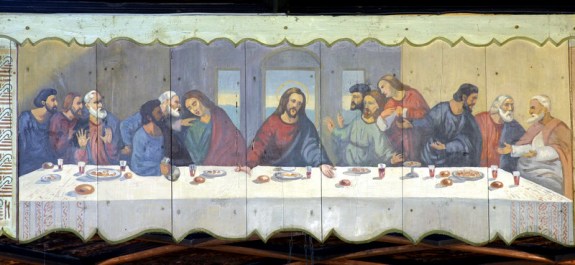
The Message in the Earliest Creeds in the New Testament

 (c) Can Stock Photo

(c) Can Stock Photo

According to Dr. Gary Habermas, Paul cites a number of early Christian creeds in his letters, and Peter cites one as well. Perhaps, the most significant creed is found in 1 Corinthians 15:3-7.

The other creeds include 1 Corinthians 11:26; Acts 2:22-36; Romans 4:25; Romans 10:9; Philippians 2:8; 1 Timothy 2:6; and 1 Peter 3:18.[1]  Other scholars identify creeds in 1 Corinthians 11:23-29; Romans 1:3-4; Romans 10:9; 1 Timothy 3:16; 2 Timothy 2:8; and Philippians 2:6-11.[ii]

The importance of these creeds is that they include the earliest message of the church following the death of Jesus. They reveal the most fundamental and central message of the early followers of Jesus. The most significant characteristic of these creeds is a common theme – the death and resurrection of Jesus. Continue reading “The Message in the Earliest Creeds in the New Testament”

Looking Back and Looking Forward, From the Beginning to the End

 (c) Can Stock Photo

(c) Can Stock Photo

“To Him who loves us”

God loves us. Love is the beginning and the ending of the story. And love is everything in between. God created us in the beginning for love.

He gave us choice, because love does not coerce. All the misery in the world, all the pain and suffering, is because God gave us freedom of will and allowed us to go our own way. He released us to our own choices in hope that we would choose Him because we want to, because we love Him.

God sustains the world on a delicate edge, finely-tuned from the moment of creation to sustain life, and He holds it in balance to give humanity the opportunity to enter into relationship with God our creator. His handiwork is obvious if we want to see it, not so obvious if we don’t, because love does not coerce. Continue reading “Looking Back and Looking Forward, From the Beginning to the End”

Aiming for Eternity

13731513_10210133390755193_1035877452838217062_n


God is from everlasting to everlasting. He sets eternity in the hearts of men (Ecc. 3.11), but our glimpse of eternity and our sense of God is often obscured by the every day realities of our lives.

That God set eternity into the hearts of men should tell us something. It should urge us to look beyond ourselves, to look to God for His purpose in our lives. Yet we are often given to walking with our heads down, driven with blinders on chasing after self-fulfillment or prone to obsessive self-reflection with eyes turned inward. We have a hard time seeing past our own noses, much less focusing on an eternal God  We have a hard time, wherever our gazes are set, letting go of self-direction.

The Bible calls that sin.

Take the morality out of sin, and sin is simply missing the mark. The mark is God, His character and His purpose. When our focus is on other things, when we are pursuing other things to the exclusion of God, we are missing the mark. We are missing the purpose of God in our lives.

God, of course, is the very reason for our existence. Continue reading “Aiming for Eternity”

God Doesn’t Send People to Hell

Sun by Me


Imagine a survivor of the Holocaust, living life out quietly, suffering the residual emotional, mental and spiritual pain of the atrocities she witnessed and experienced. She harmed no one and was a decent mother, grandmother wife and citizen. Someone preaches the Gospel to her on her death bed, and she rejects it. Will God send her to heaven or hell?

This question is compelling, suggesting that no God would send anyone who suffered so much to hell. But, the question really isn’t a good one. Not that the circumstance isn’t compelling. The question is loaded, and it’s intended to negate the the Christian idea that the only way to God is through faith and belief in him.

Jesus said that he is the way, the truth and the life and no one comes to the Father but through Him.[1] Peter, who walked with Jesus, ate meals with Him and sat at His feet as he was mentored by Jesus, proclaimed that there is salvation in no one else.[2]

If Jesus is God’s Son, sent to bring the world to the Father, and there is no other name by which men must be saved, then a person who rejects rejects Jesus is not going to heaven. according to these words that Jesus spoke. So, doesn’t that mean God sends people  who don’t believe to hell, like the good citizen who suffered in Auschwitz?

God is love.[3] Right? Many people believe, based on that proposition, that God would not send people to hell, especially people who suffered in this life. I think they are right, but for different reasons. I believe that love is the reason God will not send someone to heaven!

Continue reading “God Doesn’t Send People to Hell”

Olympic Gold and Everlasting to Everlasting

 (c) Can Stock Photo

(c) Can Stock Photo

I tend to think that life revolves around me.  From my perspective, it does.  I see the world through my eyes.  My understanding of the world starts with me, but it cannot end there.

That myopic beginning is part of my lot in life. That is where my challenge starts.

I am finite.  My view of the world is limited. My view is not just limited; it is utterly infinitesimal.

Science tells us that the world began with a “bang” about 14 billion years ago.  All of known history is less than 10,000 years.  My life began only 56 years ago, and I might only have another 30 years or so if I am fortunate. In comparison to the age of the universe, I am barely a mist. Continue reading “Olympic Gold and Everlasting to Everlasting”