By Faith We Know God and Our Place in the World

God is greater than the creation He made, that God is timeless, and He will outlast the creation as it is and as we know it

M74, nicknamed the Phantom Galaxy, as seen by the James Webb Telescope

In my daily reading today, I read these verses from the Letter to the Hebrews:


“In the beginning, Lord, you laid the foundations of the earth, and the heavens are the work of your hands. They will perish, but you remain; they will all wear out like a garment. You will roll them up like a robe; like a garment they will be changed. But you remain the same, and your years will never end.” 

Hebrews 1:10‭-‬12 NIV


These words were written in the 1st century, and they recall the words in Genesis that were written many hundreds, maybe even thousands of years before:

“In the beginning God created the heavens and the earth.”

Genesis 1:1

The statements written in the letter to the Hebrews and in Genesis, long before that, were all written before the revelations of modern science.

We argue today over the passages in Genesis about the creation of the world, whether God did it in seven days or over seven periods of time. Some people say we should take Genesis “literally” (whatever that means), and other people say that the creation account in Genesis is simply poetry and should not be taken literally. There are many people in between, and many people who do not believe or take the Bible seriously either way.

Yet, whether these words are intended to be read as a literal, seven day creation event, seven periods of time, merely a poetic conception or otherwise, they express by faith an understanding that God created the world we live in – “the heavens and the earth”. They also expressed an understanding that God is greater than the creation He made, that God is timeless, and He will outlast the creation as it is and as we know it.

Whatever you believe about the description of creation in Genesis and elsewhere, the understanding is accurate: that the earth and the greater universe as we know it will not remain the same. It is subject to entropy governed by the Second Law of Thermodynamics. In poetic words, “[The Heavens and the Earth] will wear out like a a garment…. like a garment they will be changed.” In more philosophical terms, the Apostle, Paul, says:


“[T]he creation was subjected to futility….”

Romans 8:20


We don’t need to have a sophisticated scientific understanding of the Second Law of Thermodynamics to realize that the universe is, in a sense, winding down and wearing out, that it is “subjected to futility”. The earth, which is such an incredibly minute part of the universe, will not support the life that teams on it very far into the future.

We live in a very narrow band of time in which creatures such as ourselves can thrive on planet earth, sandwiched between ice ages and other inhospitable fluctuations and epochs space and time. Out time will pass like a flower that blooms one day and is gone the next in relation to the full space/time continuum.

Regardless of any Herculean efforts we give on our part to preserve the environment of this planet as we know it, the laws of the universe guarantee that life will no longer be supportable on planet earth, or anywhere in the universe for that matter, at some point in the future. It is inevitable.

It is remarkable to me that the writers of these ancient texts understood this fact by faith, though they had no hint of the science behind it. Knowing nothing of the Second Law of Thermodynamics, they understood nevertheless that this world will wear out.

They also had faith that the God who created it is the constant. Ignorant of the science, they nevertheless perceived and understood the reality of God, His creation and their place in the world.

Though modern science seems to reveal that our universe had a beginning, just as these ancient writings stated, many modern people who have the aid and benefit of science fail to see or acknowledge the creator. This is not a failing of science, though; it’s a failing of faith.

Though science provides many benefits, science is not essential for our faith or relationship to God. All the science in the world is not sufficient to gain us knowledge of God, as it necessarily rests on faith. At the same time, we can have none of the knowledge and understanding of science and still know God and our place in the world.

I love science, as it reveals the wonder of a universe that God made understandable and searchable by us. By faith we grasp all the reality we need to know, but science reveals majesty and wonder and appreciation of the greatness of our God all the more.

By faith, we also understand that God loves us. We understand that there is more to reality than the physical, space/time continuum. We perceive that God had a purpose in subjecting the creation to futility:


“For I consider that the sufferings of this present time are not worth comparing with the glory that is to be revealed to us. For the creation waits with eager longing for the revealing of the sons of God. For the creation was subjected to futility, not willingly, but because of him who subjected it, in hope that the creation itself will be set free from its bondage to corruption and obtain the freedom of the glory of the children of God. For we know that the whole creation has been groaning together in the pains of childbirth until now. And not only the creation, but we ourselves, who have the firstfruits of the Spirit, groan inwardly as we wait eagerly for adoption as sons, the redemption of our bodies.”


The Wrath of God: Between a Rock and a Hard Place

My musing today is inspired by Bethel McGrew’s thoughts on Jordan Peterson, Sam Harris and CS Lewis.


Esther O’Reilly…. I mean Bethel McGrew, as she is wont to be known now, writes in her Essay Preview: Missing God of Jordan Peterson’s interview with Sam Harris in which Harris prodded Peterson to commit to conclusions on his flirtation with God. Harris teased Peterson into grappling with the idea of a personal God, but Peterson characteristically sidestepped the invitation.

Jordan Peterson is far more popular, or notorious, a subject than my extraneous musings, but Peterson isn’t the focus of my thoughts today. It isn’t Sam Harris either, though I have written about him before. Rather, the trajectory of my own past flirtations with the idea of a less personal God now prods me forward.

McGrew observes in Harris’s questions that he unwittingly, if not then crassly, “makes the same point C. S. Lewis makes in his fictional Letters to Malcolm, writing on the problem with trying to depersonalize God’s anger. Lewis’s hypothetical young correspondent suggests that we might reframe our experience of this anger as ‘what inevitably happens to us if we behave inappropriately towards a reality of immense power.’ A live wire doesn’t feel angry when it shocks us, but we know we will be shocked if we brush up against it.”

Before getting to the point, I must confess that I have played with a similar analogy out of a similar desire, I suspect, to make God seem less unpopularly angry. A God who is not wont to anger (or wrath as the Bible unabashedly puts it) seems more palatable to the modern mind, and, perhaps, safer,

Only my analogy, which I have thought to be rather clever, is of two magnets. The magnet signifying God is of immense proportion, of course, compared to the little magnet the size of humans. It doesn’t matter the size of the magnets, though; if we are orientated opposite to God, we are repelled by God.

It’s science. Like the laws of nature. It has nothing to do with God being angry.

I have toyed with the same human affinity to depersonalize an angry God. I admit the temptation to subscribe to the idea that primitive, Bronze Age people are less sophisticated than us and got it wrong to think that a loving God might get angry.   

I rather like my analogy, honestly. It neatly dodges the discomfort of “the God of the Old Testament” in our collective faces. Discounting God’s wrath as primitive imagery is, perhaps, convenient, if not a dead end as I now consider.

The temptation to gloss over biblical truths is no less compelling in our time than in Lewis’s time, and, perhaps, with the same unwitting results:


“But ‘My dear Malcolm,’ Lewis writes, ‘what do you suppose you have gained by substituting the image of a live wire for that of angered majesty? You have shut us all up in despair; for the angry can forgive, and electricity can’t.’”


Brilliant!

On my analogy, a magnet cannot do other than to repel a magnet orientated with its same pole forward. Of course, a tiny magnet opposing a larger magnet can always reorient itself! Right?

Of course, analogies always break done at some point. Have you ever tried holding two magnets with their north poles facing each other? The lesser magnet tends to want to flip and go the other direction. If the magnet were a person, the “attraction” might be described as unstoppable.

But that doesn’t seem to be the way we operate in our orientation to God. We seem to have this sticky business of free will milling about within us, and a real tendency toward sin that requires us to choose God’s way over our ways (if we want to be orientated in God’s direction). We don’t naturally align with God.

It isn’t quite like science. It’s messier than we like to think of science (not that science doesn’t have its own messiness with sticky things like quantum entanglement and such). We can no more remove God’s personhood than our own from the “equation”.

I am a bit embarrassed that I have fixated on this tangent to McGrew’s point in writing about Jordan Peterson, but it’s what caught my attention and held it. It gave my a springboard for my own thoughts. I have taken her work afield, but it’s the path I am on, so I will continue.

Continue reading “The Wrath of God: Between a Rock and a Hard Place”

Top Ten Articles on Navigating By Faith in 2022

If you want to retrace my steps this past year, jump in and read on.

I have been blogging now for a decade. When I started, I felt like I had learned some things I had learned on my journey, especially from many years ago, that I needed to work out in writing. I also wanted to work out new things I was learning through the process of writing.

I felt called to write, but I ignored what seemed like God’s gentle, but steady voice for some time before I relented and committed myself on the path forward. I explored blog tools and sites, and I created Navigating by Faith late in 2013.

I have written 1035 articles since that time. Article views have grown from a meager 728 readers and 1028 views in 2013 to a very modest 22,608 readers and 30,751 views in 2021. In 2022, I finish with 21,716 readers and 30,198 views. Readership picked up through COVID, but it has plateaued.

The numbers ultimately are not of primary importance. The content is the key. The content reflects my own journey – where I have been, where I am, and where I am going. I try not to make it about me, though.

I have worked out some of the threads of thought that were first mined in my college days, and I have gone on to explore new threads of thought as I have applied myself to learning new things and exploring many tangents. From the beginning, I have tried to by guided by that same “voice” that prompted me to write. I have tried to go where it leads.

Following are the top ten articles in 2022 as determined by the number of views. I have added one additional article at the end because the theme it emphasizes in that total. If you want to retrace my steps this past year, jump in and read on.

Continue reading “Top Ten Articles on Navigating By Faith in 2022”

The Surprising Context of the Idea that God’s Ways Are Not Our Ways, and God’s Thoughts Are Not Our Thoughts

How many times have you heard someone say, “God’s thoughts are not our thoughts, and His ways are not our ways”? Think about the context in which those words tend to be spoken….

The death of a loved one, a difficult time you are going through, plans that don’t work out, change you long for doesn’t happen, or unexpected change throws your life into chaos: these are the kinds of circumstances in which these words are often spoken.

Bad things are happening, or the good things we hope for seem never to come. That’s when someone says, “You know, God’s ways are not our ways.” The implication is that we should trust Him anyway, and that is good advice, but it’s often not very comforting in the moment.

Speaking those words in those kinds of circumstances also takes them completely out of the context in which they were spoken by the Prophet, Isaiah, whose words they are:


“Seek the Lord while he may be found; call to him while he is near. Let the wicked one abandon his way and the sinful one his thoughts; let him return to the Lord, so he may have compassion on him, and to our God, for he will freely forgive. 

“’For my thoughts are not your thoughts, and your ways are not my ways.’ This is the Lord’s declaration. ‘For as heaven is higher than earth, so my ways are higher than your ways, and my thoughts than your thoughts.'”

Isaiah 55:6-9 CSB


Until today I had not considered these verses in the context of the previous two verses. Or in the context of the whole chapter, for that matter. In fact, Isaiah 55 begins with the words, “Come, all you who are thirsty!”[i] I encourage you to read all of Isaiah 55, which I have provided at the end of this article.

But the focus of this article is the two verses spoken right before the enigmatic words of comfort that we often hear: “For my thoughts are not your thoughts, and your ways are not my ways.”

These verses are spoken in the context of encouragement to seek God and return to him so that God may have compassion on you, for God freely forgives. This is the context for the statement that God’s thoughts are not our thoughts, and His ways are not our our ways.

The implication here is that God forgives where we are not likely to forgive. God has compassion where we fail to have compassion. God freely forgives where we have much difficulty forgiving, and He has compassion when we would not have compassion.

That God’s thoughts are higher than our thoughts is often mentioned in the context of things we do not understand about life, such as the death, tragedy, catastrophe, and hopelessness. We think of the negative things that happen to us and the good things for which we hope that never seem to come about.

While it’s true that God sees things we do not see, and He has purposes that He is working out in history, throughout the earth, and even in our own loves that we do not understand, Isaiah’s statement that God’s way are not our ways, and His thoughts are not our thoughts, was not spoken in that context at all.

God’s thoughts are not our thoughts because He has compassion that we do not have and do not understand! God’s ways are not our ways because God freely forgives those who turn to Him.

Thank about that: This means that God is much more compassionate and forgiving than we understand or give him credit for.

We sometimes fixate on God’s judgment. We struggle with God’s wrath and the problem of pain and suffering in the world. In these contexts is when we heard it said that God’s thoughts are higher than our thoughts, and His ways are higher than our ways.

God is much more compassionate and forgiving than we understand or give him credit for

The real import of these versus, however, it’s not that God is mysterious in some dark and tragic way, but that God is mysterious in a compassionate and forgiving way!

We may actually have more difficulty understanding the compassion of God, than the wrath of God sometimes. We may have more difficulty understanding the forgiveness of God than the judgment of God. We may not like the idea of God’s wrath or judgment, but we somehow grasp it in a twisted kind of way, even if only to hold it against him.

Yet, we sometimes struggle to understand His great compassion and forgiveness.

Why would God empty himself of His glory, give up His divine privileges, make Himself nothing (Phil. 2:7), and enter into His creation in the most vulnerable way? Why would He humble Himself in that way and be obedient like a servant (Phil. 2:8) to submit himself to the worst that his own creation could do to Him? Humiliating and excruciating death on a Roman cross!

And then, after all of that, the words of Christ, who was God Incarnate, spoken as he died on a Roman cross are the most mysterious thing we could ever imagine:” Father forgive them, for they know not what they do.” (Luke 23:34)

Continue reading “The Surprising Context of the Idea that God’s Ways Are Not Our Ways, and God’s Thoughts Are Not Our Thoughts”

Take a Risk to Prepare Room for God in Your Life

If you won’t leave what you’re guarding to see what God is doing, then what you are guarding is your god.

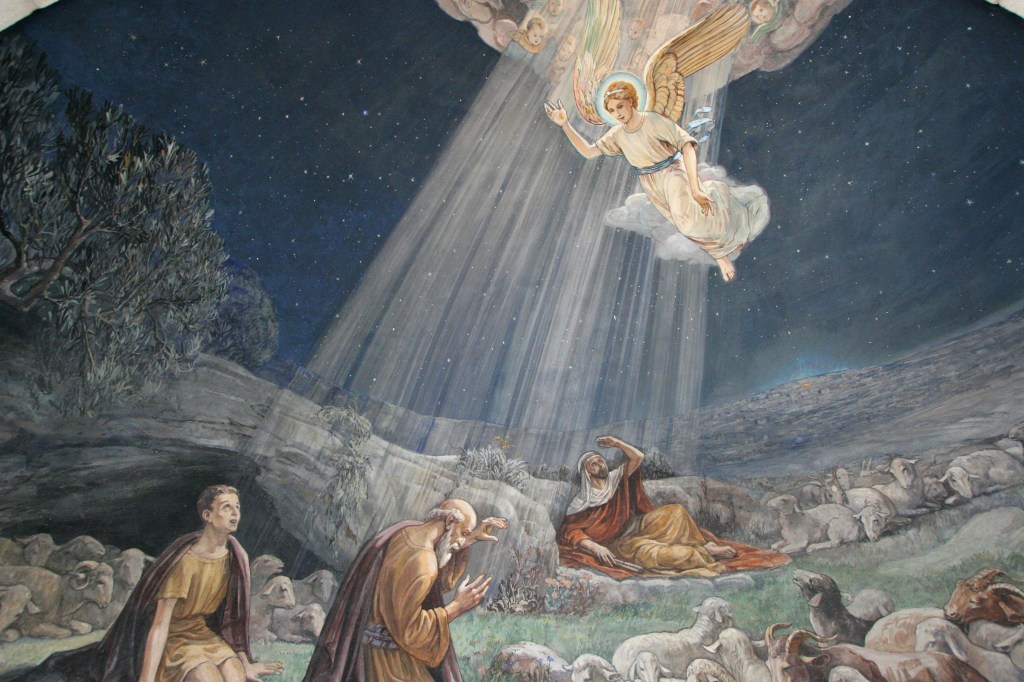
An angel of the Lord visited the shepherds and informed them of Jesus’ birth, Bethlehem, Church at the Shepherds’ Fields

My inspiration today comes from the sermon at church.[1] Very little of my material in this blog is original. If I am being perfectly candid, none of it is. After all, there is nothing new under the sun!

The sermon today was on the shepherds who left their fields in response to the message they received from an angel to seek out and visit the Christ child who was born near them in a manger used to feed animals.[2] If we are tempted to think that the purpose of this story in Luke’s Gospel is the miraculous appearance of an angel to these shepherds, I believe we would be wrong.

The story of the shepherds follows right on the heels of the story of Joseph and Mary traveling to Joseph’s ancestral home, Bethlehem, for a census that was being taken. While they were there, Mary gave birth to Jesus. Luke concludes that story with this seemingly insignificant statement:


“Then she gave birth to her firstborn son, and she wrapped him tightly in cloth and laid him in a manger, because there was no guest room available for them”.

Luke 2:2:7


We have the wrong picture in our heads if we are imagining a guest room in an inn. Mary and Joseph went to Joseph’s ancestral community where his family was gathering from wherever they were scattered. They may not have known their extended family members well, but they likely stayed in one of their homes.

The guest room in the home would have been upstairs, and it was already taken by the time they arrived, so they were forced to stay on the ground floor of the home with the animals. The manger was a food trough. Their accommodations were not the least bit inviting.

The smell of animal dung, urine, and straw hung in the darkness of the cold, dank air. The animals slept or chewed their cud. There was no fanfare for God who was had just entered His own creation in the humblest of circumstances.  

Meanwhile, an angel suddenly stood before a watchful group of shepherds in the outlying hills of Bethlehem. The abrupt apparition broke the silence like lightning from the sky. They were alarmed, but the angel calmed them. “Do not be afraid”, the angel said.


“Look, I proclaim to you good news that will be for all the people: Today in the city of David a Savior was born for you, who is the Messiah, the Lord.”

Luke 2:10-11


The angel added the instruction that they would find a sign: a baby wrapped tightly in cloth, laying in a manger. (Luke 2:13) Nothing seems special about this sign. A little unusual, maybe, that the child would have no other place to lay. Perhaps, though, the shepherds heard echoes of these words in the angel’s statement:


“Therefore the Lord himself will give you a sign: The virgin will conceive and give birth to a son, and will call him Immanuel.”

Isaiah 7: 14


An inkling from the Prophet Isaiah may have just dawned on them when “a multitude of heavenly host” appeared with the angel praising God and saying:


“Glory to God in the highest heave, and peace on earth to people he favors.”

Luke 2:14


They were moved. The angel encouraged them to “look” for themselves, and they didn’t hesitate. They decided among themselves “to go see”. (Luke 2:15)

We might be tempted gloss over the scene and fail to consider their circumstances. They were shepherds, and their job was to watch over the sheep. Sheep are prone to wander off. Even if they don’t stray, they are sitting ducks for large predators like lions, wolves and bears. Guarding the sheep was their livelihood.

The shepherds risked losing the sheep to leave them. They risked the sheep wandering off or being attacked if they left them. They risked losing their jobs.

The shepherds were menial laborers, dispensable and easily replaceable, but when the angel encouraged them to go see, they didn’t hesitate. They responded and went.

The word, “see”, is emphasized in this passage. They responded and saw for themselves. They experienced God for themselves. They didn’t just listen and ponder; they went and saw for themselves.

As I reflect on this, I note that they might have missed the Messiah if they didn’t respond right away. It occurs to that, when God prompts us, perhaps not as dramatically, how we respond is critical. Whether we respond at all, and how promptly we respond, may be a matter of whether we encounter God… or not.

Continue reading “Take a Risk to Prepare Room for God in Your Life”