What Does It mean that the Kingdom of Heaven Is Subjected to Violence, and Violent People Take It By Force?

Does Jesus authorize violent or forceful behavior in defending Christianity?


I engage in many conversations with people of faith on just about any topic. I remember one conversation (on the topic of guns, I believe) in which a fellow believer cited Mathew 11:12 in support of a Christian defense of gun ownership.


From the days of John the Baptist until now, the kingdom of heaven has been subjected to violence, and violent people have been raiding it.” Matthew 11:12 NIV


My friend also mentioned Jesus turning over tables and instructing his followers to buy swords (Luke 22:36, though he tells them in the same chapter to but them down (Luke 22:49-51); “for all who draw the sword will die by the sword.” (Matthew 26:52)). My friend believes that Jesus was saying that force, and even violence, is ok as long as it is used for a good purpose.

I am reminded of his comments as I read through Matthew 12 in my yearly reading plan. I didn’t follow up on his comment then, but reading this passage in context brings it to mind, and it brings clarity to me at the same time.

Does this passage justify violent or forceful behavior in defending Christianity? That is the question

Let’s start with the context. Jesus is preaching in Galilee where John the Baptist has recently been imprisoned for calling out Herod for adultery. John was no shrinking violet. He was bold and forthright, and it landed him behind bars when Herod didn’t take kindly to the criticism.

While in prison, John heard reports of the miraculous things that Jesus was doing. These reports prompted John to send his own followers to ask Jesus, “Are you the one who is to come, or should we expect someone else?” (Matt. 11:3).

I imagine John the Baptist was wrestling with doubt as he languished in prison. In his mind, and in the minds of most Jews at that time, the Messiah was expected to come and take over the world, but it didn’t seem to be happening. The Roman Empire was still very much in charge.

John’s imprisonment must have given him second thoughts about the Messiah stuff. The miraculous signs seemed to mark Jesus as the Messiah, but why was he not wielding the power and the glory of God against the Roman occupation and Roman Empire? John the Baptist may have been hoping that Jesus was just biding his time when he sent for a report.

Jesus sent this message back:


Go back and report to John what you hear and see: The blind receive sight, the lame walk, those who have leprosy are cleansed, the deaf hear, the dead are raised, and the good news is proclaimed to the poor. Blessed is anyone who does not stumble on account of me.” (Matt. 11:4-6) (quoting Isaiah 35:5-6)


Was that the report John was expecting? Jesus didn’t say anything about driving out Rome and restoring King David’s throne. He didn’t pull from the prophetic messages about a conquering messiah. He pulled a different thread from the Prophets.

When John’s followers left, Jesus praised John the Baptist to the disciples. He affirmed that John the Baptist is the one spoken of in Malachi 3:1 – the messenger sent ahead of the Messiah to prepare the way. He affirmed that he is the Messiah, but the response he sent back to John was about healing, cleansing, and proclaiming good news to the poor.

In this context, Jesus said, “the kingdom of heaven has been subjected to violence, and violent people have been raiding it.”

Jesus seems to be confirming only what John was already hearing about the miraculous signs, but John already knew about those things. Therefore, I think Jesus was doing more than confirming what John already knew. Jesus was tying what he was doing to prophetic passages like the language he quoted from Isaiah when he announced his public ministry (Luke 4:18-19):


The Spirit of the Lord is on me,
    because he has anointed me
    to proclaim good news to the poor.
He has sent me to proclaim freedom for the prisoners
    and recovery of sight for the blind,
to set the oppressed free,
     to proclaim the year of the Lord’s favor.”


These words from Isaiah 61:1-2 with overtones from Isaiah 58:6 were read aloud by Jesus in his hometown synagogue in Nazareth before he sat down with all eyes on him and said, “Today this scripture is fulfilled in your hearing.” (Luke 4:21) These are the words Jesus used to to characterize the purpose for which he came.

We know, of course, that Jesus came to die on a cross, but John and his followers didn’t know that and probably could not have imagined it. Jesus’s followers also didn’t get it even when he tried to tell them.

Jesus pulled passages from Isaiah that alluded to the suffering servant motif to affirm his identity. John the Baptist would have immediately recognized the thread Jesus was pulling, but it wasn’t likely what he was expecting or what he was hoping.

First Century Jews were expecting the Messiah to reestablish the Davidic kingdom “here and now”. The Romans were well aware of that Jewish sentiment and had been putting down factions of zealots who took up the sword to attempt to bring it about.

Imagine Pontius Pilate’s confusion that prompted him to ask Jesus, “Are you the king of the Jews? …. Your own nation and the chief priests have delivered you over to me. What have you done?” This is how Jesus responded to Pontius Pilate:


My kingdom is not of this world. If my kingdom were of this world, my servants would have been fighting, that I might not be delivered over to the Jews. But my kingdom is not from the world.” (John 18:36)


With this as the backdrop, let’s turn back to Matthew 12. If we understand the context, and the bigger picture, we see that Jesus is not advocating violence or force: he is doing just the opposite.

Continue reading “What Does It mean that the Kingdom of Heaven Is Subjected to Violence, and Violent People Take It By Force?”
Do We Have Any Evidence of the Resurrection? A Critique of Skepticism and Proof

People confuse proof, as in a mathematical proof, and proof, as in an offer of evidence that tends to support a proposition.


Some people say that we have absolutely no evidence for the resurrection (and no evidence that God exists in the first place). Nothing could be further from the truth. We have evidence. The issue isn’t a lack of evidence; the issue is how we approach the evidence and weigh it it.

A person who approaches “supernatural” phenomenon with purely materialistic assumptions will weigh the evidence differently than one who is open to nonmaterialistic possibilities. Jesus, though, lived in time and space in history. Many people in the first century who saw him die claim to have seen Jesus and interacted with him in the flesh after he died, and those people were willing to die for what they saw.

That is evidence. Full stop. People may be skeptical of it. People may assume Jesus couldn’t have risen from the dead, despite what people think they saw, because miracles don’t happen. But, now I am talking about how people approach and weigh the evidence.

People confuse proof, as in a mathematical proof, and proof, as in an offer of evidence that tends to support a proposition. Fallible, finite human beings deal almost exclusively in the latter realm of evidence, even in science, because we don’t know what we don’t know.

Mathematical proofs are an achievable goal in mathematics (though sometimes not even then). Such proof is impossible outside of mathematics.

Science does not provide us that kind of certainty, either. Science changes all the time on the basis of new evidence, and things we thought we knew in the past are constantly being adjusted, or even discarded, on the basis of additional evidence.

Finite beings such as ourselves are limited in our knowledge, our access to knowledge, and our understanding of how the knowledge we have fits together. We have to be humble as we cautiously put our confidence in the things we think we know because we are limited in our ability to know and understand our world, and we will always lack absolute proof for most, if not all, things.

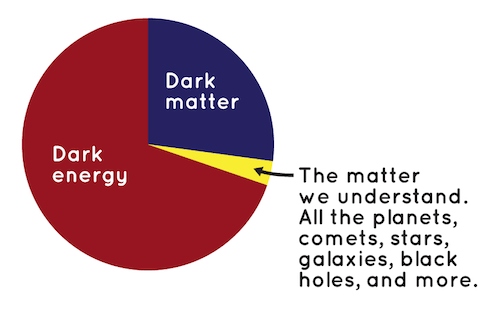
The extent of our limitations can even be quantified. For instance, 95% of the physical universe is invisible to us! The vast, unseen reaches of the universe are comprised of things like dark matter and dark energy that we cannot see and know little about, except for what we can infer about them. We aren’t sure what these things are, but we know they exist by the affects we see on the matter we see and know.


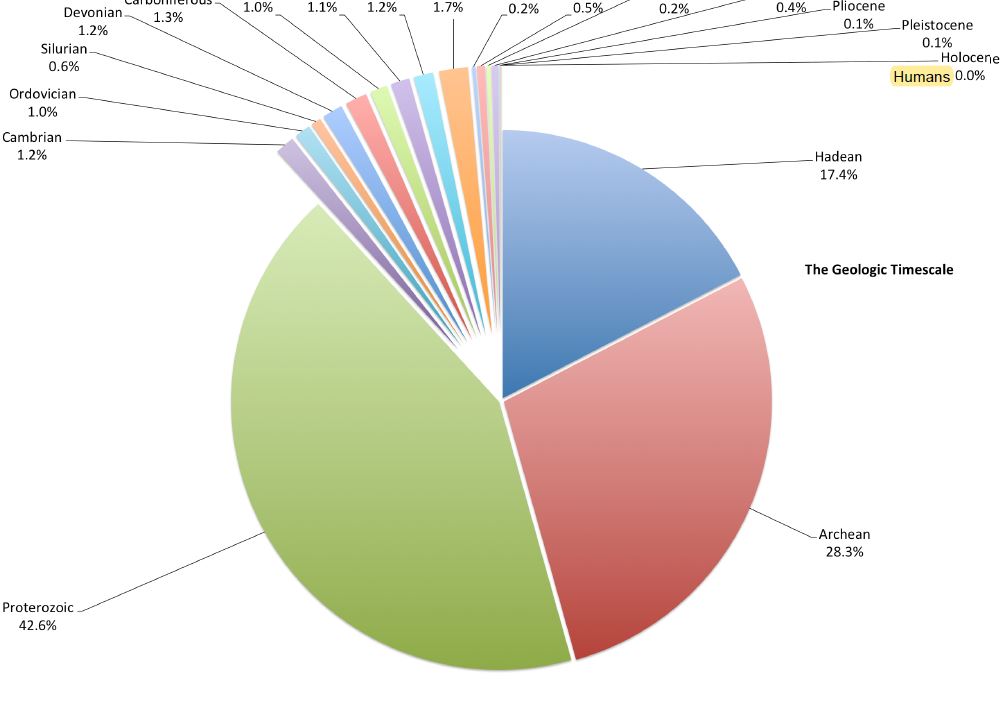
According to scientific consensus, the universe is about about 13.7 billions years old, and the earth is about 4.543 billion years old (give or take about 50 millions years), and homo sapiens appeared only 300,000 years ago (and maybe even only190,000 years ago). Assuming those calculations to be true, human-like beings have existed for only 0.0066% of the time the earth has existed and only 0.002% of the time the universe has existed. (If my math is correct.)

If we view the existence of the earth (not even the universe) on a 24-hour scale from the beginning to the present time, life began at 5:00 AM, the first vertebrates appeared at 8:00 AM, and human beings appeared just a fraction of a second before midnight.

Homo sapiens have only developed knowledge and the ability to communicate and preserve a record of it for about 5,500 years. We have been developing and recording our knowledge for only 0.00022% of the time the earth has existed, which is only 0.00007% of the time the universe has existed.


During that relatively short, 5500-year time period we have developed the capability to see only about five percent (5%) of the universe, though we have actually examined very little of it – and then only at very great distances. We hnave only explored more than five percent (5%) of the oceans on this earth – a very small planet orbiting a very small sun in a very small solar system in the inconceivably large expanse of what we we call the universe.

The body of our scientific knowledge has grown tremendously, even exponentially, especially in the last 200 years, but we have only just begun to know and understand the universe we live in. If humans live another 5,500 years, we will not have explored all of the universe, and we will not know all that there is to know.

Our world is grand and almost inconceivably complex. The DNA of a single human cell contains so much information that if it were represented in printed words, simply listing the first letter of each base would require over 1.5 million pages of text! Imagine how much information exists in the universe and how much we don’t know.

We will likely never know all there is to know about the expanse of the universe and everything in it, large and small, in all the years mankind is on the earth. Thus, we are in no position to write off the possibility of God creating the universe and Jesus rising from the dead.

The title to this piece is (admittedly) a bit misleading, so I need to provide the following disclaimer. Some people will read the title and assume that I am attempting to prove the resurrection. I am not doing that. I am offering only the beginning of proof (as in offering evidence) in this article, but it is evidence. You can weigh it how you will.

We should at least be open to consider what evidence there is for the existence of God and not write off the possibility that God exists. If God exists and made the universe out of nothing, which is what the Bible claims in Genesis 1, John 1, and Hebrews 11, then He could certainly raise Jesus from the dead.

How arrogant it would be for us to determine for ourselves (categorically) that there is no God, that He did not create the universe, and that Jesus did not raise from the dead. We don’t know what we don’t know, and we don’t understand perfectly what we think we know.

With that said, I want to provide some minimal facts that provide some evidence that tends to support the resurrection. These things are not proof; they are an offer of proof. We cannot achieve definitive proof, but there is evidence for the credibility of the claims made that Jesus rose from dead.


Continue reading “Do We Have Any Evidence of the Resurrection? A Critique of Skepticism and Proof”

The Chicken or the Egg and basic Assumptions on Origins

The chicken and the egg question confronts the basic assumptions about life


Which came first? The chicken or the egg? This is a school child’s question, but sometimes the most profound questions about life and reality as we know it can be boiled down (to keep with the theme) to simple questions and simple propositions.

Spoiler alert: I am not going to take a position on the chicken/egg controversy. That was just a teaser. The questions I want to address are far more fundamental (though actually related).

The assumptions we make, even the greatest geniuses among us, are pretty simple at their core. And we can’t prove them. We have to take them on “faith”, yet we construct our view of the world and how it works on the basis of those assumptions.

Many people develop those assumptions from an early age without much critical examination. Though our basic assumptions are the filter through which we view everything, and we use those filters constantly to make critical examinations of the world around us, we rarely examine or critique those filters, themselves.

Because our assumptions are the basis on which we reason, do science, and live our lives, we tend to be reluctant to subject them to rigorous examination. Two of the most fundamental filters by which people see the world are diametrically opposed to each other: 1) the assumption that a divine being exists through which the universe was created, and 2) the assumption to no such divine being exists, and all that exists is physical matter and energy.

(A third view is that the divine “entity” is one with matter and energy, but this view can be lumped in with the view that all that exists is matter and energy since this third view equates the divine with matter and energy. Only the first view assumes that divine reality exists separate and apart from matter and and energy and caused it to come into being.

I note that many people try to mix and match these fundamental assumptions. The view that the divine is “one with” and undifferentiated from the matter and energy that makes up the universe is such an attempt, and it runs into problems as a result.)

The assumptions could not be more simply stated: either God exists, or God does not exist. We vigorously defend whichever of these two assumptions we have embraced. We cannot definitely prove either of these assumptions, but we are often loathe to subject them to critical examination.

That doesn’t mean that we don’t “test” them. In some ways, our daily lives are a continual test of those basic assumptions – consciously or unconsciously. As we live our lives, our assumptions are repeatedly put to the test as we apply the filters derived from our assumptions.

I think all people have encountered some disconnection between reality and their basic assumptions. I think we have all struggled with feeling like the world doesn’t make perfect sense – it doesn’t add up according to our assumptions. I submit that is the inevitable state of a finite being who doesn’t know what she she doesn’t know (and, perhaps, never will).

Human beings are nothing, however, if not resilient. We are good at ploughing forward with vague feelings of unease that our basic assumptions are not adding up. We may not always be conscious of this unease. Some people simply shrug their shoulders and resign themselves to it.

“Eat, drink, and be merry” (for tomorrow we die), is the attitude people often hold onto who have reached a state of mental and emotional confusion and resolved it with indifference. Life has a way of confronting that indifference, however, when loved ones die, injustice hits close to home, and the age old question, “Why?!” pushes to the surface like rocks in a New England yard after a hard rain.

I submit that our faith is revealed in the way in which we hold to those assumptions, believing that they will be vindicated, despite the incongruities between those assumptions and the reality that continually confronts us. We put our trust in those assumptions and plow forward, moving the rocks to the edges of our intellectual territory.

Frankly, what else is a finite being to do?

A friend of mine, when I posed the question about the chicken or the egg, said the answer is easy: the egg came first. I don’t know whether he was being facetious or serious, but his confidence illustrates the point that we have faith/trust in our basic assumptions. He can’t prove the egg came first, but he was confident in his assumption.

In the following presentation, Sy Garte unpacks the basic chicken and egg question about the origin of life. Sy Garte is a scientist, a biochemist, who is retired from a career in science. He is published in scientific journals, and he is very familiar with the challenge of unpacking those basic assumptions.

His father was also a scientist. He grew up in an atheistic household that was hostile to the idea of God. He assumed that no God exists, and the world consists only of matter and energy into his 40’s.

At that point, he changed his mind on his basic assumptions. It was science that led him to question his basic assumptions and, eventually, to examine them rigorously. He came away from that rigorous examination with a new set of basic assumptions that, he says, make much more sense of science and reality.

If you are interested in his story, he wrote a book about his journey from a purely materialistic view of the world to the view that God exists: The Works of His Hands: A Scientist’s Journey from Atheism to Faith. But that isn’t the subject of my writing today.

I write today on the subject of our basic assumptions, and how they affect the way in which we approach the world. I hope you will take the time to watch the following presentation, which demonstrates how those basic assumptions affect our thinking. The presentation is only about 27 minutes long with Q & A at the end.

He presents the chicken and the egg question in two syllogisms. The first one is the assumption he grew up with and which formed the basis of his views for over 40 years:

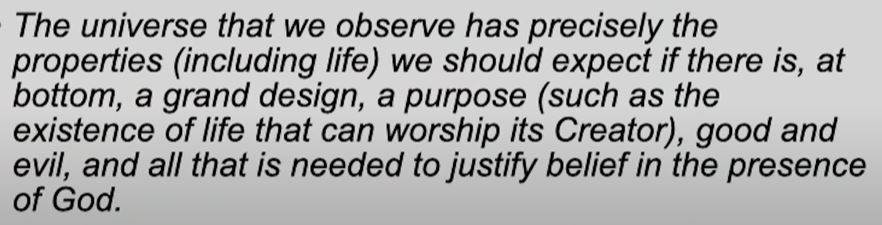
As noted above, he was led to reexamine his basic assumptions through science. First, it was physics that posed a challenge to his basic assumption that no God exists. Much later, his beloved biochemistry led him further down the path. The second syllogism is the one he know assumes:

I have often thought of the importance of perspective for finite beings such as humans. Our individual and collective perspectives are unique and fixed in time and space to a very small connection with the universe. We are parochial with our perspective, and we tend to be adverse to other perspectives breaking in on our little corners of the universe. But, the universe is vast, and we should not be so fearful or defensive as to shield ourselves from other perspectives.

The Best Explanation for a Finite Universe (or an Infinite Universe)

What if new evidence calls into question that the universe had a beginning?


The best scientific data and analysis that we have today leads to the conclusion that the universe we live in began a finite time ago. That understanding, however, was far from evident just 100 years ago. In fact, most scientists, then, believed the universe always existed (the Steady State Theory).

Evidence that suggested to the contrary, that the universe is expanding (and therefore had a beginning “point”), was not received enthusiastically. Even the people whose discoveries led to that conclusion resisted it. Einstein famously added a cosmological constant to his equations on general relativity to avoid that conclusion.

Such was the commitment in the scientific community to the “Steady State” theory: the theory that the universe always existed infinitely in the past.

Indeed, that evidence unfolded like a “big bang” that blew apart the previous scientific consensus. Thus, the “Big Bang Theory” theory of an expanding universe from a “point” of beginning was coined, perhaps, more for the effect it had on the scientific community than as a descriptor of the occurrence. (See Is the Big Bang finally Over?)

The evidence as it has unfolded since the discovery of the red shift on stars farther away from us (the first big clue that our universe is expanding) has continued to strengthen the so-called Big Bang Theory. The design of the James Webb Telescope is only the latest in a long line of evidence vindicating the “Big Bang Theory” that dramatically changed the paradigm of physics and cosmology.

Though the evidence continues to substantiate the view that our universe is expanding (and therefore had a beginning a finite time ago), I have often been aware that science is provisional. Just when we think we know something, something else comes along to change the paradigm. The recent history of physics and cosmology is a case in point.

A primary reason that the Big Bang Theory landed so hard in the scientific community is because it challenged more than the accepted science. It challenged the prevalent worldview of the scientific community since the Enlightenment.

Since the days of Darwin (and even before Darwin), people in the scientific community had been advocating for separating science from religion. When Darwin proposed evolutionary theory (natural “selection” acting on random changes), the scientific community was more than ready to use that “key” to unlock what they viewed as the “shackles” of religion.

The Steady State Theory, that the universe always existed infinitely in the past, was the natural assumption of scientists based on a worldview with no God and no religion at the center of it. Life was good for the proponents of naturalistic materialism until the specter of a beginning to our universe (and the real possibility of a “Beginner”).

That many people have managed to keep that specter at bay despite the strong evidence that gets stronger as time goes on that our universe is expanding is a testament to the faith some people have in naturalistic materialism. Never since before the Enlightenment, however, has science been so harmonious with the Bible and belief in God.

Even so, I have often wondered: what if the paradigm shifts again? What if new evidence is discovered to upset the apple cart again? What if that new evidence begins to cut against the grain of the Big Bang Theory and reinvigorates the Static State Theory?

What if the new evidence shows what Einstein and most other cosmologists and physicists believed 100 years ago? That our universe is past eternal; that it is not expanding after all; or that the earth is expanding, but that the expansion is not proof of a “singularity” (beginning)?

Indeed, this is what many preeminent scientists have been trying to prove since the scientific world conceded the evidence of the apparent expansion and singularity of our universe.

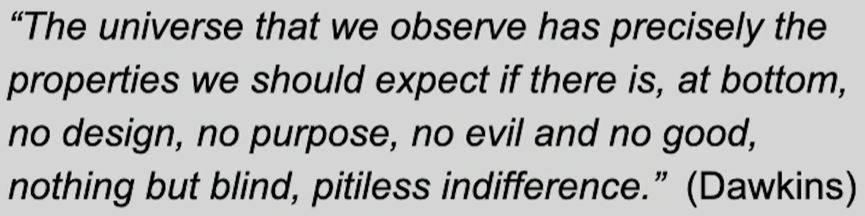
Would Christians, like myself, and other theists simply cling to faith without evidence? Would we cling to our faith “in the teeth of the evidence”, as Richard Dawkins has charged?

I wasn’t sure before today. As I was listening to Return of the God Hypothesis by Stephen C. Meyer on Audible, an answer to my question began to materialize. I will attempt to summarize it.

Continue reading “The Best Explanation for a Finite Universe (or an Infinite Universe)”

What It Means to Bear God’s Name and the Significance of Not Taking God’s Name in Vain

We who take God’s name are His representatives in the world.


In a previous blog article, I tried to summarize the view developed by Old Testament scholar, Carmen Imes, on what it means that human beings are made in God’s image. I have only summarized her view as I understand it from a conversation on the Holy Post podcast (with some thoughts of my own added in), but she wrote a whole book about it!

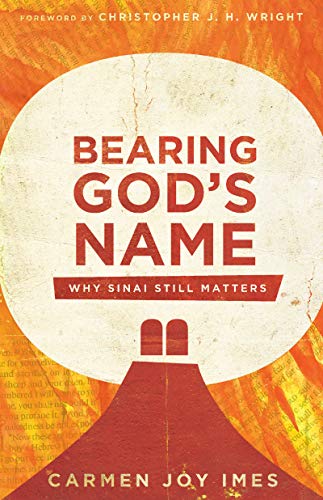
The book, Being God’s Image: Why Creation Still Matters, was recently published as a prequel to her previous book, Bearing God’s Name: Why Sinai Still Matters. The previous book on bearing God’s name, in turn, was distilled from Imes’ doctoral dissertation.

Her observations are profound in my book! (Which I don’t have because I am speaking figuratively now.) Having summarized her view on human beings being made in God’s image, I am turning now to the significance of bearing God’s name and not taking His name in vain.

Imes says we don’t bear (take on) God’s image because we are (already made in) God’s image, but we do take on (bear) God’s name if we are His covenant people. The significance of taking on God’s name is what is implicated in the third commandment: thou shalt not take the Lord’s name in vain.

In Carmen Imes’ first book, Bearing God’s name: Why Sinai Still Matters, she explores the commandment not to take the Lord’s name in vain. She argues for what she calls “missional reading”. Thus, she says we should not understand this command simply as a rule to be applied to our speech and how we refer to God verbally. She says the meaning is much broader, deeper and more fundamental than that.


This commandment implicates our whole lives! We who take God’s name are His representatives in the world. We bear or carry His name, so what we do, and who we are, and how we represent God, who’s name we carry, matters deeply!

Every human being is made in image of God, but only God’s covenant people bear His name. Every member of the human race is invited to join the covenant community, but until people join themselves to God’s covenant community, they do not take His name.

Thus, Imes says, “It’s impossible for a nonbeliever to take God’s name in vain.” They haven’t taken His name at all, so they cannot violate the command not to take God’s name in vain. If a person doesn’t take God’s name in the first place, he/she cannot take His name in vain.

Remember that God revealed His proper name, Yahweh, only to His covenant people. Yahweh was not revealed to all people at the time the commandments were given to Moses. The name of God, Yahweh, was only revealed to Israel in the context of the covenant God made with them.

In New Testament verbiage, we are ambassadors of Christ if we have been born again and accepted Christ as our Lord. When we are born again, we take on the “heredity” of God as His children. When we accept Jesus as Lord, we “take his name”: we become identified as Christ followers, traditionally known as Christians.

Because we are followers of Christ who bear his name, everything we do and say is a reflection of Him. We are representatives of the kingdom of God. We carry His flag as we live our lives in the world. (If, indeed, we are not ashamed to be called by His name.)

Continue reading “What It Means to Bear God’s Name and the Significance of Not Taking God’s Name in Vain”