I saw Haley Heynderickx this evening at Space in Evanston, IL. She was (once) an obscure, modern folk artist. Then, a song of hers went viral on TikTok. (So, my son tells me.) The crowd this evening was young, even for this trendy venue on Chicago’s ever hip north shore.
Existential angst (or dread, depending on your flavor of melancholy) is the thread that runs through her work. She is a siren for the spirit of this age. Her chords strike true with my son, who turned me on to her, and with my daughter, who accompanied us to the show.
I was young once also, and the existential angst of my youth drove me on a quest that led me to the threshold of Jesus, the Lamb of God who was slain for the sins of the world. A different generation, now, leans into a similar ages old myopia.
“Meaningless! Meaningless!” …. “Utterly meaningless! Everything is meaningless.”
Ecclesiastes 1:2
This words may have accompanied a more ancient tune played on a lyre from a more distant youth, but the melody sounds the same.
Existential first visited me one night when I was too young to have a vocabulary for the experience. We watched old home movies from a projector in our living room. Younger ghosts of my parents and grandparents played on the grainy screen in washed out black and white.
I remember it like a dream sequence. The images and feelings of the past are equally washed out in my mind now, but the poignance and clarity of the dread that I felt is clear.
This was, I believe, the first time I became aware of the unforgiving and unrelenting passage of time. This was the first time, perhaps, that I stared the inevitability of death in the face, and the eyes of death stared back, penetrating into my soul.
The next sequence in this dream is now (and always has been) more palpable and imminent than those grainy home movies. Later that night, I found myself detached …. floating in a yawning chasm of outer space …. utterly alone and disconnected.
I don’t know to this day whether I had a dream when I fell asleep that night or whether it came to me in a ghastly vision. It doesn’t matter. If claustrophobia can be felt in an endless void, the experience would be close to what I felt. Angst and dread have nothing on the feelings I had that night.
I say this to frame my thoughts as I recall the song with which Haley Heynderickx closed out the evening: the Untitled God Song.
I have been writing now for about twelve years on this blog. I started it because I am a professional writer (of sorts), and I wanted to use the talents God gave me for something bigger than me.
I became a Christian in college, and that conversion diverted me from any career path I might have wandered down. I should emphasize the wandering, because I wasn’t very career-minded to begin with. I was a truth seeker, and I still am.
I thought I would go into “ministry”. That’s all I really wanted to do, but I wasn’t on a track for ministry. It was a very secular college with very traditionally secular guidance to provide. I was a crazy Christian convert who was reading the Bible and believing it.
I became a student leader of the campus InterVarsity group. We had virtually no oversight. That group of fledgling college students, like myself, was my discipleship group
I was certain about one thing: that God existed, and He had changed me. I didn’t know much of anything else.
I gravitated toward a local independent, Charismatic church about 40 minutes away. I would go to church there many Sundays, but I was a college student preoccupied with the things college students did. I mentored with the head pastor for a short time, but not long enough to make much of a difference.
I didn’t trust my college advisors because they didn’t believe the Bible like I did. I should have gone to seminary, but I didn’t because the apostles who stood up on the day of Pentecost and preached powerfully and eloquently in various tongues to the crowds in Jerusalem were unlearned men. I wanted to be like them.
These words Paul spoke to the Corinthians heavily influenced me: The Gospel is foolishness to those who are perishing (1 Corinthians 1:18); and God makes foolishness the wisdom of the age. (1 Cor. 1:20-21) I thought I didn’t need a seminary. In truth, I was afraid that a seminary would try to conform me by the wisdom of the age.
I should have paid more attention to what Paul said to the Corinthians: Greeks look for (worldly wisdom), but the Jews demand signs. (I Cor. 1:22) I wanted signs. It turns out that Paul was right. Worldly wisdom and demanding signs are both misguided paths.
I went off to the East Coast chasing after a church, the legend of which I heard from the man who become my best friend in college. Maybe the best friend I have ever had. A true brother in the Lord, Jesus.
We encouraged each other in that season of our lives. We both had become Christians after leading wild, existentially-angst-filled lives in our youth. We came to the kingdom of God with baggage (who doesn’t?), but we knew that Jesus had the words of life, and we were all in.
I packed my bags for a summer counseling job in a Christian camp on the south side of Like Winnipesaukee like Abraham leaving behind his homeland for the promised land. I didn’t believe I was ever coming back. Only God knew my intentions at the time.
After camp ended and I helped to close it up for the next camping season, I moved a half hour north into the last communal house left over from the Jesus People movement that swept this tourist area in the late 60’s and early 70’s. That movement of the Holy Spirit caught a bunch of migrant hippies in its current and deposited them downstream from wherever they thought they were wandering into Christian communal living.
Those communes were a legend I only heard snippets about when I arrived, but the communal spirit was still in the air. I loved it. I embraced that communal spirit for the next 40 months, and I plugged into the life of that church.
I grew up as person and as a young Christian during that time in many ways. The church was edgy. It was brash. It tried to be authentic. It dared to think big, and I ate it up. But, it wouldn’t last. (It disintegrated and splintered into many fragments not long after we left it.)
I still wanted to be in ministry, though I had no vision. I thought it would just happen. I had heard that a man’s gift makes room for itself. (I think that is in a Proverb somewhere.) But it wasn’t happening for me. I was also young and impatient and impetuous.
I had always longed for love and intimacy. I was a romantic dreamer. I was heavily influenced by Disney stories of life lived happily ever after, but I knew nothing of the promise those stories offered. I still don’t.
I married on a whim, encouraged by “a word spoken over me” that I didn’t understand, but I acted anyway. That determination to act was pivotal.
Just over 40 years have past. I have been married, now, for 39 years. It would be 40 years in November, but my wife left me almost two years ago, and I don’t think we are going to make it to 40.
I am not sure exactly where I am going here today, other than the need I feel to keep things real. I don’t usually focus so much on myself, but I have gotten used to writing to work out the thoughts in my head, and today those thoughts involve trying to make some sense of my life.
As an English Literature major in college, I have always been interested in literary devices. Symbolism, hyperbole, allegory, imagery, metaphor, analogy, and simile are some common literary devices, and we can add parable to the list.
Jesus often spoke in parables, but he also used other literary devices. The statement that it’s easier for a camel to go through the eye of a needle than for a rich man to enter the kingdom of God is both figurative and hyperbole.
According to the Oxford Dictionary online, “figurative” means “departing from a literal use of words; metaphorical.” Many literary devices are figurative, including all the ones I listed in the opening paragraph. Literary devices make our communication more interesting, and they communicate truth in a way that is more nuanced, robust, and multi-dimensional than literal statements.
Jesus often used literary devices to convey nuanced, spiritual meaning. For instance, in the Sermon on the Mount, Jesus encouraged a more nuanced (spiritual) understanding of sin when he said:
“You have heard that it was said, ‘You shall not commit adultery.’[Literal] But I tell you that anyone who looks at a woman lustfully has already committed adultery with her in his heart.” [Figurative]
Matthew 5:27-28
In fact, Jesus used figurative language often. To some people, he spoke only figuratively! (Matthew 13:34) (in parables) He even spoke figuratively to his disciples, and he seems to express frustration when they didn’t get it:
“When the disciples went to the other side, they forgot to take bread. ‘Watch out,’ Jesus said to them, ‘beware of the yeast of the Pharisees and Sadducees.’ So they began to discuss this among themselves, saying, ‘It is because we brought no bread. When Jesus learned of this, he said, ”You who have such little faith! Why are you arguing among yourselves about having no bread? Do you still not understand? Don’t you remember the five loaves for the five thousand, and how many baskets you took up? Or the seven loaves for the four thousand and how many baskets you took up? How could you not understand that I was not speaking to you about bread? But beware of the yeast of the Pharisees and Sadducees!’ Then they understood that he had not told them to be on guard against the yeast in bread, but against the teaching of the Pharisees and Sadducees.” [emphasis added]
Matthew 16:5-12 NET
The “yeast of the Pharisees and Sadducees” is a figurative statement. Jesus wasn’t talking about bread (literally). When the disciples didn’t get what he was talking about, Jesus told them literally not to take him literally! He also seems to suggest that seeing the figurative meaning is a matter of faith. (Not the other way around.)
Jesus used the metaphor of yeast to convey the idea of the corrupting influence of the Pharisees and Sadducees in the community. We have to discern, though, what he meant. Was he talking about their thinking, their teaching, their attitudes, their assumptions, their hypocrisy, all of the above, or something else? …. Truth be told, I am not exactly sure exactly what all he meant by their “yeast”.
That’s the thing with figurative speech. It isn’t as precise. It doesn’t carry with it a detailed explanation, but figurative speech can be more profound than literal speech, and it can carry fuller and deeper meaning.
Often though, figurative meaning requires deeper thinking and discernment to determine all the meaning. The meaning has a surface level meaning and a deeper level meaning. The meaning may even be multi-layered, which explains why we often “see” new things in Scripture the more we read it and become familiar with it.
The Jesus had to provide some explanation to the disciples in the example above, because they didn’t fully understand it (telling them that he wasn’t making a point about bread at all), but Jesus doesn’t fully explain exactly when he meant by the “yeast” of the Pharisees. What is it about the Pharisees and Sadducees that Jesus was talking about? He doesn’t really say!
People we we label “fundamentalists” have developed the idea that we do not take the Bible seriously if we do not take it literally. The ministry of Jesus is replete with examples that run completely counter to that idea, but it’s easy to understand why people might want to read the Bible literally. It’s easier! We don’t have to wonder what is meant if we simply take it literally. At that same time, we run the risk of missing the whole point if we insist on reading everything literally.
I am reminded again in my daily reading of Scripture of the prominence of women in the life and ministry of Jesus. Every time I read through the Gospels, I see it. As I read through the Old Testament with eyes sensitized by the Gospels, I see the theme there also. This theme is somewhat, hidden, however.
We have only committed to the idea that women should be equals of men in very modern times, and that idea is still not universal around the world. A cultural revolution was required in the western world to change ancient paradigms. The change has been slow, difficult, and filled with tension.
Christianity was influential in bringing about that change, but many Christians have also resisted it. This is true even while the roots of that cultural revolution are embedded in Judeo-Christian Scripture.
Tom Holland, in his epic book, Dominion, traced modern, secular humanist values back to a surprising root. He had no idea where the values he took for granted came from: gender equality, racial equality, individual freedoms, civil rights, etc. When he searched for them, he for found them in Genesis, in the Gospel accounts of Jesus, and in the letters of Paul, the apostle.
Rebecca McLaughlin writes about the prominence of women in the Gospel accounts of Jesus in her 2021 article, Jesus Changed Everything for Women. She quotes Holland to remind us of the cultural context in which those accounts were written:
In Greco–Roman thinking, men were superior to women and sex was a way to prove it. “As captured cities were to the swords of the legions, so the bodies of those used sexually were to the Roman man,” Holland wrote. “To be penetrated, male or female, was to be branded as inferior.”
In Rome, “men no more hesitated to use slaves and prostitutes to relieve themselves of their sexual needs than they did to use the side of a road as a toilet.” The idea that every woman had the right to choose what happened to her body was laughable.
Jesus chantged Everything
Jesus didn’t introduce the these radical notions, however. They go all the way back to Genesis, where we read that God made men and women, together, in His image. (More on that below)
Modern westerners have learned to reject and even to despise the paternalism of most of the history of mankind (pun intended), so it’s easy to miss the way the Bible elevates women. After all, the Bible was written by many men many centuries ago, before anyone in the west (or anywhere else) got the notion that women should be treated as equals.
Let that sink in a moment: the Bible was written by men.
As much as modern westerners like to recoil from the idea of men treating women as second class citizens, the 1st Century Roman world thought nothing of it. Aristotle taught that women are “defective men”. He believed that “women were fit only to be the subjects of male rule“, and “they are born to be ruled by men”. Aristotle and most men for millennia thought that the inferiority of women was obvious, stemming from their nature as the “weaker gender”.
Given that context, the “clues” we find “hidden” in the Bible of a different narrative about women is remarkable. Though the Bible was written, literally, by men, Christians like myself maintain that it was inspired by God, and a divinely inspired narrative shines through it. This is true despite the obvious cultural influences we see on the face of it.
The Bible was written by men during times in which men dominated thought and culture. it is no wonder that the Bible is often criticized for being backward and paternalistic, but that view can only be sustained on a cursory, shallow reading of the Bible. A closer reading belies a very different narrative!
I was listening to the podcast, Apollos Watered hosted by Travis Michael Fleming, recently when NT Wright made a very simple, but poignant, statement:
“One of the most fundamental things about Christianity is that it is for everyone.”
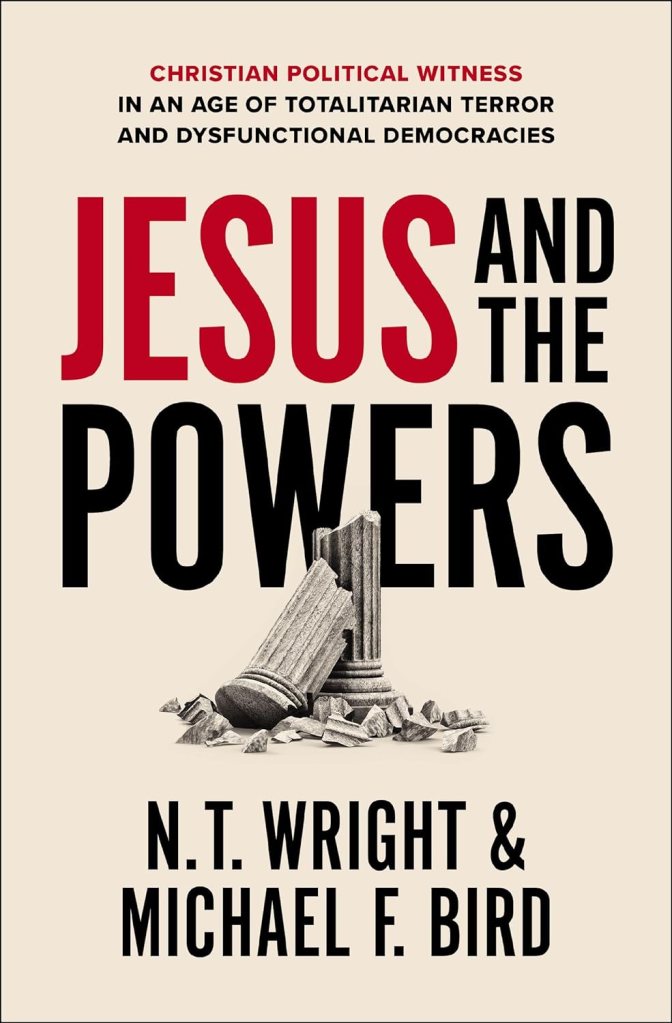
NT Wright, of course, is from the UK. He just authored and published a book with Michael F. Bird, that is called JESUS AND THE POWERS, Christian Political Witness in an Age of Totalitarian Terror & Dysfunctional Democracies.
The context in which he made this comment was a discussion on Christian nationalism. Christian nationalism is currently a hot topic in the United States, though we are hardly the first nation that has religious, nationalist tendencies. England had such a period in its history.
The nation of Israel had arguably the most provenance to think that way. After all, Israel was a nation of “God’s chosen people”. God became incarnate in Jesus in the 1st Century, and He “came to His own” – His chosen people. Before moving on to the point I am inspired to write about today, I want to focus on how God’s chosen people reacted to God becoming flesh and walking among them.
The Apostle, John, tells us in the first chapter of his Gospel that they, tragically, “did not receive him!” (John 1:1-11) They did not recognize God who had become flesh and was standing right in front of them!
That stunning fact should cause us to ask, “Why?” How is it that God became flesh, and He walked among the very people He chose, and they didn’t recognize Him?
We might excuse them on the basis that we have the Holy Spirit, and they didn’t. We might be tempted to think that we would respond differently today because of that advantage. But then again, they had God in human flesh!
We might assume that having the Holy Spirit makes us different than them. Perhaps, that is true. Theoretically, a person who actually has the Holy Spirit and who actually lives by and listens to the Holy Spirit does seem to have advantage.
Of those who have the Holy Spirit, do we actually live by and listen to the Holy Spirit? All of the time? Even most of the time? I can’t answer that question for you, but I think it is a question worth asking ourselves.
NT Wright is a prolific and influential theologian. He has written key works on Paul and Romans. His insights are particularly relevant and poignant as such an expert who has no dog in the political and cultural “war” that rages in the United States of America.
Such a simple statement: “Christianity is for everyone.” Who would not agree with that statement? Jesus said he came for everyone who believes. Paul said there is no Jew nor Gentile; and we are all one in Christ.
In the 1st Century Jewish world, only two groups of people existed: Jews and everyone else. The Jews called everyone else Gentiles. What Paul means, therefore, is that everyone in the world is unified in Jesus Christ. This should be our reality as Christians, right?
Paul said that Jesus tore down the wall that divided the two groups of people in the world, and he made the two groups one. He reconciled all people to himself through the cross. (Ephesians 2:14-16)
The danger of Christian nationalism in the United States (or anywhere) is that some Christians may see themselves as uniquely Christian, uniquely privileged by God, and they may conclude that their own nation that they consider to be Christian is uniquely, divinely authorized by God. That attitude can lead to us to see other people as less uniquely blessed and less divinely privileged.
This is dangerous because we are tempted to view ourselves as better than others. We may even excuse some of our ungodly behavior because we are a Christian nation that has divine authority in the world.
This attitude can hinder us from seeing our own faults and weaknesses that are unique to our culture. We are apt not to see the planks in our own eyes while we focus our attention on the specs in others’ eyes, assuming ourselves to be better than others.
We might also tend to focus on maintaining our privileged position we believe God has given us to the exclusion of other people. We might be tempted to focus on our own good while we should be focusing on helping our neighbors, including our foreign neighbors – and even our enemies.
Jewish people in the 1st Century had this kind of attitude, and it blinded them from seeing who Jesus was – the Messiah they had been waiting for – because they thought he was only their Messiah, and he would liberate only them. They weren’t prepared for a Messiah who came to liberate the whole world!
Though “God’s own” didn’t receive Him, “Yet to all who did receive him, to those who believed in his name, he gave the right to become children of God….” (John 1:12) We might be so familiar with the following verse that we miss the scope of God’s focus:
“For God so loved the world that he gave his one and only Son, that whoever believes in him shall not perish but have eternal life. For God did not send his Son into the world to condemn the world, but to save the world through him.”
John 3:16-17
God’s focus is the world – the whole world. He even gives us a sneak peak at His end game through the same Apostle, John:
“After this I looked, and there before me was a great multitude that no one could count, from every nation, tribe, people and language, standing before the throne and before the Lamb.”
Revelation 7:9
With Christian nationalism, however we might define it, our perspective is too narrow. The danger is that we focus too much on us when God is focused on the world.
Religious people wanted to kill Jesus in his hometown because he challenged their views as God’s privileged people. They became angry with Jesus when he talked about Elijah visiting and blessing the Canaanite woman in Sidon to the exclusion of all the widows in Israel. They were enraged when Jesus said that Elisha healed the Samaritan war general of leprosy rather than people in Israel who had leprosy. They were so incensed by Jesus pointing these things out that they tried to throw him off a cliff! (Luke 4:24-29)
Christian nationalism of any kind flirts with unhealthy pride in national identity. Pride and identity associated with anything other than Christ has a tendency to warp us inwardly and to diminish our sense of primary identity in Christ. Thus, Christian nationalism can lead us to diminish our love for God, as well as our love for our neighbors.
When we think too highly of ourselves, we value our own culture and ways of looking at and doing things more than we should. When we think too highly of ourselves and value our own ways too much, we also tend to devalue others and the ways of other people. Thus, Christian nationalism can lead us to diminish our love for others.
As finite human beings, we all have a deficiency of perspective. Each individual and cultural perspective is limited, which is why Isaiah said:
“For my thoughts are not your thoughts, neither are your ways my ways, declares the Lord. For as the heavens are higher than the earth, so are my ways higher than your ways and my thoughts than your thoughts.”
Isaiah 55:8-9
In short, we do not have the perspective of God. His perspective is far greater than ours. This is true individually, of course, but it’s also true of humankind. It is equally true of people groups, cultures, and nations.










 Navigating by Faith