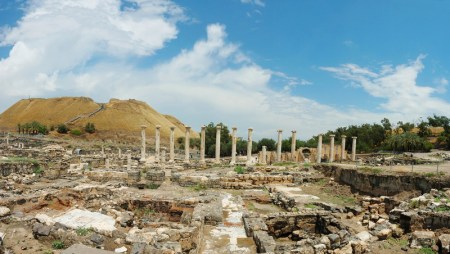
Enter Into His Gates with Thanksgiving

© Can Stock Photo Inc. / lzf

Enter[1] His gates[2] with thanksgiving[3] and His courts with praise[4]. Give [5]thanks[6] to Him, bless His name. For the LORD is good; His lovingkindness is everlasting[7], and His faithfulness to all generations[8]. (Psalm 100:4-5)

Psalm 100 is short, just five verses. It is subtitled “A Psalm for Thanksgiving”. So, it is a perfect verse for celebrating Thanksgiving. There is a lot packed in to this short verse from a short Psalm.

When I read this, I picture a procession of musicians and worshippers entering in to the Temple, but a closer look at the Hebrew words used reveals a slightly different picture. The word for “gates” more specifically references the gates to a city that open to the public square where the elders traditionally gather and public hearings are held and business and legal transactions take place.

Cities in Israel were gated and walled. They were safe havens. They were the center of the community that was surrounded by villages and agricultural land. Cities were where the important transactions take place.

The verse is obviously figurative, inviting us to enter into God’s gates with thanksgiving and into God’s courts with praise. We are invited to enter into the “place” where God’s sits, as the elders of the City sat.

We are invited to into the “place” of God’s influence with thanksgiving and praise. The word for “thanksgiving” means , literally, a “thank-offering”. Offerings in the Old Testament suggest the presentation of a gift, a sacrifice, to God. Here the gift and sacrifice is the offer of thanksgiving to God.

The word for “praise” means, literally, “to cast, throw on target” (as in “hit the bullseye”). Figuratively, the two words suggest the acknowledgment of God for who He is, the Giver of Life, the provider of our souls. It includes the sense that, regardless of our circumstances, we know and acknowledge that God is sovereign and in control of the elements of our lives, and we gratefully recognize it.

Further, this thanksgiving and praise is an intentional act. Thanksgiving can be a spontaneous feeling, but the Psalmist here is encouraging an intentional, willful act of thanksgiving and praise to God, even if we do not “feel like it”. In this sense, it really is a sacrifice and an offering we are encouraged to give.

Ultimately, thanksgiving is not a physical act, but a willful act of the heart and of the inner being. This is how we are to enter into God’s sphere of influence. We do this purposefully with the heart, and, by doing so, are able to enter into relationship with God.

The emphasis and focus of the text is on the everlasting loving kindness and faithfulness of God. This is why we can be thankful! God is sovereign. His promises and love for us are everlasting. Our present circumstances and afflictions are “light and momentary” compared to the everlasting goodness God has in store for us.

Thankfulness, gratitude, is an appropriate response from us toward God because of who He is and because of who we are in relation to God. We enter into relationship with God by approaching Him the right way. Gratitude is the way to enter into relationship with God, entering through the “gates” into the “court” of His influence.

This connection with God that we access with gratitude is transformational. We are changed when enter into relationship with God.

Nothing brings this reality home to me more than the story of Martin Pistorius. Martin succumbed to a mystery illness when he was twelve and became trapped inside his own body. He lapsed into unconsciousness for two years. When he “woke” from that unconsciousness, he was unable to talk, unable to move, unable to communicate.

His family and the people who tended to him believed he was virtually brain dead. They kept him alive and sustained him, but they thought he would never recover. He attempted to beg, plead and scream at them, but he could not make a movement or a sound.

Though people were around him and tended to him, he was utterly alone with nothing but his own thoughts… and God. In his own words, he said, “Soon after I started to become aware, God came into my life…. As I became fully aware, the only certainty I could cling to when so much didn’t make sense was that God was with me…. The people around me didn’t know I existed, but God did. And I knew he existed.

In that lonely, isolated place, God developed a relationship with Martin as Martin engaged God in prayer and conversation:

Sometimes my prayers were answered. Sometimes they weren’t. But when I felt disappointed and powerless, my conversations with God taught me that gratitude could sustain me. When the smallest prayer was answered, I gave thanks to the Lord. Caught in perhaps the most extreme isolation a person can experience, I grew ever closer to God.

Gratitude is tremendously underrated. Martin learned gratitude in relationship with God, and it sustained him in the most horrendous circumstances one could imagine. Martin eventually regained his ability to move and communicate after many years in the prison of his own body, but gratitude sustained him through the hardest times.

How much more should we be grateful to God? The world chases happiness while overlooking the power of gratitude. Gratitude ushers us into God presence where God’s influence empowers our lives. On this Thanksgiving Day, let us enter into God’s gates with thanksgiving and into His court with praise because He is sovereign and true, and our lives are secure in the knowledge of God.

The gate to God is in our own hearts. Is the gate open? We can enter into the court of God’s influence with a posture of gratitude and praise for God in our hearts.

~~~~~~~~~~~~~~~~~

[1] 935/bo’ – literally, come in, go in by stepping into a new opportunity or perceived benefit; (figuratively) enter into a new status or experience.

[2] 8179/shaʽar – a gate of a city, the center of social influence where open-court was held for the community. (Amos 5:10-15)  Justice was administered “at the gate.”  Here cases were heard by the elders.  They sat in the public square just inside the town gate.  See Gen 23:10, 18; Prov 24:7, 31:23. Gateways of Israelite cities were the ideal locations to hold public hearings, make legal transactions, and conduct business (Ruth 4:1; 1 Kings 22:10; 2 Kings 7:1).

[3] 8426/tôdâ (one of three types of peace offerings) – the praise-thank offering, acknowledging the Lord’s dealings are good, even in the most difficult tribulations.  This root means both praise and thanks, i.e. includes both ideas. Believers today still make spiritual “todah’s” by their sincere praise or thanks to God in every scene of life (cf. Heb. 13:15; 1 Thes. 5:17).

[4] 8416/tehillah meaning praise, song of praise

[5] Hiphel word tense/form indicates a kind second subject, a second layer of meaning, something beyond the bare action that is driving the action, a second layer of intentionality. .

[6] 3034/yāâ – properly, to cast, throw on-target (hit the “bull’s-eye”) – acknowledge as “spot on”; grateful recognition which includes thanksgiving, confession, or praise – being right on-target (cf. Neh. 12:46; P.s 6:6, 92:2, 119:62; Is. 12:4). No one word in the OT means “give thanks” (thanksgiving) per se (E. Jenni). Rather, this concept is blended with appropriate praise (thankful recognition, confession, cf. Ps 43:5). Believers offer this praise with thanksgiving when acknowledging all the Lord’s dealings are “right on,” without flaw (exactly “spot on”).

[7] This word is emphasized in the original text indicting the importance of focus on the word.

[8] This word is also emphasized in the original text.

~~~~~~~~~~~~~~~~~

TheDiscoveryBible Logo

I use The Discovery Bible to gain a deeper, richer and more complete understanding of the Scripture. If you want ready understanding of the original Greek, the original word emphasis and Greek tenses that do not exist in English, definitions of Greek words and more to make your reading of the New Testament deeper and richer, check out The Discovery Bible. The Discovery Bible opens up knowledge of the original New Testament text in Greek to you in your everyday Bible reading. It shows the words emphasized in the Greek text, the tenses and the meanings that do not always translate well into English or English sentence structure. If you are ready to dig deeper in your Bible reading, try a free 30-day trial download of The Discovery Bible.

Dating the Gospels and the Resurrection Story

© Can Stock Photo Inc. / CWMGary

When were the Gospels written? This is an important question.

Most scholars date the Gospels between 40 and 65 years from the death of Christ as follows: Mark 70 AD, Matthew 80 AD, Luke 85 AD and John 95 AD. The scholarly position is stated concisely in the narrative on Dating the Gospels linked here.  Other scholars date them much earlier than that, but Gary Habermas, adopts the majority scholarly view in making his argument for the historical resurrection. (Gary Habermas Explains The Earliest Source Of Resurrection Facts.)

Virtually no one disagrees that Paul’s letters (the ones scholars concede) were written in the 50’s AD. James, Peter and Paul all died in the 60’s AD during the persecution of Christians by Rome. Another key date is the destruction of the Temple in Jerusalem in 70 AD. The scholarly consensus is that “the deaths of these important figures likely encouraged the writing down of the narratives about Jesus”.

Some scholars maintain the narratives were written down well before that time, the reasons for which I will explore in this article. Incidentally, that was the the common view until about the 19th Century, when scholars from the Tubingen school in Germany began to posit the idea that the Gospels were written much later, even as late as the 2nd Century. They also began to question that the Gospels were written by the people attributed to them.

That view of the Gospels is what I learned in college in the late 1970’s, but modern scholars have backed off that view and concede that the Gospels were written within a generation of the death of Jesus. Most scholars agree that Mark was the first Gospel to be written, and that Mark was written around the year 70 AD. Most scholars believe the Gospels of Matthew and Luke were composed in the 80’s, using Mark as source material and a “collection of Jesus’s sayings” (oral tradition). The Gospel of John was believed to derive from different sources (like the Apostle John, himself) and was written toward the end of the 1st Century..

While there is some disagreement on how early the Gospels were written, the work of Gary Habermas has convinced many (most?) scholars, even skeptical ones, that the message of the Gospel – that Jesus, lived, died and rose from the dead, appearing to his followers – goes back many years before the Gospels are believed to have been written. 

In fact, it seems fairly clear that this message (of the resurrection) goes back virtually to the beginning. It goes back, at least, to the time when Paul says he “received” the message at his conversion, but it goes back further than that because he corroborated the message he received with the apostles in Jerusalem who were sharing the same message before Paul did. That message was also at the heart of all the creeds found in Paul’s writings, which were arguably before the Gospels were written.

Continue reading “Dating the Gospels and the Resurrection Story”

Equality, Fairness and Me

© Can Stock Photo Inc. / Bialasiewicz


I recently read an article on equality and fairness titled, surprisingly, People Don’t Actually Want Equality, by Paul Bloom published October 22, 2015, in the Atlantic. This seems like an heretical statement in the home of the brave and the land of the free where we grew up on a diet of equal rights. Of course, equality will never happen. Genes, heritage, place of birth, physical and mental disabilities and other things we do not control frustrate true equality.

The evidence in the article suggests we do not even really want equality. Studies show that “younger children actually have an anti-equality bias” and prefer “distributions where they get a relative advantage.” One for you, two for me, sits well with the one who gets two. Small children and primates will complain bitterly if they get less, but are perfectly satisfied to receive more.

The author goes on to summarize:

“What we see from studies of children and studies of small-scale societies is an early-emerging desire for fairness, and a particularly strong motivation not to get less than anyone else. But we don’t find a smidgen of evidence that humans or any other species naturally value equality for its sake.”

There is much more to the article, which I have linked above, and there are many nuances to human reactions, especially as we mature as people and societies. The article got me thinking, though, about the difference between society and human response to the Kingdom of God and God’s view of things. If you do not believe in God, you might as well stop here (unless you are curious).

Continue reading “Equality, Fairness and Me”

Money in God’s Economy

canstockphoto10984788


One pretends to be rich[1], yet has nothing; while another pretends to be poor, yet has great wealth[2]. Proverbs 13:7

In God’s economy, things are often upside down and inside out, at least from our perspective, because we tend to value things differently than God does. Take money for instance. God says, “The love of money is a root of all sorts of evil.” (1 Tim. 6:10) This verse, along with the passage about the rich young ruler, cause most of us to pause and consider how different from our ways God’s ways are.

Money is not intrinsically bad. Money, by itself is neither bad nor good. The “love of money”, not money itself, is a root of evil. It is not the money, but how we treat it that is the problem. The “love” comes from us, not from money, itself. “For from within, out of the heart of man, come evil thoughts….” (Mark 7:21)

The fact is that money has no intrinsic value at all. Dollar bills are just pieces of paper. Coins are just inorganic substance. A rock might as well be just as valuable as a dollar bill. So, if money has no intrinsic value, we (people) are the ones who ascribe value to money.

The value of money comes from the value we ascribe to it. Some rocks we value highly, and other rocks we value hardly at all. Diamonds, rubies and precious gems we covet, but pebbles lying at our feet are not worth bending over to pick up.

In God’s economy, however, value is ascribed much differently than the values projected by people in the human marketplace. Because God is who is, the Creator of the Universe, God and what God values are the only things with intrinsic value. The values that people have given things are, ultimately, worthless in God’s economy unless God, Himself, gives them value.

We are God’s crowning creation. God made us, and not we ourselves. (Ps. 100:3) God values people who were made in His image above all things.

It should be no surprise, then that value in the economy of God is ranked according to the greatest commandment (to love God above all things) and to the second greatest commandment (to love our neighbors as ourselves). If we are going to be rich in God’s economy, we should value what God values.

While God may value us most highly, our greatest value must be in God Himself.

When we value money before God and other people, we are deviating from God’s what God values ans accepting something less. Money does, obviously, have value, but the value lies not in the money, itself. The value is imparted by us, by society, and the value is in what money can gain for us. Since money, unlike God and people, has no intrinsic value, it should be subordinated to those things that do have intrinsic value.

Money is not evil in itself. Evil is what flows out of the hearts of people. The value we ascribe to money can be at the heart of all kinds of evil that flow out of our hearts, but money is not the culprit – we are the culprits.

As always, throughout Scripture, the real issue lies with us. Our treasure is where are hearts are. If we do not value God above all things and love other people only second to our love for God, we have the world upside down and inside out.

God’s economy provides freedom from the pressures and the stress of being tied to worldly, fleshy fortunes. When we value what God values, we are free to live as God intends us to live. When we value what God values, we put our treasures up in heaven where the value will not rust, rot, fade or diminish.

The ransom of a man’s life is his wealth, but a poor man hears no threat. Proverbs 13:8

Money, in God’s economy, has no intrinsic value, but it may be valuable to the extent that it can be used to the benefit of what God values.


[1] The action, “pretends to be rich,” is expressed with the hithpael verb stem.  It conveys a sense of acting on one’s self. The fundamental (“inside”) meaning of hithpael adds an inner layer of meaning beyond the literal sense of the verb – stressing the self-benefit (motivation) driving the subject to act.  This personal benefit is understood from the context (not the form itself) and metaphorically roots to the spiritual or psychological element moving the person to act.

[2] This term, 1952/hôn, implies freedom from pressures of life because enjoying surplus (accumulation).


TheDiscoveryBible Logo

I use The Discovery Bible to gain a deeper, richer and more complete understanding of the Scripture. If you want ready understanding of the original Greek, the original word emphasis and Greek tenses that do not exist in English, definitions of Greek words and more to make your reading of the New Testament deeper and richer, check out The Discovery Bible. The Discovery Bible opens up knowledge of the original New Testament text in Greek to you in your everyday Bible reading. It shows the words emphasized in the Greek text, the tenses and the meanings that do not always translate well into English or English sentence structure. If you are ready to dig deeper in your Bible reading, try a free 30-day trial download of The Discovery Bible.


The Ways of Death and a Way of Life

11224320_10207795029052221_6102066277185157717_n


We all have a “way”. The way that we traverse in this life is the path that we follow, the road that guides us, an inner compass, a moral code, a worldview. Some us, perhaps most of us, waver in the way that we travel. Some of us have constructed our own ways; others have borrowed from others: friends, family, culture, teachers, philosophers, church, the Bible and other sources.

We all have moral imperatives that guide us. They are so embedded in most of us that we hardly even think about them. When we are faced with decisions, we fall back on them, often without consciously thinking about them. They become habits of thought and action. Continue reading “The Ways of Death and a Way of Life”