
In the episode of the After Class podcast link to above, the theologians who do the podcast continue their discussion of politics and the Bible. Among other things, they talk about how Israel rejected God by wanting a king like all the other nations.
I have read that story many times, but the import of it didn’t hit me until a number of years ago. It must have been 2016-17 when the following words God spoken to the prophet, Samuel, settled into my heart and have continued to hang over me ever since. The people of Israel demanded a king, and Samuel warned them about what they were requesting. Then God said to Samuel:
“Listen to all that the people are saying to you; it is not you they have rejected, but they have rejected me as their king.”
1 Samuel 8:7
God gave them a king even though they were rejecting God as their king by their very request. This is a sobering thought, because Paul tells us in Romans 1 that God gives us over to our delusions if we persist in them.
The fact that God gave them the king they requested was not a blessing and it was not what God desired for them. The fact that God used Israeli kingship to establish David and his line, out of which the Messiah would eventually come, is beside the point. God is able to work all things together for the good, but that doesn’t mean that all things are good.
In case there is any doubt in anyone’s mind about these things, God spoke again through the prophet, Hosea, many years later to drive the point home:
“Where is your king, that he may save you? … [I]n my anger I gave you a king, and in my wrath I took him away“
Hosea 13:10-11
I dare say these words haunt the American church presently. We have put our faith in politics, and in doing so I firmly believe that we have rejected God.
I could easily rail on conservative Christians who have championed and defended Donald Trump as if he could do no wrong. But I could just as easily critique Christians who have rallied in opposition to Donald Trump. We have taken positions on the front lines of a cultural war of political ideologies – on both sides – to our own detriment and the detriment of the global and timeless purposes of God.
Not that we might frustrate God in achieving His purposes any more than the people of Israel did in rejecting God to want a king. God works despite us, perhaps, more often than he works through us. Meanwhile, our distraction and exhaustion with politics keeps us from being salt and light in the world that Jesus meant us be.
The United States of America is not Israel, the covenant people of God. The modern nation of Israel is not the covenant people of God either. Israel, the nation-state that exists today, is a secular nation. The Temple is not the center of Israeli religious life. The modern nation state of Israel is not governed by the law of Moses. It is not a continuation of the covenant relationship that was established under the law of Moses.
Modern Christians have even less provenance than Jewish people to support the notion that a modern nation can replace or continue the former covenant relation established by God through Moses. As Paul says, the law was only a shadow. It was only a tutor.
Jesus is the reality, and He is the fulfillment of the covenant relationship God made with Abraham who did not put stakes down into the promised land. Abraham lived in tents as a sojourner, waiting for the city the architect and maker of which is God. He was still waiting for it when He died, as were all the men and women of faith commended to us in Hebrews 11.
Jesus dispels the notion that infiltrating or overtaking and establishing a nation state on earth is a proper purpose for his followers. Jesus introduced a kingdom that is not of the world. He could have, but he did not, model Christian involvement in secular governmental authority.
God does establish secular nations and authorities under powers and principalities that He allows (and uses) to create order in the world. Though God uses them, the powers and the principalities are not all aligned with God. In fact, they are opposed to Him, and they will all crumble and be no more when Jesus takes the throne as the rightful king when God remakes the world into a new heaven and earth.
The only thing that will remain, then, is the kingdom of God. Nowhere does the Bible suggest or Jesus teach that we should usher in God’s kingdom in through secular political means. As a matter of fact, it’s just the opposite.
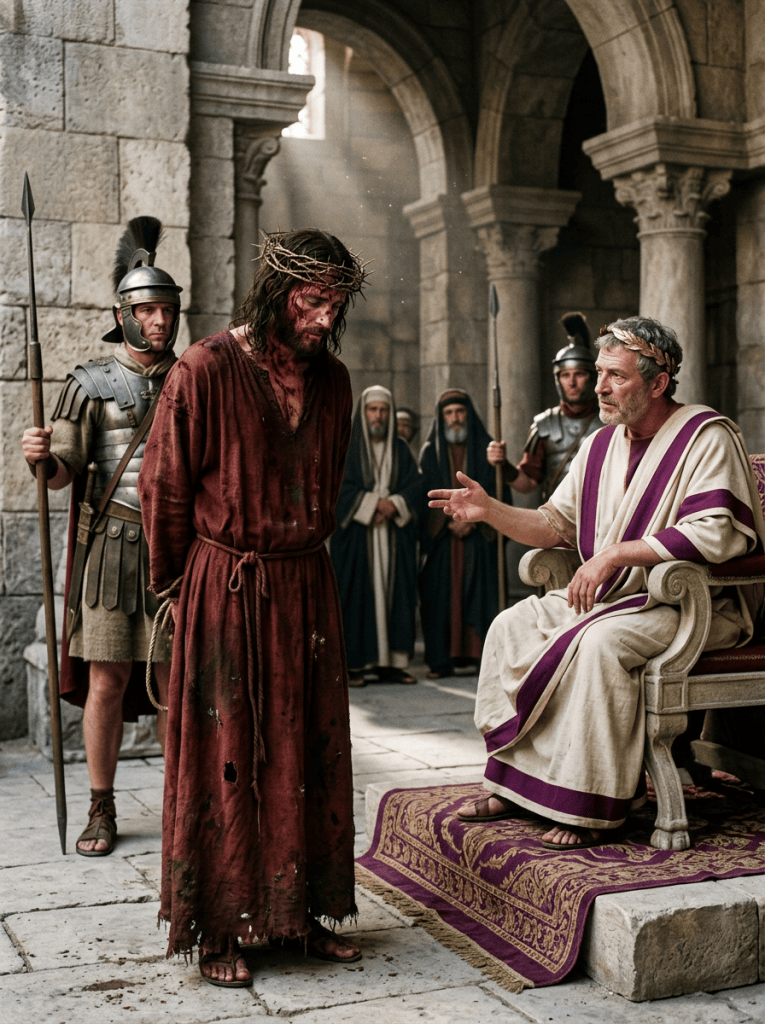
The people of Israel rejected God when they asked for a king like all the other nations. Jesus eschewed political power. When Satan offered the nations to Jesus, he refused, (Matthew 4:8-10) When the people tried to make Jesus king by force, he withdrew from them. (John 6:15) When Pilate asked him if he was King of the Jews, Jesus said:
“My kingdom is not of this world. If it were [of this world], my servants would fight to prevent my arrest by the Jewish leaders. But now my kingdom is from another place.”
John 18:35-36
When Jesus said, “Now my kingdom is from another place,” He was alluding to the fact that the powers and dominions currently rule the earth; but someday there will be a new heavens and earth and a new Jerusalem. Christ alone will rule over God’s kingdom when it is finally established on this earth, but… that time has not yet come. We are still in the “now” Jesus identified to Pilate.
In one sense, the kingdom of God has come. The kingdom of God is near. (Mark 1:15) Jesus demonstrated that it has “come upon” us by casting out demons. (Matt. 12:28; Luke 11:20) Jesus said it is in the midst of (within/among) his followers (Luke 17:20-21); we can enter the kingdom now (Colossians 1:13); and receive the kingdom now. (Hebrews 12:28)
Christ already reigns in the God’s kingdom (1 Corinthians 15:25), but we must still pray (and wait) for the kingdom to come fully on earth as it is in heaven. (Matt. 6:10) Flesh and blood cannot enter it. (1 Corinthians 15:50) The kingdom will not fully come on earth as it is in heaven until Christ returns. (Matt. 25:31) Then – and only then – “the kingdom of the world will become the kingdom of our Lord and of His Messiah.” (Revelation 11:15)
People wanted to make Jesus king, and Satan tempted Jesus with the kingdoms of the world, which Satan currently has authority to rule in God’s providence, but Jesus rejected the idea. He did not give in to the temptation, and he did not set up a kingdom in this world, because the kingdom of God is different than the kingdoms of this world.
The kingdom of God, now, is like a mustard seed – like a seed that is small and grows slowly; it is like leaven in bread that does not call attention to itself; it is like weeds and wheat growing together until the harvest.
People following Jesus are to be like salt and light. Salt is scattered to be of use. Salt is not readily noticeable. It preserves, enhances, and brings out the flavor in food, now if he doesn’t call attention to himself. Light is more noticeable in the absence.
Jesus, of course, could have infiltrated the Roman government. He could have overthrown the Roman government. We could have established the throne of David in his lifetime. He could have established his kingship and ruled Judea, Samaria, Rome, and the entire world in his lifetime… but Jesus didn’t do that.
On what basis do we think we should rule a nation and control the world?
Jesus created a different model for us. It is a model that has no flashy outward appearance that would draw people to it. It is like a treasure hidden in a field or pearls obscured under the surface of the sea. We have to want it to dig and dive for it.
The kingdom of God that is here now is a model that looks like weakness, self-sacrifice, self-deprecation, and servanthood. It looks like the cross, which Jesus told us to pick up and follow him. These things are counter-intuitive; yet they are God’s way for His kingdom to spread in the here and now.
God could have done things differently. We most certainly would have done things differently. We are surely tempted to do things differently – just as Jesus was – but we need to resist that temptation.
This doesn’t mean that modern Christians should not be involved in politics. We just need to be careful not to do politics the way the world does it. We are first and foremost citizens of another kingdom. Our allegiance is pledged to a different king who modeled to us how we should walk and conduct ourselves in this world.
We are ambassadors of God’s kingdom. There is no end in this world that justifies a means that deviates from the model Jesus demonstrated for us. We cannot conduct ourselves like the world does and be faithful ambassadors of the kingdom of God.
Jesus rejected the power of the kingdoms of the world and we must reject it also. Jesus triumphed over the powers and principalities through his death on the cross. (Col. 2:15) God’s power is made perfect in our weakness. (2 Cor. 12:9) These ways are not attractive to people in the world, but they should not be unattractive to us who follow Christ, because we know His grace is sufficient for us, and we serve God, who is worthy of our sacrifice.
I encourage you to go back and listen to the After Class podcast episode linked at the top of this blog article. In fact, you would do well to listen to the whole series of articles on politics and faith from the three theologians who do the podcast as they flush out the picture of what it means to be a Christian in a political world. I do not agree with them in every aspect, but I think they get much more right than they get wrong.

 Navigating by Faith
I haven’t yet seen the podcasts you refer to, but your article confirms for me that we are on the same page with a very similar biblical worldview. I continue to be much concerned for the situation in your country and for the Christians there. Thanks for keeping up this necessary work of your Christian-outlook blog.
LikeLiked by 1 person
Thank you for your encouragement
LikeLike