
Joel Furches recently posted the following on social media:
“The Aesop’s Fable I have come to most appreciate over the years is ‘The Frog and the Scorpion’. If you’re not familiar, it’s about a scorpion who asks a frog to swim him across the water. The frog doesn’t want to, because he’s afraid of getting stung. The scorpion points out that if he stings the frog, they will both drown. So the frog swims him, the scorpion stings the frog, and they both drown. Why? Because it is the nature of scorpions to sting.
“The moral: things act out of their nature, even at the expense of their self-interest. Or as my dad used to say, ‘a person will never do something that person wouldn’t do.’ Which, I suppose, could be rephrased, ‘A person’s always going to do what that person does.’ (My dad would say ‘peoples are peoples’)”
A more modern version of this idea is the tiger that can’t change its stripes or the leopard that can’t change its spots. The fable or adage stands for the proposition that people don’t change their essential nature or character.
We shouldn’t expect people to be anything other than who they really are. Despite what the scorpions tells you, the scorpion IS going to sting you. That’s what they do. That’s who they are.
Fables are meant to teach life lessons. They are meant to pass on wisdom to help us avoid having to learn it the hard way – from experience. (Though it seems most of us need firsthand experience to learn wisdom, and even then we don’t always get it.)
Still, these fables are helpful in allowing us to crystallize those hard learned lessons into memorable, graphic illustrations that we can hold onto and pass on – if only people would listen. Right?
But what is the lesson? Don’t trust people? Fool me once, shame on you, but fool me twice shame on me!
Fables teach us something about human nature, but fables don’t give us specific guidance tailored to our own dilemmas. We still need wisdom to apply the lessons we learn (however we learn them) in our particular circumstances. “A word to the wise” requires wisdom for its application in our own lives.
Aesop may have been a very wise man (if there really was an Aesop), and Aesop’s fables carry with them the ring of truth, but truth is often more complicated than we like to think it is. Just when you think you understand the laws of physics, quantum mechanics comes along and turns everything inside out.
The fable of the Frog and Scorpion is something we identify with, but Scripture provides a different angle. Scripture provides guidance to deal with the scorpions in our lives.
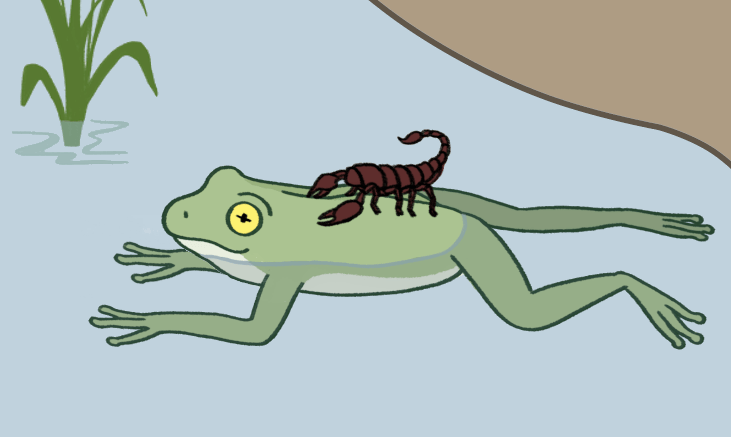
This fable is written in a way that we are supposed to identify with the frog who trusts the scorpion and gets stung. The immediate lesson is this: a frog should not trust a scorpion because a scorpion stings.
Implicit in the story is the idea that frogs are frogs and scorpions are scorpions, but is that really true? Is it really that simple?
The truth is that there is sometimes a little scorpion in in the people we know, our friends and our family. The truth is that we all have a little scorpion in each of us! (If we are being honest with ourselves.)
We live in a culture in which the popular narrative characterizes people as basically good. We like to think of ourselves as good people, and we want to give others the benefit of the doubt. Unless we don’t.
We tend view our tribe (however we define ourselves) as good guys. We all know there are “bad guys” in the world, but we tend to think we and our tribes are not like “them”. “We” are the good guys, and the bad guys are “them”.
I submit that the reality is different than we popularly suppose. Scripture is much more realistic and candid about the human condition than Aesop and our popular culture.
The Bible tells us that people are not scorpions or frogs. We all have the nature of the scorpion in us. That scorpion is called sin, and its sting, biblically speaking, is death.
We are also all frogs. The scorpion in us will take us down. That is the nature of sin. It destroys and leads to death. That is what it does.
On the other hand, frogs are “scorpions” to other creatures, like the fly.
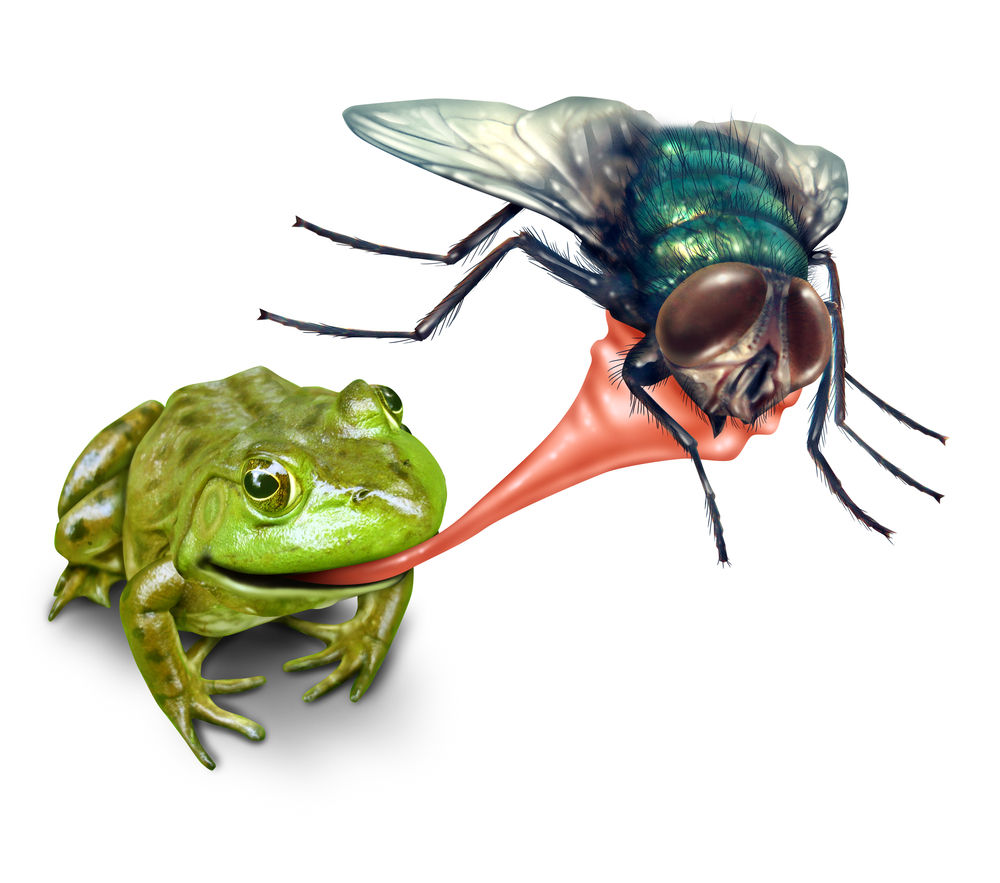
We are part scorpion and part frog. We are made in God’s image, so we have the potentiality of being like God in his purity, goodness, justice and righteousness. Because of sin, though, we do not live up to our potential.
The Bible is brutally honest about it: we have all sinned and fallen short. We are flawed creatures. We tend toward corruption in our natural state, and that is where we will gravitate unless we fight it.
And that’s not. It gets worse!
None of us can overcome the scorpion in ourselves. The more we fight it, the worse it appears to be! In fact, we might not even realize how flawed we are until we make an intentional effort to be good. Paul says it this way:
“I do not understand what I do. For what I want to do I do not do, but what I hate I do. And if I do what I do not want to do, I agree that the law is good.… I know that good itself does not dwell in me, that is, in my sinful nature. For I have the desire to do what is good, but I cannot carry it out. For I do not do the good I want to do, but the evil I do not want to do—this I keep on doing.” (Romans 7:15-16, 18-19)

If the story of Nazi Germany tells us anything, it tells us that good guys (an educated, advanced and Christian nation) can become bad guys under the right conditions. We all have it in us to be evil, and we fool ourselves to think we are basically good people who “uncharacteristically” do bad things.
The parable is right about one thing. Scorpions are different than frogs, and scorpions cannot be anything other than what they are. Try as it might, the scorpion cannot become a frog. A tiger cannot change its stripes, and a leopard cannot change its spots!
And that applies to all of us! None of us are good guys. Sin is our natural condition, and we are all stuck in the same boat.
This is the bad news, but there is good news. Exceedingly good news! The thing we cannot do for ourselves, God has done for us!
Though we are all born with sin in our “genes”, and therefore we are what we are, God offers us a second chance, a new birth by which we may become children of God and learn to live up to our potential.
God became man. He lived out a flawless life, and in death he took our sins upon Himself when He submitted himself to the cross. By virtue of that effort, He is able to offer to all who receive Him, who believe in His name, “the right to become children of God – children born not of natural descent, nor of human decision or a husband’s will, but born of God.” (John 1:12-13)
If we understand our true nature, it should not surprise us that we must be born again. (John 3:7) Flawed humans can only give birth to other flawed humans (John 3:6), but God offers us union with Himself by which union we may inherit eternal life, and, with it, righteousness and all that we lack in our finite humanness.
Paul, the Apostle, explains the answer offered by Christ this way:
“I find this law at work: Although I want to do good, evil is right there with me. For in my inner being I delight in God’s law; but I see another law at work in me, waging war against the law of my mind and making me a prisoner of the law of sin at work within me. What a wretched man I am! Who will rescue me from this body that is subject to death? Thanks be to God, who delivers me through Jesus Christ our Lord!” (Rom. 7:21-25)
The truth about the fable of the Scorpion and the Frog is that we are all scorpions and frogs. (And even frogs are like scorpions to flies!)
We are all flawed by sin, but thanks be to God who has offered us a way out of our flawed condition! By offering us Himself and the opportunity to become sons and daughters of the Father, we have access to Life and freedom from the curse of sin and death by simply receiving Him and believing in the name of Jesus.
When we do this and, thereby, submit ourselves to God and to his mercy, we are born again. We are born spiritually into relationship with God as our Father. This is not just metaphor, but a reality that becomes evident in us as we submit to Him. It becomes reality as our spirit begins to testify with God’s Spirit that we are His children. (Rom. 8:16)
The Tiger cannot change it stripes. The leopard cannot change its spots. The scorpion is not a frog, and it cannot be anything other than that which is its nature to be. A man cannot overcome or change his sinful nature, but God can cause us to be born again into new creatures, new creations, born of the Spirit as children of God!

 Navigating by Faith
I was stung once by a scorpion, but that is because, not seeing it, I stepped on it with my bare foot. If I had been taking it across a stream, I doubt it would have stung me. Scorpions do not sting randomly; they sting to protect themselves from enemies. Treat a scorpion as a friend, and you are not likely to be stung.
On the other hand, some people are just plain vicious…. J.
LikeLiked by 1 person
Good points!
LikeLiked by 1 person