
The words of the ancient prophet, Isaiah, are spoken often this time of year:
“For to us a child is born, to us a son is given, and the government will be on his shoulders. And he will be called Wonderful Counselor, Mighty God, Everlasting Father, Prince of Peace. Of the greatness of his government and peace there will be no end. He will reign on David’s throne and over his kingdom, establishing and upholding it with justice and righteousness from that time on and forever. The zeal of the Lord Almighty will accomplish this.”
Isaiah 9:6-7 NIV
These words were spoken many centuries before one, Jesus of Nazareth, was born in Bethlehem while his parents were in town for a census. This passage is full of triumph: “Mighty God”, an “Everlasting Father”, and “Prince of Peace”. “The government will be on his shoulders,” and he will “reign on David’s throne” – the “Lord Almighty!”
These words foretell of a mighty, conquering, benevolent God. (Benevolent after the conquering bit, of course). Human beings have always venerated and celebrated strength, and what could be more compelling to us than a conquering king (provided he is benevolent also!)
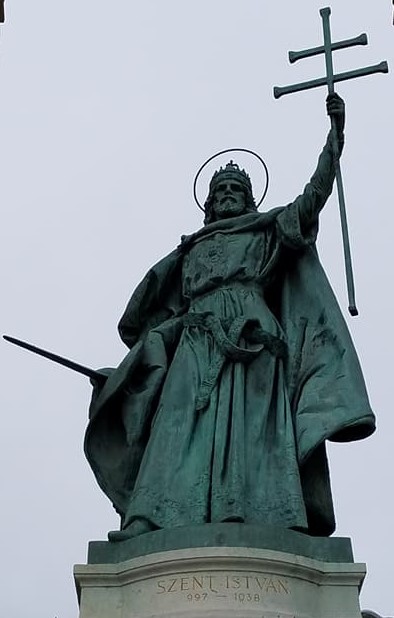
This is the way people view God and the world. This view of God inspired the crusades. It inspired many kings and nobleman through the ages like Stephen I, Szent István király. Born in 975, Stephen took the throne on December 25, 1000, and he became the last “grand prince of the Hungarians”, and he is the first King of Hungary.
I took the photos I have reproduced here when I was visiting my daughter in Hungary this time of year 6 years ago. The prominence of Steven and other kings in Hungarian lore is evident in the statuary around Budapest and in the stately basilica named after him that lies near the Danube in the center of the City.
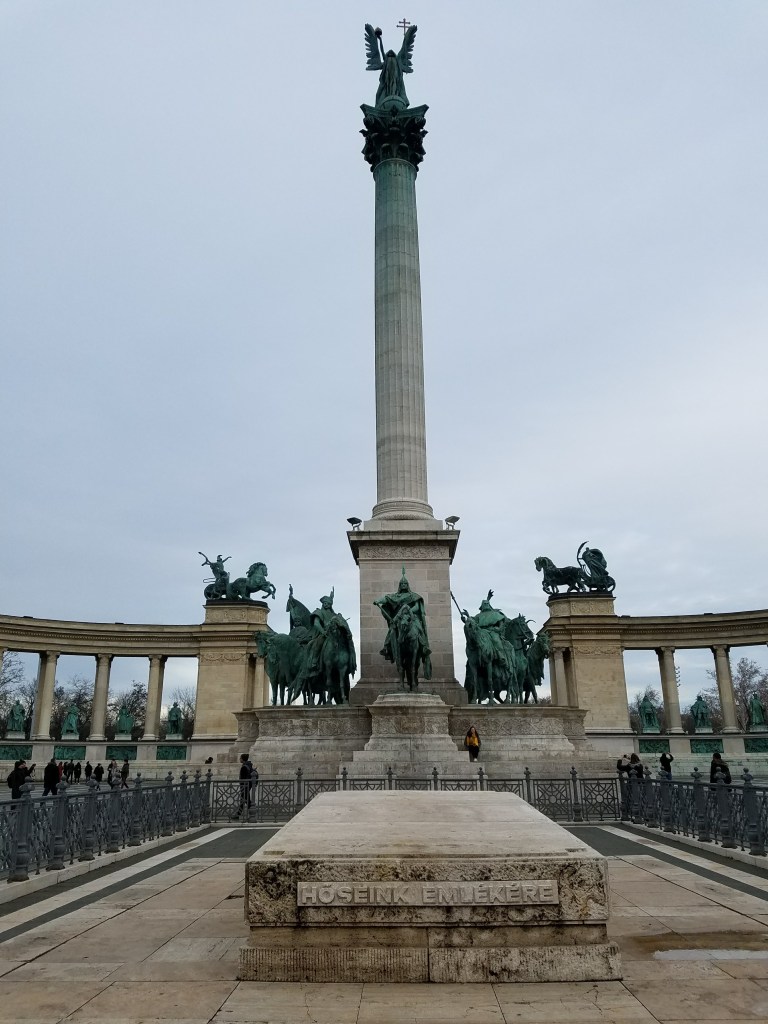
Stephen succeeded his father as a grand prince of the Hungarians, but he had to fight for the throne against his own extended family. He fought many wars against surrounding tribes and chieftains, including his own uncle. He “converted his uncle’s ‘country to the Christian faith by force’ after its conquest,” and he “encouraged” the spread of Christianity “by meting out severe punishments for ignoring Christian customs.” (See Wikipedia)
Many modern minded people with sensibilities trained over the last generation likely squirm (or fume) over stories like Stephen’s, as children are taught in grammar school to recoil at the “imperialism” of our Western/Christian forebears. The so-called “Christian nationalists” among us likely count Stephen a hero of the faith.
Indeed, Hungarians today proudly celebrate Saint Stephen as a national hero, but this celebration seems more focused on nationalistic pride than the spread of Christian faith – if faith can be commandeered by force. Stephen is hailed for unifying the tribal regions around him under his kingship, giving birth to the nation of Hungary.
That the nation was unified under a Christian flag seems to be more of a national identity than a statement of faith. While I was visiting, I observed that Hungarians did not appear, as a whole, to be a people of devout faith.
A 2017 poll reveals that Hungarians, indeed, are not very religious. While about 76% of Hungarians self-identified as “Christian”, only about 8% of Hungarians attended church services on a weekly basis, “placing Hungary among the countries with the lowest church attendance in Europe” (according to my very cursory research using Chat GPT).
While the notion of a king conquering in the name of Christ may be a source of national pride for some, it makes other people feel uneasy. It makes me uneasy.
We celebrate at Christmastime the triumphal prophecies foretold by Isaiah of the Lord Almighty taking the government on his shoulders with zeal and reigning on David’s throne. Yet, this imagery contrasts with the images of the story of the birth of Jesus, born of a humble virgin in a lowly manger because they had no influence to make room for themselves anywhere else.
As this story goes, God incarnate was born in poverty, on the edge of the Roman empire, in the humblest of circumstances, to parents who were not even married. God came into the world as an infant, weak and vulnerable.
God is human form became a refugee when his parents fled to Egypt to avoid King Herod’s decree to kill the male babies in the region of Galilee. They returned after Herod’s death but moved to the more remote and neglected area of Nazareth where Jesus grew up in almost total anonymity apart from the small community of people who knew him.
These realities stand in stark contrast to the conquering and reigning king imagery of Isaiah and the images of kingly might we celebrate in people like Saint Stephen. We consider these paradoxical images this Christmas day, December 25, 2024, as we recall the birth of our Savior and Lord, Jesus, and what it all means for us.
Continue reading “Christmas: The Triumph of the Almighty God Is Not Exactly As We Might Have Imagined It”




 Navigating by Faith