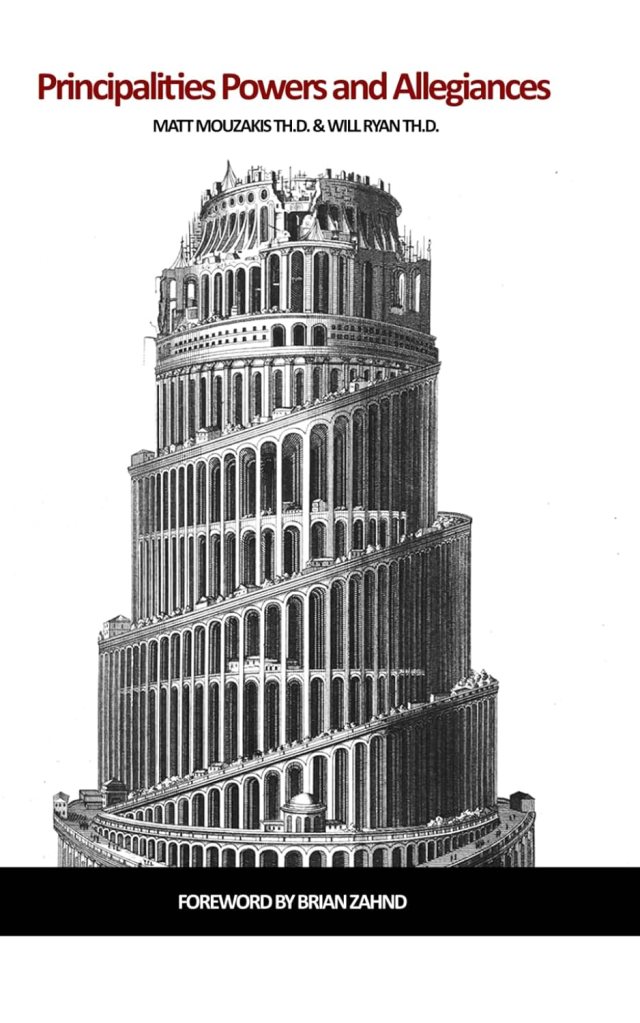
A Review of Principalities Powers and Allegiances: Submission in Enemy Territory

Untangling submission to authority and allegiance to God


A friend posted an glowing endorsement of the book, Principalities Powers and Allegiances, by Matt Mouzakis & Will Ryan, that intrigues me because the subject is a topic I have spent some time considering and writing about. The book is an exegesis of biblical passages that have posed challenges to modern Christians like myself: Romans 13:1-7 and 1 Peter 2:11-17.

These passages instruct Christians to submit to earthly authorities “for the Lord’s sake” (1 Peter 2:13). Mouzakis and Ryan provide background and Scriptural insight that sheds some fresh light on these passages. It is not new light. In fact, it is ancient light that was likely understood by the original readers of those words, but which has been lost in the centuries since that time.

I do not have the book, but I was curious because of my own interest in the tension between faithful adherence to the Gospel and submission to governing authorities, so I asked Google Gemini for a summary of the book. More specifically, I asked for a summary of the exegesis of Romans 13:1-7 for comparison to my own exegesis. (How Should the Church Act Regarding Authority? and more recently Submitting to Authority For the Lord’s Sake Like Peter, Paul, and Jesus Did)

The exegesis of Romans 13:1-7 offered by Mouzakis and Ryan is a departure from modern reading that views government as God’s benevolent institution for all time. They argue that the passage must be read through the lens of the Deuteronomy 32 worldview and the larger narrative of sin and God’s judgment in the book of Romans.

The Deuteronomy 32 worldview, in a nutshell, is that Yahweh, is the sole supreme Deity, and that the gods of the other nations are lesser, created spiritual beings (“sons of God” or elohim). It pulls from the judgment following the Tower of Babel that included the scattering of the people:

“When the Most High gave to the nations their inheritance,
    when he divided mankind,
he fixed the borders of the peoples
    according to the number of the sons of God.”

(Deut. 32:8)(ESV)

The “sons of God” are sometimes translated “sons of Israel”, but Israel was not yet a nation at that time. Abraham, Isaac, and Jacob (whose name was changed to Israel) from which God formed His people were not yet born. God called Abraham out from among the nations and formed a people of God, the nation of Israel, separate and apart from the nations. Thus, Jews identified only two sets of people: the Jews and the Gentiles.

The Deuteronomy 32 worldview notes that the “sons of God” (the elohim) rebelled. They demanded the worship that belonged only to Yahweh, and they lead the nations into idolatry and violence. They are the principalities and powers that Paul speaks of who rule the “world system.” Jesus defeated those principalities and powers by his life, death, and resurrection (Colossians 2:15), broke down the dividing wall between Jews and Gentiles (Ephesians 2:14), and established his Church for the purpose of reclaiming the nations for the Kingdom of God.

Romans 13 needs to be read in the context of the sweep and arc of the story of God and what He is doing in space and time. Here are the key points of their specific interpretation of Romans 13:

1. The Context:

From Handing Over to Submission

The authors connect Romans 13 directly to Romans 1:21-23, where Paul describes God “handing over” (paradidomi) humanity to the consequences of their idolatry. In the Deuteronomy 32 worldview, this “handing over” included disinheriting the nations and appointing elohim (spiritual beings) to govern them.

The Problematic Authorities:

By the time of the New Testament, these spiritual beings—the principalities and powers—had fallen, becoming demonic forces that oppose God. When humanity rejects God, they are handed over to the “world” and to these spiritual powers, which are associated with the consequences of “sin and death.”

The Assertion:

The Roman government (specifically the Empire under Nero in the 1st Century) is viewed as aligned with these demonic forces. Paul’s message is that because Christians serve KING JESUS, they are no longer slaves to these demonic forces, even while living under their political rule.

2. The Nature of “The Authorities”

The Greek word used for “authorities” in Romans 13:1 is exousiai, which refers both to human governing authorities and spiritual powers (seen in Ephesians 6:12). Mouzakis and Ryan contend that Paul is deliberately using this ambiguous term to encompass the reality that earthly governments are influenced by unseen spiritual powers.

When Paul says the authorities are “instituted by God,” he does not mean God approves or blesses their actions. Rather, God established them as the temporary framework of consequences and judgment that the world is subjected to—a framework that God ultimately controls in his sovereignly.

3. The Ruler as “God’s Servant”

The authors evaluate the terms used for the governing official: leitourgos (minister/servant, v. 6) and diakonos (servant/minister, v. 4).

A Tool of Wrath:

The ruler is called both “God’s servant for good” and an “avenger who carries out God’s wrath” (v.4)(ESV). This wrath is seen not necessarily as God’s positive blessing on good governance, but as the execution of the consequences already outlined in Romans 1—the judgment of being “handed over” to a system that operates by the sword. the “good” is the carrying out of God’s purposes. The government’s function is to maintain basic civic order and punish wrongdoers, which is a necessary restraint in a fallen world, but the government itself is not necessarily acting righteously.

Consistent with this, we can find multiple times in Scripture where unjust nations are identified as servants of God. Isaiah identifies Assyria as the “the rod of my anger, in whose hand is the club of my wrath!” even as Isaiah pronounces, Woe to the Assyrian!” (Is. 10:5-6) Jeremiah called the Babylonian king, Nebuchadnezzar, God’s servant. (Jer.25:9 & 27:6) to bring God’s judgment.

The Non-Endorsement:

The term leitourgos neutral. It refers to public servants, generally. It means a tool or agent of God, like Assyria and Babylon were to accomplish God’s purposes in exiling his people. It is not an endorsement of them as God’s representative.

4. Allegiance vs. Submission

The most crucial distinction is between submission and allegiance:

Allegiance is to Christ:

The Christian’s primary and ultimate loyalty is to Jesus and the Kingdom of God. Our allegiance (our citizenship in the kingdom of God) made the Christian community a rival kingdom to the Roman Empire. That is why Christians were viewed with suspicion and called “atheists” (because they didn’t bow to Caesar and they didn’t worship the Roman pantheon of gods). Jesus was crucified, in part, because he was perceived to claim to be the King of the Jews, though his kingdom is not of this world.

Submission is Tactical:

The command to “be subject” (hypotassō) is a call for voluntary, orderly yielding to maintain peace, prevent anarchy, and avoid creating unnecessary offense that would hinder the spread of the Gospel. Peter says to submit “for the Lord’s sake”, so that the Gospel message is not hindered. It is an act of discipleship lived out in enemy territory.

Taxes and Honor:

Paul’s only specific instruction about submitting to the governing authorities is to “pay to all what is owed them” (v.7), including taxes. He echoed Jesus in this who told us to pay unto Caesar what is Caesar’s and to his disciples to pay the Temple tax. It is a call to fulfill one’s basic civic duty (giving to Caesar what bears Caesar’s image). However, the ultimate message is a remez (a subtle link or hint) to Jesus’s teaching to give yourself wholly to God because you bear His image.

In summary, for Mouzakis and Ryan, Romans 13 is not a command for blind obedience to the state, but a strategic directive for Kingdom citizens to live non-violently and orderly in a world ruled by lesser, fallen powers, while reserving ultimate worship and allegiance for King Jesus.


If you are interested in what the authors have to say about the book, this video features Dr. Matt Mouzakis discussing the process of writing the book and exploring its underlying theological themes in a conversation about writing worship music. Write Biblically Accurate Songs For The Church with Dr. Matt Mouzakis

If you want to read what I have written about the tension between submission to authority and allegiance to God, see How Should the Church Act Regarding Authority? and more recently Submitting to Authority For the Lord’s Sake Like Peter, Paul, and Jesus Did.

Did AI do a good job summarizing the book? I have added to the AI summary I obtained. Did “we” do a good job? If you have read the book, please let me know.

If this helped you, made you curious, or even if you disagree, please feel free to start a conversation in the comments.


How Should the Church Act Regarding Authority?

If we have to ignore Scripture and the character God desires to work in us, we are moving in the wrong direction!

I come back to this with a heavy sigh. I started it yesterday as the news unfolded of people breaching the Capitol building as the Trump rally changed gears. I know there were people there peacefully gathering, but a good many of them crossed the line.

As I watched the events unfold, I struggled to find some solid ground to stand on as I see people who call themselves Christians continue to support Trump regardless of what he says and does. At best, he sent mixed messages that were ambiguous enough to encourage what happened. At worst he incited insurrection, and stood by watching it happen, saying nothing until it was too late. Even then, it was a poor excuse for what he should have said.

The thing that troubles me most as I think about these things is the way Christians who support Trump and this “resistance” at at all costs ignore Scripture that is inconvenient. Paul defined the way followers of Jesus Christ should act regarding authority:

“Let every person be subject to the governing authorities. For there is no authority except from God, and those that exist have been instituted by God. Therefore whoever resists the authorities resists what God has appointed, and those who resist will incur judgment.”

Romans 13:1-2

Peter, the rock on whom Jesus said he would build his church, said the same thing:

“Be subject for the Lord’s sake to every human institution, whether it be to the emperor as supreme, or to governors as sent by him….”

1 Peter 2:13-14

If anyone thinks insurrection is justified because Democrats are “bad” today, consider that Peter and Paul said these things at a time when their world was ruled by Nero.

Nero was a bad leader, even by pagan, Roman standards. He considered himself God. He persecuted Christians and had them publicly killed, setting them on fire at night to light the City. Peter and Paul were both martyred under the rule of Nero.

Democrats are not nearly as bad as Nero. Peter’s and Paul’s words were spoken at a time much worse than the political squabbling today. We can’t justify resisting authority because Democrats are bad – not when we consider the context in which Peter and Paul told believers to respect governing authorities!

At the same time, I am aware that people may justify their resistance on other grounds. Peter, himself, resisted the governing authority in the Book of Acts. Peter and John were arrested for preaching. (Acts 4:2-3) They were commanded not to preach about Jesus, but Peter and John refused to comply, saying,

“Which is right in God’s eyes: to listen to you, or to him? You be the judges! As for us, we cannot help speaking about what we have seen and heard.” 

Acts 4:19

They were arrested again for refusing to remain quiet. (Acts 5:20) Again, they were commanded not to speak. Again, they responded, “We must obey God rather than human beings!” (Acts 5:19) This time they were flogged and let go.

So which is it? Submit to authorities? Or boldly rebel?

It seems like a conundrum. Do we get to take our Pick?

Maybe those are not the right questions to ask. Maybe we need to be more careful to weigh the words of Peter and Paul together with their actions and divide the Word of God more accurately.

Continue reading “How Should the Church Act Regarding Authority?”

The End of White Christian America?


The headline reads: White Christian America ended in the 2010s.[1] As a white evangelical (and male), the first reaction to such a headline, I admit, is to cringe. We hear so much about the white privilege, white evangelicals and white Christians, generally, and none of it with “white” in the description is positive.

It gets old for me, if I am being honest. I am human after all. But, if this time really spells the end of “white Christian America”, however that might actually be defined, then so be it.  Truth is truth. Reality is reality.

Of course, the headline in the NY Times in 1966 reading that God is Dead[2] proved to be a bit exaggerated. Thus, I don’t necessarily concede that white Christian America ended in the 2010s. I am skeptical of statistics and statisticians. I am skeptical of sweeping statements. I am skeptical of the biases that inform the conclusions we reach.

Further, the statement implies that we can identify white Christian America (and agree on a definition). I don’t identify with the stereotypes that appear to be informing the article. As an example, my wife and I decided to live in a city and allow our children to go to public school in which white folks like us are minorities. We made that decision for the sake of giving them the experience of diversity. We embrace diversity.

That’s the problem with broad, sweeping generalizations. I feel that most of the white Christians I know view the world more like me than the article suggests. Maybe I’m wrong, but some significant segment, at least, of the white Christian population is mischaracterized in the assumptions.

I don’t associate white with Christian. No educated person could (or should) associate Christian with white (European) people globally. Not anymore.

“White Christian” Europe is a ghost of what it was. Europe and Canada are decidedly “post-Christian”, and the United States is following. Meanwhile, Christianity in Latin and South America is growing at a record pace, as is Christianity in China and Iran, even amidst increasing oppression and persecution. Jesus was a Middle Eastern “man of color”, and most Christians in the world are non-white.

Still, the numbers in the United States tell a story. I am just not sure we are very good at reading and understanding the story they tell. I would argue that the story these numbers tell is more about a seismic shift in the predominant worldviews that drive societal change in the United States than a racial divide – not that there is no racial divide.

Though I am skeptical about the story this article tells, the numbers suggest that something is going on. Some shift has occurred over the last decade or two that is revealed in these numbers, and it is a shift away from a politically conservative, Christian position (white, black, brown or other).

The predominantly white, evangelical movement that has rallied around Trump as a political savior is a last ditch, desperate and ill-conceived attempt (in my opinion) at clinging to a position of societal influence. It’s an attempt to exert human wisdom and strength into a flawed human system. I am not sure how much of that effort is inspired by faith in the sovereignty of God and how much of it is inspired by “the will of man”.

Yes, God establishes authorities, like Donald Trump, and that means God establishes the authority of other leaders, like Barack Obama (or any other leader, for that matter).[3] If we believe God establishes any authority, we have to believe He establishes all of them (even the ones we don’t like, the ones that we feel are a threat to us). We can’t say with any degree of integrity that God only establishes certain authorities that we favor, and not others.

Frankly, we need to reconsider how to interpret Romans 13 on that score, starting with the fact that Paul spoke those words to the Romans who suffered greatly under a harsh and hostile Roman world that worshiped Caesar and put to death those who would not bow down to him. It can’t mean what we popularly think it means in the United States.

We also need to be careful about putting our confidence in kings. Our confidence should be grounded in God, alone. God established Saul as king when the people wanted a king (like the other nations), but that wasn’t actually a blessing; it was actually a rejection of reliance on God.[4]

God gave the people what they wanted, though they were rejecting God in the process. God used that circumstance, as He uses all things, to accomplish His purposes, of course. But that doesn’t mean that the people who championed a king were on the right side of that equation.

We have to remember that our ultimate destiny isn’t in this world, but in the life to come. If the numbers and the trends they reveal suggest anything, they suggest that we will need an eternal perspective all the more as we lose hold of our significance among the powers and influences of this modern world. This is no less true in the United States.

And if the world hates us (for the right reasons – because we are God’s people, not because we have power or privilege), we shouldn’t be surprised. The world hated Jesus too. Our best response isn’t to cling to worldly power, but to die on the cross that God has shaped for us.

God is strong in our weakness. In this time in which Christians seem to be losing our foothold in the national power structure, we need to look to God for our strength. That isn’t a bad thing, in my opinion. That’s where we should be looking for our strength in all circumstances. It’s easier, though, to lean on God’s strength when we are weak.

And, assuming that is the case, it’s going to be easier for us to lean on God as time goes on. Not necessarily because we want to, or because that is our natural inclination (because it isn’t), but because we will have no other choice. And if that is the case, then so be it.

I won’t rue the end of white America, though I would gladly trade the white part for the Christian part. The white part will continue to color. It’s inevitable, and frankly I think for the best in a world that is increasingly global and diverse. Every tribe and tongue is represented in Revelations, so why would Christians do anything but applaud the increasing diversity of the United States?

As for Christianity, I would gladly lose cultural (American) Christianity for real spiritual renewal.  Maybe God is stripping away the impurities to expose the gold. If that is the case, we have a long way to go, and the fire is going to get hotter.

~~~~~~~~~~~~~~

[1] White Christian America ended in the 2010s, by Robert P. Jones, the CEO and founder of PRRI (Public Religion Research Institute) and the author of “The End of White Christian America,” which won the 2019 Grawemeyer Award in Religion. His forthcoming book is “White Too Long: The Legacy of White Supremacy in American Christianity”, published at NBCnews.com Dec. 27, 2019.

[2] God is dead, and religion dying, remembered by James Finn in the New York Times April 19, 1970

[3] For an excellent expose on the way we cite Romans 13 to support our own bias, see Misusing Romans 13 To Embrace Theocracy, by Stephen Mattson at sojo.net December 10, 2019.

[4] See Is Donald Trump the King We Wanted? at Navigatingbyfaith.com November 17, 2019.