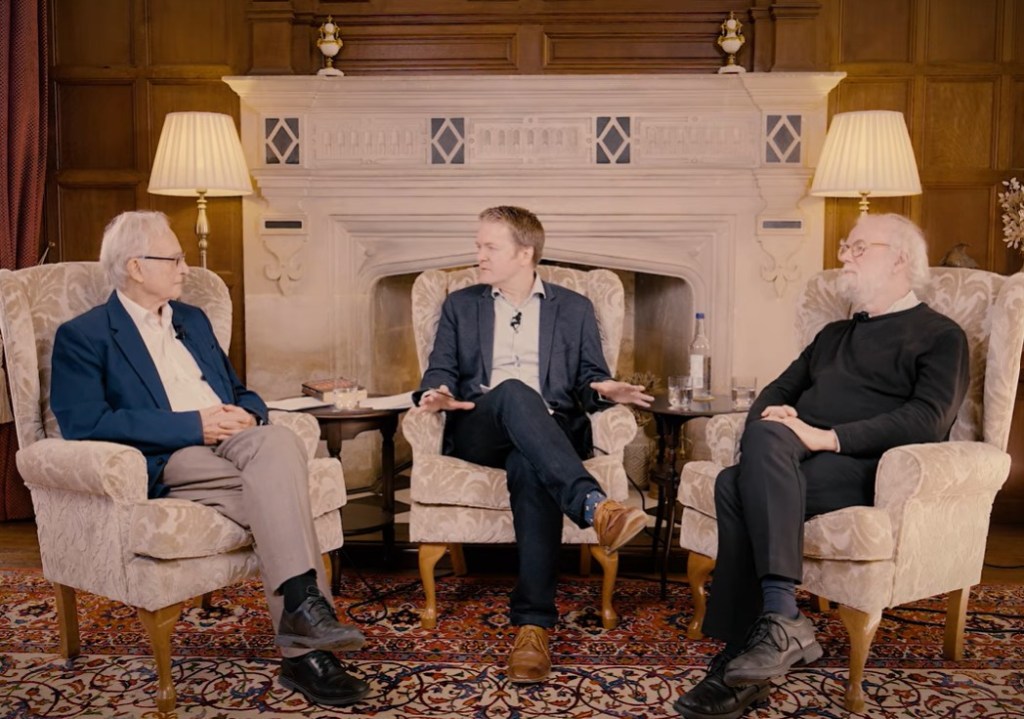
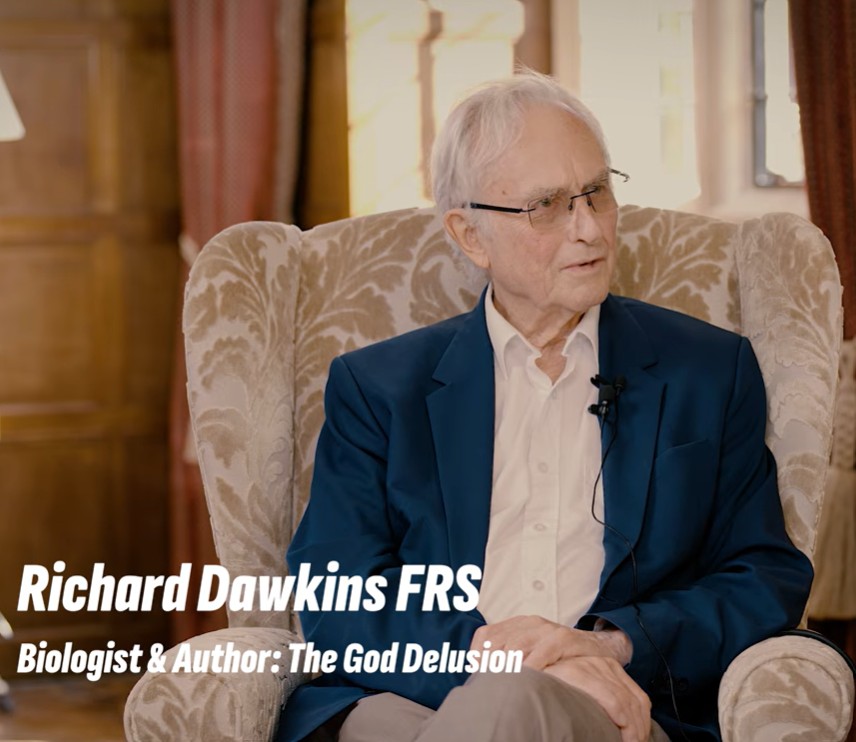
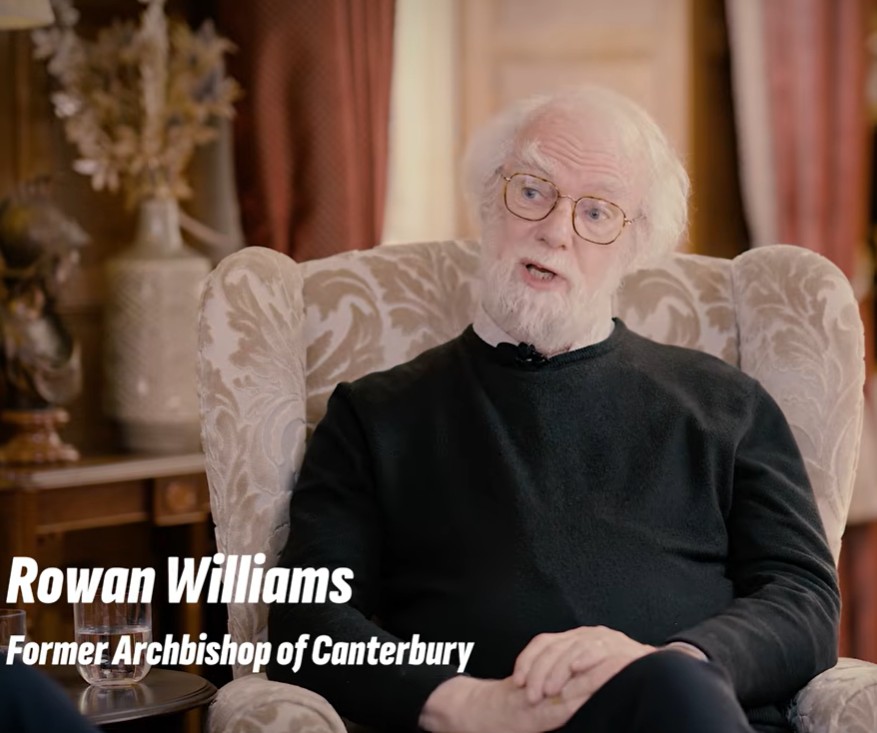
The first episode of the Uncommon Ground podcast with Justin Brierley is titled “What is Behind the Poetry of Reality?” The podcast features a conversation with Richard Dawkins and the former Archbishop of Canterbury, Rowan Williams. Dawkins of New Atheist fame has a purely materialist view of reality – maintaining that reality is comprised only of materials things that operate on their own without the aid of God or any immaterial thing.
The discussion is amicable and informative, if not predictable. Rowan Williams accepts the evolutionary paradigm, but believes in God – an immaterial, personal creator of the universe. They seemed to agree on the science. The only difference is that Williams believes there is a God behind the science and the universe.
When Brierley asked Williams to summarize Richard Dawkins’ view of reality, Dawkins graciously conceded, “Rowan… understands so well that he can summarize what I think better than I can.”
Dawkins should be given credit for reading Williams’ recent book that was the backdrop for the discussion, but Dawkins admitted to being “baffled” by it.
Dawkins was unable to provide a cogent summary of Williams’ view of reality. He succeeded only in criticizing Rowan’s view, and Dawkins conceded, “I think Rowan understands where I’m coming from much better than I understand where he’s coming from.”
This reminds me of C.S. Lewis, who says that the Christian worldview can take in science into account, but a view of the world limited to the constructs of science cannot take into account Christianity. One is robust enough to hold the other, but the other is not sufficiently robust to do the same. (I have provided the whole quotation in its context below.)
I will admit that the robustness of Christianity to be able to make sense of science does not necessarily make it true. Conversely, the limited scope of science that is unable to account for Christianity does not necessarily make it untrue. If reality truly consists of nothing but matter and natural processes, then the limitations of science are the limitations of reality itself.
I think that reality is not sufficiently explained by science, which is limited to natural explanations. I am also fascinated with Dawkins’ attempt to explain his own worldview as follows:
“I see the world as a very complex thing, like a clock or like a car or like a computer, and, and in the case of a clock or a computer or a car, I know how it’s made. It’s made by engineers with drawing boards and they… put together the parts and, and those parts all work together. [T]he equivalent of the engineer in the world of nature is evolution by natural selection.”
I am an English literature major and an attorney. In both disciplines, the ability to draw connections, and distinctions, and juxtapositions between and among word meanings and concepts is essential. Attorneys are professionals in comparing and contrasting facts and circumstances to be to argue (consistent with clients’ interests) that laws either apply in the same way or do not apply in the same way to similar but different sets of facts and circumstances. Perhaps, this why I noticed that Richard Dawkins made a category error. Or did he?
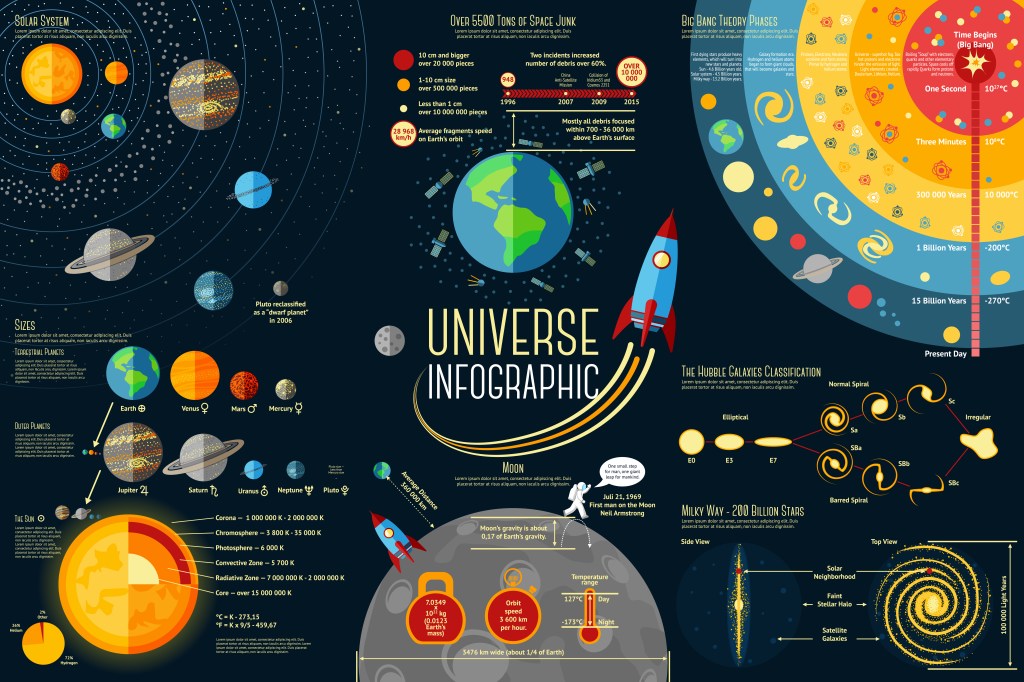
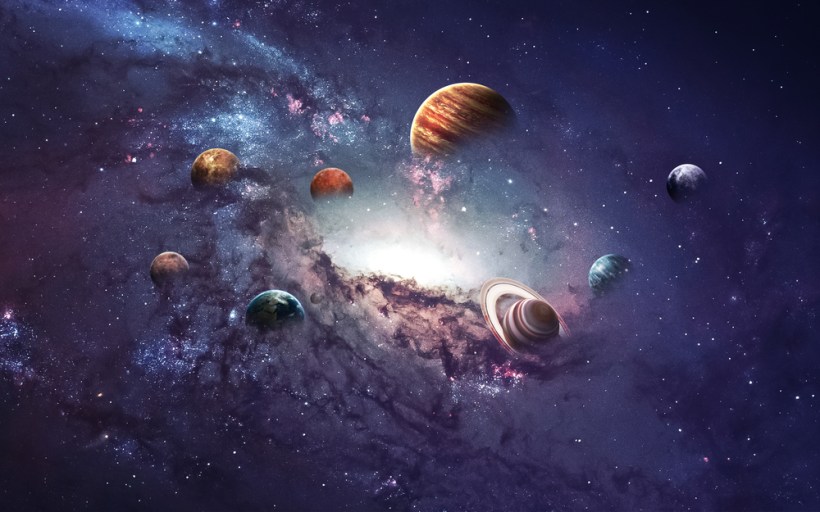
Set of Universe Infographics – Solar system, Planets comparison, Sun and Moon Facts, Space Junk made by man, Big Bang Theory, Galaxies Classification, Milky Way description. Vector illustration
The question that forms the title of this blog article is the subject of a recent video on YoutTube. I am embedding the video here so you can watch and listen for yourself. The suggestion, however, that the James Webb Telescope is disproving the “Big Bang”, is overstated. You might even call it clickbait!
Before launching into my thoughts on this, however, what is meant by the “Big Bang” needs to be defined. The terminology is credited to Fred Hoyle. When Hoyle coined the phrase in a 1949 a talk on BBC Radio, he was probably speaking tongue in cheek.
Hoyle (like most scientists of his age) had long believed in a steady state universe. The new evidence indicating that the universe is expanding was like a big bang to them. It rocked the long-held view that our universe is static and unchanging.
The laws of physics seemed immutable. Why wouldn’t scientists believe the universe was equally immutable?
That the evidence that the universe is expanding was unsettling to the accepted “science” at the time is an understatement. As Hoyle was describing the then recent discoveries and the theories that derived from that evidence, he said:
“These theories were based on the hypothesis that all the matter in the universe was created in one big bang at a particular time in the remote past.”
Because these discoveries came as a shock wave to scientists in the first half of the 20th Century. the term, “big bang”, may have been used to characterize how those discoveries were received!
The evidence that the universe is actually expanding raised the specter that the universe isn’t static, and it might even have had an origination “point”. This realization that the universe may have had a beginning wasn’t lost on scientists at the time, and it wasn’t eagerly received.
The term didn’t really “stick” until the 1970’s, and it isn’t really a good descriptor for what we (think we) know happened. It probably wasn’t a “bang” for instance, because no sound was likely generated. The history of the development of this evidence is interesting and can be found on Wikipedia.
The Big Bang does suggest a beginning to the Universe (to put it bluntly). This possibility, of course, has theological implications, another realization that wasn’t lost on scientists who largely viewed the universe through a materialistic lens. That possibility was largely downplayed then, and many scientists have continued to downplay that possibility.
We still don’t have evidence that reveals how the universe was formed. We can’t see back that far, and doubt exists whether we ever will be able to see back that far. As the Wikipedia article states: “[T]he Big Bang model does not describe how energy, time, and space were caused, but rather it describes the emergence of the present universe from an ultra-dense and high-temperature initial state.”
The current suggestion that the James Webb Telescope is disproving the “Big Bang” (the implication of an expanding universe with a “beginning”) comes from people who would like to downplay the implication of an expanding universe with a beginning, and it seems to be more wishful thinking than reality.
The James Webb discoveries fueling this resurgence in old thinking include images of old stars and galaxies that are more formed than they should be on our standard (Big Bang expansion) model of the Universe. The standard Big Bang expansion model is similar to the concept of evolution. If the universe expanded, it must have progressed from a simpler state to a more complex state.
Just as life began with a simple, self-replicating molecule and progressed to ever increasing complexity over a long span of time, the thinking has been that the universe must have developed in the same progressive sort of way. This is the paradigm that has driven much of modern science: that natural processes developed from the bottom up.
The new James Webb images reveal more highly developed stars and galaxies than we imagined would exist in the earliest stage of the universe on the standard model. The mature development of ancient galactic stars and star formations is surprising on the progressive view.
These images do not contradict the fact that the universe is expanding, however, and they don’t disprove the appearance of a “beginning”.
People are “surprised that things grew so quickly”. People are perplexed that stars and galaxies are so well-formed at such an early stage, when they would expect to find “fledgling” galaxies in more undeveloped states.
People are scratching their heads at the appearance of extremely small and extremely large galaxies in the early Universe because it does not comport with the progression of the expansion of the Universe as modern scientists have modeled it before the advent of the James Webb Telescope.
These observations have nothing to do with the evidence that the universe is expanding. A more accurate statement is that models for how that expansion occurred are being called into question: not the fact of expansion from “a point of beginning”.
The James Webb findings do not negate the evidence we have that our universe is expanding from some very dense “point”. If anything, the findings evoke even more theological implications, perhaps, than the standard Big Bang model.
The idea that the universe developed from simple to complex over time is difficult to maintain when stars, galaxies, and other formations in the farthest (and earliest) regions of the universe that we can see are so well-formed and “mature”. These things conjure up the specter that this evidence is more consistent with the idea of the universe being created than we previously thought.
Of course, we had clues that this should be not surprising to us: the standard expansion inflation model incorporates the assumption that an early, extremely rapid and short “burst” of expansion occurred, and this assumption was necessary to accommodate the short time frame in which the Universe appeared to have “developed” based on what we could see before the James Webb telescope. Perhaps, then, we shouldn’t be surprised to find even greater “development” at earlier stages.
We shouldn’t be surprised either that modern scientists who are committed to a materialistic worldview are struggling with these things. A materialistic worldview has colored modern science for a couple hundred years, at least.
A materialistic worldview was perfectly at home with the old static state view of the universe. It took a hit with the evidence that the universe is actually not static, but expanding from a point of beginning, though materialist thinking held firm, and most scientists have continued to hold to a strictly materialist position.
Stephen Hawking and Roger Penrose famously calculated “singularity” that “proved” the so-called Big Bang (that expansion necessitates a “beginning”). Vilenkin (and some other guy who I can’t remember, lol) determined that even a multiverse that is expanding would have to have a “singularity” (a euphemism, it seems, for a beginning).
So far, modern discoveries have continued to negate good reason to believe in a static universe (which theory was discarded after centuries of use when we found that our universe is expanding) or an oscillating or cyclic universe. Multiverse(s) seem to make sense theoretically, but we will likely never be able to prove it/them anymore than we are likely to see back before the “beginning” of this universe.
Scientists like Neil de Grasse Tyson, Hawking, and Penrose who are committed to finding explanations for these things that do not implicate a Beginner (a/k/a God), will likely continue to try to prove their point. Hawking spent much of the rest of his life after mathematically proving the “singularity” trying to get around “singularity” and its theological implications. Penrose (and Vilenkin) do not concede any theological implications either.
Nothing (much) has changed on that score, but the new james Webb images are certainly is producing some head scratching! Some scientists, like Hoyle, who were once very antagonistic about people drawing theological implications from cosmology have backed off their dogmatic stances. Penrose seems to concede the possibility of a legitimate “metaphysical” component to reality, though he “doesn’t go there” in his own thinking.
There certainly is a lot of head scratching going on, and these are interesting times. We may all be at the edges of our seats to learn where all of this will take us, though I strongly doubt that we will get definitive answers to our most fundamental questions, like the origin of the Universe in my lifetime – if ever.
The new discoveries do call into question the expansion models that scientists have developed, but they do not call into question the evidence that the universe is, indeed, expanding. The new discoveries do not align with they way scientists have believed the universe expanded, but the evidence that the universe expanded from a “point” of singularity remains solid.
Mary Jo Sharp grew up in a secular home. Her parents didn’t go to church. Her community in Portland, Oregon was post-Christian, and she didn’t even know people who claimed to be Christian.
She was aware of Christianity in culture, but she didn’t have any firsthand contact with Christian culture. Her parents weren’t’ religious, and they didn’t go to church.
Her father was a “huge Carl Sagan fan”, and she was influenced by his love for science, outer space and nature. She was influenced almost exclusively by a materialist worldview from a young age – the view that reality consists only of what we can see, hear, feel, touch, and taste in the material realm. (There is no other “realm”.)
Materialism was the theme that ran through the TV shows on science and nature that her father would watch. “This was the background that formed my view of reality,” says Sharp, “I really didn’t have a view of God, and I wouldn’t have thought to gain one or why a person should want to gain one. It just wasn’t on the radar”
She says she didn’t know that the materialist view is only one view among other views on the nature of reality. She says, “It’s just what I was exposed to.” She didn’t know any other way to view the world and reality.
The Christians she would later meet seemed “nice and innocuous”, but she predisposed to be wary of them from the exposure to Christianity on television. Her view of religion was also shaped by her knowledge of a cult at a compound in her area that attempted a bio-terrorist attack on nearby cities, using salmonella to poison people. Therefore, she says,
“I had a lot of misgivings about what religion was, who God is or was. I didn’t understand what religion was for. It seemed like the kind of thing people did because they were raised that way, and I wasn’t.”
Mary Jo Sharp was an atheist from as young as she can remember. Atheism to her was normative. She had a good life. Her parents loved her. She loved science. She loved music. She had no needs that might drive her to religion for comfort.
Her primary exposure to religion was in the myths of ancient religions. She says, now, that she had a kind of “chronological snobbery”, believing that she was more “progressed” than other people who still had vestiges of a religious faith. She felt her family was better than others who still clung to religious myths.
There was no crisis in her life. She saw herself as a good person. “I had it together,” she says, but one thing opened a door (just a crack) to the possibility that reality was more than she supposed.
She was becoming aware of the wonder of the world, and that wonder caused a subtle tension in her materialist assumptions. She felt wonder at sunsets and mountain ranges and music that she couldn’t explain on the basis of her view of the world as the product of random and meaningless matter and energy.
Things were about to change for her when a person she respected in her life gave her a Bible. She “didn’t receive it well”, but the timing was fortuitous because of the subtle questions that were beginning to occur to her prompted by wonder.
She didn’t have a source for answering the questions she had. She didn’t have philosophy training to help put her questions into context because her public school education did not include training in critical thinking or how to tackle the big questions of life.
Though she didn’t react well to the gift of a Bible she received one day, she read it. Reading the Bible opened her mind up to possibilities she hadn’t considered before.
She says, “I was really caught off guard because it wasn’t what I expected.” She was experienced in reading mythology from the Samarians, Greeks, Egyptians and Native Americans, but the Bible stood in contrast to those mythological writings. “As I was digging into the Bible, it was nothing like that…. It sounded more report-like.”
She realized, of course, that some portions of the Bible are poetic. Other portions of the Bible, however, like Luke, read like reports of factual things. Those portions of the Bible include many details of places, times, people, happenings, etc. On reading Luke, she recalls, “It sounds like he was just trying to report what was going on.”
That “shook” her because the Bible seemed to be written by people who were just trying to convey what happened. It didn’t read like mythological stories made up with the primary purpose of conveying moral lessons, as the writings with which she was more familiar.
Do we have free will? Modern science seems to suggest that we do not have free will. This is what I learned watching an episode in a series on science that was hosted by Stephen Hawking on Public Broadcast Television.
In one experiment designed to test question whether humans have free will, the subjects were told to choose to push a button and to note the time on the clock at which the decision was made. At the same time, the subject’s brain waves were being monitored for activity. Over and over again, the brain waves registered activity before the subject was conscious of the decision being made to take the action.
The experiment demonstrated the following sequence: (1) a brain signal occurs about 550 milliseconds prior to the person’s finger moving; (2) the person is aware of his decision to move his finger about 200 milliseconds prior to his finger moving; and (3) the person’s finger moves.
This was interpreted as evidence by Hawking that we don’t have free will. The decisions we make are actually prompted by brain activity before we are conscious of making a decision. The conclusion is that we are responding to some prior stimuli and only think that we are making independent decisions.
This experiment was only one experiment in a series of experiments that demonstrate such things as the cosmological constants that that we learn in physics and the apparent indeterminism that we appear to see in quantum mechanics. Each experiment, however, that to the conclusion that our world and even we are determined by natural laws in an endless stream of cause and effect.
Ancient Greeks might have called it fate. Modern science calls it determinism. We have even have a religious term for this apparent phenomenon: predestination.
I think that skepticism of what we think we know is a good thing. The Apostle Paul seems to agree when he encourages people to “test everything”. Therefore, I dug a little deeper and found that the scientist who first conceived and conducted these experiments, Benjamin Libet, actually came to the opposite conclusion.
Scientific experiments like this often seem hyper-theoretical, but they can have some practical application. As I dug deeper and sought greater understanding of what is going on in these experiments and what it means for you and I, I find some interesting applications to our struggles with sin.
On a typical Sunday morning, I am contemplative, thinking about God, the nature of the world and other ultimate things. I have gotten home from church. The distant rumbling of thunder portends more rain to add to the buckets (more like vats) that came down earlier this morning. (We’ve had an unusual amount of precipitation in the Chicago area for about a year now.)
Though sunlight threatens to break through the clouds, despite the rumblings to the contrary, it’s a good day for reading and thinking.
In that vein, I read an article from Forbes magazine that came up in my Google feed: Ask Ethan: Can We Really Get a Universe From Nothing? Ethan, is Ethan Siegel, a Forbes contributor. He is an astrophysicist, author and “science communicator” according to the short bio at the end of the article.
It just so happens that I spent my Friday evening this week with another astrophysicist, Hugh Ross, a brilliant man who is a Christian, and also a man of science. In fact, it was science that led him to his belief in God. But I digress. (You can hear the story of how science led Hugh Ross to God in his own words here.)
My meeting with Hugh Ross isn’t really relevant to the topic, other than the fact that our conversation got me thinking about science and ultimate things, things that science doesn’t really address (or hasn’t yet answered). Does God exist? Where did the universe come from?
The article suggests an answer to one of those ultimate questions: where did the universe come from? It suggests that the universe didn’t really come from nothing – at least not the kind of nothing that we usually imagine when we think of nothing. It entices the reader with a title that suggests an ultimate answer, but it doesn’t deliver.






 Navigating by Faith