
Is the American Church a House Divided Against Itself?

Whether God for us or against us is the wrong question.


I have yet to find my equilibrium after the Charlie Kirk killing. I didn’t know Charlie Kirk. I didn’t follow him. I heard him speak one time at an event in which Ravi Zacharias was the keynote speaker, but I never watched, or listened, or read anything from Charlie Kirk online. I didn’t agree with his Republican apologetic, though I couldn’t have identified anything Charlie Kirk specifically said before his death.

Since his death, I have heard and read testimony of his love for Jesus. His wife, Erika, publicly forgave his killer in an ultimate act of sacrificial obedience to Jesus.

Charlie Kirk’s legacy will always be that of a follower of Jesus and a staunch Republican, friend and defender of Donald Trump, who maintained political views opposed to mine.

I am a born again Christian. I believe in the death of Jesus Christ for the forgiveness of my sins and his resurrection from the dead. I believe the Bible is the word of God and His revelation to mankind. I read the Bible daily. I believe there is only one path to God, and that is through Jesus Christ. I go to church every Sunday, and I am involved in Wednesday evening and Saturday morning Bible studies.

I have been a Christian for 45 years. The fundamentals of my faith have not changed in that time, but I have gone down some side roads from which I had to retreat back to a more orthodox faith. I was tempted by the prosperity gospel, and I once embraced an Americanized Christianity verging on idolatry.

Jesus is the same yesterday, today, and forever. God has not changed during my life (or at any time since the foundation of the earth), but I have changed often, as I have had to adjust my thinking, confess my sin, and allow my mind to be transformed by God’s Word and the influence of the Holy Spirit in my life.

I am a work in progress, of course. I have yet to arrive at any final destination, but I look forward with yearning for the day when I see Him face to face, and I will know as I am fully known!

I used to believe that all true Christians should (and therefore must) believe all of the same things about everything. That makes sense in a rationalistic way because we all have the same Holy Spirit, and we all read the same Bible, so we all should believe exactly the same things about everything. Right?

Continue reading “Is the American Church a House Divided Against Itself?”
What is the Quantum of Proof Necessary to Believe a Biblical Account?

Believers are told to take the stories of the Bible in faith, Skeptics take the opposite view. There is evidence consistent with belief that the stories are true, but insufficient evidence to prove them beyond a reasonable doubt.

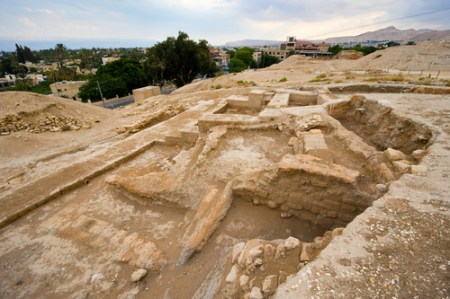
Ruins and remains in Tell es-Sultan, better known as Jericho, the oldest city in the world

I previously wrote a piece on the city of Jericho of biblical fame that was inspired by a presentation given by an archaeologist, Ted Wright, who excavated at tell es-Sultan, the modern site known formerly as Jericho. He commented that archaeology is not really divided over issues like whether Jericho existed. Rather, archaeologists differ on the chronology they find in the story of the stratified remains of prior habitation.

That issue of timing regarding the destruction of the city of Jericho was the focus of the previous blog. There is no doubt that Jericho was surrounded by a double wall of which the interior wall collapsed on the outer wall, forming a virtual ramp up into the city. The city was also clearly destroyed by a conflagration (fire). The only question is: when did those events that are evident in the rocky soils on the site took place?

The first archaeologist to dig at the site reached the conclusion that the city of Jericho was destroyed in the early bronze period, well before the Israelites may have come upon the heavily fortified City. According to the first assessment, Jericho had long been uninhabited by the time the Israelites arrived.

Subsequent archaeological digs revealed disputing conclusions. John Garstang found evidence in the 1930s that Jericho was destroyed around 1400 BC, exactly the time frame of the biblical account. Subsequently, archaeologist, Kathleen Canyon, came to the opposite conclusion, reaffirming the earlier opinion that the city was uninhabited by the time Joshua and his combatants came along. But wait… there is more.

The most recent archaeological findings, seem to suggest that the biblical timing is correct. Kathleen Canyon apparently ignored and failed to register the significance of Late Bronze period pottery that would not have been found in an area that was uninhabited by that time. Many factors that she missed reveal the error and suggest a date consistent with biblical chronology. (See Believers Score in Battle Over the Battle of Jericho, by John Noble Wilford, published February 22, 1990, The New York Times).

The story of the excavation of Jericho reveals how archaeology and interpreting what we find is sometimes highly influenced by what we believe about history. The same finding can suggest different conclusions, depending on what we are looking for (or not looking for). The difference as Ted Wright suggested, isn’t in the what, but the when.

The Bible, of course, has many fantastic stories in it. They are so fantastic, that many people simply find them incredible, as in not credible at all. Believers are told to take the stories on faith. Skeptics take the opposite view and reject them, hook, line and sinker (to turn a phrase). There is evidence consistent with belief that the stories are true, but insufficient evidence to prove them beyond a reasonable doubt.

Should modern archaeology require something more than reasonable doubt simply because the biblical accounts have a miraculous, religious bent to them?

Continue reading “What is the Quantum of Proof Necessary to Believe a Biblical Account?”